• start here
  • about
  • itineraries
  • brooke beyond

  • hiking guides
  • outdoor gear
    • hiking boots
    • hiking backpacks
    • cold-weather layers
    • backpacking tent
    • outdoor sleep system
    • backcountry food
    • day-hike packing list
    • hut-to-hut packing list
    • via ferrata packing list
    • backpacking packing list
    • mountaineering packing list

brooke beyond

Chile / Latin America

Hiking ‘The W’ in Parque Nacional Torres del Paine

19 January 2015

This content has been archived. It may no longer be relevant

Last Updated on 23 May 2025

Sometime during our weeks spent volunteering in Peru, we caught wind of Patagonia. I knew hardly anything about what we would find in southern Chile, but I did know there would be mountains beautiful enough to reduce us to tears, so we shuffled existing plans and purchased pricey flights to the end of the world in search of some Patagonian magic.

A month later, after travelling through Peru, Bolivia, and northern Chile, we fly from Santiago down to Punta Arenas where we spend a surprisingly comfortable night at the airport on a make-shift bed of blankets and towels, nestled between our bags. We are just excited to be here.

In the morning, we catch a bus into the main town and then another bus to Puerto Natales, which is to be our base for the hike into Parque Nacional Torres del Paine. After dropping the bags in our hostel, we quickly set out to rent gear– a simple task considering every third shop is selling hiking boots,
booking tours, and (of course) renting out camping equipment. We carefully inspect sleeping bags, a tent, inflatable air matresses, a camp stove, and mess kit, spend five minutes teaching the owner to pronounce the word “inflatable”, and then scurry off to the supermercado to pick out an exciting variety of pouch soups and pasta sauces (also in pouches).

Despite concern about fitting even our scarce selection into our packs, we stock up on several boxes of Gato, the local red wine of choice. We also splurge last minute on some cheese, which ends up being the highlight of every meal.

Day 1

The next morning, we set off on a bus into the national park, pay our entrance fee, and catch the catamaran across Lago Pehoe to reach Campamento Paine Grande, the start of our trek.


Thankfully, since we don’t actually arrive until about 2pm, I’ve mapped out a short first day for us: 11km to Camp Grey. We are not used to our packs being so weighed down with camping gear and hike slowly as we try to find our rhythm.

The hike is through a beautiful forrest (a large section of which has been burnt to a crisp by an idiotic hiker) and opens up about half way along to a series of small peaks from which we start to catch glimpses of the reason for our visit to this section of the trail: Glacier Grey. It really is “the bluest grey ever”, just as a poster claimed back in the park office. We hardly gain any distance, stopping every few minutes to photograph the glacier from different angles. The mirador is another half hour beyond the camp, but we decide, due to serious hunger, to just set up at camp for the night and visit the glacier in the morning.


Presumably due to the massive forrest fire set a few years ago, we are now permitted to use our camp stoves only in a designated enclosure. The result is no wind disrupting the flame and a deliciously cozy meal area, so I really can’t complain. Spiral pasta with salsa italiano and parmesan, soon to be a recurring theme, are on the menu tonight, plus some boxed Gato. Sleep is difficult, considering the sun doesn’t set until 11pm, so we play cards until we can manage to drift off. This is the only night we have difficulty sleeping; exhaustion works wonders to block out the glare of the sun.

Day 2

Somehow, we manage to sleep until almost 10am and get another incredibly late start at hiking. After breakfast, we trek out to see more views of the glacier from the mirador and spend several hours scrambling along rocks to get closer, eventually just sitting and appreciating what an incredible sight ice can be. It’s late afternoon before we are back to Camp Grey and ready to start moving along the trail again.

“The W” hike is so-named because of the path it follows through the park, which means it features three different sections of backtracking. Yesterday, we hiked out to Camp Grey to view the glacier, only to turn around today and walk back to Camp Paine Grande, our starting point.


It was the original plan to cover that distance plus another 7.5km to Campamento Italiano, but it quickly becomes clear that neither one of us is willing to hike through dinnertime, so we end up stopping at Camp Paine Grande for the night. I’m delighted to have my pasta meal, but our short day today means that we must cover 22.5km tomorrow, an admittedly daunting distance.

Day 3

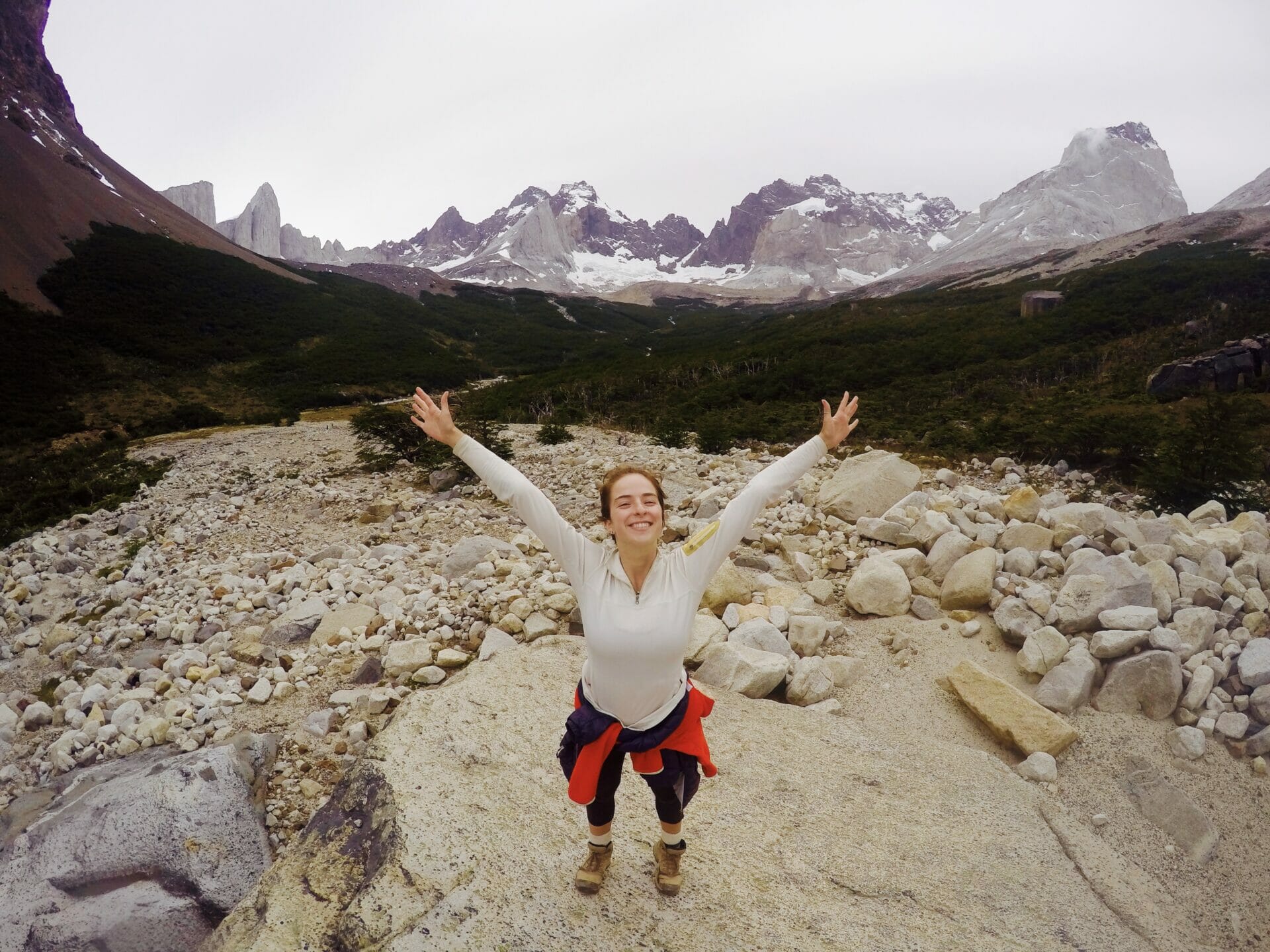
We do not make another afternoon-start mistake today; we’ve eaten, packed our tent and backpacks, and are on the trail by mid-morning. The hike is studded with incredible views of snowy-mountain peaks above the glacier-fed river– probably one of the best parts of the park is the frequency of rivers and streams, all ice-cold and delicious to drink. It’s not long before we reach Camp Italiano and head 5km upwards to a series of miradors looking out over the Valle del Frances, the last of which is Mirador Britanico. The panoramic views of the mountains are unbelievable and I’m not sure either of our cameras do it justice.

After lunch on a rock, we head back down towards Camp Italiano and make our camping reservation for the last night at Camp Torres (!!) before heading onwards another 5km to Camp Los Cuernos, our final destination for the day.

In the final kilometre of the hike, we walk briefly alongside the most beautiful lake and the temptation to dive in is ever-increasing. Yet, we somehow manage to divert ourselves away from the lakeside path and spend the next 40 minutes bush-whacking through what was obviously once a trail (hence the confusion) that has long since been abandoned in favour of something more accommodating to the girth of a backpack. It is scratched and highly irritated that we finally emerge from the brambles into camp.


Due to deviations from the original itinerary, we have only camped at paid campgrounds thus far into the trip; tonight, though, I do not regret the 8,600 pesos ($17) because there are hot showers. Some girl in line for the bathroom tries to make conversation with me, but I am functioning at a level far below normal and can’t understand a word she’s saying. I later find out she’s Brazilian and consider the possibility that she was speaking Portuguese, in which case: obviously not my fault. More likely, though, I’m just brain-dead from hitting myself against low-hanging tree branches for the last hour.

The shower is amazing (I don’t even want to talk about how long it’s been since our last hot shower) and the 22.5km just wash away. Aristo and I cook soup for dinner and fall asleep before I’m even sure what’s happened.

Day 4

Another efficient morning sees us out of camp around 10am for 22km of rising and descending past Hotel Las Torres and Camp Chileno until we reach Camp Torres, where we plan to drop our big packs and scramble an hour straight up the mountain to the Base de Las Torres. Spirits are high, the sun is stronger than ever, and the day flies by. By mid-afternoon we’ve reached Camp Torres (finally, a free camp!) and set up our tent.


The fast pace of the day requires us to have a brief rest before we can move again, so we cook an early dinner and leave for the hike to the final mirador. The first half hour is incredibly steep trails, followed by a half hour of boulder-scrambling across loose rocks to reach the base of the three peaks that give the park its name. We share chocolate cookies and oranges on a rock by the lake in front of the mountains, taking in the views all around us and trying not to drop things into the Laguna. The view is indescribable. Tired legs scramble back down and fall into bed early in anticipation of the 4am wake-up tomorrow, repeating the same uphill trek in time for sunrise.

Day 5

The sunrise is greatly diminished by the unmanageable cold as soon as we finish the hike and sit in wait. It’s not long before we are both on our feet pacing just to keep some feeling in our limbs. We are both wearing every piece of clothing we’ve brought, but it feels like we are standing naked in below freezing weather. My time at the mirador is entirely spent jumping around and doing awkward shuffly dances to stay warm. A group of cold Italians suggest a dance-off.


As soon as we get back to the tent around 8am, we crawl back into our sleeping bags to recover. Around 11am, we are up from our nap, make noodles for breakfast, and pack for our last day. We only need to cover 10km today, backtracking through Camp Chileno and ending at Hotel Las Torres, where we catch a quick bus back to Laguna Amarga. From there, we board our return bus and journey back to Puerto Natales.

The hike is quick and we are eager to arrive back in civilisation, mostly just because we’ve run out of pasta. Honestly, we both wish we were continuing on to complete the Circuit, another set of trails around the opposite side of the mountains. The utter lack of food, however, leaves us with little choice.

0 Comments
Share
brooke beyond

Hey, I'm Brooke and I'm obsessed with getting off the beaten path, exploring backcountry gems & travelling beyond the ordinary! I left Australia 6 years ago after finishing a PhD in Biomechanics & have been travelling the world full-time ever since (joined by my husband/climbing partner, James). Whether it’s road-tripping through Mexico, climbing alpine peaks in the Andes, scuba diving in the Red Sea, or tackling epic via ferrata in the Dolomites, I hope this blog will inspire your future adventures & help you find wonder in every corner of the globe. xx bb

Leave a Comment Cancel Comment

You May Also Like

13 January 2015

Santiago a Mil

24 February 2020

Snorkelling at Las Tintoreras on Isla Isabela, Galápagos

11 July 2020

The best day trips & excursions from Santa Marta, Colombia

hi, I’m brooke!

I'm obsessed with getting off the beaten path, exploring backcountry gems & travelling beyond the ordinary! I left Australia 6 years ago after finishing a PhD in Biomechanics & have been travelling the world full-time ever since (now joined by my husband/climbing partner, James). I hope this blog will inspire your future adventures & help you find wonder in every corner of the globe. xx bb

read my story
currently exploring

currently exploring

finland

read our gear guides

🥾 hiking boots

🎒 hiking backpacks

🌨️ cold-weather layers

⛺️ backpacking & alpine tents

🛌 sleeping bag & pads

🍪 backcountry food

📸 travel camera gear

trail guides

summit guides

itineraries

outdoor gear

GPS maps

recent posts

  • Little Bridge, Wadi Rum

    Wadi Rum adventure guide: how to plan an epic trip to Jordan’s red desert

    2 April 2026
  • 2-week Norway winter itinerary: Arctic Circle to southern fjords

    20 February 2026
  • Tjeldbergtind winter hike

    Complete Lofoten winter packing list: what to wear for hiking in Arctic Norway

    8 February 2026
  • Ryten winter hike

    Best winter hikes in Lofoten: your guide to safe winter hiking in Arctic Norway

    30 January 2026
  • Laguna Humantay, Cusco Peru

    6 awesome day trips from Cusco, Peru

    24 November 2025

@brookebeyond_
brooke ✨travel & mountain gal

@brookebeyond_

  • A few snapshots from one of our most unique adventures: a 4-day dogsledding trip through Sámi country (Sápmi) in Northern Sweden ❄️

For thousands of years, dogsledding has been an essential form of Arctic transport for Indigenous communities, used to travel, hunt, and survive in some of the harshest conditions on earth. Huskies are bred specifically for this environment, capable of running for hours across frozen landscapes + hauling several hundred kilos as a team.

To experience it for ourselves, we took a 15hr train from Stockholm to Kiruna, drove 2hrs deep into the wilderness, and then caught a snowmobile the final kilometres to reach a remote kennel with about 50 dogs. Our first day was spent learning the basics: how to harness the huskies, attach them to the sled, and steer + brake properly. 

And then, we set off into the wilderness with our team of 6 dogs, travelling through snowy forests + across frozen lakes. 

James + I shared the sled, taking turns driving while the other sat bundled up inside, eyelashes freezing into icicles in the -30°C (-22°F) chill for hours at a time.

It was unbelievably remote, the conditions were challenging, and the cold was brutal, but through it all, we formed a real bond with our team— particularly surprising given that I’m usually very scared of dogs (pictured several times here is my beloved Reisling, the best doggie 🐕🖤)

It was a surprising + unexpected adventure, but such a special way to experience wild + beautiful Sápmi*

*we learned that Sápmi is the traditional + often preferred term (over “Lapland”) for the region of northern Norway, Sweden, Finland, and Russia inhabited by the Indigenous Sámi people

—
#sweden #kiruna #dogsledding #sápmi #lapland
  • magical winter lighting delivering midday sunrises and northern lights before dinner ✨ 

—
#lofoten #winter #norway #northernlights #polarnight
  • With sufficient outdoor experience, sound judgement, and reasonable conditions, these 10 hikes are an excellent choice for safe winter hiking in Lofoten!

We personally completed all of these hikes in January 2026 with just microspikes + trekking poles (and no other technical climbing equipment), though it should be noted that conditions vary winter to winter— and even week to week. In the event of heavy snowfall, some trails may become impassable without snowshoes or simply unsafe altogether.

**It should ALSO go without saying that you are responsible for yourself in the outdoors; this list is based on our own personal experience and must be interpreted within the bounds of your own experience and current winter conditions.

For more on winter hiking safety and details on these 10 amazing winter hikes, check out my post 🔗 brookebeyond.com/lofoten-winter-hiking
  • a collection of some mind-blowing aurora moments from our 5 weeks in Norway 🤯 

*watch the videos with sound to hear me & @flyingcrepes screaming like it’s our first day on earth lol

—
#norway #northernlights #aurora #northernlightsphotos
  • The exact layers I wore for chilly winter hiking all through January in Lofoten ☃️

see the complete list at 🔗 brookebeyond.com/lofoten-winter-packing-list

——
#norway #lofoten #winterhiking #layering #winterstyle
  • Everything we spent for 2 people travelling around Norway for 5 weeks in January 2026:

**this is not meant to represent the cheapest way to explore Norway in winter, it’s just what we personally spent for one of the best trips of our whole lives!!

$6,388 ACCOMMODATION
🏡35 nights in apartments/cabins = $6,388

$2,785 TRANSPORTATION
✈️ airfare = $647
🚘 car hire = $1,807
⛽️ fuel + parking = $113
🚕 private transport (Uber) = $111
🚃 public transport (train) = $107

$1,699 FOOD & DRINKS
🧁 bakery treats = $103
🍹 drinks = $152
🌮 eating out = $611
🧀 groceries = $833

$1,155 ACTIVITIES
🔥 sauna entry = $302
🐋 tours = $853

$27 TRAVEL LOGISTICS
📲 eSIM = $27

TOTAL…
—> $12,054 USD for 2 people over 35 days
—> an average of $172/day per person

Is this more or less than you expected??

———
#norway #norwaytravel #lofoten #tromsø #travelbudget
  • Although sauna culture is shared across much of the Nordic region, Norway has put its own spin on the tradition with thousands of floating, fjord-side saunas (that I am truly obsessed with).

In many coastal towns, these wood-fired saunas are moored right in the harbour, with a hatch or ladder that drops straight into the icy fjord for a cold plunge. The result is a distinctly Norwegian winter ritual: alternating intense heat and 3C seawater while surrounded by dramatic mountain and fjord scenery 😍

a few of our favourite floating saunas in Norway:
📍 Fjordsauna, Flåm @fjordsauna 
📍 Vulkana Arctic Spa Boat, Tromsø @vulkana.adventure 
📍 Pust Lavvo Sauna, Tromsø @pust.lifestyle 
📍 KOK Langkaia, Oslo @kokoslo.no 
📍 Soria Moria Sauna, Dalen @dalenhotel 

———
#sauna #floatingsauna #norway #scandinavia #winterescape
  • Nearly 2,000 stone steps (installed by a Nepalese Sherpa team in 2021) have transformed Reinebringen from a notoriously dangerous ascent into a straightforward hike to the most iconic viewpoint in all of Lofoten!

In good winter conditions, it’s a steep but spectacular ~45min push.

But in POOR winter conditions? Or with no experience + insufficient winter gear?? It’s a drain on the Norwegian search & rescue teams who keep having to haul tourists off the mountain.

I’m expecting some criticism for even posting about hiking Reinebringen in winter, but I believe strongly in personal accountability + responsibility in the outdoors, so I hope this empowers you to make an informed decision, whether that means tackling routes like Reinebringen or finding equally beautiful but easier + safer hikes around the islands!

——
#lofoten #norway #reinebringen #reine #winterhiking
  • *me frantically sending Lofoten photos to every group chat I’m part of*

We spent the last 3 weeks exploring this dramatic archipelago off the northwestern coast of Norway, high above the Arctic Circle & almost never considered a winter destination.

Yet we turned to each other no less than 10 times a day to announce that THIS IS ONE OF THE BEST TRIPS WE’VE EVER TAKEN.

We hiked to empty summits without seeing another person, snapped photos on windy ridges, watched the aurora on 20 different nights, ate soup in the hot tub at 5am while it snowed around us, baked cardamom buns with our favourite friends, ran out of the sauna in towels to witness the strongest solar storm in 20 years, and had a lifetime worth of wow-moments in the span of just 22 days.

It was the kind of trip where everything just feels ✨special✨, like you already know you’re going to remember it forever.

——
#lofoten #norway #aurora #northernlights #arcticcircle
follow @brookebeyond_

travel beyond the ordinary

Explore my travel guides, custom itineraries & blog posts with an interactive world map ✨

all destinations

  • A few snapshots from one of our most unique adventures: a 4-day dogsledding trip through Sámi country (Sápmi) in Northern Sweden ❄️

For thousands of years, dogsledding has been an essential form of Arctic transport for Indigenous communities, used to travel, hunt, and survive in some of the harshest conditions on earth. Huskies are bred specifically for this environment, capable of running for hours across frozen landscapes + hauling several hundred kilos as a team.

To experience it for ourselves, we took a 15hr train from Stockholm to Kiruna, drove 2hrs deep into the wilderness, and then caught a snowmobile the final kilometres to reach a remote kennel with about 50 dogs. Our first day was spent learning the basics: how to harness the huskies, attach them to the sled, and steer + brake properly. 

And then, we set off into the wilderness with our team of 6 dogs, travelling through snowy forests + across frozen lakes. 

James + I shared the sled, taking turns driving while the other sat bundled up inside, eyelashes freezing into icicles in the -30°C (-22°F) chill for hours at a time.

It was unbelievably remote, the conditions were challenging, and the cold was brutal, but through it all, we formed a real bond with our team— particularly surprising given that I’m usually very scared of dogs (pictured several times here is my beloved Reisling, the best doggie 🐕🖤)

It was a surprising + unexpected adventure, but such a special way to experience wild + beautiful Sápmi*

*we learned that Sápmi is the traditional + often preferred term (over “Lapland”) for the region of northern Norway, Sweden, Finland, and Russia inhabited by the Indigenous Sámi people

—
#sweden #kiruna #dogsledding #sápmi #lapland
  • magical winter lighting delivering midday sunrises and northern lights before dinner ✨ 

—
#lofoten #winter #norway #northernlights #polarnight
  • With sufficient outdoor experience, sound judgement, and reasonable conditions, these 10 hikes are an excellent choice for safe winter hiking in Lofoten!

We personally completed all of these hikes in January 2026 with just microspikes + trekking poles (and no other technical climbing equipment), though it should be noted that conditions vary winter to winter— and even week to week. In the event of heavy snowfall, some trails may become impassable without snowshoes or simply unsafe altogether.

**It should ALSO go without saying that you are responsible for yourself in the outdoors; this list is based on our own personal experience and must be interpreted within the bounds of your own experience and current winter conditions.

For more on winter hiking safety and details on these 10 amazing winter hikes, check out my post 🔗 brookebeyond.com/lofoten-winter-hiking
  • a collection of some mind-blowing aurora moments from our 5 weeks in Norway 🤯 

*watch the videos with sound to hear me & @flyingcrepes screaming like it’s our first day on earth lol

—
#norway #northernlights #aurora #northernlightsphotos
  • The exact layers I wore for chilly winter hiking all through January in Lofoten ☃️

see the complete list at 🔗 brookebeyond.com/lofoten-winter-packing-list

——
#norway #lofoten #winterhiking #layering #winterstyle
A few snapshots from one of our most unique adventures: a 4-day dogsledding trip through Sámi country (Sápmi) in Northern Sweden ❄️

For thousands of years, dogsledding has been an essential form of Arctic transport for Indigenous communities, used to travel, hunt, and survive in some of the harshest conditions on earth. Huskies are bred specifically for this environment, capable of running for hours across frozen landscapes + hauling several hundred kilos as a team.

To experience it for ourselves, we took a 15hr train from Stockholm to Kiruna, drove 2hrs deep into the wilderness, and then caught a snowmobile the final kilometres to reach a remote kennel with about 50 dogs. Our first day was spent learning the basics: how to harness the huskies, attach them to the sled, and steer + brake properly. 

And then, we set off into the wilderness with our team of 6 dogs, travelling through snowy forests + across frozen lakes. 

James + I shared the sled, taking turns driving while the other sat bundled up inside, eyelashes freezing into icicles in the -30°C (-22°F) chill for hours at a time.

It was unbelievably remote, the conditions were challenging, and the cold was brutal, but through it all, we formed a real bond with our team— particularly surprising given that I’m usually very scared of dogs (pictured several times here is my beloved Reisling, the best doggie 🐕🖤)

It was a surprising + unexpected adventure, but such a special way to experience wild + beautiful Sápmi*

*we learned that Sápmi is the traditional + often preferred term (over “Lapland”) for the region of northern Norway, Sweden, Finland, and Russia inhabited by the Indigenous Sámi people

—
#sweden #kiruna #dogsledding #sápmi #lapland
A few snapshots from one of our most unique adventures: a 4-day dogsledding trip through Sámi country (Sápmi) in Northern Sweden ❄️

For thousands of years, dogsledding has been an essential form of Arctic transport for Indigenous communities, used to travel, hunt, and survive in some of the harshest conditions on earth. Huskies are bred specifically for this environment, capable of running for hours across frozen landscapes + hauling several hundred kilos as a team.

To experience it for ourselves, we took a 15hr train from Stockholm to Kiruna, drove 2hrs deep into the wilderness, and then caught a snowmobile the final kilometres to reach a remote kennel with about 50 dogs. Our first day was spent learning the basics: how to harness the huskies, attach them to the sled, and steer + brake properly. 

And then, we set off into the wilderness with our team of 6 dogs, travelling through snowy forests + across frozen lakes. 

James + I shared the sled, taking turns driving while the other sat bundled up inside, eyelashes freezing into icicles in the -30°C (-22°F) chill for hours at a time.

It was unbelievably remote, the conditions were challenging, and the cold was brutal, but through it all, we formed a real bond with our team— particularly surprising given that I’m usually very scared of dogs (pictured several times here is my beloved Reisling, the best doggie 🐕🖤)

It was a surprising + unexpected adventure, but such a special way to experience wild + beautiful Sápmi*

*we learned that Sápmi is the traditional + often preferred term (over “Lapland”) for the region of northern Norway, Sweden, Finland, and Russia inhabited by the Indigenous Sámi people

—
#sweden #kiruna #dogsledding #sápmi #lapland
A few snapshots from one of our most unique adventures: a 4-day dogsledding trip through Sámi country (Sápmi) in Northern Sweden ❄️

For thousands of years, dogsledding has been an essential form of Arctic transport for Indigenous communities, used to travel, hunt, and survive in some of the harshest conditions on earth. Huskies are bred specifically for this environment, capable of running for hours across frozen landscapes + hauling several hundred kilos as a team.

To experience it for ourselves, we took a 15hr train from Stockholm to Kiruna, drove 2hrs deep into the wilderness, and then caught a snowmobile the final kilometres to reach a remote kennel with about 50 dogs. Our first day was spent learning the basics: how to harness the huskies, attach them to the sled, and steer + brake properly. 

And then, we set off into the wilderness with our team of 6 dogs, travelling through snowy forests + across frozen lakes. 

James + I shared the sled, taking turns driving while the other sat bundled up inside, eyelashes freezing into icicles in the -30°C (-22°F) chill for hours at a time.

It was unbelievably remote, the conditions were challenging, and the cold was brutal, but through it all, we formed a real bond with our team— particularly surprising given that I’m usually very scared of dogs (pictured several times here is my beloved Reisling, the best doggie 🐕🖤)

It was a surprising + unexpected adventure, but such a special way to experience wild + beautiful Sápmi*

*we learned that Sápmi is the traditional + often preferred term (over “Lapland”) for the region of northern Norway, Sweden, Finland, and Russia inhabited by the Indigenous Sámi people

—
#sweden #kiruna #dogsledding #sápmi #lapland
A few snapshots from one of our most unique adventures: a 4-day dogsledding trip through Sámi country (Sápmi) in Northern Sweden ❄️

For thousands of years, dogsledding has been an essential form of Arctic transport for Indigenous communities, used to travel, hunt, and survive in some of the harshest conditions on earth. Huskies are bred specifically for this environment, capable of running for hours across frozen landscapes + hauling several hundred kilos as a team.

To experience it for ourselves, we took a 15hr train from Stockholm to Kiruna, drove 2hrs deep into the wilderness, and then caught a snowmobile the final kilometres to reach a remote kennel with about 50 dogs. Our first day was spent learning the basics: how to harness the huskies, attach them to the sled, and steer + brake properly. 

And then, we set off into the wilderness with our team of 6 dogs, travelling through snowy forests + across frozen lakes. 

James + I shared the sled, taking turns driving while the other sat bundled up inside, eyelashes freezing into icicles in the -30°C (-22°F) chill for hours at a time.

It was unbelievably remote, the conditions were challenging, and the cold was brutal, but through it all, we formed a real bond with our team— particularly surprising given that I’m usually very scared of dogs (pictured several times here is my beloved Reisling, the best doggie 🐕🖤)

It was a surprising + unexpected adventure, but such a special way to experience wild + beautiful Sápmi*

*we learned that Sápmi is the traditional + often preferred term (over “Lapland”) for the region of northern Norway, Sweden, Finland, and Russia inhabited by the Indigenous Sámi people

—
#sweden #kiruna #dogsledding #sápmi #lapland
A few snapshots from one of our most unique adventures: a 4-day dogsledding trip through Sámi country (Sápmi) in Northern Sweden ❄️

For thousands of years, dogsledding has been an essential form of Arctic transport for Indigenous communities, used to travel, hunt, and survive in some of the harshest conditions on earth. Huskies are bred specifically for this environment, capable of running for hours across frozen landscapes + hauling several hundred kilos as a team.

To experience it for ourselves, we took a 15hr train from Stockholm to Kiruna, drove 2hrs deep into the wilderness, and then caught a snowmobile the final kilometres to reach a remote kennel with about 50 dogs. Our first day was spent learning the basics: how to harness the huskies, attach them to the sled, and steer + brake properly. 

And then, we set off into the wilderness with our team of 6 dogs, travelling through snowy forests + across frozen lakes. 

James + I shared the sled, taking turns driving while the other sat bundled up inside, eyelashes freezing into icicles in the -30°C (-22°F) chill for hours at a time.

It was unbelievably remote, the conditions were challenging, and the cold was brutal, but through it all, we formed a real bond with our team— particularly surprising given that I’m usually very scared of dogs (pictured several times here is my beloved Reisling, the best doggie 🐕🖤)

It was a surprising + unexpected adventure, but such a special way to experience wild + beautiful Sápmi*

*we learned that Sápmi is the traditional + often preferred term (over “Lapland”) for the region of northern Norway, Sweden, Finland, and Russia inhabited by the Indigenous Sámi people

—
#sweden #kiruna #dogsledding #sápmi #lapland
A few snapshots from one of our most unique adventures: a 4-day dogsledding trip through Sámi country (Sápmi) in Northern Sweden ❄️

For thousands of years, dogsledding has been an essential form of Arctic transport for Indigenous communities, used to travel, hunt, and survive in some of the harshest conditions on earth. Huskies are bred specifically for this environment, capable of running for hours across frozen landscapes + hauling several hundred kilos as a team.

To experience it for ourselves, we took a 15hr train from Stockholm to Kiruna, drove 2hrs deep into the wilderness, and then caught a snowmobile the final kilometres to reach a remote kennel with about 50 dogs. Our first day was spent learning the basics: how to harness the huskies, attach them to the sled, and steer + brake properly. 

And then, we set off into the wilderness with our team of 6 dogs, travelling through snowy forests + across frozen lakes. 

James + I shared the sled, taking turns driving while the other sat bundled up inside, eyelashes freezing into icicles in the -30°C (-22°F) chill for hours at a time.

It was unbelievably remote, the conditions were challenging, and the cold was brutal, but through it all, we formed a real bond with our team— particularly surprising given that I’m usually very scared of dogs (pictured several times here is my beloved Reisling, the best doggie 🐕🖤)

It was a surprising + unexpected adventure, but such a special way to experience wild + beautiful Sápmi*

*we learned that Sápmi is the traditional + often preferred term (over “Lapland”) for the region of northern Norway, Sweden, Finland, and Russia inhabited by the Indigenous Sámi people

—
#sweden #kiruna #dogsledding #sápmi #lapland
A few snapshots from one of our most unique adventures: a 4-day dogsledding trip through Sámi country (Sápmi) in Northern Sweden ❄️

For thousands of years, dogsledding has been an essential form of Arctic transport for Indigenous communities, used to travel, hunt, and survive in some of the harshest conditions on earth. Huskies are bred specifically for this environment, capable of running for hours across frozen landscapes + hauling several hundred kilos as a team.

To experience it for ourselves, we took a 15hr train from Stockholm to Kiruna, drove 2hrs deep into the wilderness, and then caught a snowmobile the final kilometres to reach a remote kennel with about 50 dogs. Our first day was spent learning the basics: how to harness the huskies, attach them to the sled, and steer + brake properly. 

And then, we set off into the wilderness with our team of 6 dogs, travelling through snowy forests + across frozen lakes. 

James + I shared the sled, taking turns driving while the other sat bundled up inside, eyelashes freezing into icicles in the -30°C (-22°F) chill for hours at a time.

It was unbelievably remote, the conditions were challenging, and the cold was brutal, but through it all, we formed a real bond with our team— particularly surprising given that I’m usually very scared of dogs (pictured several times here is my beloved Reisling, the best doggie 🐕🖤)

It was a surprising + unexpected adventure, but such a special way to experience wild + beautiful Sápmi*

*we learned that Sápmi is the traditional + often preferred term (over “Lapland”) for the region of northern Norway, Sweden, Finland, and Russia inhabited by the Indigenous Sámi people

—
#sweden #kiruna #dogsledding #sápmi #lapland
A few snapshots from one of our most unique adventures: a 4-day dogsledding trip through Sámi country (Sápmi) in Northern Sweden ❄️

For thousands of years, dogsledding has been an essential form of Arctic transport for Indigenous communities, used to travel, hunt, and survive in some of the harshest conditions on earth. Huskies are bred specifically for this environment, capable of running for hours across frozen landscapes + hauling several hundred kilos as a team.

To experience it for ourselves, we took a 15hr train from Stockholm to Kiruna, drove 2hrs deep into the wilderness, and then caught a snowmobile the final kilometres to reach a remote kennel with about 50 dogs. Our first day was spent learning the basics: how to harness the huskies, attach them to the sled, and steer + brake properly. 

And then, we set off into the wilderness with our team of 6 dogs, travelling through snowy forests + across frozen lakes. 

James + I shared the sled, taking turns driving while the other sat bundled up inside, eyelashes freezing into icicles in the -30°C (-22°F) chill for hours at a time.

It was unbelievably remote, the conditions were challenging, and the cold was brutal, but through it all, we formed a real bond with our team— particularly surprising given that I’m usually very scared of dogs (pictured several times here is my beloved Reisling, the best doggie 🐕🖤)

It was a surprising + unexpected adventure, but such a special way to experience wild + beautiful Sápmi*

*we learned that Sápmi is the traditional + often preferred term (over “Lapland”) for the region of northern Norway, Sweden, Finland, and Russia inhabited by the Indigenous Sámi people

—
#sweden #kiruna #dogsledding #sápmi #lapland
A few snapshots from one of our most unique adventures: a 4-day dogsledding trip through Sámi country (Sápmi) in Northern Sweden ❄️

For thousands of years, dogsledding has been an essential form of Arctic transport for Indigenous communities, used to travel, hunt, and survive in some of the harshest conditions on earth. Huskies are bred specifically for this environment, capable of running for hours across frozen landscapes + hauling several hundred kilos as a team.

To experience it for ourselves, we took a 15hr train from Stockholm to Kiruna, drove 2hrs deep into the wilderness, and then caught a snowmobile the final kilometres to reach a remote kennel with about 50 dogs. Our first day was spent learning the basics: how to harness the huskies, attach them to the sled, and steer + brake properly. 

And then, we set off into the wilderness with our team of 6 dogs, travelling through snowy forests + across frozen lakes. 

James + I shared the sled, taking turns driving while the other sat bundled up inside, eyelashes freezing into icicles in the -30°C (-22°F) chill for hours at a time.

It was unbelievably remote, the conditions were challenging, and the cold was brutal, but through it all, we formed a real bond with our team— particularly surprising given that I’m usually very scared of dogs (pictured several times here is my beloved Reisling, the best doggie 🐕🖤)

It was a surprising + unexpected adventure, but such a special way to experience wild + beautiful Sápmi*

*we learned that Sápmi is the traditional + often preferred term (over “Lapland”) for the region of northern Norway, Sweden, Finland, and Russia inhabited by the Indigenous Sámi people

—
#sweden #kiruna #dogsledding #sápmi #lapland
A few snapshots from one of our most unique adventures: a 4-day dogsledding trip through Sámi country (Sápmi) in Northern Sweden ❄️

For thousands of years, dogsledding has been an essential form of Arctic transport for Indigenous communities, used to travel, hunt, and survive in some of the harshest conditions on earth. Huskies are bred specifically for this environment, capable of running for hours across frozen landscapes + hauling several hundred kilos as a team.

To experience it for ourselves, we took a 15hr train from Stockholm to Kiruna, drove 2hrs deep into the wilderness, and then caught a snowmobile the final kilometres to reach a remote kennel with about 50 dogs. Our first day was spent learning the basics: how to harness the huskies, attach them to the sled, and steer + brake properly. 

And then, we set off into the wilderness with our team of 6 dogs, travelling through snowy forests + across frozen lakes. 

James + I shared the sled, taking turns driving while the other sat bundled up inside, eyelashes freezing into icicles in the -30°C (-22°F) chill for hours at a time.

It was unbelievably remote, the conditions were challenging, and the cold was brutal, but through it all, we formed a real bond with our team— particularly surprising given that I’m usually very scared of dogs (pictured several times here is my beloved Reisling, the best doggie 🐕🖤)

It was a surprising + unexpected adventure, but such a special way to experience wild + beautiful Sápmi*

*we learned that Sápmi is the traditional + often preferred term (over “Lapland”) for the region of northern Norway, Sweden, Finland, and Russia inhabited by the Indigenous Sámi people

—
#sweden #kiruna #dogsledding #sápmi #lapland
@brookebeyond_
@brookebeyond_
•
Follow
A few snapshots from one of our most unique adventures: a 4-day dogsledding trip through Sámi country (Sápmi) in Northern Sweden ❄️ For thousands of years, dogsledding has been an essential form of Arctic transport for Indigenous communities, used to travel, hunt, and survive in some of the harshest conditions on earth. Huskies are bred specifically for this environment, capable of running for hours across frozen landscapes + hauling several hundred kilos as a team. To experience it for ourselves, we took a 15hr train from Stockholm to Kiruna, drove 2hrs deep into the wilderness, and then caught a snowmobile the final kilometres to reach a remote kennel with about 50 dogs. Our first day was spent learning the basics: how to harness the huskies, attach them to the sled, and steer + brake properly. And then, we set off into the wilderness with our team of 6 dogs, travelling through snowy forests + across frozen lakes. James + I shared the sled, taking turns driving while the other sat bundled up inside, eyelashes freezing into icicles in the -30°C (-22°F) chill for hours at a time. It was unbelievably remote, the conditions were challenging, and the cold was brutal, but through it all, we formed a real bond with our team— particularly surprising given that I’m usually very scared of dogs (pictured several times here is my beloved Reisling, the best doggie 🐕🖤) It was a surprising + unexpected adventure, but such a special way to experience wild + beautiful Sápmi* *we learned that Sápmi is the traditional + often preferred term (over “Lapland”) for the region of northern Norway, Sweden, Finland, and Russia inhabited by the Indigenous Sámi people — #sweden #kiruna #dogsledding #sápmi #lapland
2 weeks ago
View on Instagram |
1/5
magical winter lighting delivering midday sunrises and northern lights before dinner ✨ 

—
#lofoten #winter #norway #northernlights #polarnight
magical winter lighting delivering midday sunrises and northern lights before dinner ✨ 

—
#lofoten #winter #norway #northernlights #polarnight
magical winter lighting delivering midday sunrises and northern lights before dinner ✨ 

—
#lofoten #winter #norway #northernlights #polarnight
magical winter lighting delivering midday sunrises and northern lights before dinner ✨ 

—
#lofoten #winter #norway #northernlights #polarnight
magical winter lighting delivering midday sunrises and northern lights before dinner ✨ 

—
#lofoten #winter #norway #northernlights #polarnight
magical winter lighting delivering midday sunrises and northern lights before dinner ✨ 

—
#lofoten #winter #norway #northernlights #polarnight
magical winter lighting delivering midday sunrises and northern lights before dinner ✨ 

—
#lofoten #winter #norway #northernlights #polarnight
magical winter lighting delivering midday sunrises and northern lights before dinner ✨ 

—
#lofoten #winter #norway #northernlights #polarnight
magical winter lighting delivering midday sunrises and northern lights before dinner ✨ 

—
#lofoten #winter #norway #northernlights #polarnight
magical winter lighting delivering midday sunrises and northern lights before dinner ✨ 

—
#lofoten #winter #norway #northernlights #polarnight
magical winter lighting delivering midday sunrises and northern lights before dinner ✨ 

—
#lofoten #winter #norway #northernlights #polarnight
magical winter lighting delivering midday sunrises and northern lights before dinner ✨ 

—
#lofoten #winter #norway #northernlights #polarnight
magical winter lighting delivering midday sunrises and northern lights before dinner ✨ 

—
#lofoten #winter #norway #northernlights #polarnight
@brookebeyond_
@brookebeyond_
•
Follow
magical winter lighting delivering midday sunrises and northern lights before dinner ✨ — #lofoten #winter #norway #northernlights #polarnight
3 weeks ago
View on Instagram |
2/5
With sufficient outdoor experience, sound judgement, and reasonable conditions, these 10 hikes are an excellent choice for safe winter hiking in Lofoten!

We personally completed all of these hikes in January 2026 with just microspikes + trekking poles (and no other technical climbing equipment), though it should be noted that conditions vary winter to winter— and even week to week. In the event of heavy snowfall, some trails may become impassable without snowshoes or simply unsafe altogether.

**It should ALSO go without saying that you are responsible for yourself in the outdoors; this list is based on our own personal experience and must be interpreted within the bounds of your own experience and current winter conditions.

For more on winter hiking safety and details on these 10 amazing winter hikes, check out my post 🔗 brookebeyond.com/lofoten-winter-hiking
With sufficient outdoor experience, sound judgement, and reasonable conditions, these 10 hikes are an excellent choice for safe winter hiking in Lofoten!

We personally completed all of these hikes in January 2026 with just microspikes + trekking poles (and no other technical climbing equipment), though it should be noted that conditions vary winter to winter— and even week to week. In the event of heavy snowfall, some trails may become impassable without snowshoes or simply unsafe altogether.

**It should ALSO go without saying that you are responsible for yourself in the outdoors; this list is based on our own personal experience and must be interpreted within the bounds of your own experience and current winter conditions.

For more on winter hiking safety and details on these 10 amazing winter hikes, check out my post 🔗 brookebeyond.com/lofoten-winter-hiking
With sufficient outdoor experience, sound judgement, and reasonable conditions, these 10 hikes are an excellent choice for safe winter hiking in Lofoten!

We personally completed all of these hikes in January 2026 with just microspikes + trekking poles (and no other technical climbing equipment), though it should be noted that conditions vary winter to winter— and even week to week. In the event of heavy snowfall, some trails may become impassable without snowshoes or simply unsafe altogether.

**It should ALSO go without saying that you are responsible for yourself in the outdoors; this list is based on our own personal experience and must be interpreted within the bounds of your own experience and current winter conditions.

For more on winter hiking safety and details on these 10 amazing winter hikes, check out my post 🔗 brookebeyond.com/lofoten-winter-hiking
With sufficient outdoor experience, sound judgement, and reasonable conditions, these 10 hikes are an excellent choice for safe winter hiking in Lofoten!

We personally completed all of these hikes in January 2026 with just microspikes + trekking poles (and no other technical climbing equipment), though it should be noted that conditions vary winter to winter— and even week to week. In the event of heavy snowfall, some trails may become impassable without snowshoes or simply unsafe altogether.

**It should ALSO go without saying that you are responsible for yourself in the outdoors; this list is based on our own personal experience and must be interpreted within the bounds of your own experience and current winter conditions.

For more on winter hiking safety and details on these 10 amazing winter hikes, check out my post 🔗 brookebeyond.com/lofoten-winter-hiking
With sufficient outdoor experience, sound judgement, and reasonable conditions, these 10 hikes are an excellent choice for safe winter hiking in Lofoten!

We personally completed all of these hikes in January 2026 with just microspikes + trekking poles (and no other technical climbing equipment), though it should be noted that conditions vary winter to winter— and even week to week. In the event of heavy snowfall, some trails may become impassable without snowshoes or simply unsafe altogether.

**It should ALSO go without saying that you are responsible for yourself in the outdoors; this list is based on our own personal experience and must be interpreted within the bounds of your own experience and current winter conditions.

For more on winter hiking safety and details on these 10 amazing winter hikes, check out my post 🔗 brookebeyond.com/lofoten-winter-hiking
With sufficient outdoor experience, sound judgement, and reasonable conditions, these 10 hikes are an excellent choice for safe winter hiking in Lofoten!

We personally completed all of these hikes in January 2026 with just microspikes + trekking poles (and no other technical climbing equipment), though it should be noted that conditions vary winter to winter— and even week to week. In the event of heavy snowfall, some trails may become impassable without snowshoes or simply unsafe altogether.

**It should ALSO go without saying that you are responsible for yourself in the outdoors; this list is based on our own personal experience and must be interpreted within the bounds of your own experience and current winter conditions.

For more on winter hiking safety and details on these 10 amazing winter hikes, check out my post 🔗 brookebeyond.com/lofoten-winter-hiking
With sufficient outdoor experience, sound judgement, and reasonable conditions, these 10 hikes are an excellent choice for safe winter hiking in Lofoten!

We personally completed all of these hikes in January 2026 with just microspikes + trekking poles (and no other technical climbing equipment), though it should be noted that conditions vary winter to winter— and even week to week. In the event of heavy snowfall, some trails may become impassable without snowshoes or simply unsafe altogether.

**It should ALSO go without saying that you are responsible for yourself in the outdoors; this list is based on our own personal experience and must be interpreted within the bounds of your own experience and current winter conditions.

For more on winter hiking safety and details on these 10 amazing winter hikes, check out my post 🔗 brookebeyond.com/lofoten-winter-hiking
With sufficient outdoor experience, sound judgement, and reasonable conditions, these 10 hikes are an excellent choice for safe winter hiking in Lofoten!

We personally completed all of these hikes in January 2026 with just microspikes + trekking poles (and no other technical climbing equipment), though it should be noted that conditions vary winter to winter— and even week to week. In the event of heavy snowfall, some trails may become impassable without snowshoes or simply unsafe altogether.

**It should ALSO go without saying that you are responsible for yourself in the outdoors; this list is based on our own personal experience and must be interpreted within the bounds of your own experience and current winter conditions.

For more on winter hiking safety and details on these 10 amazing winter hikes, check out my post 🔗 brookebeyond.com/lofoten-winter-hiking
With sufficient outdoor experience, sound judgement, and reasonable conditions, these 10 hikes are an excellent choice for safe winter hiking in Lofoten!

We personally completed all of these hikes in January 2026 with just microspikes + trekking poles (and no other technical climbing equipment), though it should be noted that conditions vary winter to winter— and even week to week. In the event of heavy snowfall, some trails may become impassable without snowshoes or simply unsafe altogether.

**It should ALSO go without saying that you are responsible for yourself in the outdoors; this list is based on our own personal experience and must be interpreted within the bounds of your own experience and current winter conditions.

For more on winter hiking safety and details on these 10 amazing winter hikes, check out my post 🔗 brookebeyond.com/lofoten-winter-hiking
With sufficient outdoor experience, sound judgement, and reasonable conditions, these 10 hikes are an excellent choice for safe winter hiking in Lofoten!

We personally completed all of these hikes in January 2026 with just microspikes + trekking poles (and no other technical climbing equipment), though it should be noted that conditions vary winter to winter— and even week to week. In the event of heavy snowfall, some trails may become impassable without snowshoes or simply unsafe altogether.

**It should ALSO go without saying that you are responsible for yourself in the outdoors; this list is based on our own personal experience and must be interpreted within the bounds of your own experience and current winter conditions.

For more on winter hiking safety and details on these 10 amazing winter hikes, check out my post 🔗 brookebeyond.com/lofoten-winter-hiking
With sufficient outdoor experience, sound judgement, and reasonable conditions, these 10 hikes are an excellent choice for safe winter hiking in Lofoten!

We personally completed all of these hikes in January 2026 with just microspikes + trekking poles (and no other technical climbing equipment), though it should be noted that conditions vary winter to winter— and even week to week. In the event of heavy snowfall, some trails may become impassable without snowshoes or simply unsafe altogether.

**It should ALSO go without saying that you are responsible for yourself in the outdoors; this list is based on our own personal experience and must be interpreted within the bounds of your own experience and current winter conditions.

For more on winter hiking safety and details on these 10 amazing winter hikes, check out my post 🔗 brookebeyond.com/lofoten-winter-hiking
With sufficient outdoor experience, sound judgement, and reasonable conditions, these 10 hikes are an excellent choice for safe winter hiking in Lofoten!

We personally completed all of these hikes in January 2026 with just microspikes + trekking poles (and no other technical climbing equipment), though it should be noted that conditions vary winter to winter— and even week to week. In the event of heavy snowfall, some trails may become impassable without snowshoes or simply unsafe altogether.

**It should ALSO go without saying that you are responsible for yourself in the outdoors; this list is based on our own personal experience and must be interpreted within the bounds of your own experience and current winter conditions.

For more on winter hiking safety and details on these 10 amazing winter hikes, check out my post 🔗 brookebeyond.com/lofoten-winter-hiking
With sufficient outdoor experience, sound judgement, and reasonable conditions, these 10 hikes are an excellent choice for safe winter hiking in Lofoten!

We personally completed all of these hikes in January 2026 with just microspikes + trekking poles (and no other technical climbing equipment), though it should be noted that conditions vary winter to winter— and even week to week. In the event of heavy snowfall, some trails may become impassable without snowshoes or simply unsafe altogether.

**It should ALSO go without saying that you are responsible for yourself in the outdoors; this list is based on our own personal experience and must be interpreted within the bounds of your own experience and current winter conditions.

For more on winter hiking safety and details on these 10 amazing winter hikes, check out my post 🔗 brookebeyond.com/lofoten-winter-hiking
@brookebeyond_
@brookebeyond_
•
Follow
With sufficient outdoor experience, sound judgement, and reasonable conditions, these 10 hikes are an excellent choice for safe winter hiking in Lofoten! We personally completed all of these hikes in January 2026 with just microspikes + trekking poles (and no other technical climbing equipment), though it should be noted that conditions vary winter to winter— and even week to week. In the event of heavy snowfall, some trails may become impassable without snowshoes or simply unsafe altogether. **It should ALSO go without saying that you are responsible for yourself in the outdoors; this list is based on our own personal experience and must be interpreted within the bounds of your own experience and current winter conditions. For more on winter hiking safety and details on these 10 amazing winter hikes, check out my post 🔗 brookebeyond.com/lofoten-winter-hiking
1 month ago
View on Instagram |
3/5
a collection of some mind-blowing aurora moments from our 5 weeks in Norway 🤯 

*watch the videos with sound to hear me & @flyingcrepes screaming like it’s our first day on earth lol

—
#norway #northernlights #aurora #northernlightsphotos
a collection of some mind-blowing aurora moments from our 5 weeks in Norway 🤯 

*watch the videos with sound to hear me & @flyingcrepes screaming like it’s our first day on earth lol

—
#norway #northernlights #aurora #northernlightsphotos
a collection of some mind-blowing aurora moments from our 5 weeks in Norway 🤯 

*watch the videos with sound to hear me & @flyingcrepes screaming like it’s our first day on earth lol

—
#norway #northernlights #aurora #northernlightsphotos
a collection of some mind-blowing aurora moments from our 5 weeks in Norway 🤯 

*watch the videos with sound to hear me & @flyingcrepes screaming like it’s our first day on earth lol

—
#norway #northernlights #aurora #northernlightsphotos
a collection of some mind-blowing aurora moments from our 5 weeks in Norway 🤯 

*watch the videos with sound to hear me & @flyingcrepes screaming like it’s our first day on earth lol

—
#norway #northernlights #aurora #northernlightsphotos
a collection of some mind-blowing aurora moments from our 5 weeks in Norway 🤯 

*watch the videos with sound to hear me & @flyingcrepes screaming like it’s our first day on earth lol

—
#norway #northernlights #aurora #northernlightsphotos
a collection of some mind-blowing aurora moments from our 5 weeks in Norway 🤯 

*watch the videos with sound to hear me & @flyingcrepes screaming like it’s our first day on earth lol

—
#norway #northernlights #aurora #northernlightsphotos
a collection of some mind-blowing aurora moments from our 5 weeks in Norway 🤯 

*watch the videos with sound to hear me & @flyingcrepes screaming like it’s our first day on earth lol

—
#norway #northernlights #aurora #northernlightsphotos
a collection of some mind-blowing aurora moments from our 5 weeks in Norway 🤯 

*watch the videos with sound to hear me & @flyingcrepes screaming like it’s our first day on earth lol

—
#norway #northernlights #aurora #northernlightsphotos
a collection of some mind-blowing aurora moments from our 5 weeks in Norway 🤯 

*watch the videos with sound to hear me & @flyingcrepes screaming like it’s our first day on earth lol

—
#norway #northernlights #aurora #northernlightsphotos
@brookebeyond_
@brookebeyond_
•
Follow
a collection of some mind-blowing aurora moments from our 5 weeks in Norway 🤯 *watch the videos with sound to hear me & @flyingcrepes screaming like it’s our first day on earth lol — #norway #northernlights #aurora #northernlightsphotos
2 months ago
View on Instagram |
4/5
@brookebeyond_
@brookebeyond_
•
Follow
The exact layers I wore for chilly winter hiking all through January in Lofoten ☃️ see the complete list at 🔗 brookebeyond.com/lofoten-winter-packing-list —— #norway #lofoten #winterhiking #layering #winterstyle
2 months ago
View on Instagram |
5/5

  • start here
  • about
  • group trips
  • destinations
  • hiking guides
  • outdoor gear
  • custom GPS maps
  • privacy
  • contact

COPYRIGHT © 2025 BROOKE BEYOND. TRAVEL BEYOND THE ORDINARY. Site Powered by Pix & Hue.


Loading Comments...