• start here
  • about
  • group trips
  • brooke beyond

  • hiking guides
  • outdoor gear
    • hiking boots
    • hiking backpacks
    • cold-weather layers
    • backpacking tent
    • outdoor sleep system
    • backcountry food
    • day-hike packing list
    • hut-to-hut packing list
    • via ferrata packing list
    • backpacking packing list
    • mountaineering packing list

brooke beyond

Hiking from Dana to Petra on the Jordan Trail
Jordan / Middle East

Hiking the Jordan Trail from Dana to Petra: Jordan’s best 5-day hike

5 October 2024

Last Updated on 27 April 2025

The Jordan Trail is a breathtaking hiking route that winds from the lush green forests of Umm Qais in the north all the way to the coral-filled waters of the Red Sea in Aqaba, Jordan’s southernmost tip. Officially opened in 2017, the trail stitches together ancient pathways to offer an intimate journey through the heart of Jordan’s diverse landscapes and rich heritage.

One of the most celebrated parts of the Jordan Trail is the section from Dana to Petra, a 5-day journey covering around 80km of striking desert wilderness. This iconic stretch takes you from the jagged cliffs and highlands of Dana Biosphere Reserve, skirting the Sharah Mountains above the Wadi Araba desert, to conclude at the awe-inspiring ancient city of Petra. The experience weaves together nature, history, and the warm hospitality of the local Bedouin people—instantly one of our all-time favourite hikes!

This guide contains everything you need to know about hiking from Dana to Petra based on our experience in September 2024, including when to go, trip costs, what to expect on the trail, campsite amenities, and a detailed day-by-day itinerary of the route. Happy trails!

A massive thank you to Experience Jordan Adventures for hosting me on their Dana to Petra hike! As always, all opinions contained within this post are entirely my own and recommendations are an honest reflection of my experience.

What's in this guide

Toggle
  • About the Jordan Trail
    • Dana Biosphere Reserve to Petra via Little Petra
    • When to hike the Jordan Trail
    • Guided vs unguided on the Jordan Trail
  • About Experience Jordan Adventures
    • Dana to Petra with Experience Jordan Adventures
    • Cost of hiking the Jordan trail from Dana to Petra
  • Dana to Petra: detailed 5-day hiking itinerary
    • Day 1: Dana Biosphere Reserve to Mansoura
    • Day 2: Mansoura to Furon
    • Day 3: Furon to Ghbour Whedat 
    • Day 4: Ghbour Whedat to Little Petra 
    • Day 5: Little Petra to Petra
  • What to expect on the trail
    • Terrain on the Jordan Trail
    • Navigation on the Jordan Trail
    • Campsites on the Jordan Trail
    • Food on the Jordan Trail
    • Services (toilets, showers, water) on the Jordan Trail
  • What to pack for the Jordan Trail
    • Trail essentials
    • What to wear on the Jordan Trail
    • Camp & personal items
Hiking from Dana to Petra on the Jordan Trail

About the Jordan Trail

Conceived as a way to connect people with Jordan’s cultural and natural heritage, the expansive 675km Jordan Trail, typically completed over 40 days, offers intrepid explorers an immersive experience of the country’s diverse ecosystems, rich culture, and most spectacular historical sites.

It took nearly two years of collaboration between local hiking enthusiasts (including Experience Jordan Adventures!), Bedouin communities, international volunteers, and the Jordanian government to map out the trail, secure the necessary permits, and prepare it for visitors— the Jordan Trail now stands as the premier long-distance hiking route in the Middle East and I guarantee that whatever you’re picturing, this trail will surpass all expectations.

interactive map courtesy of Experience Jordan (click to access)
Hiking from Dana to Petra on the Jordan Trail

Dana Biosphere Reserve to Petra via Little Petra

For those looking to experience a sliver of the magic, the 80km section of trail from Dana Biosphere Reserve to Petra is considered to be the most spectacular of the entire Jordan Trail. 

In just 5 days, this segment leads through the greatest variety of landscapes, forested mountains giving way to dramatic valleys, and it is from Dana to Petra that you can truly experience a sense of pilgrimage—walking for days through a challenging and ever-changing desert to arrive ‘through the back door’ at one of the Seven Wonders of the World, an ancient city tucked deep into the sandstone canyons of central Jordan and shrouded in millennia of mystery.

If you only have time for a sample of the Jordan Trail, there’s nothing more spectacular than the experience of hiking from Dana to Petra! For more about terrain, navigation, and campsites, see What to expect on the trail. 

Hiking from Dana to Petra on the Jordan Trail
The Dana to Petra trek concludes after 5 days at the Treasury

When to hike the Jordan Trail

The best time to hike the Jordan Trail is from mid-September to November OR March to early May, avoiding the soaring temperatures of the summer months (June-August can reach up to 40°C) and the rainy season from mid-December to February (where flash floods make the route dangerous and nighttime temps fall below freezing).

We hiked from Dana to Petra on 22-26 September, and it’s worth noting that this time of year was still quite hot. Although daytime temperatures never really exceeded 30°C (and nighttime was a comfortable 15°C), hiking in the direct sun was intense and draining. Thankfully, there is shade to be found throughout the day, and our guide with Experience Jordan Adventures took full advantage of overhanging rocks and pistachio trees, such that we were never hiking for more than 1 hour without a packs-off break in the shade. The entire group agreed that it was hot but entirely manageable with a relaxed pace and frequent breaks!

Hiking from Dana to Petra on the Jordan Trail
Gorgeous scenery on the Jordan Trail

Guided vs unguided on the Jordan Trail

Are you able to hike the Jordan Trail without a guide? Sure. Would I recommend it? Absolutely not.

Long-time readers will know I’m a staunch advocate for unguided activities and solo treks— but in the case of the Jordan Trail, your experience will be infinitely better with the support of a well-connected local guide and all the mountain services that come along with joining group. 

Hiking from Dana to Petra on the Jordan Trail
The incredible Eid and his family made our trip so special!

Although not a technically challenging or overly demanding route, the Jordan Trail is a desert hike through uniquely rugged and remote terrain. There is no access to water, no established camps, no bathroom facilities (poo doesn’t break down in the dessert, so responsible hikers should bag out), AND no marked trails. This is to say nothing of the oppressive heat that makes carrying a 30kg+ pack with camping gear, 5 days of water, and all your own food rather impractical.

By joining a hiking trip, like those offered by Experience Jordan Adventures, you’ll have access to clean water every day, your gear will be transported between camps, and you’ll be supporting local Bedouin families who’ve lived in this desert for centuries and are passionate about sharing it with visitors. It’s more practical, more enjoyable, and certainly more sustainable to hike from Dana to Petra with a guide!

Hiking from Dana to Petra on the Jordan Trail
Local bedouin support staff on the Jordan Trail

About Experience Jordan Adventures

Experience Jordan Adventures is a local pioneer in adventure travel throughout Jordan, especially known for their hiking expeditions along the Jordan Trail—a route they were intimately involved in conceiving! 

With a mission to promote responsible and sustainable tourism, Experience Jordan Adventures aims to connect travellers with the natural beauty, cultural heritage, and the Bedouin people of Jordan. They provide training and employment to dozens of local families, empowering Bedouin communities in the remote parts of the country to benefit from tourism and share their passion for the land with visitors, an ethos that we are extremely proud to support.

Hiking from Dana to Petra on the Jordan Trail

Before partnering with Experience Jordan Adventures, James and I visited the office in Amman to meet some of the dedicated staff involved in designing their trips and went out for a laugh-filled dinner where we were simply blown away by the passion and vision of owner Ayman in bringing responsible tourism to Jordan. There is knowledge, experience, and so much love in every trip— this was not just a routine collaboration for us, it was a truly life-changing trip that we can’t wait to share with more travellers. 

Hiking from Dana to Petra on the Jordan Trail
Experience Jordan Adventures

Dana to Petra with Experience Jordan Adventures

The Dana to Petra hike with Experience Jordan Adventures is a fully supported trek designed to make the journey as smooth and enjoyable as possible. From the moment you start at Dana Biosphere Reserve, you’re accompanied by a professional guide who not only leads the way but also shares fascinating insights about the land and history of the region— our guide, Mutaz Jarrar, was one of the most beautiful souls we’ve ever had the pleasure of hiking with and we are now honoured to call him a dear friend!

Our local Bedouin support staff, the charming Eid and his beautiful family, also took care of setting up spectacular wilderness camps, cooking fresh traditional meals, and transporting gear, which allowed our group to focus on the trek itself without the burden of heavy backpacks. Their insights into Bedouin culture helped to make this trip SO special and our experience on the Jordan Trail wouldn’t have been the same without them.

Hiking from Dana to Petra on the Jordan Trail

Groups are anywhere from 2-15 participants, and as long-time solo travellers, this was perhaps the part of the experience James and I were most wary of—but within the first day, our group of 12 hikers from Australia, Canada, England, Scotland, South Africa, and the US were more like old friends than a collection of strangers, bonded together by a shared passion for adventure and deeper travel. The camaraderie of the group, combined with the sense of adventure and discovery, made this a truly unforgettable experience that I’d recommend again and again.

Hiking from Dana to Petra on the Jordan Trail
Hiking from Dana to Petra with our international trail family!

Cost of hiking the Jordan trail from Dana to Petra

Here’s a breakdown of the expected costs for the 5-day Dana to Petra trek with Experience Jordan Adventures:

  • Dana to Petra 5-day trip $1000USD
  • Tips for Bedouin support staff, trekking guide + local guide at Petra $85USD (60JOD)
  • Jordan Pass from $100USD (70JOD)*

*Is the Jordan Pass worth it?

The Jordan Pass packages together entrance to Petra (otherwise 50JOD/$70USD), most of the historical landmarks in Jordan (Amman Citadel, Jerash, Wadi Rum Protected Area, etc), AND waives the cost of a Jordan visa (otherwise 40JOD/$60USD)— a Jordan Pass is actually the cheapest way to visit Petra, without even considering the 35 other included sites!

Hiking from Dana to Petra on the Jordan Trail
The incredible scenery of the Jordan Trail

Dana to Petra: detailed 5-day hiking itinerary

  • Day 1: Dana to Mansoura (15km; 260m up, 690m down)
  • Day 2: Mansoura to Furon (16km; 560m up, 170m down)
  • Day 3: Furon to Ghbour Whedat (17km; 750m up, 920m down)
  • Day 4: Ghbour Whedat to Little Petra (14km; 610m up, 560m down)
  • Day 5: Little Petra to Petra (20km; 500m up, 520m down)
Hiking from Dana to Petra on the Jordan Trail
Dana Biosphere Reserve

Day 1: Dana Biosphere Reserve to Mansoura

Distance: 15km; 260m up, 690m down

Starting at the cool, high-altitude Dana Biosphere Reserve, Jordan’s oldest nature reserve renowned for its biodiversity, the first day of the trek descends through Wadi Dana along old Bedouin trails. You’ll walk through terraced gardens and rocky terrain against a backdrop of dramatic cliffs before dropping into Khashasha Valley and reaching the tranquil desert camp at Mansoura.

Hiking from Dana to Petra on the Jordan Trail
Our support donkey, Tarrad, on day 2 of the hike

Day 2: Mansoura to Furon

Distance: 16km; Elevation: 560m up, 170m down

On day 2, the landscape shifts as rocky outcrops give way to sandier valleys. You’ll ascend gradually to cliffs overlooking the vast Wadi Araba desert, with sweeping views that necessitate frequent photo stops. The day offers more open terrain as the vast wilderness unfolds and finally a gorgeous sunset awaits at the wilderness camp in Furon.

Hiking from Dana to Petra on the Jordan Trail
Our favourite scenery on the trail: day 3!

Day 3: Furon to Ghbour Whedat 

Distance: 17km; Elevation: 750m up, 920m down

While this is the most challenging day in terms of elevation, it is also the most spectacular day of trekking before reaching Petra— the route to Ghbour Whedat is a true wilderness of rock arches and otherworldly formations that will leave you speechless. 

Hiking from Dana to Petra on the Jordan Trail

The campsite itself was also our favourite of the whole trip, with endless views across a shallow valley dominated by skull-shaped rocks, the ruins of an ancient Nabatean wine press, and stargazing like you’ve never seen before!

Hiking from Dana to Petra on the Jordan Trail
Nabatean staircases leading through Little Petra

Day 4: Ghbour Whedat to Little Petra 

Distance: 14km; Elevation: 610m up, 560m down

Approaching Little Petra, the desert opens up into broad, flat expanses, passing ancient irrigation systems and water collection tanks, sunny pomegranate vineyards— and the first signs of other tourists since departing Amman. 

Finally, you’ll arrive into the pleasant bustle of Little Petra, believed by archaeologists to be a ‘suburb’ of Petra that was likely intended to house traders traveling along the Silk Road. Entering the cool walls of Siq al-Barid (Cold Canyon), climbing ancient stairs carved into the sandstone that lead to not-long-ago inhabited Bedouin caves, and getting your first glimpse at impressive Nabatean ruins, the excitement is truly palpable!

Little Petra
Little Petra

*Tonight’s accommodation in Little Petra is in comfortable Bedouin tents, a short walk from another worthwhile addition to the trip: The Experience, a tasting room newly opened by Jordan River winery and local brewery Carakale to showcase Jordan’s modern beverage culture.

Our group heard about this and we all jumped at the opportunity to share wine flights and cold local beer while the owner gave a small presentation on the history of wine-making in Jordan and the efforts of local winemakers to revive these traditions. We highly recommend popping in while you’re staying in Little Petra!
Day 5: Little Petra to Petra

Distance: 20km; Elevation: 500m up; 520m down

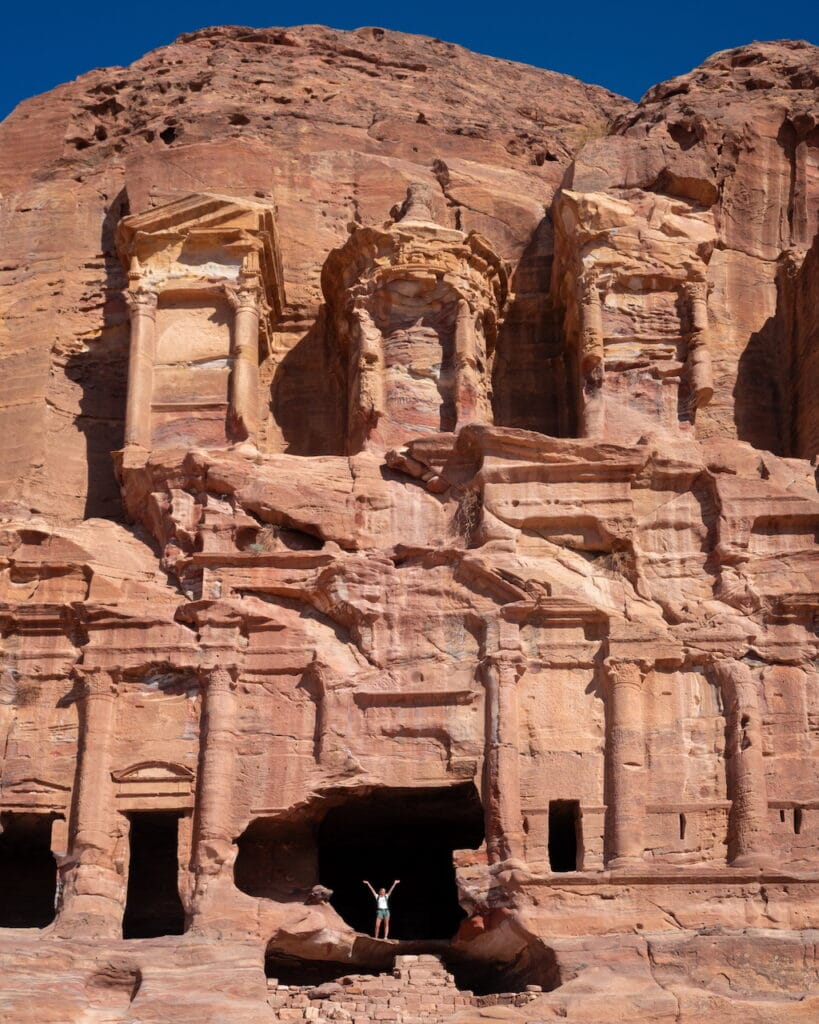
The final day of the trek leads you from Little Petra into Petra ‘through the back door’, a long route that sees few tourists and offers the most comprehensive exploration of this 2000-year-old site—which is SO much more than just the Treasury!

We were joined today by a spectacular Bedouin guide, Mahmoud, who was actually born in one of the caves within Petra (and took us to visit his family cave as part of the tour!). Experiencing Petra through his eyes was absolutely incredible and gave us a far deeper appreciation for the rich history of this World Heritage Site, yet another way Experience Jordan Adventures is facilitating meaningful local interactions that capture the true heart of this country.

Hiking from Dana to Petra on the Jordan Trail
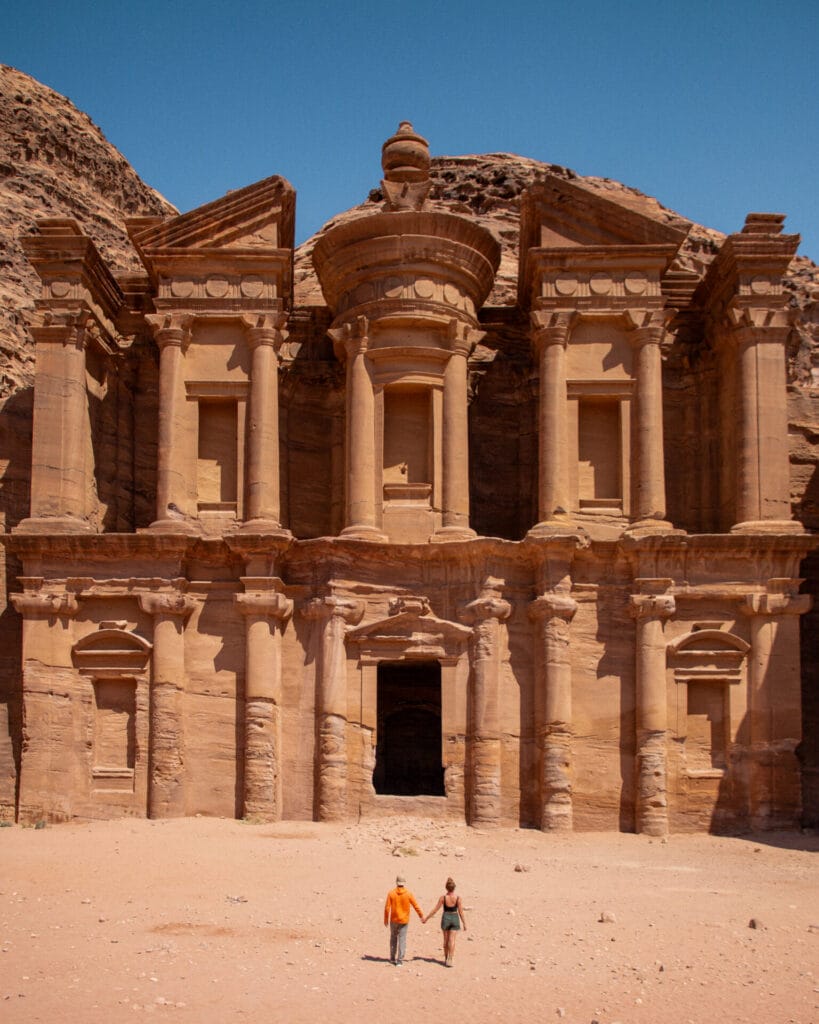
The Monastery in Petra

Following Nabataean paths and rock terraces high above the valley, you’ll catch your first glimpse of one of Petra’s most spectacular sites: The Monastery. From here, it’s non-stop temples, tombs, theatres, and caves all the way to the iconic Treasury.

Hiking from Dana to Petra on the Jordan Trail

By the time we walked out of the Siq, a beautiful slot canyon that links the main entrance to the Treasury, we’d spent nearly 9hrs hiking through the site and probably saw more of Petra than 99% of other visitors. There are almost no words to describe this place—so you’ll just have to Experience Jordan for yourself!

Read more: The best 1-day & 2-day Petra itineraries for adventure travellers COMING SOON

Hiking from Dana to Petra on the Jordan Trail
Soaring views on the Jordan Trail

What to expect on the trail

Terrain on the Jordan Trail

The terrain on the Jordan Trail from Dana to Petra is incredibly diverse, ranging from rugged mountain paths to sandy desert stretches. On the first couple of days, expect well-worn Bedouin trails and rocky, uneven terrain with some steep descents. As the hike nears Petra, it becomes flatter and sandier, but Petra itself is filled with stairs, so the work isn’t quite over!

While some sections of Dana to Petra are relatively smooth, others are more challenging with loose rocks and uneven footing; most days, there are also opportunities to scramble high into the rocky surrounds! Almost our entire group hiked in shoes, ranging from adidas running shoes to Salomon trail shoes, and felt comfortable; I wore my trusty pair of (ancient and very well-broken-in) Blundstones and was also quite happy—these kept the sand out really well and provided ample support for 15-20km per day.

Hiking from Dana to Petra on the Jordan Trail
Trail conditions on the Jordan Trail
Hiking from Dana to Petra on the Jordan Trail
Heaps of fun scrambling opportunities along the route!

Navigation on the Jordan Trail

There are no trail signs on the Jordan Trail, the path is not obvious, and GPS signals are almost entirely jammed due to proximity to the Israeli border (on our first day of the hike, James’ watch showed that we’d walked 130km and my GPS had us at the Amman airport). For this reason, having a local guide is extremely helpful!

For your own interest, Experience Jordan Adventures have published an interactive trail map and JordanTrail.org has also published a GPX file of the entire route (this is not super helpful currently with the signal jamming from Israel, but hopefully in future it will be possible to navigate along the route).

Hiking from Dana to Petra on the Jordan Trail
The Jordan Trail is an incredible network of Bedouin paths through the desert

Campsites on the Jordan Trail

Campsites along the route are basic but beautiful, set in secluded valleys or beneath dramatic cliffs, established each day by the local Bedouin support team. Our private tents supplied by Experience Jordan Adventures were super comfortable, kitted out with plush mattresses, warm blankets, and pillows before we even arrived.

At the centre of the camp, there’s a large communal tent providing shade— on day 2, we arrived into camp at 2pm and got to lounge about for several hours! Each day, Eid and family made tea, brought out snacks and juice, and set up camp chairs and floor pillows for us to relax while we watched the sun illuminate the canyon walls and dip below the horizon. Camp was a central part of our experience on the trail and we loved it every single day!

Hiking from Dana to Petra on the Jordan Trail
Camping in Ghbour Whedat

Food on the Jordan Trail

After sunset each night, our Bedouin support team put out an impressive spread of traditional food, usually centred around flavourful chicken and rice, veggies, Arabic salad with tahini, humous, and fresh bread. I don’t think I’ve ever eaten so well while camping!

Each morning, a breakfast/lunch spread was also set up, typically consisting of veggies and beans in flavourful sauce, humous, fresh fruit/veggies (tomato, cucumber, banana), crackers/muffins, and juice boxes. We dished up our breakfast and packed lunch from the same table and there was always plenty to go around (plus a communal bag of mixed nuts, dates, and local cookies that our support donkey carried for additional snacks throughout the day). Vegetarians and GF were catered for and everyone was full and satisfied every day!

Hiking from Dana to Petra on the Jordan Trail

Services (toilets, showers, water) on the Jordan Trail

Despite the remote location, our camps were appointed with all the essentials: clean drinking water, simple pit toilets, and even an outdoor pump shower. Yet another perk of hiking the Jordan Trail with Experience Jordan Adventures!

Hiking from Dana to Petra on the Jordan Trail
The incredible ruins of Petra

What to pack for the Jordan Trail

If you’re hiking with Experience Jordan Adventures, all camping equipment and food along the trail is provided for you— all you need to pack is lightweight hiking clothing and a few other essentials, listed below.

Trail essentials

You’ll carry your own water, snacks, and personal items each day, so keep your trail kit lightweight and efficient in a small daypack.

daypack (20–35L): Osprey Tempest 30 (women’s) / Osprey Talon 33 (men’s)

A small daypack is all you’ll need on the Jordan Trail— enough to hold your lunch, water, sunscreen, and maybe an extra layer. I personally carried a 21L daypack, but anything in the 20-35L range should be more than adequate.


2x water bottles: Nalgene Wide Mouth

I personally don’t like bladders on overnight trips since they can be especially challenging to fill, so instead I packed 2 standard Nalgene bottles for the Jordan Trail.


What to wear on the Jordan Trail

Balancing sun protection with desert heat is critical in the desert. I recommend ultralight, breathable layers that cover your skin without overheating, allowing you to hike safely in the harsh sun without risking dehydration or burns.

sun hat: Arc’teryx Sinsola Shade Hat

I called this my sun bonnet because it made me look like a pioneer woman, but it did an excellent job of keeping sun off my face and neck! Highly recommend bringing a hat on this trail, the sun is unrelenting.


Buff

neck gaiter: Buff Original

Lightweight and versatile, a Buff is essential for protecting against daily sun, sweat, dust, and wind on the Jordan Trail.


sports bras + underwear

I’m not going to tell you what undergarments to pack, but just consider you’ll have 5 days on the trail and it’s very nice to have clean underwear every day!


hiking shirt: Arc’teryx Taema Crew Shirt (women’s) / Cormac Crew Shirt (men’s)

I’d suggest bringing 2 shirts and swapping between them as needed.


sun shirt: Arc’teryx Taema Hoody (women’s) / Cormac Hoody (men’s)

Breathable, quick-drying, and UPF-rated to protect from the intense afternoon sun. This is a great daily layer on the Jordan Trail, James lived in his!


hiking shorts: Vuori Villa Trouser Shorts

I wore these shorts all over Jordan as an alternative to my usual tight-fitting hiking shorts— they felt a little more modest, very airy for the hot desert, and still looked nice at Petra! Not a classic hiking short, but absolutely did the job.


lightweight hiking pants: Arc’teryx Gamma SL Pants (women’s) / (men’s)

I bought the “super lightweight” version of my favourite Gamma hiking pants specifically for the Jordan Trail and have ended up using them all over the world! Super lightweight and surprisingly cool, even in the desert heat, these are truly fantastic pants.


Alta Via 1 2 4 Packing List- Italian Dolomites

2x boot socks: Darn Tough Hiker Micro Crew Cushion Socks (women’s) / (men’s)

My go-to socks for backpacking— durable, padded, and still comfy after multiple days of trail grime. Not too hot for the desert!


hiking boots: Blundstone Square Toe

I hiked the Jordan Trail in a pair of old Blundstones and loved how comfortable they were over the entire trip, not to mention what a great job they did of keeping sand out (while James’ runners filled with buckets of sand and caused blisters). Honestly, I’d do it again in Blundstones or another lightweight hiking boot like the adidas Terrex Free Hiker 2.0. The terrain is mellow enough that you don’t need a ton of tread or support, just something comfortable to run around in.


Camp & personal items

Experience Jordan Adventures provides tents, sleeping bags, sleeping mats, and all camp equipment— just bring your personal comforts for camp.

Arc'teryx rho kyanite

fleece top: Arc’teryx Kyanite Zip Neck Top (women’s) / Rho Heavyweight Zip Neck Top (men’s)

fleece bottoms: Arc’teryx Kyanite Base Layer Bottoms (women’s) / (men’s)

This Rho/Kyanite series from Arc’teryx is my favourite comfy camp clothing, perfect for bundling up a little bit when it starts to cool off in the desert but still lightweight, stretchy, and packable.


camp shoes: Teva Original

Easy to slip on after hiking boots, great for giving feet a breather and cooling off in the afternoons at camp.


toiletries + bathroom bits

Toothbrush, toothpaste, hairbrush, deodorant, medications, contact solution… whatever you need to stay clean and comfortable for multiple days on the trail!

All the campsites have wilderness toilet facilities, but they are very rustic. For the wilderness bathroom along the trail, pack toilet paper, hand sanitiser, and a ziplock bag to pack out used items if needed.


sun safety

Sun exposure builds quickly when you’re spending hours outside every day. Pack SPF 50+ sunscreen, SPF lip balm, and whatever else you need to stay sun-safe on the trail!


Alta Via 1 2 4 Packing List- Italian Dolomites

headlamp: Black Diamond Spot 400-R

A bright, rechargeable headlamp is essential for evenings around camp. Lightweight and easy to stash in a top pocket for quick access!


Alta Via 1 2 4 Packing List- Italian Dolomites

powerbank: VRURC Portable Charger with Built-in Cables, 10000mAh

I used my phone constantly for photos, so I carried a 10,000mAh powerbank to stay topped up on the Jordan Trail.


camera: Canon 6D M2 + 24-105mm lens

All photos in this post shot on this set-up!


Jordan Pass + passport + Jordanian Dinar

Be sure to pack your passport and a copy of your Jordan Pass for entry to Petra, plus some Jordanian cash for tipping the support staff or making small purchases along the way.


Hiking from Dana to Petra on the Jordan Trail
Would you hike the Jordan Trail?

Read more about Jordan

  • Our favourite places in Jordan (after travelling for 1 month!) COMING SOON
  • The ultimate 10-day Jordan roadtrip itinerary COMING SOON
  • 2-day Petra hiking itinerary
TAGS:trail guides
1 Comment
Share
brooke beyond

Hey, I'm Brooke and I'm obsessed with getting off the beaten path, exploring backcountry gems & travelling beyond the ordinary! I left Australia 5 years ago after finishing a PhD in Biomechanics & have been travelling the world full-time ever since (joined by my life/climbing partner, James). Whether it’s road-tripping through Mexico, climbing alpine peaks in the Andes, scuba diving in the Red Sea, or tackling epic via ferrata in the Dolomites, I hope this blog will inspire your future adventures & help you find wonder in every corner of the globe. xx bb

Leave a Comment Cancel Comment

The Comments

  • Tony Howard
    14 November 2024

    glad you enjoyed it 🙂

    Reply

You May Also Like

7 February 2025

Socotra travel journal: our epic 8-day roadtrip in Yemen

16 November 2024

Hiking Petra through the “back door” & off the beaten path: 2-day adventure itinerary

hi, I’m brooke!

I'm obsessed with getting off the beaten path, exploring backcountry gems & travelling beyond the ordinary! I left Australia 5 years ago after finishing a PhD in Biomechanics & have been travelling the world full-time ever since (now joined by my life/climbing partner, James). I hope this blog will inspire your future adventures & help you find wonder in every corner of the globe. xx bb

read my story
currently exploring

currently exploring

iceland

read our gear guides

🥾 hiking boots

🎒 hiking backpacks

🌨️ cold-weather layers

⛺️ backpacking & alpine tents

🛌 sleeping bag & pads

🍪 backcountry food

📸 travel camera gear

✈️ travel clothing

trail guides

summit guides

itineraries

outdoor gear

GPS maps

recent posts

  • Laguna Humantay, Cusco Peru

    6 awesome day trips from Cusco, Peru

    24 November 2025
  • Adventure-ready picks from the REI Co-op Holiday Sale

    17 November 2025
  • 2-week Montenegro road-trip itinerary: epic hiking, Riviera beaches & wine country

    3 September 2025
  • 10-day Switzerland itinerary: Zermatt, Interlaken, Jungfrau & beyond!

    31 August 2025
  • Climbing Iztaccíhuatl volcano

    2-week Mexico volcanoes itinerary: climbing Pico de Orizaba, Izta, Malinche & Toluca

    3 June 2025

@brookebeyond_
brooke ✨travel & mountain gal

@brookebeyond_

  • hi from arctic Norway!!!!! 🇳🇴❄️

I’ve spent the last 5 years of full-time travel chasing summer + basically avoiding winter at all costs, but this year we decided to do something TOTALLY different: 3 months in Norway, Sweden, and Finland. Basically the most winter that winter can be.

And already a month into Scandinavia, we’ve been absolutely loving it!!! 

We arrived in Tromsø at the end of December to -15C blizzards and *polar night* (where the sun literally doesn’t come over the horizon), but despite being absolutely FREEZING and completely dark for 22hrs a day, it’s insanely beautiful for the few hours of glowing sunset lighting around midday and the northern lights are out in full force as early as 3pm. It is, quite simply, MAGIC ✨

We can’t wait to share more of our adventures as we hike, ski, sauna, dogsled, and romp with our cameras through the glorious Nordics over the next few months!

——
#norway #tromsø #arcticcircle #winterwonderland #tromso
  • A friend asked me recently if I’d noticed a shift in my follower demographic here on Instagram (as it had been my goal over the last year to reach more women). According to the data, not really— I still have a majority male followers— but I have absolutely FELT a shift in the quality of people who choose to interact with my account. 

There was a time when posting a photo in a swimsuit or a sports bra would trigger a flood of angry villagers sprinting to the comments to tell me that I needed to leave more to the imagination, that I was sexualising myself (and therefore couldn’t expect others not to), that I was a wh*re … simply for existing in the body that I was born in. 

And I’ve always pushed back against the notion that my only solution was to wear baggy t-shirts or turtlenecks simply to make others feel more comfortable with MY BODY. 

The reality is that a woman’s worth CANNOT come down to what she’s wearing, her cup size, her willingness to cover herself up so that others don’t feel tempted to treat her like an object... If you only respect a woman when her body is entirely hidden, do you really respect her??

It’s been difficult to cling to these ideals amidst disparaging + often disgusting comments from strangers online, but it felt important to keep showing up as myself, in whatever I felt comfortable in, saying whatever I needed to say, if only to prove that wearing a swimsuit doesn’t make me less of a person, just like wearing sports bra doesn’t make me less of a climber and having breasts doesn’t automatically invalidate my opinions as a travel blogger. 

And somewhere along the way (after many feminist rants that cleaned out the undesirables & quite a bit of good ol fashioned blocking), I felt the shift I’d been waiting for. Comments this past year have been more about the content of my posts and the recommendations I make than what I’m wearing, and it feels SO FJKING GOOD to have made even a small degree of progress in this tiny corner of the internet. 

So please comment below if you don’t agree with any this and want to continue judging me based on what I wear so that I can block your account & protect my inner peace 🥰✌🏼
  • IS IT SAFE TO TRAVEL TO ETHIOPIA?? 🇪🇹

Since falling in love with Ethiopia and sharing so many spectacular, unique experiences here on insta, I’ve received a small flood of DMs asking about traveller safety— especially considering the US currently lists Ethiopia as “Level 3: Reconsider Travel”

So here’s some context and our personal experience 👇🏻

From 2020 to 2022, Ethiopia experienced a brutal civil war centred in the northern Tigray region that spilled over into some of the surrounds. The conflict claimed hundreds of thousands of lives and displaced millions, but by the grace of a peace agreement signed in late 2022, communities across northern Ethiopia have been actively rebuilding in the years since.

We travelled through Ethiopia twice in 2025 for several weeks at a time, visiting many regions that were directly affected by the war and, with our own eyes, experienced a country that felt stable, welcoming, generous, and deeply grateful for visitors returning. 

Perhaps most importantly, tourism here has REAL power. Every guesthouse stay, home-cooked meal, and local service directly injects money into communities recovering from the conflict, helping families restore their livelihoods, put food on the table, and send their children to school.

We absolutely adore Ethiopia and the beautiful people we’ve met here, so we’re passionate about sharing these experiences with fellow travellers— especially at a time when tourism dollars mean life and opportunity for so many. 

PLEASE don’t trust everything you read online. I would strongly encourage you to come discover this warm, unique, resilient country for yourself WITH the support of a trusted local guide and/or driver, who will always prioritise your safety based on real risk, not fear-mongering.

If you need a recommendation for a great guide/driver anywhere in the country, talk to our local friend Kiros @lucyethiopiatours and he will absolutely take care of you 🙏🏼

—
#ethiopia #travelsafety #travelethiopia #tigray
  • One of our last destinations of 2025: Djibouti, a country that hardly anyone seems to know anything about (but that surprised and delighted us in many ways!)

Perched on the Horn of Africa, where tectonic plates split the earth and salt flats stretch to the horizon, Djibouti feels raw, otherworldly + wildly alive. It’s home to Africa’s lowest point on land, volcanic deserts, crater lakes, pink flamingos, whale sharks, and landscapes that look more like another planet.

But it’s not just the scenery. There’s a fascinating blend of cultures here: Afar & Somali traditions, strong tribal identity, and layers of French influence that linger in language, architecture, and daily life. Standing at a crossroads between Africa, the Middle East & the Red Sea, Djibouti is truly a place shaped by movement— of people, of plates, of history.

The 3rd photo illustrates this perfectly (and it’s one of my favourite captures of the year): Afar people travelling on foot with a camel caravan across the desert borderlands, hauling bundles of palm fronds + Djiboutian salt hundreds of kilometres back towards home to Ethiopia.

Because we’ve spent so much time in Ethiopia lately (and have 2 sold-out group trips running this year!), Djibouti just felt like the next natural frontier for us, and certainly didn’t disappoint. We spent 5 days road-tripping across wild landscapes, swimming with whale sharks in the bay, camping on empty beaches, and discovering this untouched gem. 

Have you ever thought about visiting Djibouti??

—
#djibouti #afar #lacabbe #hornofafrica #travelbeyond
  • an entire year of my full-time travel expenses (365 days on the road!), from flights & hotels to healthcare & entrance fees to SIM cards & Spotify ↯

** these numbers are a reflection of my PERSONAL spending in 2025— not representative of the absolute cheapest long-term travel style, just intended to show how much I was able to experience this year for less than rent in a major city

$7,172 ACCOMMODATION
🏡 apartments = $2,415
🏕️ campsites = $121
🏨 hotels + hostels = $4,446
🛖 mountain huts = $190

$5,167 ACTIVITIES
🎟️ entrance fees + permits = $218
⛵️ experiences + tours = $4,217
🔥 hot springs + sauna = $733

$8,244 FOOD & DRINKS
🍹 drinks = $2,088
🌮 eating out = $4,999
🧀 groceries = $1,156

$4,807 PERSONAL EXPENSES 
🧴 consumables (ex. shampoo) = $981
💊 healthcare = $3,042
🧺 laundry = $69
📲 mobile data = $216
🗺️ subscriptions (ex. Garmin In-Reach, Spotify) = $500

$8,719 TRANSPORTATION
✈️ airfare = $3,826
🚘 car hire = $2,970
⛽️ fuel + parking = $659
🚕 private transport (ex. Uber) = $635
🚃 public transport (ex. train) = $627

$1,744 TRAVEL LOGISTICS
🚫 change fees + cancellations = $355
🧳 baggage fees + luggage storage = $385
🪪 ID (ex. licence renewal) = $255
💳 credit card annual fees = $448
💰 insurance = $72
🛂 travel visas = $229

= $35,852USD TOTAL LIVING EXPENSES
($98 per day)

—
#fulltimetravel #travelbudget #travelexpenses
  • HAPPY ETHIOPIAN CHRISTMAS (GENA ገና ) ✞🕯️✨

We were lucky enough to experience these celebrations last January (Christmas falls on the 7th according to the orthodox calendar), and it was truly one of the most incredible travel moments we’ve EVER had 🥹

We only saw 4 other foreigners during our 3 days in Lalibela, and we were welcomed so warmly into the churches, the festivities, and the traditions of Christmas by friendly locals who delighted in the opportunity to share their culture + customs with a couple of curious ferenjis 🤍

———

#ethiopia #gena #ethiopianchristmas #travelbeyond #lalibela
  • our cost of living as full-time travellers came in at $98/day this year (JUST UNDER OUR $100 daily goal) 💃🏻🍾✨

→ $$$ per person based on sharing rooms + joint travel costs with my partner— AND YES, THIS IS EVERY SINGLE DOLLAR SPENT ALL YEAR

this was the most expensive year I’ve had since starting full-time travel more than 5 years ago (!!), but it was also atypical in many ways...
- I had knee surgery in Mexico, which we paid for out of pocket
- because of the slow & terrible recovery from said surgery, we had to cancel most of our big hiking plans for the year, which meant extremely little camping and a lot more city time (= expensive)
- we splurged on a $5000+ campervan rental in Iceland because I’ve been trying to convince James (successfully!) that we should do van life— some of you will recall that I lived in a van for 1.5 years previously, which I LOVED, and the only thing missing was James 👩🏼‍❤️‍💋‍👨🏻
- I got a new MacBook, a new iPhone, AND we upgraded 2x cameras in 2025 (looking forward to no big upgrades in 2026 😅)

I always love chatting travel finance, so by all means— hit me with your questions in the comments! 

———

#2025 #fulltimetravel #travelfinance #costofliving
  • another year of prioritising memories > things 🔥

if you’re new here, I’m Brooke 👋🏻 and I’ve been travelling full-time for over 5 years, sharing unique experiences around the world, detailed adventure itineraries, financial breakdowns, and stories from the road.

follow @brookebeyond_ for more adventures in 2026!

———

#2025 #2025season #fulltimetravel
  • A colourful look back at 2025— my 5th full year living out of a suitcase (!!!), so many highs (& some unexpected lows 🩼), all with my other half @slatojc

Cheers to whatever wild adventures 2026 has in store for us 🍻✨

—
#2025 #travelwrapped #2025wrapped #2025season #fulltimetravel
follow @brookebeyond_

travel beyond the ordinary

Explore my travel guides, custom itineraries & blog posts with an interactive world map ✨

all destinations

  • hi from arctic Norway!!!!! 🇳🇴❄️

I’ve spent the last 5 years of full-time travel chasing summer + basically avoiding winter at all costs, but this year we decided to do something TOTALLY different: 3 months in Norway, Sweden, and Finland. Basically the most winter that winter can be.

And already a month into Scandinavia, we’ve been absolutely loving it!!! 

We arrived in Tromsø at the end of December to -15C blizzards and *polar night* (where the sun literally doesn’t come over the horizon), but despite being absolutely FREEZING and completely dark for 22hrs a day, it’s insanely beautiful for the few hours of glowing sunset lighting around midday and the northern lights are out in full force as early as 3pm. It is, quite simply, MAGIC ✨

We can’t wait to share more of our adventures as we hike, ski, sauna, dogsled, and romp with our cameras through the glorious Nordics over the next few months!

——
#norway #tromsø #arcticcircle #winterwonderland #tromso
  • A friend asked me recently if I’d noticed a shift in my follower demographic here on Instagram (as it had been my goal over the last year to reach more women). According to the data, not really— I still have a majority male followers— but I have absolutely FELT a shift in the quality of people who choose to interact with my account. 

There was a time when posting a photo in a swimsuit or a sports bra would trigger a flood of angry villagers sprinting to the comments to tell me that I needed to leave more to the imagination, that I was sexualising myself (and therefore couldn’t expect others not to), that I was a wh*re … simply for existing in the body that I was born in. 

And I’ve always pushed back against the notion that my only solution was to wear baggy t-shirts or turtlenecks simply to make others feel more comfortable with MY BODY. 

The reality is that a woman’s worth CANNOT come down to what she’s wearing, her cup size, her willingness to cover herself up so that others don’t feel tempted to treat her like an object... If you only respect a woman when her body is entirely hidden, do you really respect her??

It’s been difficult to cling to these ideals amidst disparaging + often disgusting comments from strangers online, but it felt important to keep showing up as myself, in whatever I felt comfortable in, saying whatever I needed to say, if only to prove that wearing a swimsuit doesn’t make me less of a person, just like wearing sports bra doesn’t make me less of a climber and having breasts doesn’t automatically invalidate my opinions as a travel blogger. 

And somewhere along the way (after many feminist rants that cleaned out the undesirables & quite a bit of good ol fashioned blocking), I felt the shift I’d been waiting for. Comments this past year have been more about the content of my posts and the recommendations I make than what I’m wearing, and it feels SO FJKING GOOD to have made even a small degree of progress in this tiny corner of the internet. 

So please comment below if you don’t agree with any this and want to continue judging me based on what I wear so that I can block your account & protect my inner peace 🥰✌🏼
  • IS IT SAFE TO TRAVEL TO ETHIOPIA?? 🇪🇹

Since falling in love with Ethiopia and sharing so many spectacular, unique experiences here on insta, I’ve received a small flood of DMs asking about traveller safety— especially considering the US currently lists Ethiopia as “Level 3: Reconsider Travel”

So here’s some context and our personal experience 👇🏻

From 2020 to 2022, Ethiopia experienced a brutal civil war centred in the northern Tigray region that spilled over into some of the surrounds. The conflict claimed hundreds of thousands of lives and displaced millions, but by the grace of a peace agreement signed in late 2022, communities across northern Ethiopia have been actively rebuilding in the years since.

We travelled through Ethiopia twice in 2025 for several weeks at a time, visiting many regions that were directly affected by the war and, with our own eyes, experienced a country that felt stable, welcoming, generous, and deeply grateful for visitors returning. 

Perhaps most importantly, tourism here has REAL power. Every guesthouse stay, home-cooked meal, and local service directly injects money into communities recovering from the conflict, helping families restore their livelihoods, put food on the table, and send their children to school.

We absolutely adore Ethiopia and the beautiful people we’ve met here, so we’re passionate about sharing these experiences with fellow travellers— especially at a time when tourism dollars mean life and opportunity for so many. 

PLEASE don’t trust everything you read online. I would strongly encourage you to come discover this warm, unique, resilient country for yourself WITH the support of a trusted local guide and/or driver, who will always prioritise your safety based on real risk, not fear-mongering.

If you need a recommendation for a great guide/driver anywhere in the country, talk to our local friend Kiros @lucyethiopiatours and he will absolutely take care of you 🙏🏼

—
#ethiopia #travelsafety #travelethiopia #tigray
  • One of our last destinations of 2025: Djibouti, a country that hardly anyone seems to know anything about (but that surprised and delighted us in many ways!)

Perched on the Horn of Africa, where tectonic plates split the earth and salt flats stretch to the horizon, Djibouti feels raw, otherworldly + wildly alive. It’s home to Africa’s lowest point on land, volcanic deserts, crater lakes, pink flamingos, whale sharks, and landscapes that look more like another planet.

But it’s not just the scenery. There’s a fascinating blend of cultures here: Afar & Somali traditions, strong tribal identity, and layers of French influence that linger in language, architecture, and daily life. Standing at a crossroads between Africa, the Middle East & the Red Sea, Djibouti is truly a place shaped by movement— of people, of plates, of history.

The 3rd photo illustrates this perfectly (and it’s one of my favourite captures of the year): Afar people travelling on foot with a camel caravan across the desert borderlands, hauling bundles of palm fronds + Djiboutian salt hundreds of kilometres back towards home to Ethiopia.

Because we’ve spent so much time in Ethiopia lately (and have 2 sold-out group trips running this year!), Djibouti just felt like the next natural frontier for us, and certainly didn’t disappoint. We spent 5 days road-tripping across wild landscapes, swimming with whale sharks in the bay, camping on empty beaches, and discovering this untouched gem. 

Have you ever thought about visiting Djibouti??

—
#djibouti #afar #lacabbe #hornofafrica #travelbeyond
  • an entire year of my full-time travel expenses (365 days on the road!), from flights & hotels to healthcare & entrance fees to SIM cards & Spotify ↯

** these numbers are a reflection of my PERSONAL spending in 2025— not representative of the absolute cheapest long-term travel style, just intended to show how much I was able to experience this year for less than rent in a major city

$7,172 ACCOMMODATION
🏡 apartments = $2,415
🏕️ campsites = $121
🏨 hotels + hostels = $4,446
🛖 mountain huts = $190

$5,167 ACTIVITIES
🎟️ entrance fees + permits = $218
⛵️ experiences + tours = $4,217
🔥 hot springs + sauna = $733

$8,244 FOOD & DRINKS
🍹 drinks = $2,088
🌮 eating out = $4,999
🧀 groceries = $1,156

$4,807 PERSONAL EXPENSES 
🧴 consumables (ex. shampoo) = $981
💊 healthcare = $3,042
🧺 laundry = $69
📲 mobile data = $216
🗺️ subscriptions (ex. Garmin In-Reach, Spotify) = $500

$8,719 TRANSPORTATION
✈️ airfare = $3,826
🚘 car hire = $2,970
⛽️ fuel + parking = $659
🚕 private transport (ex. Uber) = $635
🚃 public transport (ex. train) = $627

$1,744 TRAVEL LOGISTICS
🚫 change fees + cancellations = $355
🧳 baggage fees + luggage storage = $385
🪪 ID (ex. licence renewal) = $255
💳 credit card annual fees = $448
💰 insurance = $72
🛂 travel visas = $229

= $35,852USD TOTAL LIVING EXPENSES
($98 per day)

—
#fulltimetravel #travelbudget #travelexpenses
hi from arctic Norway!!!!! 🇳🇴❄️

I’ve spent the last 5 years of full-time travel chasing summer + basically avoiding winter at all costs, but this year we decided to do something TOTALLY different: 3 months in Norway, Sweden, and Finland. Basically the most winter that winter can be.

And already a month into Scandinavia, we’ve been absolutely loving it!!! 

We arrived in Tromsø at the end of December to -15C blizzards and *polar night* (where the sun literally doesn’t come over the horizon), but despite being absolutely FREEZING and completely dark for 22hrs a day, it’s insanely beautiful for the few hours of glowing sunset lighting around midday and the northern lights are out in full force as early as 3pm. It is, quite simply, MAGIC ✨

We can’t wait to share more of our adventures as we hike, ski, sauna, dogsled, and romp with our cameras through the glorious Nordics over the next few months!

——
#norway #tromsø #arcticcircle #winterwonderland #tromso
hi from arctic Norway!!!!! 🇳🇴❄️

I’ve spent the last 5 years of full-time travel chasing summer + basically avoiding winter at all costs, but this year we decided to do something TOTALLY different: 3 months in Norway, Sweden, and Finland. Basically the most winter that winter can be.

And already a month into Scandinavia, we’ve been absolutely loving it!!! 

We arrived in Tromsø at the end of December to -15C blizzards and *polar night* (where the sun literally doesn’t come over the horizon), but despite being absolutely FREEZING and completely dark for 22hrs a day, it’s insanely beautiful for the few hours of glowing sunset lighting around midday and the northern lights are out in full force as early as 3pm. It is, quite simply, MAGIC ✨

We can’t wait to share more of our adventures as we hike, ski, sauna, dogsled, and romp with our cameras through the glorious Nordics over the next few months!

——
#norway #tromsø #arcticcircle #winterwonderland #tromso
@brookebeyond_
@brookebeyond_
•
Follow
hi from arctic Norway!!!!! 🇳🇴❄️ I’ve spent the last 5 years of full-time travel chasing summer + basically avoiding winter at all costs, but this year we decided to do something TOTALLY different: 3 months in Norway, Sweden, and Finland. Basically the most winter that winter can be. And already a month into Scandinavia, we’ve been absolutely loving it!!! We arrived in Tromsø at the end of December to -15C blizzards and *polar night* (where the sun literally doesn’t come over the horizon), but despite being absolutely FREEZING and completely dark for 22hrs a day, it’s insanely beautiful for the few hours of glowing sunset lighting around midday and the northern lights are out in full force as early as 3pm. It is, quite simply, MAGIC ✨ We can’t wait to share more of our adventures as we hike, ski, sauna, dogsled, and romp with our cameras through the glorious Nordics over the next few months! —— #norway #tromsø #arcticcircle #winterwonderland #tromso
1 day ago
View on Instagram |
1/5
A friend asked me recently if I’d noticed a shift in my follower demographic here on Instagram (as it had been my goal over the last year to reach more women). According to the data, not really— I still have a majority male followers— but I have absolutely FELT a shift in the quality of people who choose to interact with my account. 

There was a time when posting a photo in a swimsuit or a sports bra would trigger a flood of angry villagers sprinting to the comments to tell me that I needed to leave more to the imagination, that I was sexualising myself (and therefore couldn’t expect others not to), that I was a wh*re … simply for existing in the body that I was born in. 

And I’ve always pushed back against the notion that my only solution was to wear baggy t-shirts or turtlenecks simply to make others feel more comfortable with MY BODY. 

The reality is that a woman’s worth CANNOT come down to what she’s wearing, her cup size, her willingness to cover herself up so that others don’t feel tempted to treat her like an object... If you only respect a woman when her body is entirely hidden, do you really respect her??

It’s been difficult to cling to these ideals amidst disparaging + often disgusting comments from strangers online, but it felt important to keep showing up as myself, in whatever I felt comfortable in, saying whatever I needed to say, if only to prove that wearing a swimsuit doesn’t make me less of a person, just like wearing sports bra doesn’t make me less of a climber and having breasts doesn’t automatically invalidate my opinions as a travel blogger. 

And somewhere along the way (after many feminist rants that cleaned out the undesirables & quite a bit of good ol fashioned blocking), I felt the shift I’d been waiting for. Comments this past year have been more about the content of my posts and the recommendations I make than what I’m wearing, and it feels SO FJKING GOOD to have made even a small degree of progress in this tiny corner of the internet. 

So please comment below if you don’t agree with any this and want to continue judging me based on what I wear so that I can block your account & protect my inner peace 🥰✌🏼
A friend asked me recently if I’d noticed a shift in my follower demographic here on Instagram (as it had been my goal over the last year to reach more women). According to the data, not really— I still have a majority male followers— but I have absolutely FELT a shift in the quality of people who choose to interact with my account. 

There was a time when posting a photo in a swimsuit or a sports bra would trigger a flood of angry villagers sprinting to the comments to tell me that I needed to leave more to the imagination, that I was sexualising myself (and therefore couldn’t expect others not to), that I was a wh*re … simply for existing in the body that I was born in. 

And I’ve always pushed back against the notion that my only solution was to wear baggy t-shirts or turtlenecks simply to make others feel more comfortable with MY BODY. 

The reality is that a woman’s worth CANNOT come down to what she’s wearing, her cup size, her willingness to cover herself up so that others don’t feel tempted to treat her like an object... If you only respect a woman when her body is entirely hidden, do you really respect her??

It’s been difficult to cling to these ideals amidst disparaging + often disgusting comments from strangers online, but it felt important to keep showing up as myself, in whatever I felt comfortable in, saying whatever I needed to say, if only to prove that wearing a swimsuit doesn’t make me less of a person, just like wearing sports bra doesn’t make me less of a climber and having breasts doesn’t automatically invalidate my opinions as a travel blogger. 

And somewhere along the way (after many feminist rants that cleaned out the undesirables & quite a bit of good ol fashioned blocking), I felt the shift I’d been waiting for. Comments this past year have been more about the content of my posts and the recommendations I make than what I’m wearing, and it feels SO FJKING GOOD to have made even a small degree of progress in this tiny corner of the internet. 

So please comment below if you don’t agree with any this and want to continue judging me based on what I wear so that I can block your account & protect my inner peace 🥰✌🏼
A friend asked me recently if I’d noticed a shift in my follower demographic here on Instagram (as it had been my goal over the last year to reach more women). According to the data, not really— I still have a majority male followers— but I have absolutely FELT a shift in the quality of people who choose to interact with my account. 

There was a time when posting a photo in a swimsuit or a sports bra would trigger a flood of angry villagers sprinting to the comments to tell me that I needed to leave more to the imagination, that I was sexualising myself (and therefore couldn’t expect others not to), that I was a wh*re … simply for existing in the body that I was born in. 

And I’ve always pushed back against the notion that my only solution was to wear baggy t-shirts or turtlenecks simply to make others feel more comfortable with MY BODY. 

The reality is that a woman’s worth CANNOT come down to what she’s wearing, her cup size, her willingness to cover herself up so that others don’t feel tempted to treat her like an object... If you only respect a woman when her body is entirely hidden, do you really respect her??

It’s been difficult to cling to these ideals amidst disparaging + often disgusting comments from strangers online, but it felt important to keep showing up as myself, in whatever I felt comfortable in, saying whatever I needed to say, if only to prove that wearing a swimsuit doesn’t make me less of a person, just like wearing sports bra doesn’t make me less of a climber and having breasts doesn’t automatically invalidate my opinions as a travel blogger. 

And somewhere along the way (after many feminist rants that cleaned out the undesirables & quite a bit of good ol fashioned blocking), I felt the shift I’d been waiting for. Comments this past year have been more about the content of my posts and the recommendations I make than what I’m wearing, and it feels SO FJKING GOOD to have made even a small degree of progress in this tiny corner of the internet. 

So please comment below if you don’t agree with any this and want to continue judging me based on what I wear so that I can block your account & protect my inner peace 🥰✌🏼
A friend asked me recently if I’d noticed a shift in my follower demographic here on Instagram (as it had been my goal over the last year to reach more women). According to the data, not really— I still have a majority male followers— but I have absolutely FELT a shift in the quality of people who choose to interact with my account. 

There was a time when posting a photo in a swimsuit or a sports bra would trigger a flood of angry villagers sprinting to the comments to tell me that I needed to leave more to the imagination, that I was sexualising myself (and therefore couldn’t expect others not to), that I was a wh*re … simply for existing in the body that I was born in. 

And I’ve always pushed back against the notion that my only solution was to wear baggy t-shirts or turtlenecks simply to make others feel more comfortable with MY BODY. 

The reality is that a woman’s worth CANNOT come down to what she’s wearing, her cup size, her willingness to cover herself up so that others don’t feel tempted to treat her like an object... If you only respect a woman when her body is entirely hidden, do you really respect her??

It’s been difficult to cling to these ideals amidst disparaging + often disgusting comments from strangers online, but it felt important to keep showing up as myself, in whatever I felt comfortable in, saying whatever I needed to say, if only to prove that wearing a swimsuit doesn’t make me less of a person, just like wearing sports bra doesn’t make me less of a climber and having breasts doesn’t automatically invalidate my opinions as a travel blogger. 

And somewhere along the way (after many feminist rants that cleaned out the undesirables & quite a bit of good ol fashioned blocking), I felt the shift I’d been waiting for. Comments this past year have been more about the content of my posts and the recommendations I make than what I’m wearing, and it feels SO FJKING GOOD to have made even a small degree of progress in this tiny corner of the internet. 

So please comment below if you don’t agree with any this and want to continue judging me based on what I wear so that I can block your account & protect my inner peace 🥰✌🏼
A friend asked me recently if I’d noticed a shift in my follower demographic here on Instagram (as it had been my goal over the last year to reach more women). According to the data, not really— I still have a majority male followers— but I have absolutely FELT a shift in the quality of people who choose to interact with my account. 

There was a time when posting a photo in a swimsuit or a sports bra would trigger a flood of angry villagers sprinting to the comments to tell me that I needed to leave more to the imagination, that I was sexualising myself (and therefore couldn’t expect others not to), that I was a wh*re … simply for existing in the body that I was born in. 

And I’ve always pushed back against the notion that my only solution was to wear baggy t-shirts or turtlenecks simply to make others feel more comfortable with MY BODY. 

The reality is that a woman’s worth CANNOT come down to what she’s wearing, her cup size, her willingness to cover herself up so that others don’t feel tempted to treat her like an object... If you only respect a woman when her body is entirely hidden, do you really respect her??

It’s been difficult to cling to these ideals amidst disparaging + often disgusting comments from strangers online, but it felt important to keep showing up as myself, in whatever I felt comfortable in, saying whatever I needed to say, if only to prove that wearing a swimsuit doesn’t make me less of a person, just like wearing sports bra doesn’t make me less of a climber and having breasts doesn’t automatically invalidate my opinions as a travel blogger. 

And somewhere along the way (after many feminist rants that cleaned out the undesirables & quite a bit of good ol fashioned blocking), I felt the shift I’d been waiting for. Comments this past year have been more about the content of my posts and the recommendations I make than what I’m wearing, and it feels SO FJKING GOOD to have made even a small degree of progress in this tiny corner of the internet. 

So please comment below if you don’t agree with any this and want to continue judging me based on what I wear so that I can block your account & protect my inner peace 🥰✌🏼
A friend asked me recently if I’d noticed a shift in my follower demographic here on Instagram (as it had been my goal over the last year to reach more women). According to the data, not really— I still have a majority male followers— but I have absolutely FELT a shift in the quality of people who choose to interact with my account. 

There was a time when posting a photo in a swimsuit or a sports bra would trigger a flood of angry villagers sprinting to the comments to tell me that I needed to leave more to the imagination, that I was sexualising myself (and therefore couldn’t expect others not to), that I was a wh*re … simply for existing in the body that I was born in. 

And I’ve always pushed back against the notion that my only solution was to wear baggy t-shirts or turtlenecks simply to make others feel more comfortable with MY BODY. 

The reality is that a woman’s worth CANNOT come down to what she’s wearing, her cup size, her willingness to cover herself up so that others don’t feel tempted to treat her like an object... If you only respect a woman when her body is entirely hidden, do you really respect her??

It’s been difficult to cling to these ideals amidst disparaging + often disgusting comments from strangers online, but it felt important to keep showing up as myself, in whatever I felt comfortable in, saying whatever I needed to say, if only to prove that wearing a swimsuit doesn’t make me less of a person, just like wearing sports bra doesn’t make me less of a climber and having breasts doesn’t automatically invalidate my opinions as a travel blogger. 

And somewhere along the way (after many feminist rants that cleaned out the undesirables & quite a bit of good ol fashioned blocking), I felt the shift I’d been waiting for. Comments this past year have been more about the content of my posts and the recommendations I make than what I’m wearing, and it feels SO FJKING GOOD to have made even a small degree of progress in this tiny corner of the internet. 

So please comment below if you don’t agree with any this and want to continue judging me based on what I wear so that I can block your account & protect my inner peace 🥰✌🏼
A friend asked me recently if I’d noticed a shift in my follower demographic here on Instagram (as it had been my goal over the last year to reach more women). According to the data, not really— I still have a majority male followers— but I have absolutely FELT a shift in the quality of people who choose to interact with my account. 

There was a time when posting a photo in a swimsuit or a sports bra would trigger a flood of angry villagers sprinting to the comments to tell me that I needed to leave more to the imagination, that I was sexualising myself (and therefore couldn’t expect others not to), that I was a wh*re … simply for existing in the body that I was born in. 

And I’ve always pushed back against the notion that my only solution was to wear baggy t-shirts or turtlenecks simply to make others feel more comfortable with MY BODY. 

The reality is that a woman’s worth CANNOT come down to what she’s wearing, her cup size, her willingness to cover herself up so that others don’t feel tempted to treat her like an object... If you only respect a woman when her body is entirely hidden, do you really respect her??

It’s been difficult to cling to these ideals amidst disparaging + often disgusting comments from strangers online, but it felt important to keep showing up as myself, in whatever I felt comfortable in, saying whatever I needed to say, if only to prove that wearing a swimsuit doesn’t make me less of a person, just like wearing sports bra doesn’t make me less of a climber and having breasts doesn’t automatically invalidate my opinions as a travel blogger. 

And somewhere along the way (after many feminist rants that cleaned out the undesirables & quite a bit of good ol fashioned blocking), I felt the shift I’d been waiting for. Comments this past year have been more about the content of my posts and the recommendations I make than what I’m wearing, and it feels SO FJKING GOOD to have made even a small degree of progress in this tiny corner of the internet. 

So please comment below if you don’t agree with any this and want to continue judging me based on what I wear so that I can block your account & protect my inner peace 🥰✌🏼
A friend asked me recently if I’d noticed a shift in my follower demographic here on Instagram (as it had been my goal over the last year to reach more women). According to the data, not really— I still have a majority male followers— but I have absolutely FELT a shift in the quality of people who choose to interact with my account. 

There was a time when posting a photo in a swimsuit or a sports bra would trigger a flood of angry villagers sprinting to the comments to tell me that I needed to leave more to the imagination, that I was sexualising myself (and therefore couldn’t expect others not to), that I was a wh*re … simply for existing in the body that I was born in. 

And I’ve always pushed back against the notion that my only solution was to wear baggy t-shirts or turtlenecks simply to make others feel more comfortable with MY BODY. 

The reality is that a woman’s worth CANNOT come down to what she’s wearing, her cup size, her willingness to cover herself up so that others don’t feel tempted to treat her like an object... If you only respect a woman when her body is entirely hidden, do you really respect her??

It’s been difficult to cling to these ideals amidst disparaging + often disgusting comments from strangers online, but it felt important to keep showing up as myself, in whatever I felt comfortable in, saying whatever I needed to say, if only to prove that wearing a swimsuit doesn’t make me less of a person, just like wearing sports bra doesn’t make me less of a climber and having breasts doesn’t automatically invalidate my opinions as a travel blogger. 

And somewhere along the way (after many feminist rants that cleaned out the undesirables & quite a bit of good ol fashioned blocking), I felt the shift I’d been waiting for. Comments this past year have been more about the content of my posts and the recommendations I make than what I’m wearing, and it feels SO FJKING GOOD to have made even a small degree of progress in this tiny corner of the internet. 

So please comment below if you don’t agree with any this and want to continue judging me based on what I wear so that I can block your account & protect my inner peace 🥰✌🏼
A friend asked me recently if I’d noticed a shift in my follower demographic here on Instagram (as it had been my goal over the last year to reach more women). According to the data, not really— I still have a majority male followers— but I have absolutely FELT a shift in the quality of people who choose to interact with my account. 

There was a time when posting a photo in a swimsuit or a sports bra would trigger a flood of angry villagers sprinting to the comments to tell me that I needed to leave more to the imagination, that I was sexualising myself (and therefore couldn’t expect others not to), that I was a wh*re … simply for existing in the body that I was born in. 

And I’ve always pushed back against the notion that my only solution was to wear baggy t-shirts or turtlenecks simply to make others feel more comfortable with MY BODY. 

The reality is that a woman’s worth CANNOT come down to what she’s wearing, her cup size, her willingness to cover herself up so that others don’t feel tempted to treat her like an object... If you only respect a woman when her body is entirely hidden, do you really respect her??

It’s been difficult to cling to these ideals amidst disparaging + often disgusting comments from strangers online, but it felt important to keep showing up as myself, in whatever I felt comfortable in, saying whatever I needed to say, if only to prove that wearing a swimsuit doesn’t make me less of a person, just like wearing sports bra doesn’t make me less of a climber and having breasts doesn’t automatically invalidate my opinions as a travel blogger. 

And somewhere along the way (after many feminist rants that cleaned out the undesirables & quite a bit of good ol fashioned blocking), I felt the shift I’d been waiting for. Comments this past year have been more about the content of my posts and the recommendations I make than what I’m wearing, and it feels SO FJKING GOOD to have made even a small degree of progress in this tiny corner of the internet. 

So please comment below if you don’t agree with any this and want to continue judging me based on what I wear so that I can block your account & protect my inner peace 🥰✌🏼
@brookebeyond_
@brookebeyond_
•
Follow
A friend asked me recently if I’d noticed a shift in my follower demographic here on Instagram (as it had been my goal over the last year to reach more women). According to the data, not really— I still have a majority male followers— but I have absolutely FELT a shift in the quality of people who choose to interact with my account. There was a time when posting a photo in a swimsuit or a sports bra would trigger a flood of angry villagers sprinting to the comments to tell me that I needed to leave more to the imagination, that I was sexualising myself (and therefore couldn’t expect others not to), that I was a wh*re … simply for existing in the body that I was born in. And I’ve always pushed back against the notion that my only solution was to wear baggy t-shirts or turtlenecks simply to make others feel more comfortable with MY BODY. The reality is that a woman’s worth CANNOT come down to what she’s wearing, her cup size, her willingness to cover herself up so that others don’t feel tempted to treat her like an object... If you only respect a woman when her body is entirely hidden, do you really respect her?? It’s been difficult to cling to these ideals amidst disparaging + often disgusting comments from strangers online, but it felt important to keep showing up as myself, in whatever I felt comfortable in, saying whatever I needed to say, if only to prove that wearing a swimsuit doesn’t make me less of a person, just like wearing sports bra doesn’t make me less of a climber and having breasts doesn’t automatically invalidate my opinions as a travel blogger. And somewhere along the way (after many feminist rants that cleaned out the undesirables & quite a bit of good ol fashioned blocking), I felt the shift I’d been waiting for. Comments this past year have been more about the content of my posts and the recommendations I make than what I’m wearing, and it feels SO FJKING GOOD to have made even a small degree of progress in this tiny corner of the internet. So please comment below if you don’t agree with any this and want to continue judging me based on what I wear so that I can block your account & protect my inner peace 🥰✌🏼
1 week ago
View on Instagram |
2/5
IS IT SAFE TO TRAVEL TO ETHIOPIA?? 🇪🇹

Since falling in love with Ethiopia and sharing so many spectacular, unique experiences here on insta, I’ve received a small flood of DMs asking about traveller safety— especially considering the US currently lists Ethiopia as “Level 3: Reconsider Travel”

So here’s some context and our personal experience 👇🏻

From 2020 to 2022, Ethiopia experienced a brutal civil war centred in the northern Tigray region that spilled over into some of the surrounds. The conflict claimed hundreds of thousands of lives and displaced millions, but by the grace of a peace agreement signed in late 2022, communities across northern Ethiopia have been actively rebuilding in the years since.

We travelled through Ethiopia twice in 2025 for several weeks at a time, visiting many regions that were directly affected by the war and, with our own eyes, experienced a country that felt stable, welcoming, generous, and deeply grateful for visitors returning. 

Perhaps most importantly, tourism here has REAL power. Every guesthouse stay, home-cooked meal, and local service directly injects money into communities recovering from the conflict, helping families restore their livelihoods, put food on the table, and send their children to school.

We absolutely adore Ethiopia and the beautiful people we’ve met here, so we’re passionate about sharing these experiences with fellow travellers— especially at a time when tourism dollars mean life and opportunity for so many. 

PLEASE don’t trust everything you read online. I would strongly encourage you to come discover this warm, unique, resilient country for yourself WITH the support of a trusted local guide and/or driver, who will always prioritise your safety based on real risk, not fear-mongering.

If you need a recommendation for a great guide/driver anywhere in the country, talk to our local friend Kiros @lucyethiopiatours and he will absolutely take care of you 🙏🏼

—
#ethiopia #travelsafety #travelethiopia #tigray
IS IT SAFE TO TRAVEL TO ETHIOPIA?? 🇪🇹

Since falling in love with Ethiopia and sharing so many spectacular, unique experiences here on insta, I’ve received a small flood of DMs asking about traveller safety— especially considering the US currently lists Ethiopia as “Level 3: Reconsider Travel”

So here’s some context and our personal experience 👇🏻

From 2020 to 2022, Ethiopia experienced a brutal civil war centred in the northern Tigray region that spilled over into some of the surrounds. The conflict claimed hundreds of thousands of lives and displaced millions, but by the grace of a peace agreement signed in late 2022, communities across northern Ethiopia have been actively rebuilding in the years since.

We travelled through Ethiopia twice in 2025 for several weeks at a time, visiting many regions that were directly affected by the war and, with our own eyes, experienced a country that felt stable, welcoming, generous, and deeply grateful for visitors returning. 

Perhaps most importantly, tourism here has REAL power. Every guesthouse stay, home-cooked meal, and local service directly injects money into communities recovering from the conflict, helping families restore their livelihoods, put food on the table, and send their children to school.

We absolutely adore Ethiopia and the beautiful people we’ve met here, so we’re passionate about sharing these experiences with fellow travellers— especially at a time when tourism dollars mean life and opportunity for so many. 

PLEASE don’t trust everything you read online. I would strongly encourage you to come discover this warm, unique, resilient country for yourself WITH the support of a trusted local guide and/or driver, who will always prioritise your safety based on real risk, not fear-mongering.

If you need a recommendation for a great guide/driver anywhere in the country, talk to our local friend Kiros @lucyethiopiatours and he will absolutely take care of you 🙏🏼

—
#ethiopia #travelsafety #travelethiopia #tigray
IS IT SAFE TO TRAVEL TO ETHIOPIA?? 🇪🇹

Since falling in love with Ethiopia and sharing so many spectacular, unique experiences here on insta, I’ve received a small flood of DMs asking about traveller safety— especially considering the US currently lists Ethiopia as “Level 3: Reconsider Travel”

So here’s some context and our personal experience 👇🏻

From 2020 to 2022, Ethiopia experienced a brutal civil war centred in the northern Tigray region that spilled over into some of the surrounds. The conflict claimed hundreds of thousands of lives and displaced millions, but by the grace of a peace agreement signed in late 2022, communities across northern Ethiopia have been actively rebuilding in the years since.

We travelled through Ethiopia twice in 2025 for several weeks at a time, visiting many regions that were directly affected by the war and, with our own eyes, experienced a country that felt stable, welcoming, generous, and deeply grateful for visitors returning. 

Perhaps most importantly, tourism here has REAL power. Every guesthouse stay, home-cooked meal, and local service directly injects money into communities recovering from the conflict, helping families restore their livelihoods, put food on the table, and send their children to school.

We absolutely adore Ethiopia and the beautiful people we’ve met here, so we’re passionate about sharing these experiences with fellow travellers— especially at a time when tourism dollars mean life and opportunity for so many. 

PLEASE don’t trust everything you read online. I would strongly encourage you to come discover this warm, unique, resilient country for yourself WITH the support of a trusted local guide and/or driver, who will always prioritise your safety based on real risk, not fear-mongering.

If you need a recommendation for a great guide/driver anywhere in the country, talk to our local friend Kiros @lucyethiopiatours and he will absolutely take care of you 🙏🏼

—
#ethiopia #travelsafety #travelethiopia #tigray
IS IT SAFE TO TRAVEL TO ETHIOPIA?? 🇪🇹

Since falling in love with Ethiopia and sharing so many spectacular, unique experiences here on insta, I’ve received a small flood of DMs asking about traveller safety— especially considering the US currently lists Ethiopia as “Level 3: Reconsider Travel”

So here’s some context and our personal experience 👇🏻

From 2020 to 2022, Ethiopia experienced a brutal civil war centred in the northern Tigray region that spilled over into some of the surrounds. The conflict claimed hundreds of thousands of lives and displaced millions, but by the grace of a peace agreement signed in late 2022, communities across northern Ethiopia have been actively rebuilding in the years since.

We travelled through Ethiopia twice in 2025 for several weeks at a time, visiting many regions that were directly affected by the war and, with our own eyes, experienced a country that felt stable, welcoming, generous, and deeply grateful for visitors returning. 

Perhaps most importantly, tourism here has REAL power. Every guesthouse stay, home-cooked meal, and local service directly injects money into communities recovering from the conflict, helping families restore their livelihoods, put food on the table, and send their children to school.

We absolutely adore Ethiopia and the beautiful people we’ve met here, so we’re passionate about sharing these experiences with fellow travellers— especially at a time when tourism dollars mean life and opportunity for so many. 

PLEASE don’t trust everything you read online. I would strongly encourage you to come discover this warm, unique, resilient country for yourself WITH the support of a trusted local guide and/or driver, who will always prioritise your safety based on real risk, not fear-mongering.

If you need a recommendation for a great guide/driver anywhere in the country, talk to our local friend Kiros @lucyethiopiatours and he will absolutely take care of you 🙏🏼

—
#ethiopia #travelsafety #travelethiopia #tigray
IS IT SAFE TO TRAVEL TO ETHIOPIA?? 🇪🇹

Since falling in love with Ethiopia and sharing so many spectacular, unique experiences here on insta, I’ve received a small flood of DMs asking about traveller safety— especially considering the US currently lists Ethiopia as “Level 3: Reconsider Travel”

So here’s some context and our personal experience 👇🏻

From 2020 to 2022, Ethiopia experienced a brutal civil war centred in the northern Tigray region that spilled over into some of the surrounds. The conflict claimed hundreds of thousands of lives and displaced millions, but by the grace of a peace agreement signed in late 2022, communities across northern Ethiopia have been actively rebuilding in the years since.

We travelled through Ethiopia twice in 2025 for several weeks at a time, visiting many regions that were directly affected by the war and, with our own eyes, experienced a country that felt stable, welcoming, generous, and deeply grateful for visitors returning. 

Perhaps most importantly, tourism here has REAL power. Every guesthouse stay, home-cooked meal, and local service directly injects money into communities recovering from the conflict, helping families restore their livelihoods, put food on the table, and send their children to school.

We absolutely adore Ethiopia and the beautiful people we’ve met here, so we’re passionate about sharing these experiences with fellow travellers— especially at a time when tourism dollars mean life and opportunity for so many. 

PLEASE don’t trust everything you read online. I would strongly encourage you to come discover this warm, unique, resilient country for yourself WITH the support of a trusted local guide and/or driver, who will always prioritise your safety based on real risk, not fear-mongering.

If you need a recommendation for a great guide/driver anywhere in the country, talk to our local friend Kiros @lucyethiopiatours and he will absolutely take care of you 🙏🏼

—
#ethiopia #travelsafety #travelethiopia #tigray
IS IT SAFE TO TRAVEL TO ETHIOPIA?? 🇪🇹

Since falling in love with Ethiopia and sharing so many spectacular, unique experiences here on insta, I’ve received a small flood of DMs asking about traveller safety— especially considering the US currently lists Ethiopia as “Level 3: Reconsider Travel”

So here’s some context and our personal experience 👇🏻

From 2020 to 2022, Ethiopia experienced a brutal civil war centred in the northern Tigray region that spilled over into some of the surrounds. The conflict claimed hundreds of thousands of lives and displaced millions, but by the grace of a peace agreement signed in late 2022, communities across northern Ethiopia have been actively rebuilding in the years since.

We travelled through Ethiopia twice in 2025 for several weeks at a time, visiting many regions that were directly affected by the war and, with our own eyes, experienced a country that felt stable, welcoming, generous, and deeply grateful for visitors returning. 

Perhaps most importantly, tourism here has REAL power. Every guesthouse stay, home-cooked meal, and local service directly injects money into communities recovering from the conflict, helping families restore their livelihoods, put food on the table, and send their children to school.

We absolutely adore Ethiopia and the beautiful people we’ve met here, so we’re passionate about sharing these experiences with fellow travellers— especially at a time when tourism dollars mean life and opportunity for so many. 

PLEASE don’t trust everything you read online. I would strongly encourage you to come discover this warm, unique, resilient country for yourself WITH the support of a trusted local guide and/or driver, who will always prioritise your safety based on real risk, not fear-mongering.

If you need a recommendation for a great guide/driver anywhere in the country, talk to our local friend Kiros @lucyethiopiatours and he will absolutely take care of you 🙏🏼

—
#ethiopia #travelsafety #travelethiopia #tigray
IS IT SAFE TO TRAVEL TO ETHIOPIA?? 🇪🇹

Since falling in love with Ethiopia and sharing so many spectacular, unique experiences here on insta, I’ve received a small flood of DMs asking about traveller safety— especially considering the US currently lists Ethiopia as “Level 3: Reconsider Travel”

So here’s some context and our personal experience 👇🏻

From 2020 to 2022, Ethiopia experienced a brutal civil war centred in the northern Tigray region that spilled over into some of the surrounds. The conflict claimed hundreds of thousands of lives and displaced millions, but by the grace of a peace agreement signed in late 2022, communities across northern Ethiopia have been actively rebuilding in the years since.

We travelled through Ethiopia twice in 2025 for several weeks at a time, visiting many regions that were directly affected by the war and, with our own eyes, experienced a country that felt stable, welcoming, generous, and deeply grateful for visitors returning. 

Perhaps most importantly, tourism here has REAL power. Every guesthouse stay, home-cooked meal, and local service directly injects money into communities recovering from the conflict, helping families restore their livelihoods, put food on the table, and send their children to school.

We absolutely adore Ethiopia and the beautiful people we’ve met here, so we’re passionate about sharing these experiences with fellow travellers— especially at a time when tourism dollars mean life and opportunity for so many. 

PLEASE don’t trust everything you read online. I would strongly encourage you to come discover this warm, unique, resilient country for yourself WITH the support of a trusted local guide and/or driver, who will always prioritise your safety based on real risk, not fear-mongering.

If you need a recommendation for a great guide/driver anywhere in the country, talk to our local friend Kiros @lucyethiopiatours and he will absolutely take care of you 🙏🏼

—
#ethiopia #travelsafety #travelethiopia #tigray
IS IT SAFE TO TRAVEL TO ETHIOPIA?? 🇪🇹

Since falling in love with Ethiopia and sharing so many spectacular, unique experiences here on insta, I’ve received a small flood of DMs asking about traveller safety— especially considering the US currently lists Ethiopia as “Level 3: Reconsider Travel”

So here’s some context and our personal experience 👇🏻

From 2020 to 2022, Ethiopia experienced a brutal civil war centred in the northern Tigray region that spilled over into some of the surrounds. The conflict claimed hundreds of thousands of lives and displaced millions, but by the grace of a peace agreement signed in late 2022, communities across northern Ethiopia have been actively rebuilding in the years since.

We travelled through Ethiopia twice in 2025 for several weeks at a time, visiting many regions that were directly affected by the war and, with our own eyes, experienced a country that felt stable, welcoming, generous, and deeply grateful for visitors returning. 

Perhaps most importantly, tourism here has REAL power. Every guesthouse stay, home-cooked meal, and local service directly injects money into communities recovering from the conflict, helping families restore their livelihoods, put food on the table, and send their children to school.

We absolutely adore Ethiopia and the beautiful people we’ve met here, so we’re passionate about sharing these experiences with fellow travellers— especially at a time when tourism dollars mean life and opportunity for so many. 

PLEASE don’t trust everything you read online. I would strongly encourage you to come discover this warm, unique, resilient country for yourself WITH the support of a trusted local guide and/or driver, who will always prioritise your safety based on real risk, not fear-mongering.

If you need a recommendation for a great guide/driver anywhere in the country, talk to our local friend Kiros @lucyethiopiatours and he will absolutely take care of you 🙏🏼

—
#ethiopia #travelsafety #travelethiopia #tigray
IS IT SAFE TO TRAVEL TO ETHIOPIA?? 🇪🇹

Since falling in love with Ethiopia and sharing so many spectacular, unique experiences here on insta, I’ve received a small flood of DMs asking about traveller safety— especially considering the US currently lists Ethiopia as “Level 3: Reconsider Travel”

So here’s some context and our personal experience 👇🏻

From 2020 to 2022, Ethiopia experienced a brutal civil war centred in the northern Tigray region that spilled over into some of the surrounds. The conflict claimed hundreds of thousands of lives and displaced millions, but by the grace of a peace agreement signed in late 2022, communities across northern Ethiopia have been actively rebuilding in the years since.

We travelled through Ethiopia twice in 2025 for several weeks at a time, visiting many regions that were directly affected by the war and, with our own eyes, experienced a country that felt stable, welcoming, generous, and deeply grateful for visitors returning. 

Perhaps most importantly, tourism here has REAL power. Every guesthouse stay, home-cooked meal, and local service directly injects money into communities recovering from the conflict, helping families restore their livelihoods, put food on the table, and send their children to school.

We absolutely adore Ethiopia and the beautiful people we’ve met here, so we’re passionate about sharing these experiences with fellow travellers— especially at a time when tourism dollars mean life and opportunity for so many. 

PLEASE don’t trust everything you read online. I would strongly encourage you to come discover this warm, unique, resilient country for yourself WITH the support of a trusted local guide and/or driver, who will always prioritise your safety based on real risk, not fear-mongering.

If you need a recommendation for a great guide/driver anywhere in the country, talk to our local friend Kiros @lucyethiopiatours and he will absolutely take care of you 🙏🏼

—
#ethiopia #travelsafety #travelethiopia #tigray
IS IT SAFE TO TRAVEL TO ETHIOPIA?? 🇪🇹

Since falling in love with Ethiopia and sharing so many spectacular, unique experiences here on insta, I’ve received a small flood of DMs asking about traveller safety— especially considering the US currently lists Ethiopia as “Level 3: Reconsider Travel”

So here’s some context and our personal experience 👇🏻

From 2020 to 2022, Ethiopia experienced a brutal civil war centred in the northern Tigray region that spilled over into some of the surrounds. The conflict claimed hundreds of thousands of lives and displaced millions, but by the grace of a peace agreement signed in late 2022, communities across northern Ethiopia have been actively rebuilding in the years since.

We travelled through Ethiopia twice in 2025 for several weeks at a time, visiting many regions that were directly affected by the war and, with our own eyes, experienced a country that felt stable, welcoming, generous, and deeply grateful for visitors returning. 

Perhaps most importantly, tourism here has REAL power. Every guesthouse stay, home-cooked meal, and local service directly injects money into communities recovering from the conflict, helping families restore their livelihoods, put food on the table, and send their children to school.

We absolutely adore Ethiopia and the beautiful people we’ve met here, so we’re passionate about sharing these experiences with fellow travellers— especially at a time when tourism dollars mean life and opportunity for so many. 

PLEASE don’t trust everything you read online. I would strongly encourage you to come discover this warm, unique, resilient country for yourself WITH the support of a trusted local guide and/or driver, who will always prioritise your safety based on real risk, not fear-mongering.

If you need a recommendation for a great guide/driver anywhere in the country, talk to our local friend Kiros @lucyethiopiatours and he will absolutely take care of you 🙏🏼

—
#ethiopia #travelsafety #travelethiopia #tigray
IS IT SAFE TO TRAVEL TO ETHIOPIA?? 🇪🇹

Since falling in love with Ethiopia and sharing so many spectacular, unique experiences here on insta, I’ve received a small flood of DMs asking about traveller safety— especially considering the US currently lists Ethiopia as “Level 3: Reconsider Travel”

So here’s some context and our personal experience 👇🏻

From 2020 to 2022, Ethiopia experienced a brutal civil war centred in the northern Tigray region that spilled over into some of the surrounds. The conflict claimed hundreds of thousands of lives and displaced millions, but by the grace of a peace agreement signed in late 2022, communities across northern Ethiopia have been actively rebuilding in the years since.

We travelled through Ethiopia twice in 2025 for several weeks at a time, visiting many regions that were directly affected by the war and, with our own eyes, experienced a country that felt stable, welcoming, generous, and deeply grateful for visitors returning. 

Perhaps most importantly, tourism here has REAL power. Every guesthouse stay, home-cooked meal, and local service directly injects money into communities recovering from the conflict, helping families restore their livelihoods, put food on the table, and send their children to school.

We absolutely adore Ethiopia and the beautiful people we’ve met here, so we’re passionate about sharing these experiences with fellow travellers— especially at a time when tourism dollars mean life and opportunity for so many. 

PLEASE don’t trust everything you read online. I would strongly encourage you to come discover this warm, unique, resilient country for yourself WITH the support of a trusted local guide and/or driver, who will always prioritise your safety based on real risk, not fear-mongering.

If you need a recommendation for a great guide/driver anywhere in the country, talk to our local friend Kiros @lucyethiopiatours and he will absolutely take care of you 🙏🏼

—
#ethiopia #travelsafety #travelethiopia #tigray
IS IT SAFE TO TRAVEL TO ETHIOPIA?? 🇪🇹

Since falling in love with Ethiopia and sharing so many spectacular, unique experiences here on insta, I’ve received a small flood of DMs asking about traveller safety— especially considering the US currently lists Ethiopia as “Level 3: Reconsider Travel”

So here’s some context and our personal experience 👇🏻

From 2020 to 2022, Ethiopia experienced a brutal civil war centred in the northern Tigray region that spilled over into some of the surrounds. The conflict claimed hundreds of thousands of lives and displaced millions, but by the grace of a peace agreement signed in late 2022, communities across northern Ethiopia have been actively rebuilding in the years since.

We travelled through Ethiopia twice in 2025 for several weeks at a time, visiting many regions that were directly affected by the war and, with our own eyes, experienced a country that felt stable, welcoming, generous, and deeply grateful for visitors returning. 

Perhaps most importantly, tourism here has REAL power. Every guesthouse stay, home-cooked meal, and local service directly injects money into communities recovering from the conflict, helping families restore their livelihoods, put food on the table, and send their children to school.

We absolutely adore Ethiopia and the beautiful people we’ve met here, so we’re passionate about sharing these experiences with fellow travellers— especially at a time when tourism dollars mean life and opportunity for so many. 

PLEASE don’t trust everything you read online. I would strongly encourage you to come discover this warm, unique, resilient country for yourself WITH the support of a trusted local guide and/or driver, who will always prioritise your safety based on real risk, not fear-mongering.

If you need a recommendation for a great guide/driver anywhere in the country, talk to our local friend Kiros @lucyethiopiatours and he will absolutely take care of you 🙏🏼

—
#ethiopia #travelsafety #travelethiopia #tigray
@brookebeyond_
@brookebeyond_
•
Follow
IS IT SAFE TO TRAVEL TO ETHIOPIA?? 🇪🇹 Since falling in love with Ethiopia and sharing so many spectacular, unique experiences here on insta, I’ve received a small flood of DMs asking about traveller safety— especially considering the US currently lists Ethiopia as “Level 3: Reconsider Travel” So here’s some context and our personal experience 👇🏻 From 2020 to 2022, Ethiopia experienced a brutal civil war centred in the northern Tigray region that spilled over into some of the surrounds. The conflict claimed hundreds of thousands of lives and displaced millions, but by the grace of a peace agreement signed in late 2022, communities across northern Ethiopia have been actively rebuilding in the years since. We travelled through Ethiopia twice in 2025 for several weeks at a time, visiting many regions that were directly affected by the war and, with our own eyes, experienced a country that felt stable, welcoming, generous, and deeply grateful for visitors returning. Perhaps most importantly, tourism here has REAL power. Every guesthouse stay, home-cooked meal, and local service directly injects money into communities recovering from the conflict, helping families restore their livelihoods, put food on the table, and send their children to school. We absolutely adore Ethiopia and the beautiful people we’ve met here, so we’re passionate about sharing these experiences with fellow travellers— especially at a time when tourism dollars mean life and opportunity for so many. PLEASE don’t trust everything you read online. I would strongly encourage you to come discover this warm, unique, resilient country for yourself WITH the support of a trusted local guide and/or driver, who will always prioritise your safety based on real risk, not fear-mongering. If you need a recommendation for a great guide/driver anywhere in the country, talk to our local friend Kiros @lucyethiopiatours and he will absolutely take care of you 🙏🏼 — #ethiopia #travelsafety #travelethiopia #tigray
1 week ago
View on Instagram |
3/5
One of our last destinations of 2025: Djibouti, a country that hardly anyone seems to know anything about (but that surprised and delighted us in many ways!)

Perched on the Horn of Africa, where tectonic plates split the earth and salt flats stretch to the horizon, Djibouti feels raw, otherworldly + wildly alive. It’s home to Africa’s lowest point on land, volcanic deserts, crater lakes, pink flamingos, whale sharks, and landscapes that look more like another planet.

But it’s not just the scenery. There’s a fascinating blend of cultures here: Afar & Somali traditions, strong tribal identity, and layers of French influence that linger in language, architecture, and daily life. Standing at a crossroads between Africa, the Middle East & the Red Sea, Djibouti is truly a place shaped by movement— of people, of plates, of history.

The 3rd photo illustrates this perfectly (and it’s one of my favourite captures of the year): Afar people travelling on foot with a camel caravan across the desert borderlands, hauling bundles of palm fronds + Djiboutian salt hundreds of kilometres back towards home to Ethiopia.

Because we’ve spent so much time in Ethiopia lately (and have 2 sold-out group trips running this year!), Djibouti just felt like the next natural frontier for us, and certainly didn’t disappoint. We spent 5 days road-tripping across wild landscapes, swimming with whale sharks in the bay, camping on empty beaches, and discovering this untouched gem. 

Have you ever thought about visiting Djibouti??

—
#djibouti #afar #lacabbe #hornofafrica #travelbeyond
One of our last destinations of 2025: Djibouti, a country that hardly anyone seems to know anything about (but that surprised and delighted us in many ways!)

Perched on the Horn of Africa, where tectonic plates split the earth and salt flats stretch to the horizon, Djibouti feels raw, otherworldly + wildly alive. It’s home to Africa’s lowest point on land, volcanic deserts, crater lakes, pink flamingos, whale sharks, and landscapes that look more like another planet.

But it’s not just the scenery. There’s a fascinating blend of cultures here: Afar & Somali traditions, strong tribal identity, and layers of French influence that linger in language, architecture, and daily life. Standing at a crossroads between Africa, the Middle East & the Red Sea, Djibouti is truly a place shaped by movement— of people, of plates, of history.

The 3rd photo illustrates this perfectly (and it’s one of my favourite captures of the year): Afar people travelling on foot with a camel caravan across the desert borderlands, hauling bundles of palm fronds + Djiboutian salt hundreds of kilometres back towards home to Ethiopia.

Because we’ve spent so much time in Ethiopia lately (and have 2 sold-out group trips running this year!), Djibouti just felt like the next natural frontier for us, and certainly didn’t disappoint. We spent 5 days road-tripping across wild landscapes, swimming with whale sharks in the bay, camping on empty beaches, and discovering this untouched gem. 

Have you ever thought about visiting Djibouti??

—
#djibouti #afar #lacabbe #hornofafrica #travelbeyond
One of our last destinations of 2025: Djibouti, a country that hardly anyone seems to know anything about (but that surprised and delighted us in many ways!)

Perched on the Horn of Africa, where tectonic plates split the earth and salt flats stretch to the horizon, Djibouti feels raw, otherworldly + wildly alive. It’s home to Africa’s lowest point on land, volcanic deserts, crater lakes, pink flamingos, whale sharks, and landscapes that look more like another planet.

But it’s not just the scenery. There’s a fascinating blend of cultures here: Afar & Somali traditions, strong tribal identity, and layers of French influence that linger in language, architecture, and daily life. Standing at a crossroads between Africa, the Middle East & the Red Sea, Djibouti is truly a place shaped by movement— of people, of plates, of history.

The 3rd photo illustrates this perfectly (and it’s one of my favourite captures of the year): Afar people travelling on foot with a camel caravan across the desert borderlands, hauling bundles of palm fronds + Djiboutian salt hundreds of kilometres back towards home to Ethiopia.

Because we’ve spent so much time in Ethiopia lately (and have 2 sold-out group trips running this year!), Djibouti just felt like the next natural frontier for us, and certainly didn’t disappoint. We spent 5 days road-tripping across wild landscapes, swimming with whale sharks in the bay, camping on empty beaches, and discovering this untouched gem. 

Have you ever thought about visiting Djibouti??

—
#djibouti #afar #lacabbe #hornofafrica #travelbeyond
One of our last destinations of 2025: Djibouti, a country that hardly anyone seems to know anything about (but that surprised and delighted us in many ways!)

Perched on the Horn of Africa, where tectonic plates split the earth and salt flats stretch to the horizon, Djibouti feels raw, otherworldly + wildly alive. It’s home to Africa’s lowest point on land, volcanic deserts, crater lakes, pink flamingos, whale sharks, and landscapes that look more like another planet.

But it’s not just the scenery. There’s a fascinating blend of cultures here: Afar & Somali traditions, strong tribal identity, and layers of French influence that linger in language, architecture, and daily life. Standing at a crossroads between Africa, the Middle East & the Red Sea, Djibouti is truly a place shaped by movement— of people, of plates, of history.

The 3rd photo illustrates this perfectly (and it’s one of my favourite captures of the year): Afar people travelling on foot with a camel caravan across the desert borderlands, hauling bundles of palm fronds + Djiboutian salt hundreds of kilometres back towards home to Ethiopia.

Because we’ve spent so much time in Ethiopia lately (and have 2 sold-out group trips running this year!), Djibouti just felt like the next natural frontier for us, and certainly didn’t disappoint. We spent 5 days road-tripping across wild landscapes, swimming with whale sharks in the bay, camping on empty beaches, and discovering this untouched gem. 

Have you ever thought about visiting Djibouti??

—
#djibouti #afar #lacabbe #hornofafrica #travelbeyond
One of our last destinations of 2025: Djibouti, a country that hardly anyone seems to know anything about (but that surprised and delighted us in many ways!)

Perched on the Horn of Africa, where tectonic plates split the earth and salt flats stretch to the horizon, Djibouti feels raw, otherworldly + wildly alive. It’s home to Africa’s lowest point on land, volcanic deserts, crater lakes, pink flamingos, whale sharks, and landscapes that look more like another planet.

But it’s not just the scenery. There’s a fascinating blend of cultures here: Afar & Somali traditions, strong tribal identity, and layers of French influence that linger in language, architecture, and daily life. Standing at a crossroads between Africa, the Middle East & the Red Sea, Djibouti is truly a place shaped by movement— of people, of plates, of history.

The 3rd photo illustrates this perfectly (and it’s one of my favourite captures of the year): Afar people travelling on foot with a camel caravan across the desert borderlands, hauling bundles of palm fronds + Djiboutian salt hundreds of kilometres back towards home to Ethiopia.

Because we’ve spent so much time in Ethiopia lately (and have 2 sold-out group trips running this year!), Djibouti just felt like the next natural frontier for us, and certainly didn’t disappoint. We spent 5 days road-tripping across wild landscapes, swimming with whale sharks in the bay, camping on empty beaches, and discovering this untouched gem. 

Have you ever thought about visiting Djibouti??

—
#djibouti #afar #lacabbe #hornofafrica #travelbeyond
One of our last destinations of 2025: Djibouti, a country that hardly anyone seems to know anything about (but that surprised and delighted us in many ways!)

Perched on the Horn of Africa, where tectonic plates split the earth and salt flats stretch to the horizon, Djibouti feels raw, otherworldly + wildly alive. It’s home to Africa’s lowest point on land, volcanic deserts, crater lakes, pink flamingos, whale sharks, and landscapes that look more like another planet.

But it’s not just the scenery. There’s a fascinating blend of cultures here: Afar & Somali traditions, strong tribal identity, and layers of French influence that linger in language, architecture, and daily life. Standing at a crossroads between Africa, the Middle East & the Red Sea, Djibouti is truly a place shaped by movement— of people, of plates, of history.

The 3rd photo illustrates this perfectly (and it’s one of my favourite captures of the year): Afar people travelling on foot with a camel caravan across the desert borderlands, hauling bundles of palm fronds + Djiboutian salt hundreds of kilometres back towards home to Ethiopia.

Because we’ve spent so much time in Ethiopia lately (and have 2 sold-out group trips running this year!), Djibouti just felt like the next natural frontier for us, and certainly didn’t disappoint. We spent 5 days road-tripping across wild landscapes, swimming with whale sharks in the bay, camping on empty beaches, and discovering this untouched gem. 

Have you ever thought about visiting Djibouti??

—
#djibouti #afar #lacabbe #hornofafrica #travelbeyond
One of our last destinations of 2025: Djibouti, a country that hardly anyone seems to know anything about (but that surprised and delighted us in many ways!)

Perched on the Horn of Africa, where tectonic plates split the earth and salt flats stretch to the horizon, Djibouti feels raw, otherworldly + wildly alive. It’s home to Africa’s lowest point on land, volcanic deserts, crater lakes, pink flamingos, whale sharks, and landscapes that look more like another planet.

But it’s not just the scenery. There’s a fascinating blend of cultures here: Afar & Somali traditions, strong tribal identity, and layers of French influence that linger in language, architecture, and daily life. Standing at a crossroads between Africa, the Middle East & the Red Sea, Djibouti is truly a place shaped by movement— of people, of plates, of history.

The 3rd photo illustrates this perfectly (and it’s one of my favourite captures of the year): Afar people travelling on foot with a camel caravan across the desert borderlands, hauling bundles of palm fronds + Djiboutian salt hundreds of kilometres back towards home to Ethiopia.

Because we’ve spent so much time in Ethiopia lately (and have 2 sold-out group trips running this year!), Djibouti just felt like the next natural frontier for us, and certainly didn’t disappoint. We spent 5 days road-tripping across wild landscapes, swimming with whale sharks in the bay, camping on empty beaches, and discovering this untouched gem. 

Have you ever thought about visiting Djibouti??

—
#djibouti #afar #lacabbe #hornofafrica #travelbeyond
One of our last destinations of 2025: Djibouti, a country that hardly anyone seems to know anything about (but that surprised and delighted us in many ways!)

Perched on the Horn of Africa, where tectonic plates split the earth and salt flats stretch to the horizon, Djibouti feels raw, otherworldly + wildly alive. It’s home to Africa’s lowest point on land, volcanic deserts, crater lakes, pink flamingos, whale sharks, and landscapes that look more like another planet.

But it’s not just the scenery. There’s a fascinating blend of cultures here: Afar & Somali traditions, strong tribal identity, and layers of French influence that linger in language, architecture, and daily life. Standing at a crossroads between Africa, the Middle East & the Red Sea, Djibouti is truly a place shaped by movement— of people, of plates, of history.

The 3rd photo illustrates this perfectly (and it’s one of my favourite captures of the year): Afar people travelling on foot with a camel caravan across the desert borderlands, hauling bundles of palm fronds + Djiboutian salt hundreds of kilometres back towards home to Ethiopia.

Because we’ve spent so much time in Ethiopia lately (and have 2 sold-out group trips running this year!), Djibouti just felt like the next natural frontier for us, and certainly didn’t disappoint. We spent 5 days road-tripping across wild landscapes, swimming with whale sharks in the bay, camping on empty beaches, and discovering this untouched gem. 

Have you ever thought about visiting Djibouti??

—
#djibouti #afar #lacabbe #hornofafrica #travelbeyond
One of our last destinations of 2025: Djibouti, a country that hardly anyone seems to know anything about (but that surprised and delighted us in many ways!)

Perched on the Horn of Africa, where tectonic plates split the earth and salt flats stretch to the horizon, Djibouti feels raw, otherworldly + wildly alive. It’s home to Africa’s lowest point on land, volcanic deserts, crater lakes, pink flamingos, whale sharks, and landscapes that look more like another planet.

But it’s not just the scenery. There’s a fascinating blend of cultures here: Afar & Somali traditions, strong tribal identity, and layers of French influence that linger in language, architecture, and daily life. Standing at a crossroads between Africa, the Middle East & the Red Sea, Djibouti is truly a place shaped by movement— of people, of plates, of history.

The 3rd photo illustrates this perfectly (and it’s one of my favourite captures of the year): Afar people travelling on foot with a camel caravan across the desert borderlands, hauling bundles of palm fronds + Djiboutian salt hundreds of kilometres back towards home to Ethiopia.

Because we’ve spent so much time in Ethiopia lately (and have 2 sold-out group trips running this year!), Djibouti just felt like the next natural frontier for us, and certainly didn’t disappoint. We spent 5 days road-tripping across wild landscapes, swimming with whale sharks in the bay, camping on empty beaches, and discovering this untouched gem. 

Have you ever thought about visiting Djibouti??

—
#djibouti #afar #lacabbe #hornofafrica #travelbeyond
One of our last destinations of 2025: Djibouti, a country that hardly anyone seems to know anything about (but that surprised and delighted us in many ways!)

Perched on the Horn of Africa, where tectonic plates split the earth and salt flats stretch to the horizon, Djibouti feels raw, otherworldly + wildly alive. It’s home to Africa’s lowest point on land, volcanic deserts, crater lakes, pink flamingos, whale sharks, and landscapes that look more like another planet.

But it’s not just the scenery. There’s a fascinating blend of cultures here: Afar & Somali traditions, strong tribal identity, and layers of French influence that linger in language, architecture, and daily life. Standing at a crossroads between Africa, the Middle East & the Red Sea, Djibouti is truly a place shaped by movement— of people, of plates, of history.

The 3rd photo illustrates this perfectly (and it’s one of my favourite captures of the year): Afar people travelling on foot with a camel caravan across the desert borderlands, hauling bundles of palm fronds + Djiboutian salt hundreds of kilometres back towards home to Ethiopia.

Because we’ve spent so much time in Ethiopia lately (and have 2 sold-out group trips running this year!), Djibouti just felt like the next natural frontier for us, and certainly didn’t disappoint. We spent 5 days road-tripping across wild landscapes, swimming with whale sharks in the bay, camping on empty beaches, and discovering this untouched gem. 

Have you ever thought about visiting Djibouti??

—
#djibouti #afar #lacabbe #hornofafrica #travelbeyond
One of our last destinations of 2025: Djibouti, a country that hardly anyone seems to know anything about (but that surprised and delighted us in many ways!)

Perched on the Horn of Africa, where tectonic plates split the earth and salt flats stretch to the horizon, Djibouti feels raw, otherworldly + wildly alive. It’s home to Africa’s lowest point on land, volcanic deserts, crater lakes, pink flamingos, whale sharks, and landscapes that look more like another planet.

But it’s not just the scenery. There’s a fascinating blend of cultures here: Afar & Somali traditions, strong tribal identity, and layers of French influence that linger in language, architecture, and daily life. Standing at a crossroads between Africa, the Middle East & the Red Sea, Djibouti is truly a place shaped by movement— of people, of plates, of history.

The 3rd photo illustrates this perfectly (and it’s one of my favourite captures of the year): Afar people travelling on foot with a camel caravan across the desert borderlands, hauling bundles of palm fronds + Djiboutian salt hundreds of kilometres back towards home to Ethiopia.

Because we’ve spent so much time in Ethiopia lately (and have 2 sold-out group trips running this year!), Djibouti just felt like the next natural frontier for us, and certainly didn’t disappoint. We spent 5 days road-tripping across wild landscapes, swimming with whale sharks in the bay, camping on empty beaches, and discovering this untouched gem. 

Have you ever thought about visiting Djibouti??

—
#djibouti #afar #lacabbe #hornofafrica #travelbeyond
One of our last destinations of 2025: Djibouti, a country that hardly anyone seems to know anything about (but that surprised and delighted us in many ways!)

Perched on the Horn of Africa, where tectonic plates split the earth and salt flats stretch to the horizon, Djibouti feels raw, otherworldly + wildly alive. It’s home to Africa’s lowest point on land, volcanic deserts, crater lakes, pink flamingos, whale sharks, and landscapes that look more like another planet.

But it’s not just the scenery. There’s a fascinating blend of cultures here: Afar & Somali traditions, strong tribal identity, and layers of French influence that linger in language, architecture, and daily life. Standing at a crossroads between Africa, the Middle East & the Red Sea, Djibouti is truly a place shaped by movement— of people, of plates, of history.

The 3rd photo illustrates this perfectly (and it’s one of my favourite captures of the year): Afar people travelling on foot with a camel caravan across the desert borderlands, hauling bundles of palm fronds + Djiboutian salt hundreds of kilometres back towards home to Ethiopia.

Because we’ve spent so much time in Ethiopia lately (and have 2 sold-out group trips running this year!), Djibouti just felt like the next natural frontier for us, and certainly didn’t disappoint. We spent 5 days road-tripping across wild landscapes, swimming with whale sharks in the bay, camping on empty beaches, and discovering this untouched gem. 

Have you ever thought about visiting Djibouti??

—
#djibouti #afar #lacabbe #hornofafrica #travelbeyond
One of our last destinations of 2025: Djibouti, a country that hardly anyone seems to know anything about (but that surprised and delighted us in many ways!)

Perched on the Horn of Africa, where tectonic plates split the earth and salt flats stretch to the horizon, Djibouti feels raw, otherworldly + wildly alive. It’s home to Africa’s lowest point on land, volcanic deserts, crater lakes, pink flamingos, whale sharks, and landscapes that look more like another planet.

But it’s not just the scenery. There’s a fascinating blend of cultures here: Afar & Somali traditions, strong tribal identity, and layers of French influence that linger in language, architecture, and daily life. Standing at a crossroads between Africa, the Middle East & the Red Sea, Djibouti is truly a place shaped by movement— of people, of plates, of history.

The 3rd photo illustrates this perfectly (and it’s one of my favourite captures of the year): Afar people travelling on foot with a camel caravan across the desert borderlands, hauling bundles of palm fronds + Djiboutian salt hundreds of kilometres back towards home to Ethiopia.

Because we’ve spent so much time in Ethiopia lately (and have 2 sold-out group trips running this year!), Djibouti just felt like the next natural frontier for us, and certainly didn’t disappoint. We spent 5 days road-tripping across wild landscapes, swimming with whale sharks in the bay, camping on empty beaches, and discovering this untouched gem. 

Have you ever thought about visiting Djibouti??

—
#djibouti #afar #lacabbe #hornofafrica #travelbeyond
One of our last destinations of 2025: Djibouti, a country that hardly anyone seems to know anything about (but that surprised and delighted us in many ways!)

Perched on the Horn of Africa, where tectonic plates split the earth and salt flats stretch to the horizon, Djibouti feels raw, otherworldly + wildly alive. It’s home to Africa’s lowest point on land, volcanic deserts, crater lakes, pink flamingos, whale sharks, and landscapes that look more like another planet.

But it’s not just the scenery. There’s a fascinating blend of cultures here: Afar & Somali traditions, strong tribal identity, and layers of French influence that linger in language, architecture, and daily life. Standing at a crossroads between Africa, the Middle East & the Red Sea, Djibouti is truly a place shaped by movement— of people, of plates, of history.

The 3rd photo illustrates this perfectly (and it’s one of my favourite captures of the year): Afar people travelling on foot with a camel caravan across the desert borderlands, hauling bundles of palm fronds + Djiboutian salt hundreds of kilometres back towards home to Ethiopia.

Because we’ve spent so much time in Ethiopia lately (and have 2 sold-out group trips running this year!), Djibouti just felt like the next natural frontier for us, and certainly didn’t disappoint. We spent 5 days road-tripping across wild landscapes, swimming with whale sharks in the bay, camping on empty beaches, and discovering this untouched gem. 

Have you ever thought about visiting Djibouti??

—
#djibouti #afar #lacabbe #hornofafrica #travelbeyond
One of our last destinations of 2025: Djibouti, a country that hardly anyone seems to know anything about (but that surprised and delighted us in many ways!)

Perched on the Horn of Africa, where tectonic plates split the earth and salt flats stretch to the horizon, Djibouti feels raw, otherworldly + wildly alive. It’s home to Africa’s lowest point on land, volcanic deserts, crater lakes, pink flamingos, whale sharks, and landscapes that look more like another planet.

But it’s not just the scenery. There’s a fascinating blend of cultures here: Afar & Somali traditions, strong tribal identity, and layers of French influence that linger in language, architecture, and daily life. Standing at a crossroads between Africa, the Middle East & the Red Sea, Djibouti is truly a place shaped by movement— of people, of plates, of history.

The 3rd photo illustrates this perfectly (and it’s one of my favourite captures of the year): Afar people travelling on foot with a camel caravan across the desert borderlands, hauling bundles of palm fronds + Djiboutian salt hundreds of kilometres back towards home to Ethiopia.

Because we’ve spent so much time in Ethiopia lately (and have 2 sold-out group trips running this year!), Djibouti just felt like the next natural frontier for us, and certainly didn’t disappoint. We spent 5 days road-tripping across wild landscapes, swimming with whale sharks in the bay, camping on empty beaches, and discovering this untouched gem. 

Have you ever thought about visiting Djibouti??

—
#djibouti #afar #lacabbe #hornofafrica #travelbeyond
@brookebeyond_
@brookebeyond_
•
Follow
One of our last destinations of 2025: Djibouti, a country that hardly anyone seems to know anything about (but that surprised and delighted us in many ways!) Perched on the Horn of Africa, where tectonic plates split the earth and salt flats stretch to the horizon, Djibouti feels raw, otherworldly + wildly alive. It’s home to Africa’s lowest point on land, volcanic deserts, crater lakes, pink flamingos, whale sharks, and landscapes that look more like another planet. But it’s not just the scenery. There’s a fascinating blend of cultures here: Afar & Somali traditions, strong tribal identity, and layers of French influence that linger in language, architecture, and daily life. Standing at a crossroads between Africa, the Middle East & the Red Sea, Djibouti is truly a place shaped by movement— of people, of plates, of history. The 3rd photo illustrates this perfectly (and it’s one of my favourite captures of the year): Afar people travelling on foot with a camel caravan across the desert borderlands, hauling bundles of palm fronds + Djiboutian salt hundreds of kilometres back towards home to Ethiopia. Because we’ve spent so much time in Ethiopia lately (and have 2 sold-out group trips running this year!), Djibouti just felt like the next natural frontier for us, and certainly didn’t disappoint. We spent 5 days road-tripping across wild landscapes, swimming with whale sharks in the bay, camping on empty beaches, and discovering this untouched gem. Have you ever thought about visiting Djibouti?? — #djibouti #afar #lacabbe #hornofafrica #travelbeyond
2 weeks ago
View on Instagram |
4/5
@brookebeyond_
@brookebeyond_
•
Follow
an entire year of my full-time travel expenses (365 days on the road!), from flights & hotels to healthcare & entrance fees to SIM cards & Spotify ↯ ** these numbers are a reflection of my PERSONAL spending in 2025— not representative of the absolute cheapest long-term travel style, just intended to show how much I was able to experience this year for less than rent in a major city $7,172 ACCOMMODATION 🏡 apartments = $2,415 🏕️ campsites = $121 🏨 hotels + hostels = $4,446 🛖 mountain huts = $190 $5,167 ACTIVITIES 🎟️ entrance fees + permits = $218 ⛵️ experiences + tours = $4,217 🔥 hot springs + sauna = $733 $8,244 FOOD & DRINKS 🍹 drinks = $2,088 🌮 eating out = $4,999 🧀 groceries = $1,156 $4,807 PERSONAL EXPENSES 🧴 consumables (ex. shampoo) = $981 💊 healthcare = $3,042 🧺 laundry = $69 📲 mobile data = $216 🗺️ subscriptions (ex. Garmin In-Reach, Spotify) = $500 $8,719 TRANSPORTATION ✈️ airfare = $3,826 🚘 car hire = $2,970 ⛽️ fuel + parking = $659 🚕 private transport (ex. Uber) = $635 🚃 public transport (ex. train) = $627 $1,744 TRAVEL LOGISTICS 🚫 change fees + cancellations = $355 🧳 baggage fees + luggage storage = $385 🪪 ID (ex. licence renewal) = $255 💳 credit card annual fees = $448 💰 insurance = $72 🛂 travel visas = $229 = $35,852USD TOTAL LIVING EXPENSES ($98 per day) — #fulltimetravel #travelbudget #travelexpenses
3 weeks ago
View on Instagram |
5/5

  • start here
  • about
  • group trips
  • destinations
  • hiking guides
  • outdoor gear
  • custom GPS maps
  • privacy
  • contact

COPYRIGHT © 2025 BROOKE BEYOND. TRAVEL BEYOND THE ORDINARY. Site Powered by Pix & Hue.


Loading Comments...