• start here
  • about
  • group trips
  • brooke beyond

  • hiking guides
  • outdoor gear
    • hiking boots
    • hiking backpacks
    • cold-weather layers
    • backpacking tent
    • outdoor sleep system
    • backcountry food
    • day-hike packing list
    • hut-to-hut packing list
    • via ferrata packing list
    • backpacking packing list
    • mountaineering packing list

brooke beyond

Ryten winter hike
Europe / Norway

Best winter hikes in Lofoten: your guide to safe winter hiking in Arctic Norway

30 January 2026

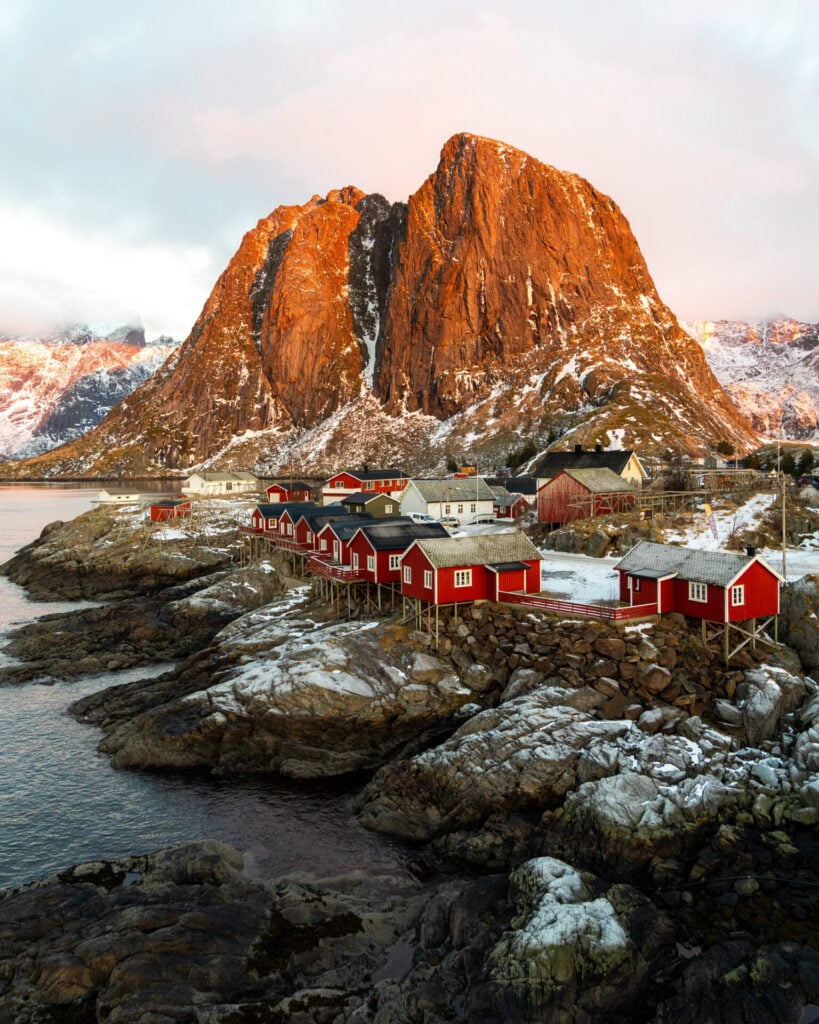
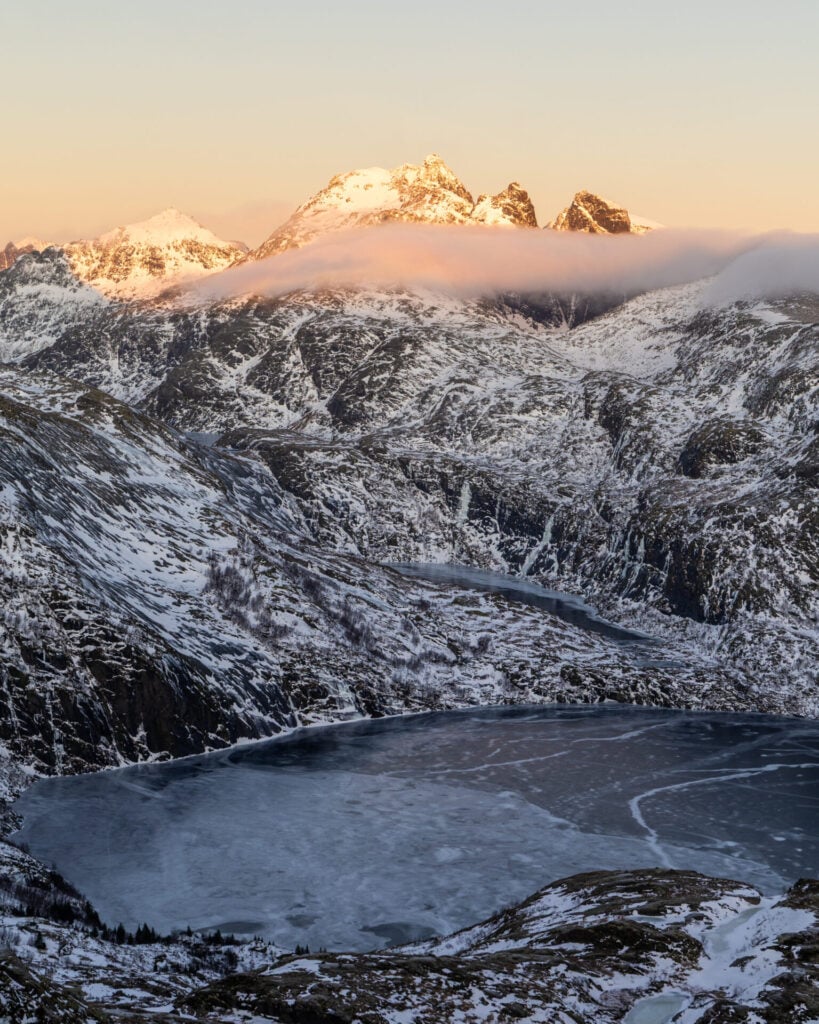
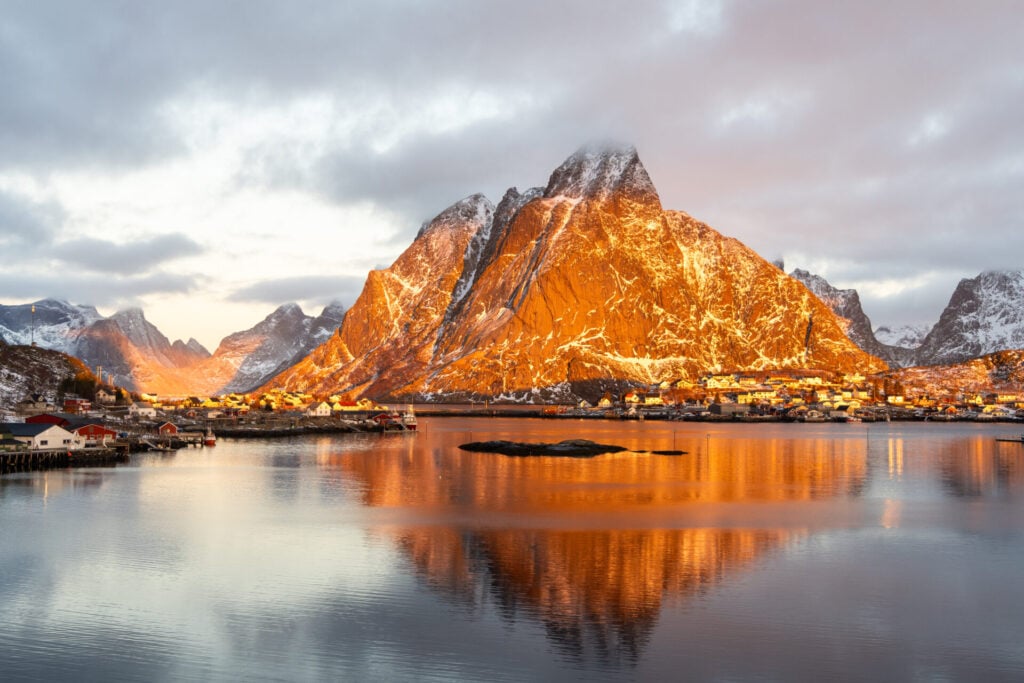
High above the Arctic Circle, a jagged spine of snow-covered mountains rises straight out of the Norwegian Sea— welcome to the Lofoten Islands, the most spectacular archipelago on the planet. Although the peaks aren’t massive by alpine standards, the landscape is so dramatic that it feels truly colossal, offering endless summit possibilities without the commitment of a long backcountry approach.

While Lofoten has become an unfortunate victim of its own beauty in summer, with unsustainable levels of over-tourism crowding the trails and congesting the roads, we were delighted to find the exact opposite in winter: empty carparks, quiet viewpoints, and spectacular summits that we didn’t have to share with a single other person.

Prior to our trip in January 2026, I read countless blog posts and forum threads claiming it’s “not possible to hike in Lofoten during the winter”— which is simply untrue. Provided you have experience hiking on snow/ice, appropriate outdoor gear, and good weather conditions, Lofoten is one of the BEST winter hiking destinations in the world! This post is my attempt to distill our personal experience from a month of snowy hiking into a practical winter hiking guide, so you too can enjoy the magic of Norway’s most beloved islands safely and confidently.

Just here for the trail inspiration? Skip ahead to our list of 10 amazing winter hikes in Lofoten!

What's in this guide

Toggle
  • How hard is the winter hiking in Lofoten?
  • When to go to Lofoten for winter hiking
    • Winter conditions by month
    • Polar night in Lofoten
    • Winter weather in Lofoten
  • Ideal winter hiking conditions: “is it safe to hike today?”
    • Precipitation
    • Wind speed
    • Avalanche risk
  • Essential winter hiking gear for Lofoten
  • Winter trip logistics 
    • Getting to Lofoten
    • Driving around Lofoten in winter
    • Where to stay in Lofoten
  • *10 best winter hikes in Lofoten
    • Tjeldbergtind
    • Offersøykammen
    • Ryten
    • Nipen/Festvågtind
    • Mannen
    • Eltofttuva
    • Tindstinden
    • Reinebringen
    • Ballstadheia
    • Nonstinden
  • Bonus: best viewpoints in Lofoten

How hard is the winter hiking in Lofoten?

Let’s get this out of the way upfront: the most essential ingredient for safely hiking Lofoten in winter is prior experience on snow and ice. Without that foundation, no amount of good weather or expensive gear will make winter hiking “safe”.

While there are hundreds of easily accessible hiking trails during the warmer summer months, snow partially or completely obscures these same trails in winter, resulting in significant navigational demands. Even when the trail is visible or you have a reliable GPS track to follow, this may not be the safest route forward— winter hiking often requires micro-route-finding through high consequence terrain.

The terrain itself is also far more demanding in winter: frost-covered boulders, thick patches of ice, and deep snow bowls through potential avalanche terrain all demand better movement skills than a dry dirt trail. Microspikes and trekking poles should be used (or at least carried) on EVERY hike for safety!

☃️ BEST STARTER TRAILS IN LOFOTEN

If you’re building confidence, start with easier trails like Tjeldbergtind, Offersøykammen, or Ballstadheia, where you can test your gear and decision-making in lower-consequence terrain. Even though you’re likely to be alone on the mountain on any given day, locals hike these routes throughout the week (often after work), so there’s typically a solid boot path to follow all the way to the top.
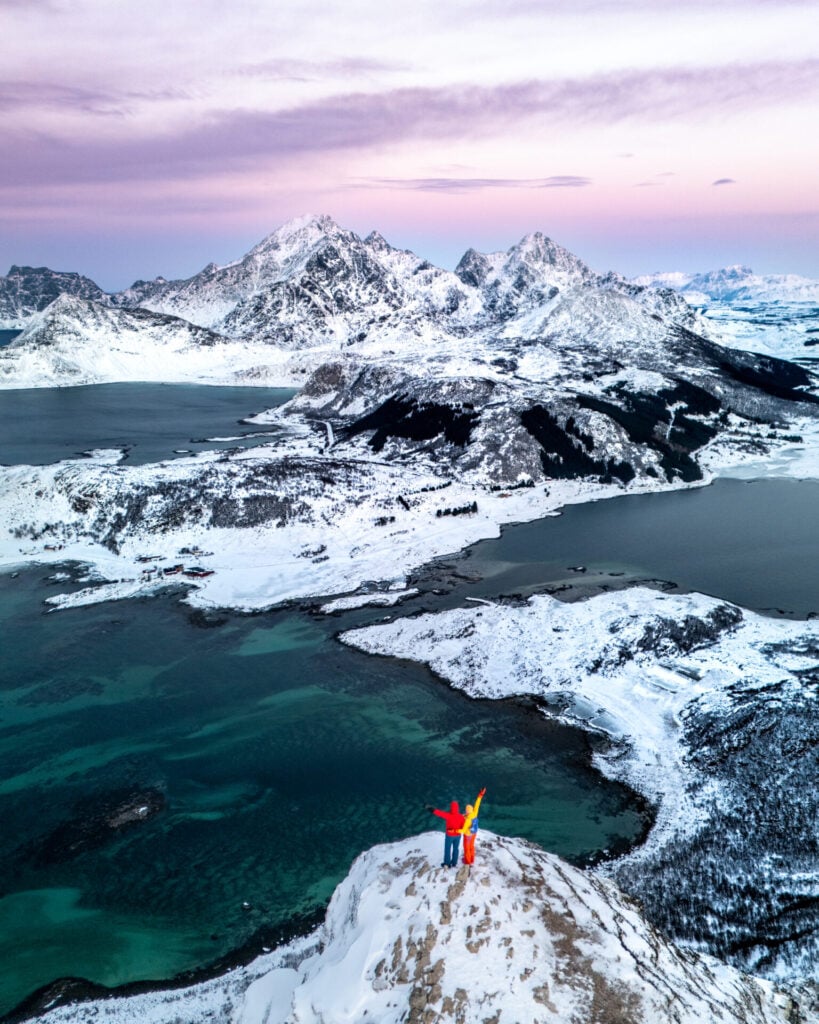
Offersøykammen winter hike
Overlooking Ballstad from Ballstadheia

When to go to Lofoten for winter hiking

Winter hiking in Lofoten is possible from November through March, but the experience varies hugely across the season (and often defies easy prediction).

Winter conditions by month

  • November: Shortening days + more storms— a mixed bag of rain/sleet/snow with lots of freeze–thaw, meaning ice can be the main challenge even when snow coverage is thin
  • December: Full winter atmosphere— snow starts to feel more established on the mountains, but coastal weather can still swing warm; polar night begins 7 Dec with long twilight and minimal “true daylight.” 
  • January: Peak winter feel— snow-covered peaks, icy terrain, and dramatic arctic light; days are still short early in the month, but light increases rapidly after 5 Jan
  • February: The sweet spot for many hikers— winter conditions remain, but daylight is noticeably longer, giving you more flexibility to wait out wind, move slower, and still hike safely
  • March: “Winter, but easier”— long hiking days and still plenty of snow in the mountains, though thaw/freeze cycles become more common (which can create both firm, fast travel or sketchy ice, depending on timing)

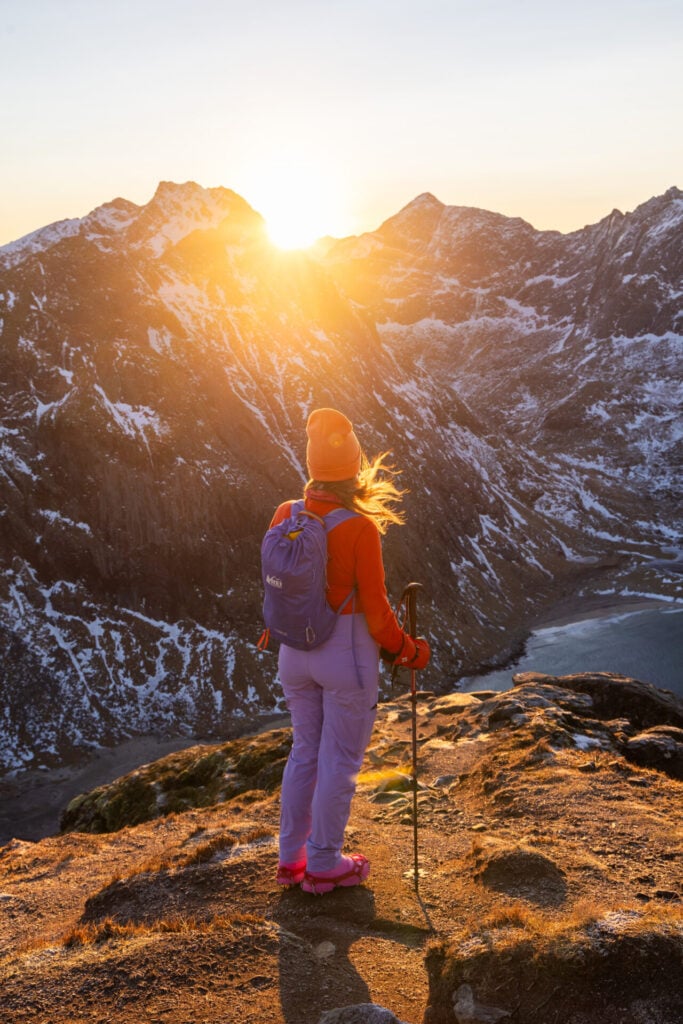
All of the photos in this post were taken in January, and you’ll notice deep snow on some hikes contrasted with almost no snow on others— a warm front swept across the islands in the middle of our stay and melted much of the existing snowpack, followed by a stretch of nearly two weeks with no new snowfall. Locals emphasised these weren’t “typical” January conditions… but also reported that winter is notoriously unpredictable, so it pays to be prepared for anything!
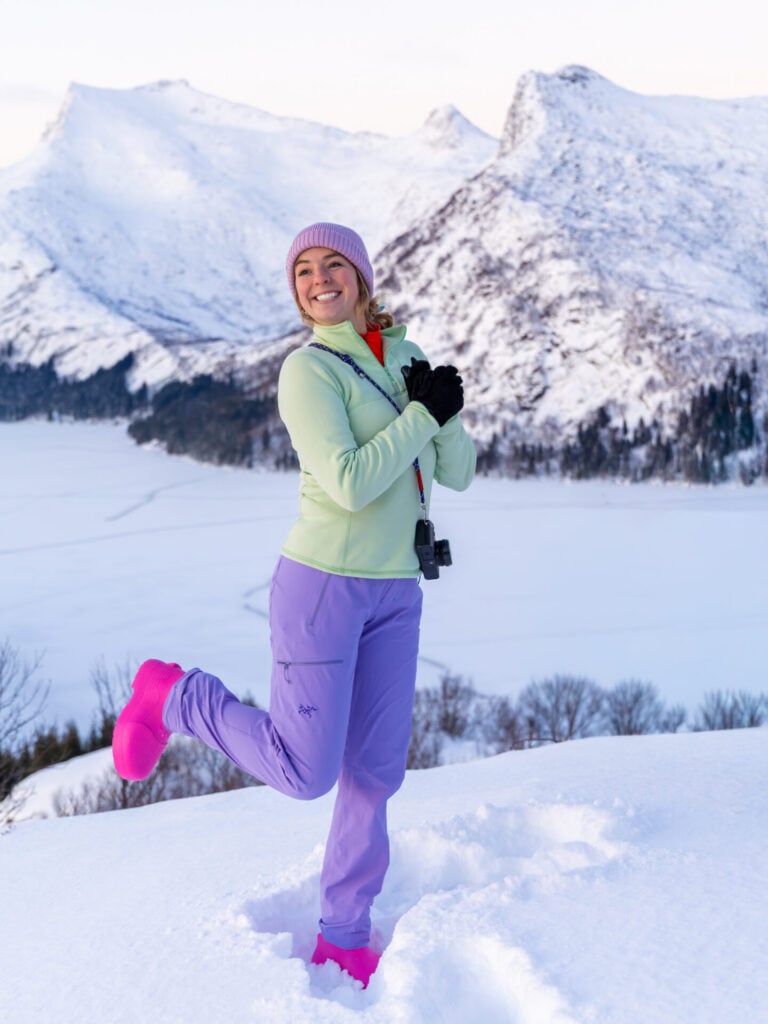
Deep snow on Tjeldbergtind
…and then a few weeks later, no snow on Ryten!

Polar night in Lofoten

Due to its position above the Arctic Circle, the entire archipelago experiences “Polar Night” from approximately 7 December to 5 January, meaning the sun doesn’t rise above the horizon (though you still get a few hours of twilight and pastel light on clear days). 

Beginning in mid-January, daylight returns quickly, and by February–March, you get a noticeably longer hiking window without losing the winter conditions. Based on the light we experienced across the month of January, we’re planning to return late January and stay through February next year to enjoy a bit more daylight.

✨ NORTHERN LIGHTS IN LOFOTEN

One of the notable perks of being above the Arctic Circle in winter is the long, dark nights that make the Northern Lights visible as early as 3pm! We saw the aurora on ALL BUT TWO of our nights in Lofoten, including some shows that were blindingly bright (literal tears!!!), and it was such an unbelievable highlight of our trip.

If you want to optimise for Northern Lights, prioritise travel right after Polar Night— especially in 2026/2027! Elevated solar activity from the recent “Solar Maximum” (the peak of the sun’s 11-year cycle) is expected to continue into 2027, meaning increased aurora frequency and intensity that we absolutely saw with our own eyes.
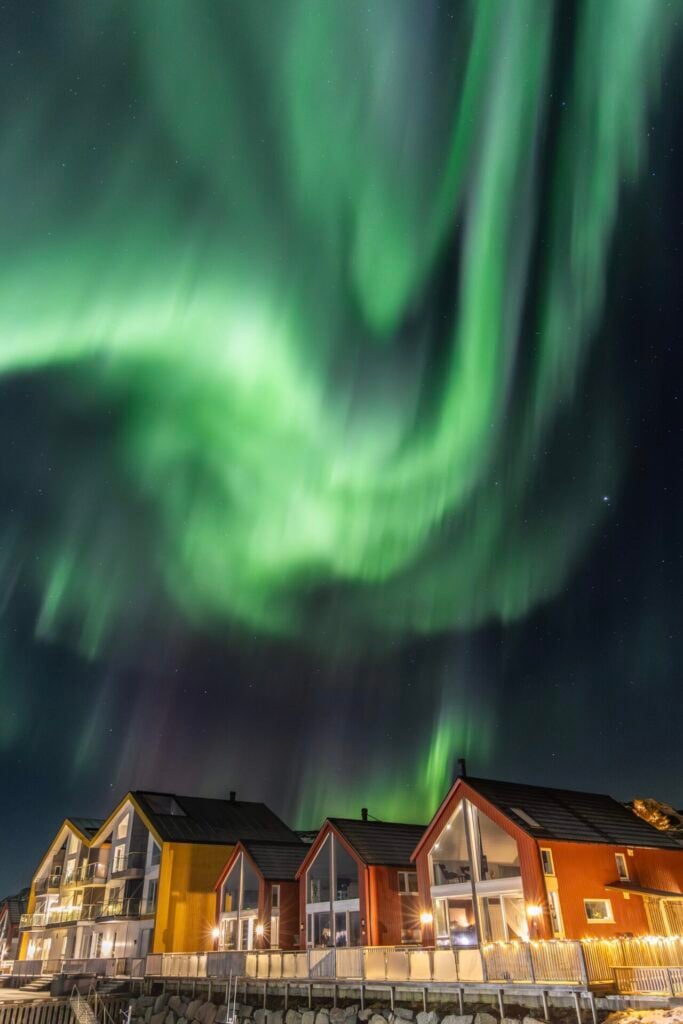
Incredible northern lights over Ballstad

Winter weather in Lofoten

Although snow conditions vary widely throughout the winter season, temperatures in Lofoten often hover close to freezing (around 0 to -5°C). As a result, it’s not unusual to see rapid swings between dry snow, rain, and “wintry mix”.

It’s somewhat counterintuitive, but despite the relatively “mild” temperatures, Lofoten’s coastal climate can create more hazardous hiking conditions than the deep, dry cold of Lapland or other arctic destinations. Wet snow, thaw/freeze cycles, and ice on rock all make both traction and layering absolutely critical.

Wind is the other major wildcard, and it can show up at any point in the season. Many hikes in Lofoten climb into exposed terrain quickly, and as storm systems roll in off the Norwegian Sea, ridgelines and summits are subject to extreme windchill (plus the added instability of moving across icy, precarious terrain in heavy wind). It’s not uncommon to feel -15°C with windchill even on a day forecasted to be 0°C in town— and if that wind is driving wet snow or sleet into your layers, your risk of hypothermia rises very quickly.

All of this underscores the importance of checking forecasts carefully AND packing the right winter hiking gear, both of which I’ll cover in detail below.

📆 HOW MANY DAYS IN LOFOTEN?

To maximise the success of any winter hiking trip, we’d strongly recommend budgeting additional time to account for the inevitability of poor weather days— an absolute minimum of one week, but ideally two weeks or more if hiking is a priority. We got super lucky during our trip in January 2026 and had only a couple days where high wind and snow prevented us from getting outside, but we understand this isn’t typical and you can reasonably expect about 20-50% of your time in Lofoten to be unsuitable for hiking.

Winter in Lofoten is all about waiting for weather windows, and when you get one, you’ll want the flexibility to actually use it!
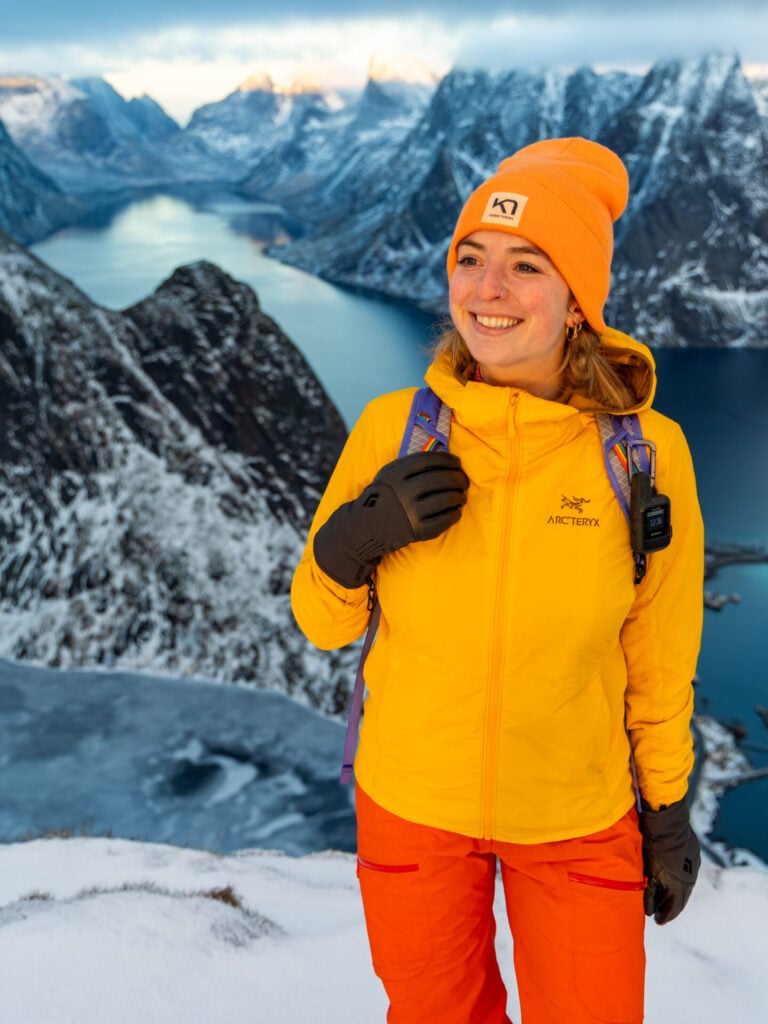
Hiking Reinebringen in winter
Careful weather/condition assessment is key on routes like Reinebringen

Ideal winter hiking conditions: “is it safe to hike today?”

There are 3 main variables we consider when determining whether the conditions are safe for hiking on a given winter day:

  • precipitation
  • wind speed
  • avalanche risk

If any one of these looks sketchy, it’s usually better to pick a lower-consequence hike (or call it and enjoy a cabin day).

Precipitation

Fresh snowfall can be beautiful, but it also reduces visibility, hides ice hazards, and can increase avalanche risk. And if temperatures are hovering around freezing, “wintry mix” (wet snow/sleet/rain) is where things can go downhill quickly— wet layers + wind is one of the fastest ways to end up dangerously cold.

Check yr.no for reliable hourly forecast and plan your hikes for days with little to no precipitation. Even with a clear forecast, conditions can change on a dime, so it’s essential to carry a Gore-Tex shell jacket in your pack for unexpected precipitation or wind!
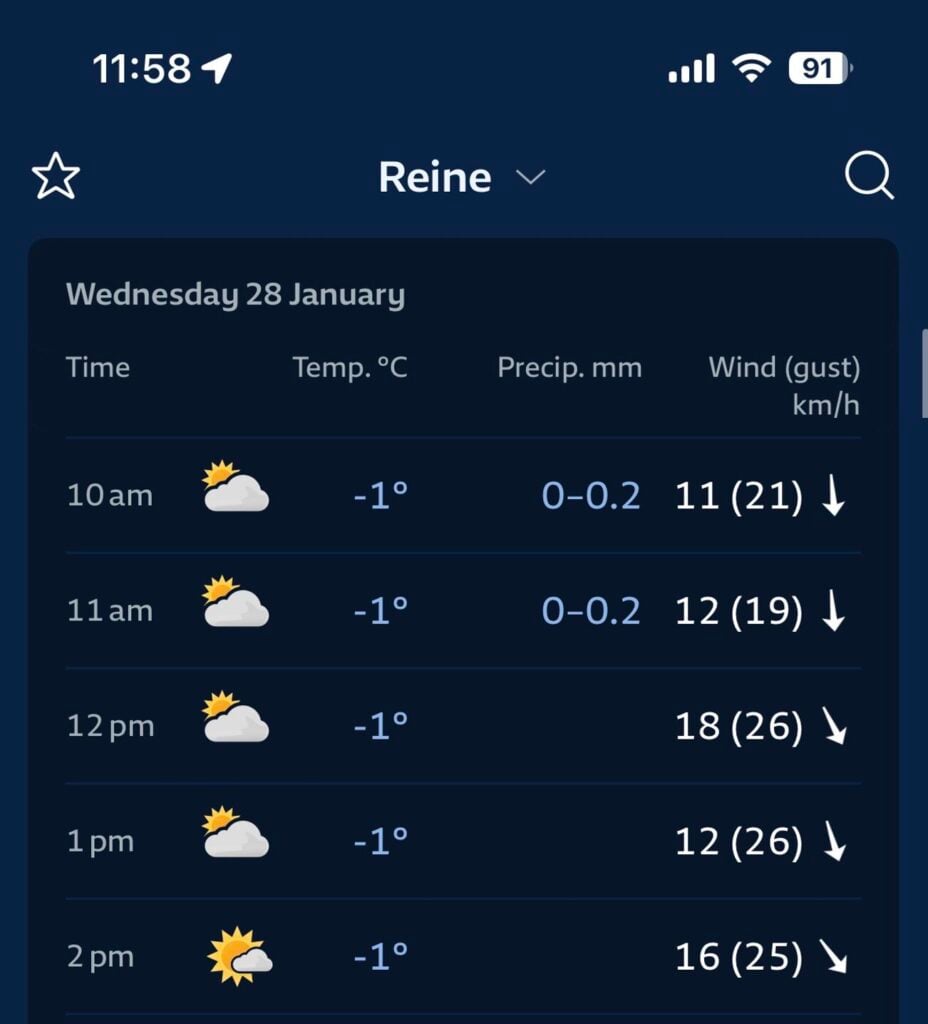
check the hourly weather on YR.NO before hitting the trail

Wind speed

Because Lofoten sits out in the Norwegian Sea, it’s notoriously windy— and thanks to the steep, open landscape, there’s often little natural protection once you’re on a ridgeline or exposed summit. Wind dramatically increases heat loss (windchill) and makes balance far less stable on icy ground, while wind-driven snow can also reduce visibility and coat your outer layers in moisture, increasing your risk of hypothermia. 

Again, check yr.no for wind forecasts. As a practical cutoff, we consider ~35km/hr sustained wind (or ~50km/hr gusts) the upper limit for “safe” winter hiking on most routes. 

Bear in mind that the windspeed forecasted at sea level can easily double at elevation, so consider saving the most exposed routes (like Mannen, Reinebringen, or Offersøykammen) for days with almost no wind in the forecast. If you do choose to hike in moderate wind, pick a less exposed objective and prioritise hard shell layers!

Avalanche risk

If your hike enters steep, open mountain terrain (as many hikes in Lofoten do), avalanche awareness is critical. This is definitely the factor that gave us the most pause before hiking in Lofoten ourselves, but thankfully we found that a general understanding of avalanche risk, reliable daily forecasts, and careful assessment of route topography was sufficient to mitigate winter risk.

Avalanche danger most commonly increases:

  • after heavy snowfall (new load on the snowpack)
  • during strong wind (wind loading creates unstable slabs)
  • after rapid warming or rain-on-snow (wet avalanches can occur)

Before any winter hike, check varsom.no for the avalanche forecast (published 2 days in advance). For the style of winter hiking in this post (microspikes + trekking poles, no avalanche rescue gear), our recommendation is stick to “Danger Level 1 (Low)” for hikes that enter steep mountain terrain. This is vital for routes with substantial avalanche risk, such at Tindstinden, Reinebringen, or Nipen/Festvågtind.

When the avalanche risk is higher (and other conditions are still favourable for hiking), you can choose a shorter, lower-angle objective like Ballstadheia, Offersøykammen, or Eltofttuva — or simply enjoy a rest day.
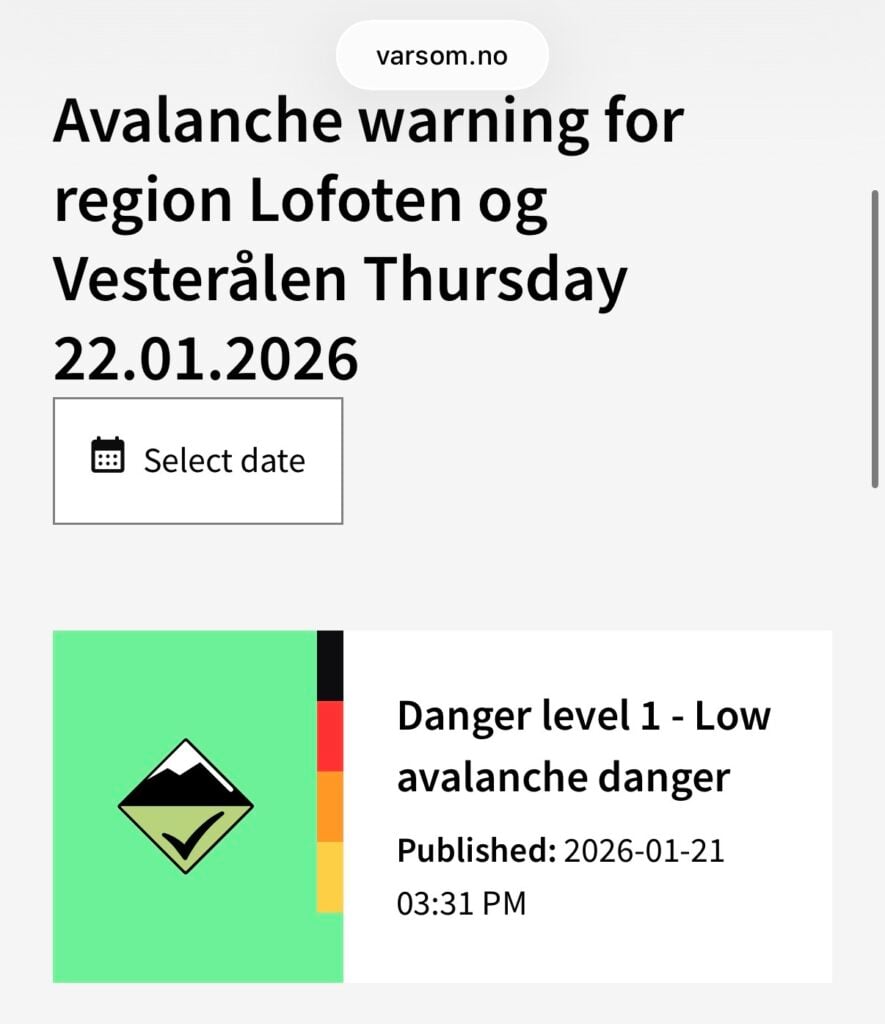
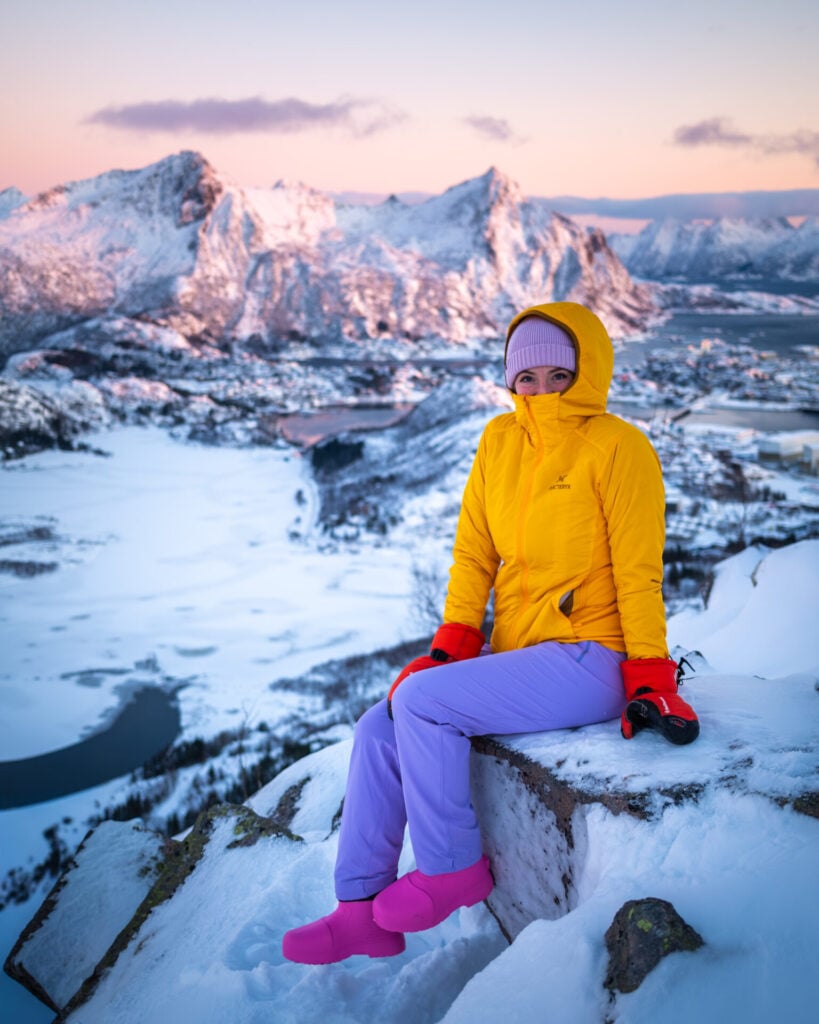
Check Varsom.No for current avalanche danger
Tjeldbergtind winter hike
layers are the difference between a fun hike and a miserable one!

Essential winter hiking gear for Lofoten

Because appropriate winter gear is so vital to safety (and enjoyment!) while hiking in Lofoten, I’ve written a super-detailed packing list for arctic Norway that details every single item I packed: COMING SOON

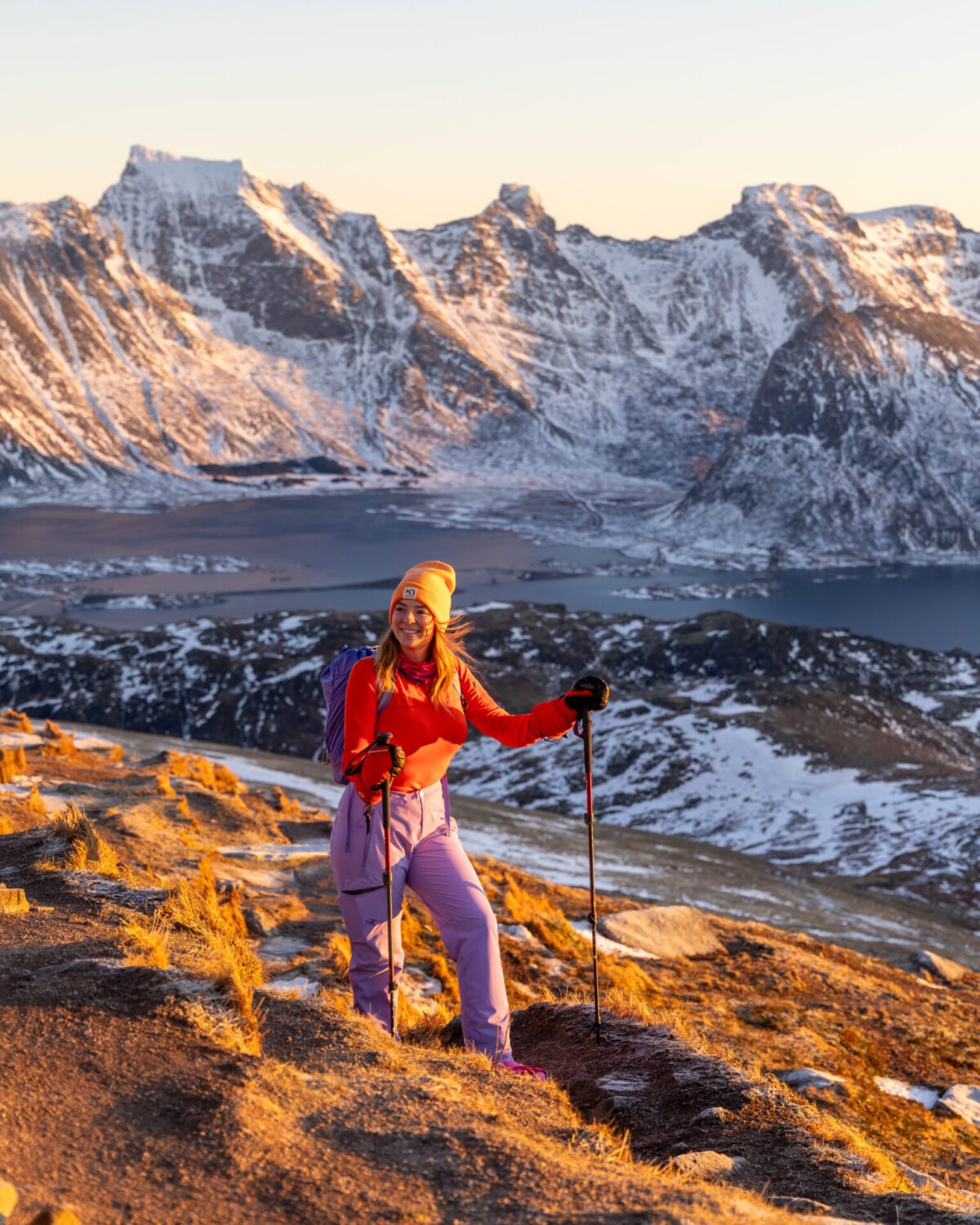
What to wear for winter hiking in Lofoten:

  • Merino wool baselayer top + bottoms— Arc’teryx Rho is a great all-rounder
  • Insulated jacket— synthetic performs better in damp environments, so we wore our Arc’teryx Atom pretty much every day
  • Softshell or hardshell pants— softshell pants like the Arc’teryx Gamma are great for milder days, while hardshell pants like the Arc’teryx Sentinel or Beta offer a better wind/precipitation barrier
  • Warm hat, Buff, and gloves/mittens— I used Black Diamond Superlight Mitts for the coldest days, Black Diamond Pro Legend Gloves when I needed more hand dexterity (for light scrambling), and OR Trail Mix Gloves on warmer days
  • Winter boots— we did every hike on this list in Fubuki low boots and, despite not being true hiking boots, they were surprisingly excellent
  • Microspikes— Kahtoola Microspikes are one of the most essential pieces of outdoor gear, DO NOT ATTEMPT WINTER HIKING WITHOUT
  • Trekking poles— we carried Black Diamond Trail Trekking Poles with snow baskets and found these to be absolutely critical to safe hiking

What to carry on every winter hike in Lofoten:

  • Goretex shell jacket— even if there’s no precipitation in the forecast, a hardshell jacket like the Arc’teryx Beta is essential safety gear if conditions turn (or wind picks up)
  • Extra gloves/mittens— we always leave the house with all 3 pairs of the gloves listed above, so whichever we aren’t wearing, we pack in our backpacks
  • Electric handwarmers— great for warming up dangerously cold hands (mostly after I take off mittens to take photos)
  • Headlamps— fully charged in case you get delayed by weather or another emergency and need to return in the dark
  • Garmin InReach Mini— an SOS/PLB to contact local rescue services in the case of serious injury or emergency weather conditions
  • Water + snacks
winter sunrise overlooking Hamnøy

Winter trip logistics 

Getting to Lofoten

In winter, the most reliable way to reach Lofoten is by flying into either Svolvær Airport (SVJ) in the lower north or Leknes Airport (LKN) in the middle of the archipelago. These are TINY airports with direct flights only from Tromsø or Bodø, so you’ll likely end up making at least one domestic connection before reaching Lofoten.

Our recommendation: Leknes and Svolvær are only about 1.5hrs apart, so let flight prices and hire car costs decide which airport makes the most sense for your arrival and departure.
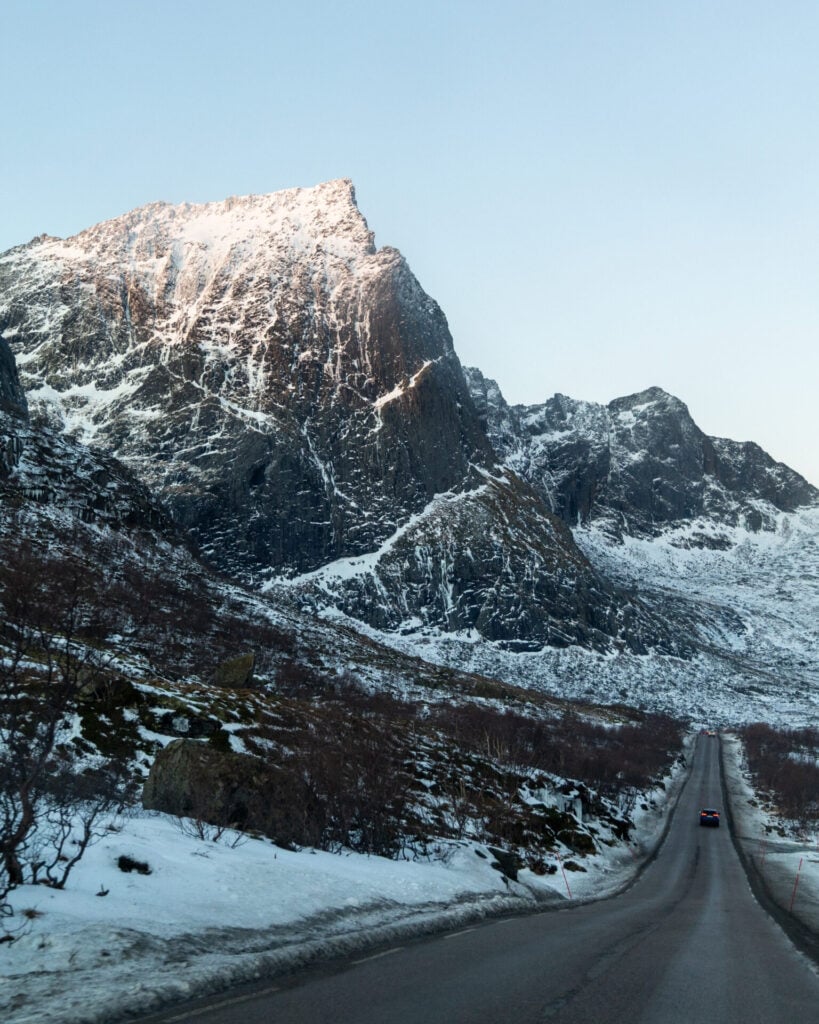
rare dry driving conditions in Lofoten this winter

Driving around Lofoten in winter

With significantly reduced winter public transportation schedules, driving is really the only practical way to get around, especially to trailheads. Thankfully, road conditions are generally good (the main road, E10, is frequently ploughed) and all hire cars come equipped with winter/studded tires. During our time on the islands, we experienced the full spectrum of compacted snow, black ice, and slush, all of which were navigable with cautious driving.

We were able to rent a 2WD hybrid for less than $90/day and this worked perfectly for our entire trip. Search for the best car hire prices at DiscoverCars and BOOK EARLY to maximise savings!

⚠️  Starting late 2025 and expected to continue for the next 2.5 years, maintenance of the Nappstraumen tunnel on E10 has reduced traffic to a schedule of 1-2 crossings per hour in each direction. If you’re staying north of Leknes and driving south to access trailheads (or vice versa), you’ll be passing through this tunnel, so review the schedule below to save yourself a long wait time! A massive thank you to the local woman who finally explained this to us.
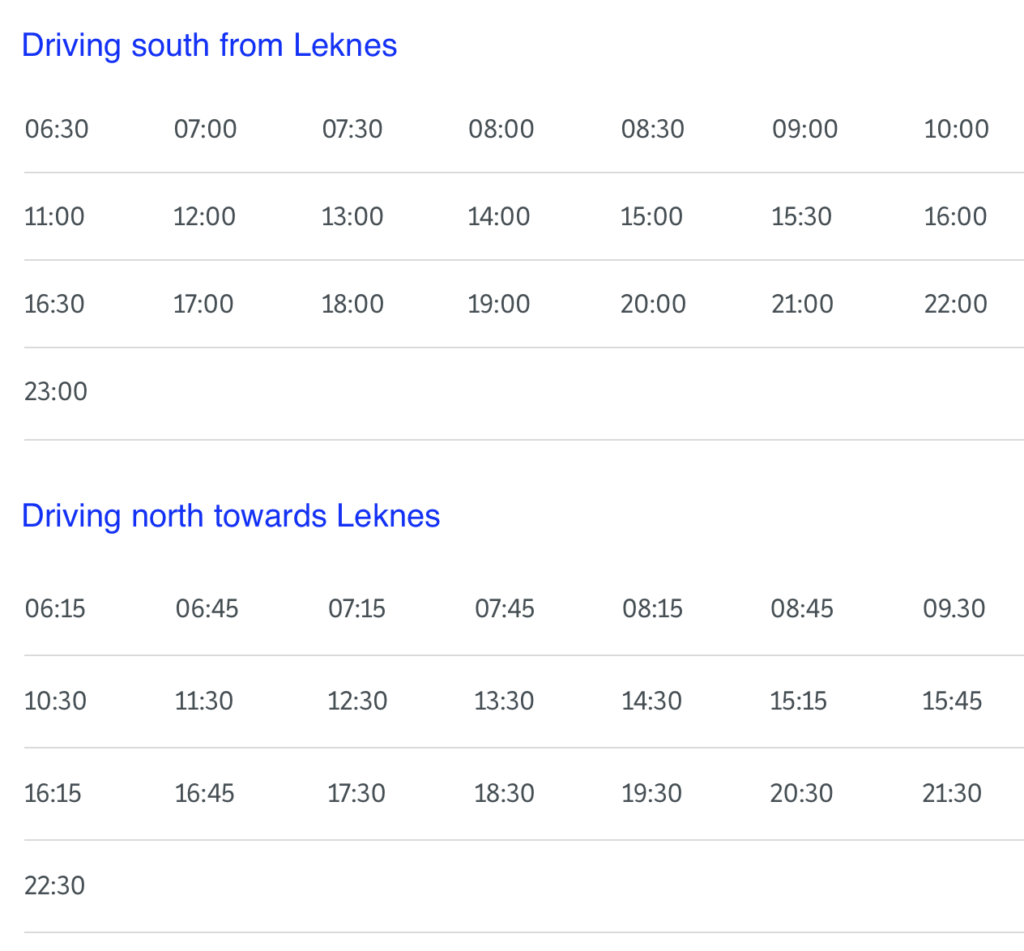
Nappstraumen tunnel schedule for 2025-2028

Where to stay in Lofoten

Where you base yourself in Lofoten matters a lot in winter— not because it’s hard to get around, but because weather windows are short and the best hiking strategy is minimising drive time and maximising flexibility.

There are amazing hikes spread across the archipelago, so the ideal setup for winter hiking is either:

  • one central stay: Ballstad (15min from Leknes) is the best all-rounder base, allowing access to the far south (Reine/Å/Lofottoden NP) AND the north/central (Svolvær/Henningsvær) within 1.5hrs, plus heaps of excellent hiking within 30min
  • one central + one southern stay: add a 2nd stay near Reine for easier access to the larger mountains of the south, best for experienced hikers/mountaineers OR in Lyngvær (20min from Svolvær) to minimise tourist crowds and maximise northern light viewing

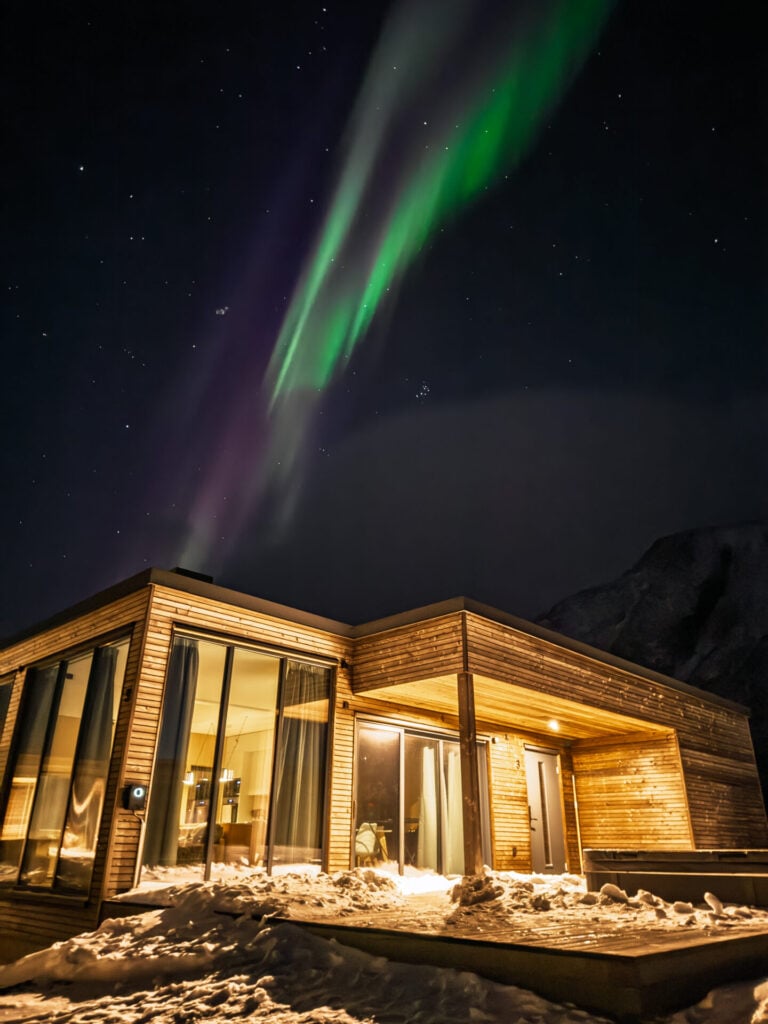
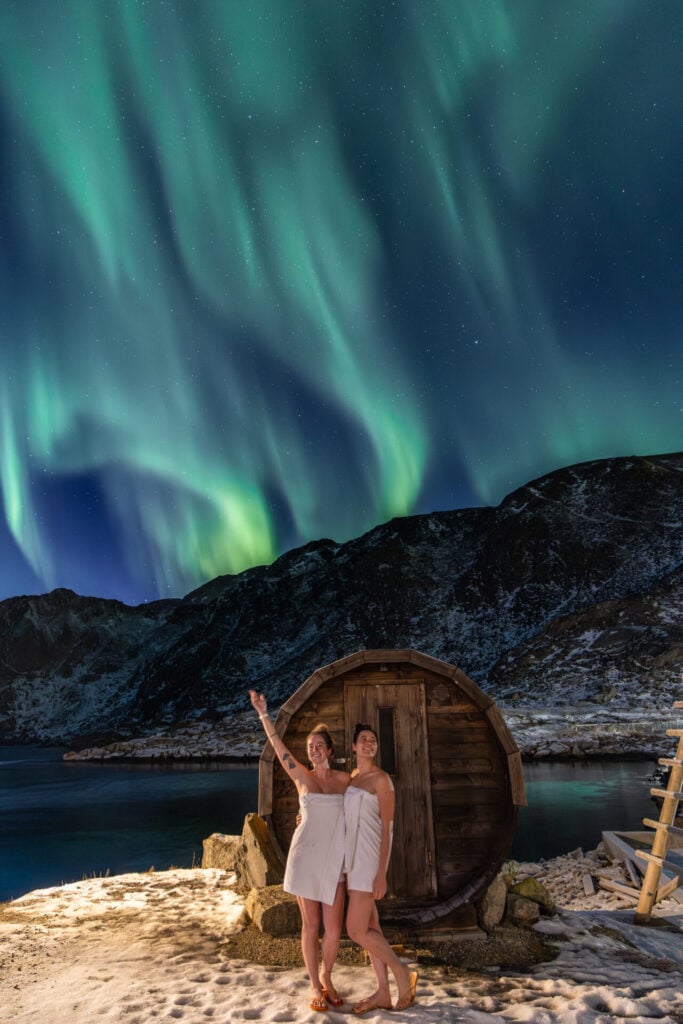
We personally split our time between a modern cabin in Lyngvær with a private outdoor jacuzzi and a traditional rorbu (fishing hut) in Ballstad with a private sauna—we absolutely loved both experiences, but will definitely incorporate a southern stay next time to minimise drive time to the bigger peaks near Reine/Lofotodden National Park. See both of our exact stays linked below!
View On AirbnbCabin in Lofoten · ★4.83 · 2 bedrooms · 4 beds · 1 bath
View On AirbnbCabin in Vestvågøy · ★4.89 · 3 bedrooms · 4 beds · 1.5 baths
Northern lights above our cabin in Lyngvær
More aurora from our private sauna in BAllstad!

*10 best winter hikes in Lofoten

With sufficient outdoor experience, sound judgement, and reasonable conditions, these 10 hikes are an excellent choice for safe winter hiking in Lofoten!

We personally completed all of these hikes in January 2026 with just microspikes + trekking poles (and no other technical climbing equipment), though it should be noted that we have a fair bit of mountaineering experience, without which a couple of these routes would have been impossible— I’ve made note of the relative difficulty below to help guide personal risk assessment.

**It should go without saying that you are responsible for yourself in the outdoors; this list is based on our own personal experience and must be interpreted within the bounds of your own experience and current winter conditions.
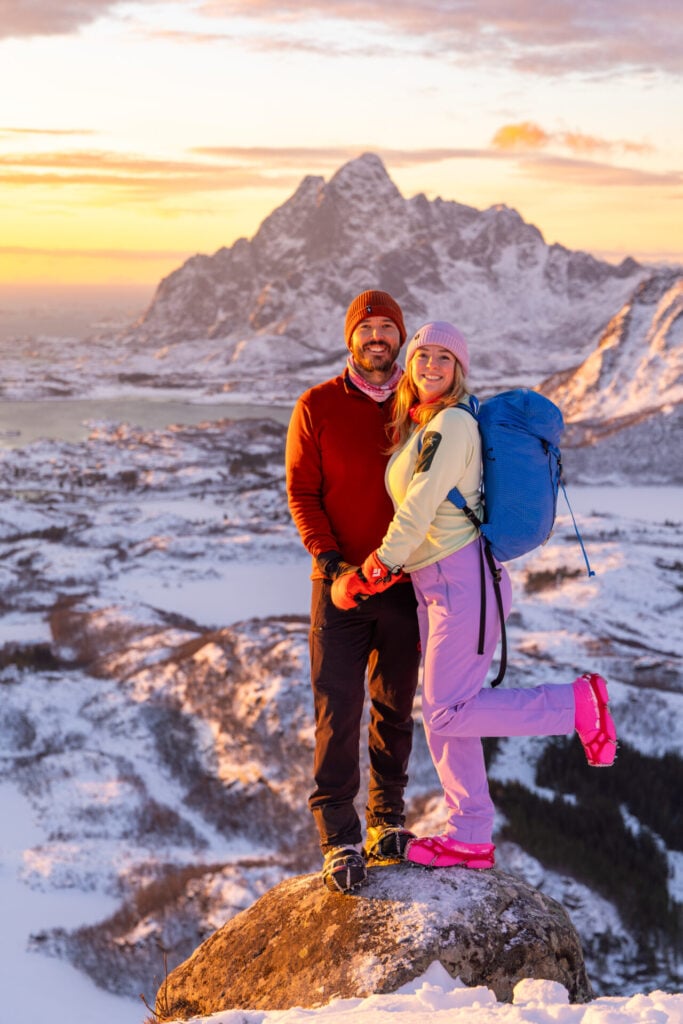
incredible summit views from Tjeldbergtind
Tjeldbergtind winter hike

Tjeldbergtind

This is a perfect “intro to winter hiking in Lofoten” route: straightforward, quick, and insanely scenic for the effort. Depending on how close you’re able to park to the trailhead, the hike begins with a gradual walk up a snowy road before turning off onto a path through the trees (usually easy to spot thanks to boot tracks). Another ~20min of steady uphill brings you above the treeline, and from here the views are spectacular the entire way up.

Deep snow can sometimes accumulate on the ascent, but there’s very little exposure and negligible avalanche risk, so take it slow, stay steady on your feet, and enjoy the constant views. The summit panorama over Svolvær, the surrounding islands, and the jagged Lofoten mountains is unreal. We loved this hike so much we did it twice!

  • 📈 370m gain
  • ⏰ ~2hrs return
  • ✅ avalanche exposure: LOW
  • 🅿️ paid parking at the head of the road (~20 min walk to trailhead) or free at a small lot near the trailhead if snow conditions allow
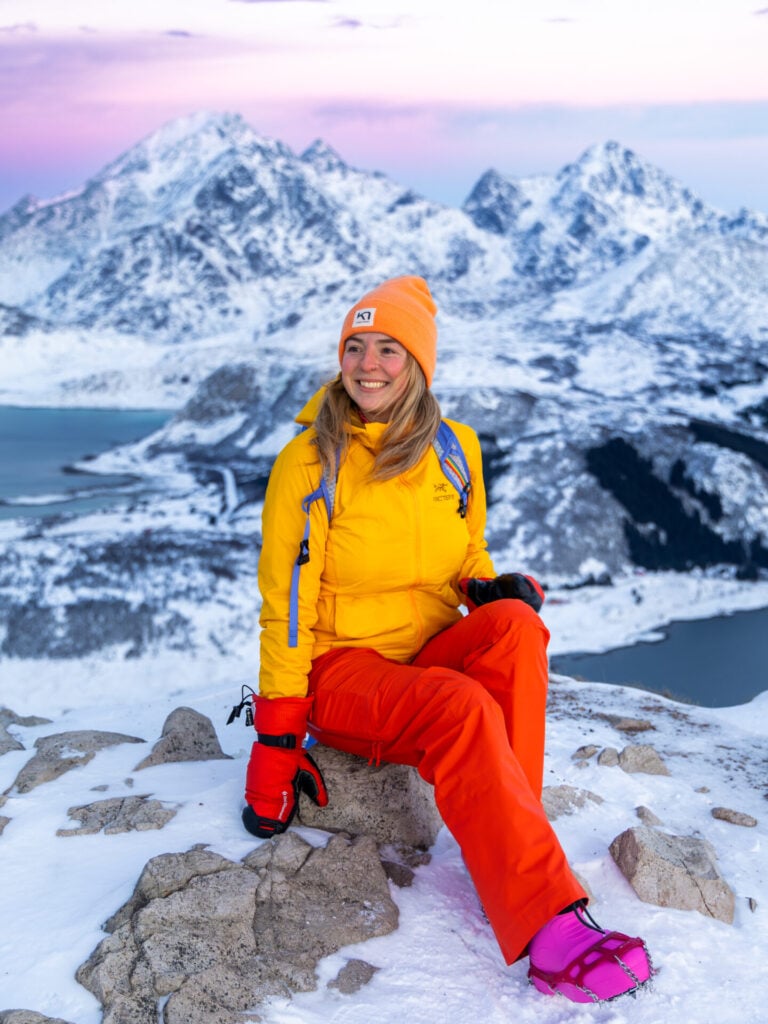
on the windy summit of Offersøykammen

Offersøykammen

Instantly one of our favourites hikes with gorgeous views above the treeline and a truly spectacular summit! The route is straightforward and climbs gradually up a snowy slope to the highpoint— and because it’s such a classic after-work route, there’s often a well-packed track to follow in winter (but rarely another person on the mountain).

The summit is famous for its 360° panorama, with sweeping views across Vestvågøy, the surrounding islands, and the open Norwegian Sea. Because the peak is very exposed, wind can be intense near the top, so dress for full windchill and bring hard shell layers!

  • 📈 450m gain
  • ⏰ ~2hrs return
  • ✅ avalanche exposure: LOW
  • 🅿️ free parking at Skreda Rest Area just before the Nappstraumtunnelen; walk right through the cottages, then cross the road to connect with the trail
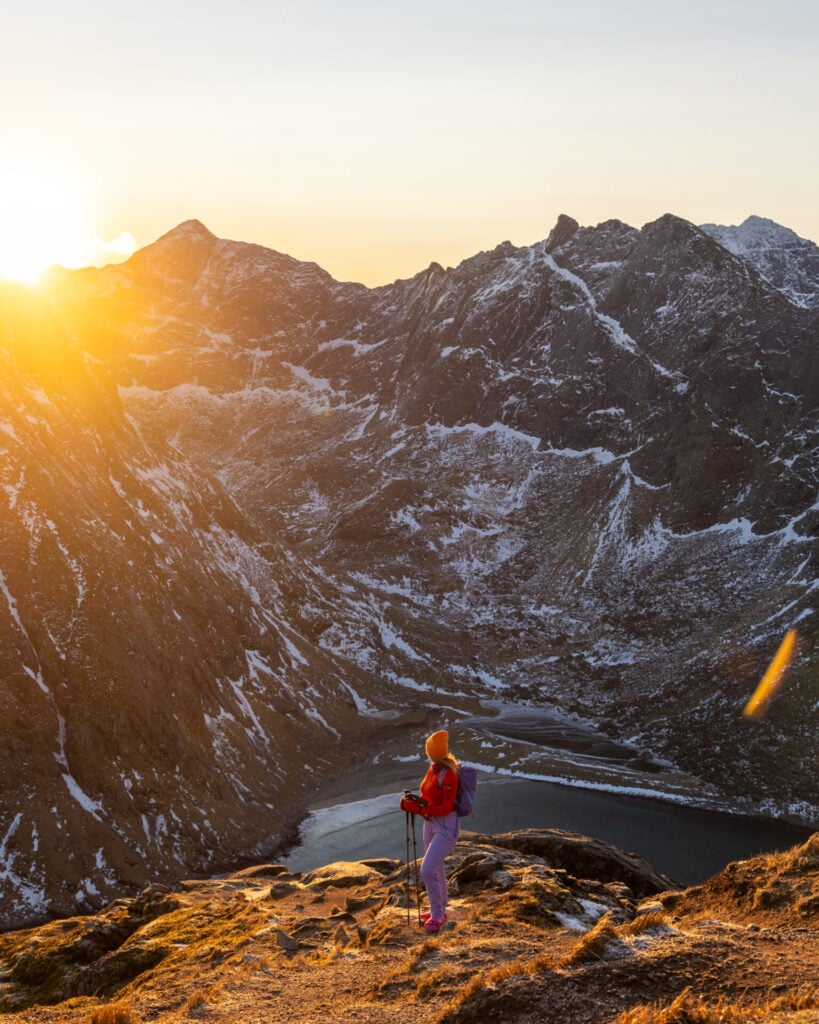
Overlooking Kvalvika Beach from Ryten
Ryten winter hike
Ryten winter hike

Ryten

Ryten is one of the most iconic hikes in southern Lofoten, delivering near-constant mountain panoramas along the route and jaw-dropping views straight down onto Kvalvika Beach from the summit. There’s usually a solid boot path through the snow and very little navigation required, making it one of the most attainable “big view” hikes on this list (yet we still only saw one other group on the trail).

The route from Innersand climbs steadily through rolling terrain before easing onto a flatter, open plateau. From here, it’s a social, meandering ascent to the high point, marked by a large summit cairn. For even more dramatic views, continue northeast for 5–10min to reach a ridgeline overlooking scattered islands and open ocean!

  • 📈 600m gain
  • ⏰ ~3hrs return
  • ⚠️ avalanche exposure: MODERATE (generally manageable, but cornices are a potential issue near edges)
  • 🅿️ paid parking at Innersand (100NOK, pay at machine)
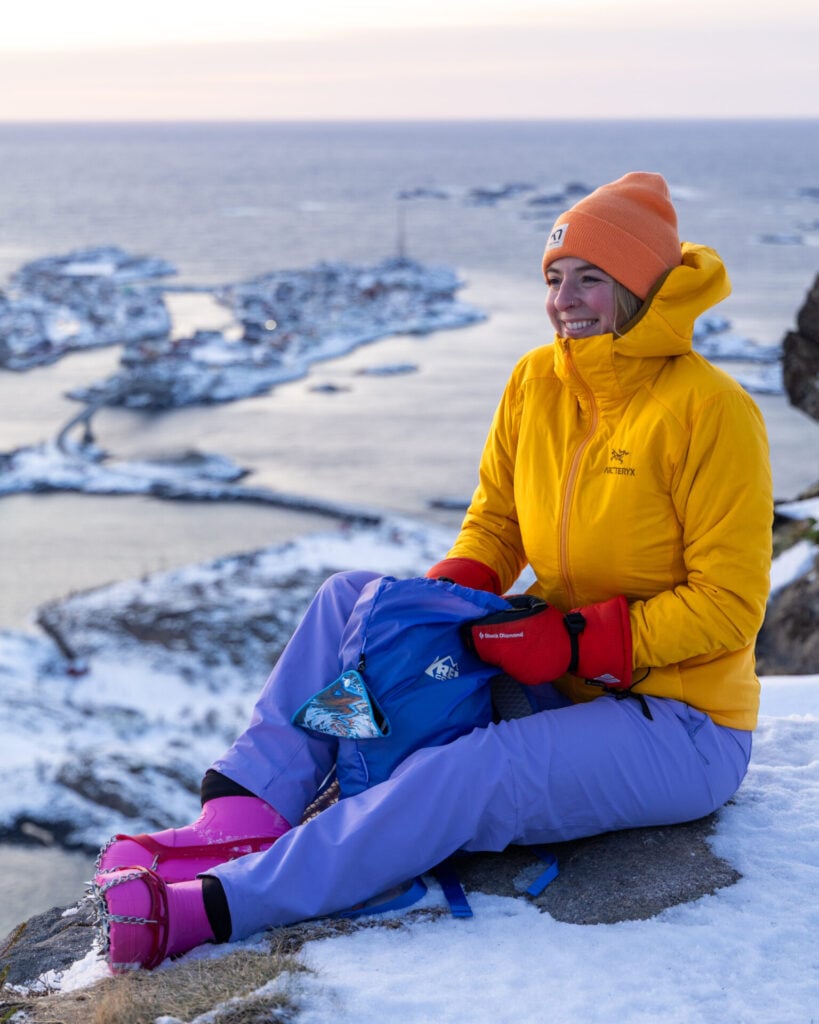
View of Henningsvær from Nipen

Nipen/Festvågtind

Although short, the hike up to Nipen and particularly onwards to Festvågtind poses a compact winter challenge as you navigate a precarious, snow-covered boulder field— a great testing ground for trickier terrain and winter nav. 

The trail is indiscernible in most conditions, but ascends straight up the centre of a snow bowl to a low saddle, then heads right to Heiavatnet (an icy lake at 207m) and the miniature summit, Nipen. Even here, there are great views overlooking the little town of Henningsvær! If you’re after an additional challenge, you can continue up to Festvågtind at 541m, but only in good conditions and with sufficient winter hiking experience. 

  • 📈 320m gain
  • ⏰ ~1.5hrs return (+ 2hrs to Festvågtind)
  • ⚠️ avalanche exposure: MODERATE (up the centre of the snow bowl and the slopes on Festvågtind)
  • 🅿️ paid parking behind the building at the Festvågtind trailhead (160NOK, pay by app); turn right on the road and walk carefully 1min to the trailhead
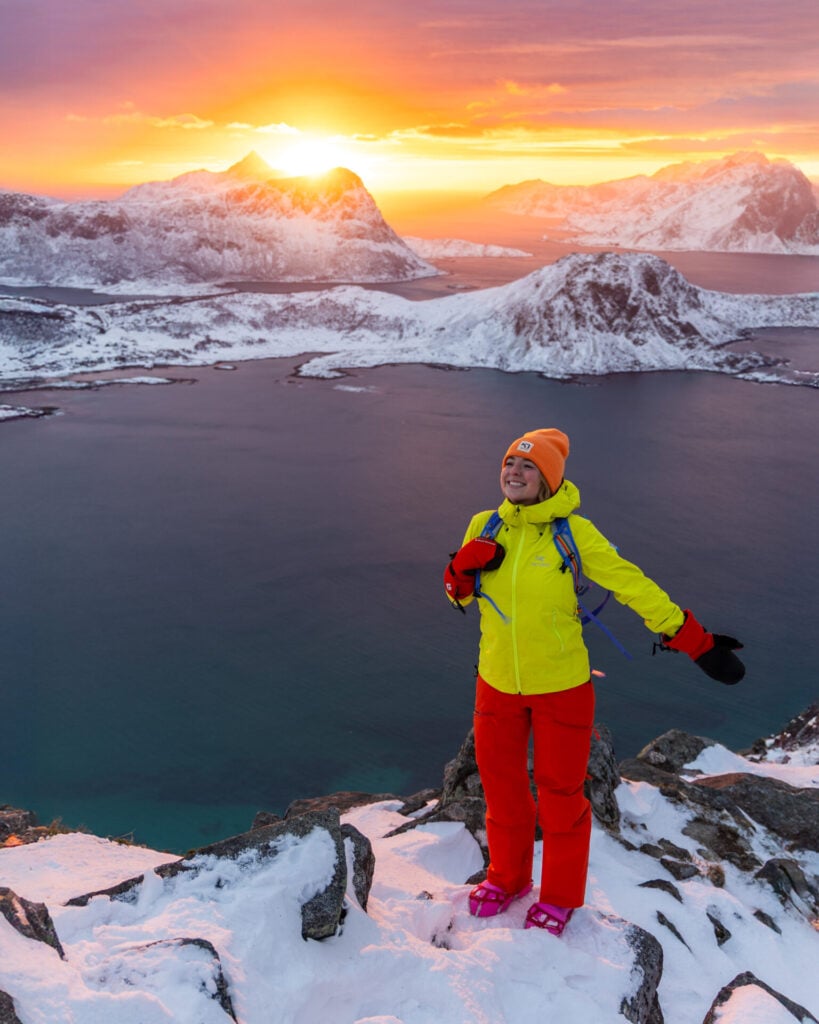
Spectacular sunset colours at 1pm on Mannen
Mannen winter hike
Mannen winter hike
Mannen winter hike

Mannen

Mannen is a beautiful ridgeline hike above the iconic Haukland Beach, and in good winter conditions, it’s one of the most spectacular climbs in Lofoten! From the café parking at the beach, the route begins with a short walk up the road, then climbs steadily via switchbacks (or a near-vertical shortcut) to a low saddle. From here, turn left and run the ridge all the way to the summit— with huge, panoramic views the entire way.

This hike is definitely more exposed than many others on this list, both in terms of terrain and wind. In winter, you’ll want a calm weather window (low wind + good visibility), but expect some of the most expansive views and wild scenery! Mannen has all the trappings of a backcountry hike, but within easy access of a warm cafe with particularly good Norwegian waffles.

  • 📈 450m gain
  • ⏰ ~3hrs return
  • ⚠️ avalanche exposure: MODERATE (mostly ridge travel, slopes around the saddle can hold wind-loaded snow depending on conditions)
  • 🅿️ paid parking at Haukland Beach (20NOK per hour, pay inside the cafe); walk up the road towards the mountains to connect with the trail
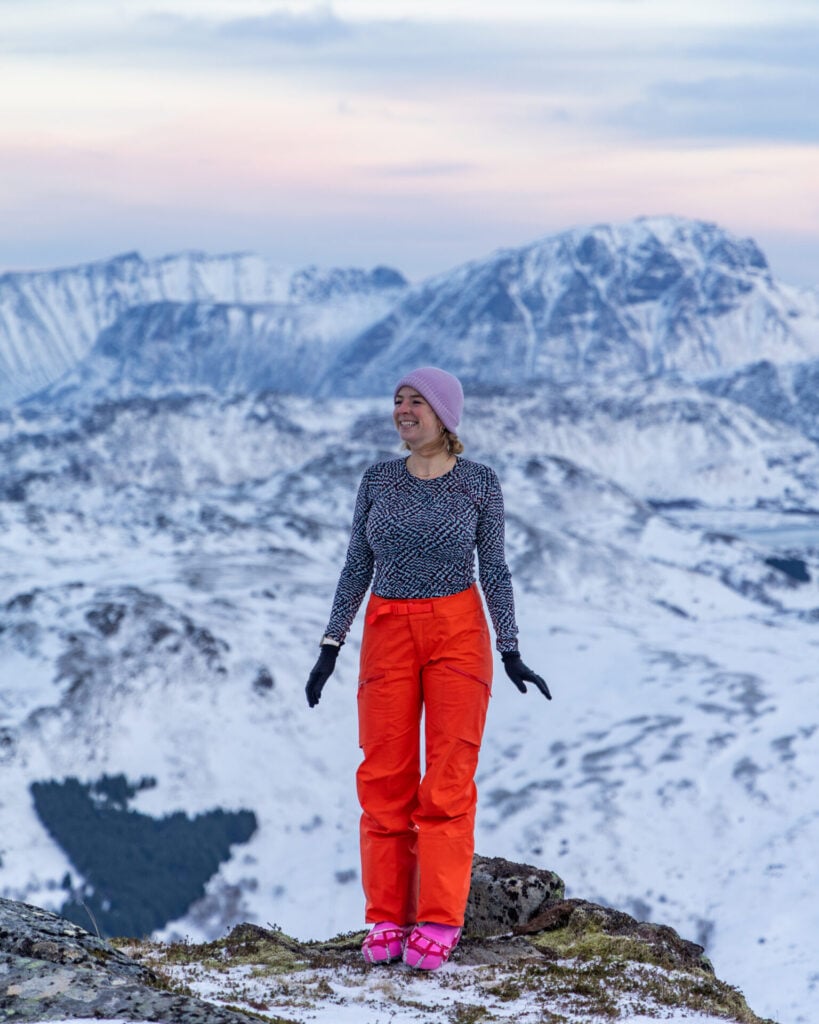
Quiet summit of Eltofttuva
Eltofttuva winter hike

Eltofttuva

This is an easy, lesser visited trail up a quiet hill in central Lofoten with an excellent view over Steinfjorden, pretty much guaranteed to be totally empty! 

The route is short and straightforward, entirely above the treeline, though in winter you may need to do a little light route-finding through the snow. If you’re already comfortable with navigation but want a chill, lower-effort summit with no major avalanche risk, this is an excellent choice!

  • 📈 380m gain
  • ⏰ ~1.5hrs return
  • ✅ avalanche exposure: LOW
  • 🅿️ free parking in the lot in front of Steinfjordgrillen, but if inaccessible due to snow, park a short walk away near the Montessoriskole
The rugged backcountry summit of Tindstinden
Tindstinden winter hike

Tindstinden

In good winter conditions, Tindstinden is an epic, backcountry climb through Lofotodden National Park— a true adventure with more route-finding, mixed terrain, and a much wilder vibe than the more popular hikes on this list. You won’t see anyone else recommending this as a winter summit, but if you have previous mountaineering experience (and there isn’t too much snow accumulation), it’s 100% doable and absolutely worth it.

The route begins with a gradual ascent to a frozen lake, then shifts into fiddly navigation across rocky (often icy) benches leading into a steep snow bowl beneath the peak. From here, choose the safest line based on conditions— we stayed right on the lower terrain, then crossed left for the steeper second half of the climb. From the saddle, run left along the ridgeline to the high point, dropping slightly left below the two false summits before the final scramble (a few moments of low Class 3).

The summit delivers unreal views over Å and the southern Lofoten archipelago, and you’re guaranteed to enjoy this one all to yourself. **we should note that this is the only mountain on this list where we thought “hmm, crampons + an ice axe couple be useful”. We found it manageable with just microspikes + poles, but I’d say mountaineering experience is a necessity.

  • 📈 550m gain
  • ⏰ 3–4hrs return
  • 🚫 avalanche exposure: HIGH (snow bowl/steep upper terrain where wind loading and fresh snow can create classic avalanche conditions)
  • 🅿️ paid parking at the Tindstinden trailhead (60NOK, pay at machine)
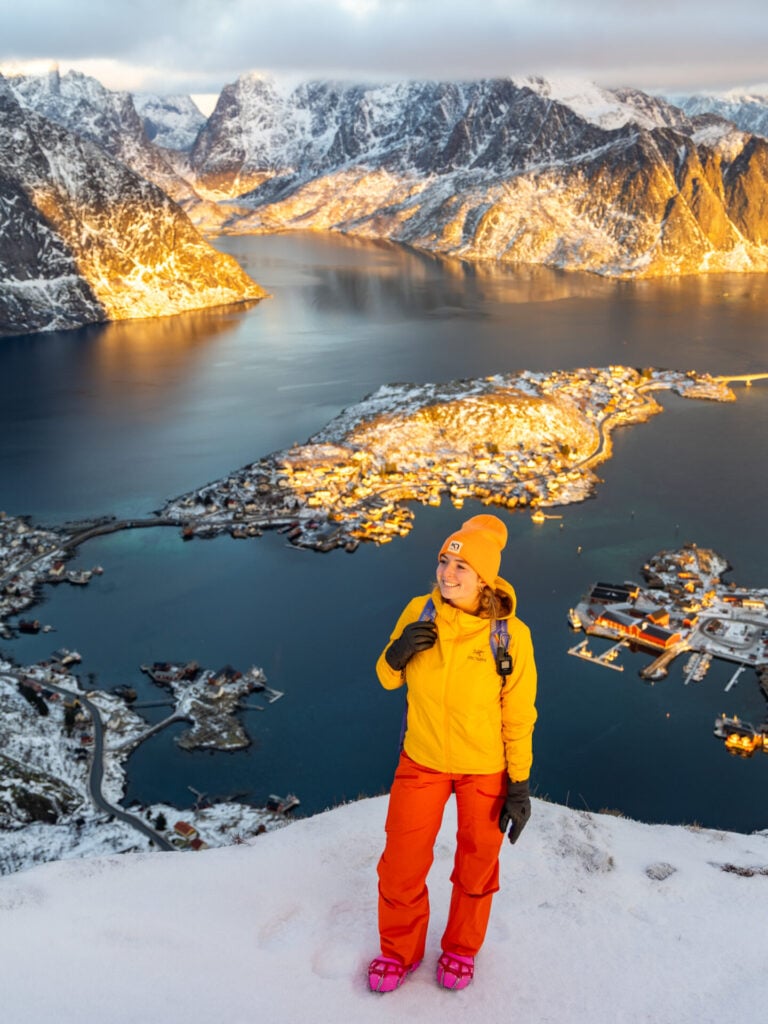
On the summit of Reinebringen in January

Reinebringen

Nearly 2,000 stone steps (installed by a Nepalese Sherpa team in 2021) have transformed Reinebringen from a notoriously dangerous ascent into a straightforward hike— and in good winter conditions, it’s a steep but spectacular ~45min push to the most iconic viewpoint in all of Lofoten!

⚠️ Due to rising rescue demands and even fatalities of inexperienced hikers attempting Reinebringen in the winter, the government has installed several signs at the trailhead “strongly discouraging” hikers from ascending in the off-season (though it’s still not illegal). Online resources have gone so far as to say that hiking Reinebringen in winter is NEVER SAFE— but I’m always sceptical of absolutes like this, especially when it comes to the outdoors.

With considerable personal mountaineering experience and a perfect weather window, we decided to attempt the hike and gather our own information. I’m sure some will criticise me for saying so, but it wasn’t even the hardest route on this list.

So here’s the truth: if you have sufficient experience, appropriate cold-weather gear, and ideal winter conditions, this is a quick, straightforward hike to a spectacular view over Reine— but PLEASE be realistic about your own abilities and don’t burden the local Search & Rescue by overextending yourself! 
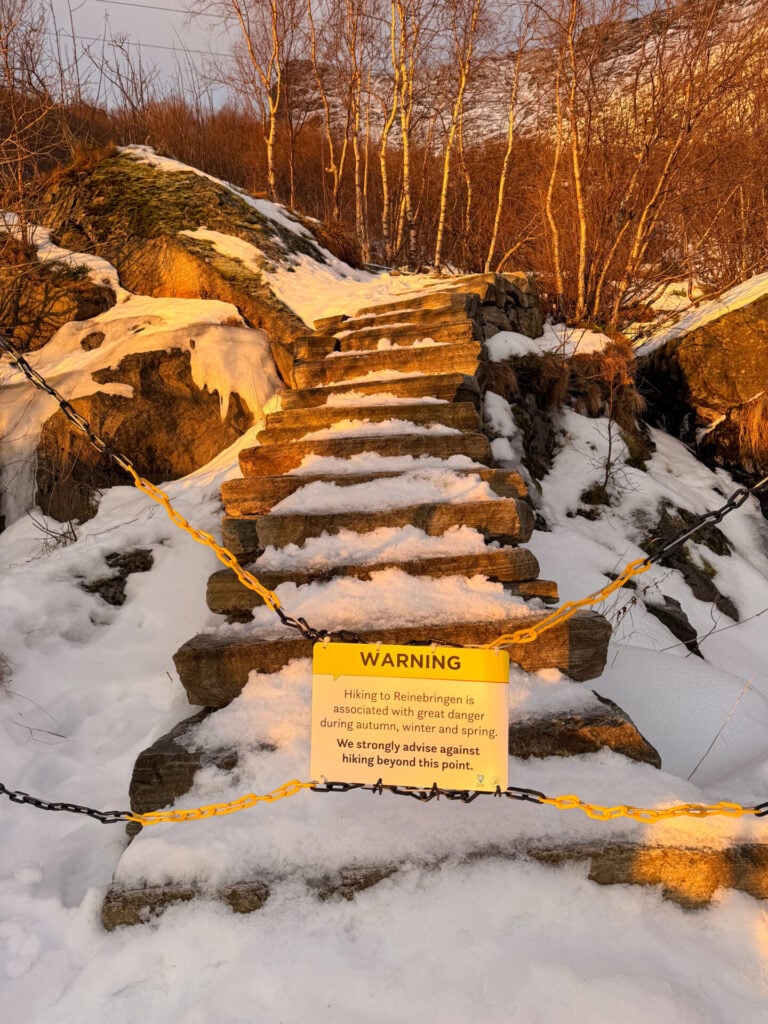
warnings on the reinebringen trail
Hiking Reinebringen in winter

The trailhead is at the southern end of the Ramsvik Tunnel (a few minutes past the town of Reine), accessible via a wide, snowy path that skirts the waterfront. In winter, you can park at the Reine Utsiktspunkt viewpoint for the shortest approach (about 10min) before ascending 450m straight up to the summit on a mix of snow and ice-covered steps. From the top, enjoy staggering views over Reinefjorden, Olstinden, and the many peaks of Lofotodden National Park.

After a big thaw or when snow levels are low, the route will be much easier to follow, but microspikes and poles are absolutely essential in winter, regardless of conditions.

  • 📈 500m gain
  • ⏰ 1.5–2hrs return
  • ⚠️ avalanche exposure: MODERATE (stairs cross through potential avalanche fall; avoid after heavy snowfall, strong wind, or warming)
  • 🅿️ limited free parking at the Reine Utsiktspunkt viewpoint (only possible in winter!), otherwise paid parking in Reine
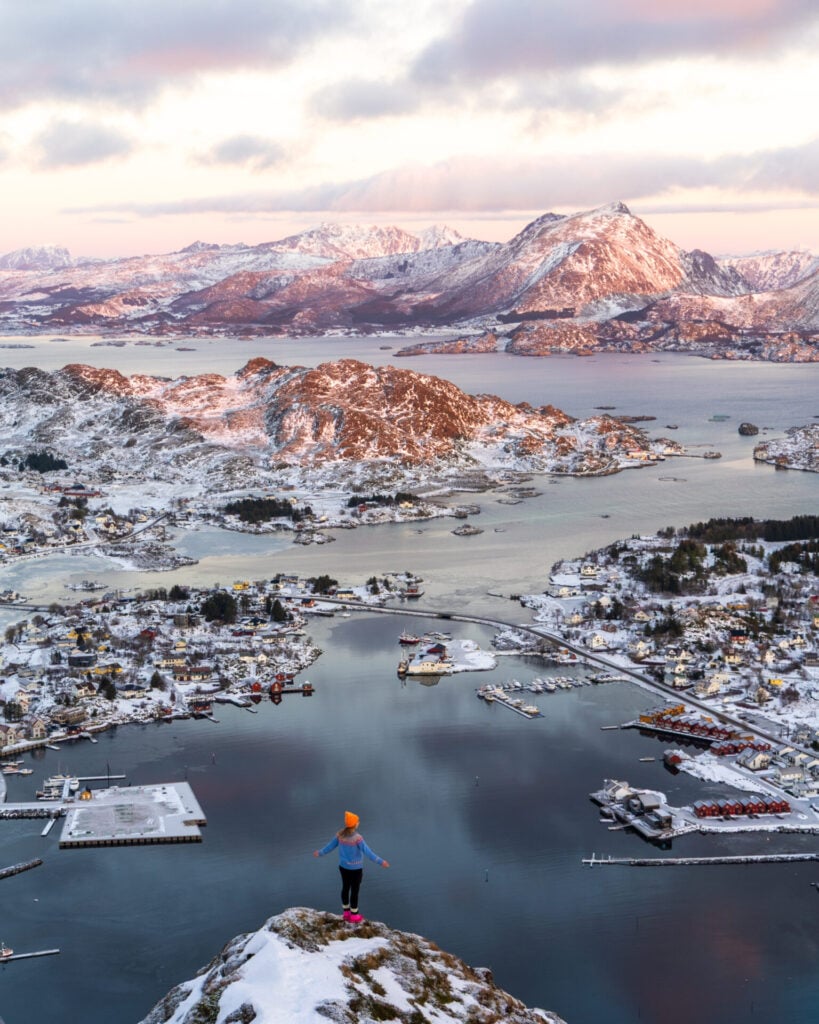
Ballstadheia winter hike
Overlooking Ballstad from Ballstadheia

Ballstadheia

The broad hill above Ballstad is a perfect easy winter hike in just about any conditions, a direct climb up Sherpa-built stone steps (typically coated in snow and/or ice) to a scenic plateau with amazing views of the harbour and surrounding mountains. If you’re staying in town, it’s incredibly convenient for a quick afternoon jaunt— and if you’re comfortable hiking by headlamp, it’s also an epic spot for northern lights viewing (popular among locals)!

With more energy, you can continue exploring the extensive network of trails branching out from Ballstadheia, including Nonstinden (next up).

  • 📈 200m gain
  • ⏰ ~1hr return
  • ✅ avalanche exposure: LOW
  • 🅿️ free parking at the Ballstadheia trailhead
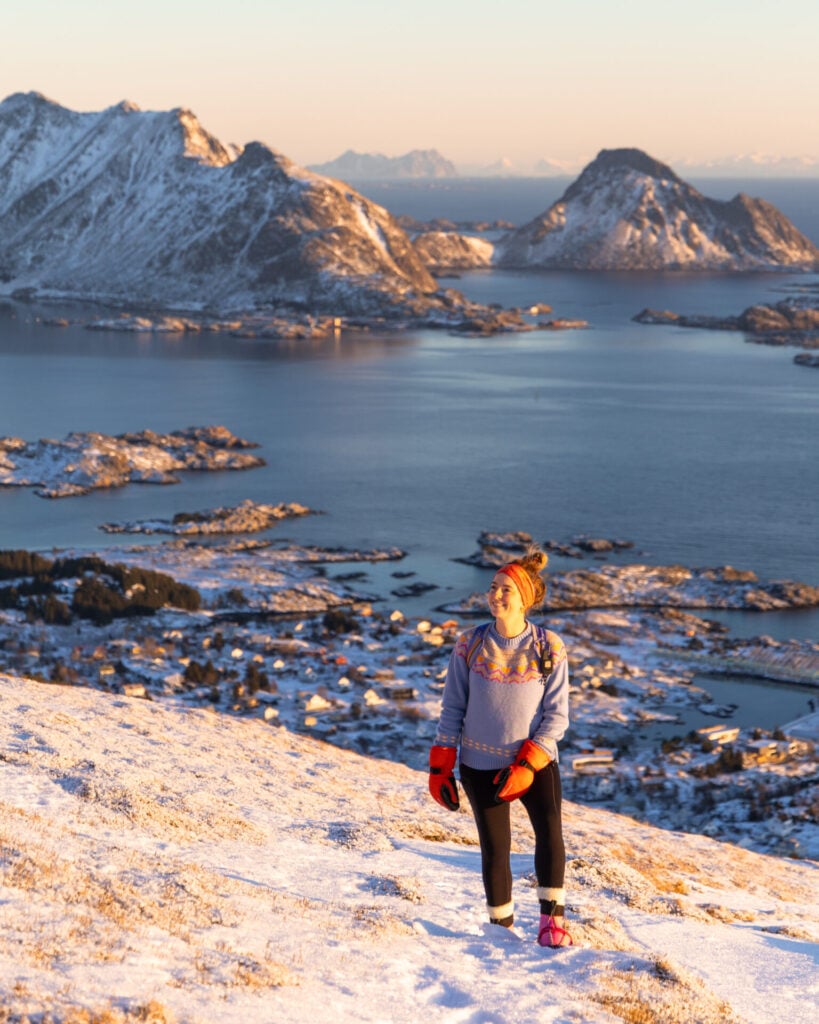
Hiking up to Nonstinden
Nonstinden winter hike

Nonstinden

Nonstinden is the perfect extension to Ballstadheia if you want something a little more dramatic. The route can be done as a gorgeous loop, wrapping anti-clockwise along the ridge with near-constant views over Ballstad, the harbour, and a sea of jagged Lofoten peaks in every direction.

Because you’re spending time on an exposed ridgeline, this hike is more weather-dependent than Ballstadheia, but still very simple in terms of navigation and terrain. Pick a calm day, bring microspikes for icy sections, and take your time along the perimeter to really enjoy the scenery.

  • 📈 480m gain
  • ⏰ ~2hrs return
  • ⚠️ avalanche exposure: MODERATE (mostly ridge travel, but conditions vary)
  • 🅿️ free parking at the Ballstadheia trailhead

Amazing view of Olstinden at sunrise

Bonus: best viewpoints in Lofoten

In between all the summits (or on high wind days where it isn’t safe to hike but you still want to get outside), here are some of our favourite easy-access winter viewpoints around Lofoten! All are shown on the Google Map above.
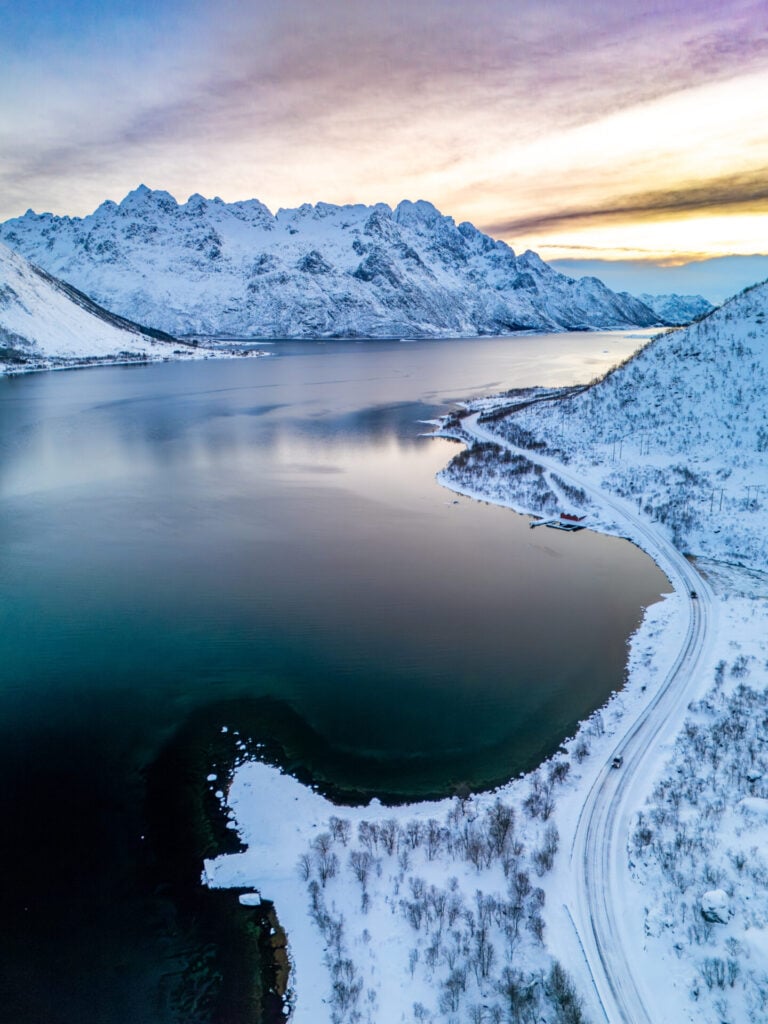
Vestpollen Lofoten in winter

Austnesfjorden

About 10 minutes north of Svolvær, this easy roadside stop leads to a short 2min walk to a viewpoint overlooking Vestpollen, with calm water and layered mountain backdrops that are especially beautiful in soft winter light. Close to: Tjeldbergtind
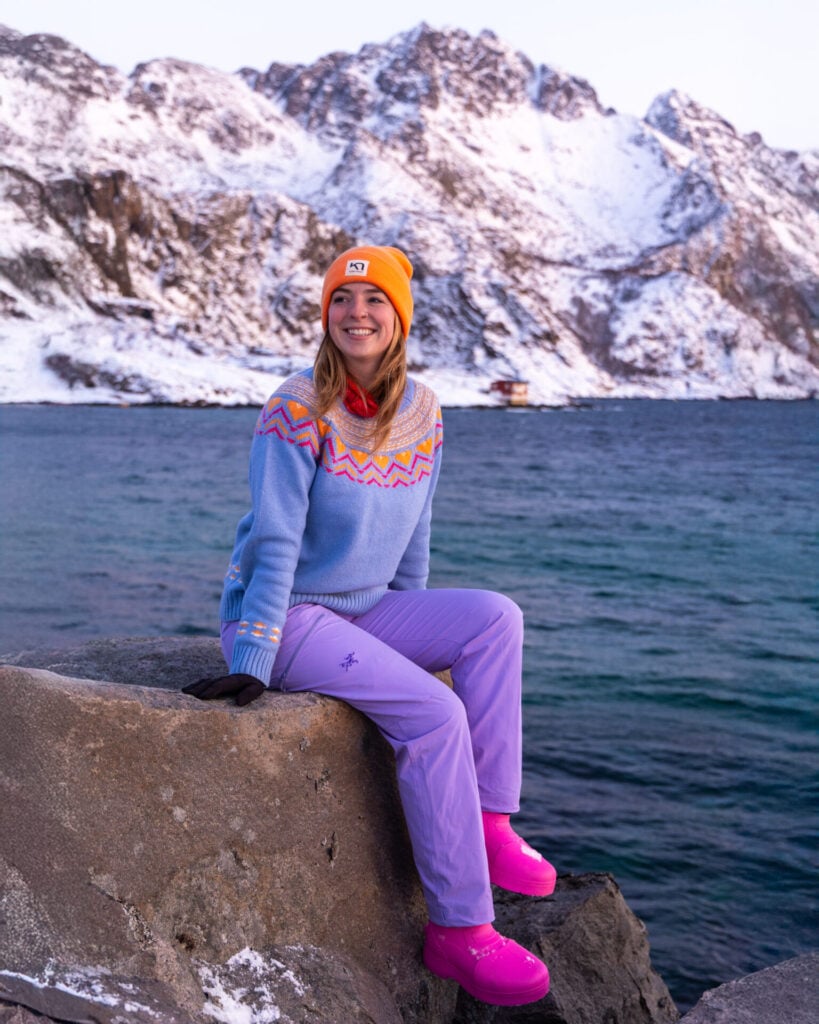
Skata Boutique Hotel

Park near the hotel and walk out towards the water for a gorgeous, low-effort viewpoint in Henningsvær. Close to: Nipen/Festvågtind
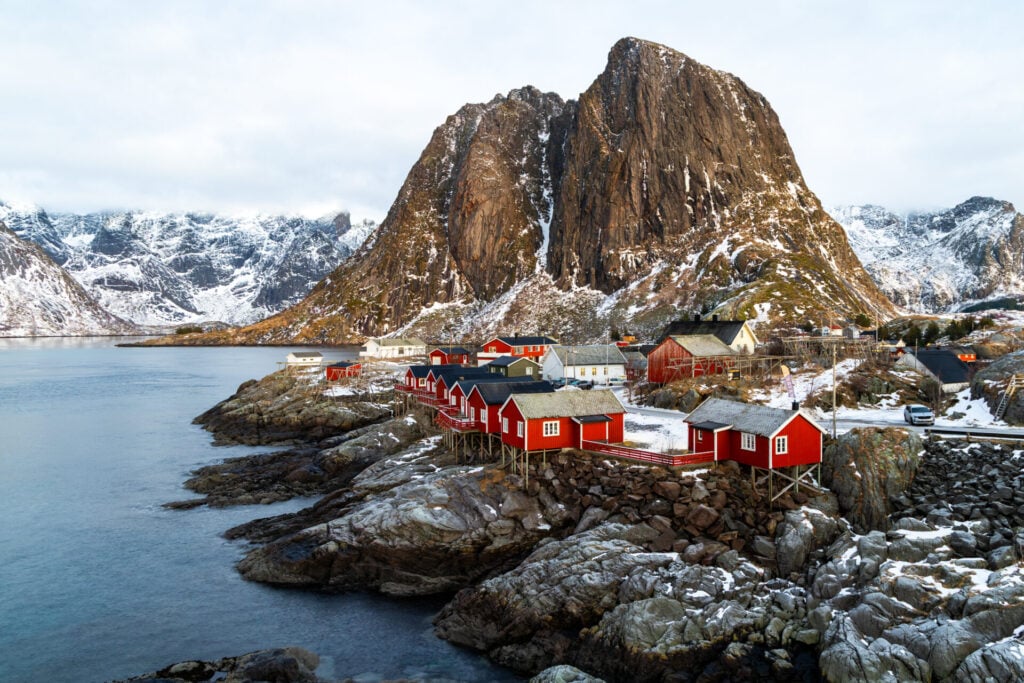
Hamnøy Bridge viewpoint

Park just before the Hamnøy bridge and walk across for one of Lofoten’s most iconic views: red rorbuer clustered below, framed by the dramatic peak of Festhæltinden rising straight out of Reinefjorden. Close to: Tindstinden + Reinebringen
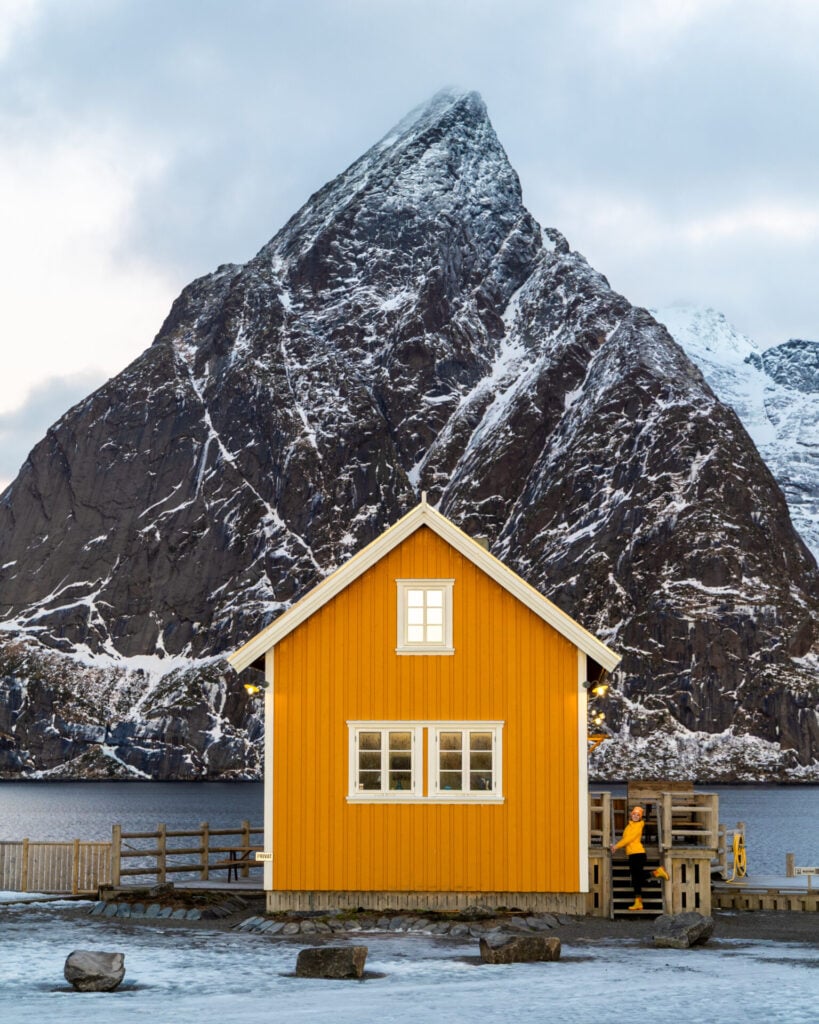
Sakrisøya Yellow House

Park near the famous yellow house on Sakrisøya for classic views across the fjord toward Olstinden, the sharp, pyramidal peak that dominates the skyline behind Reine. Close to: Tindstinden + Reinebringen
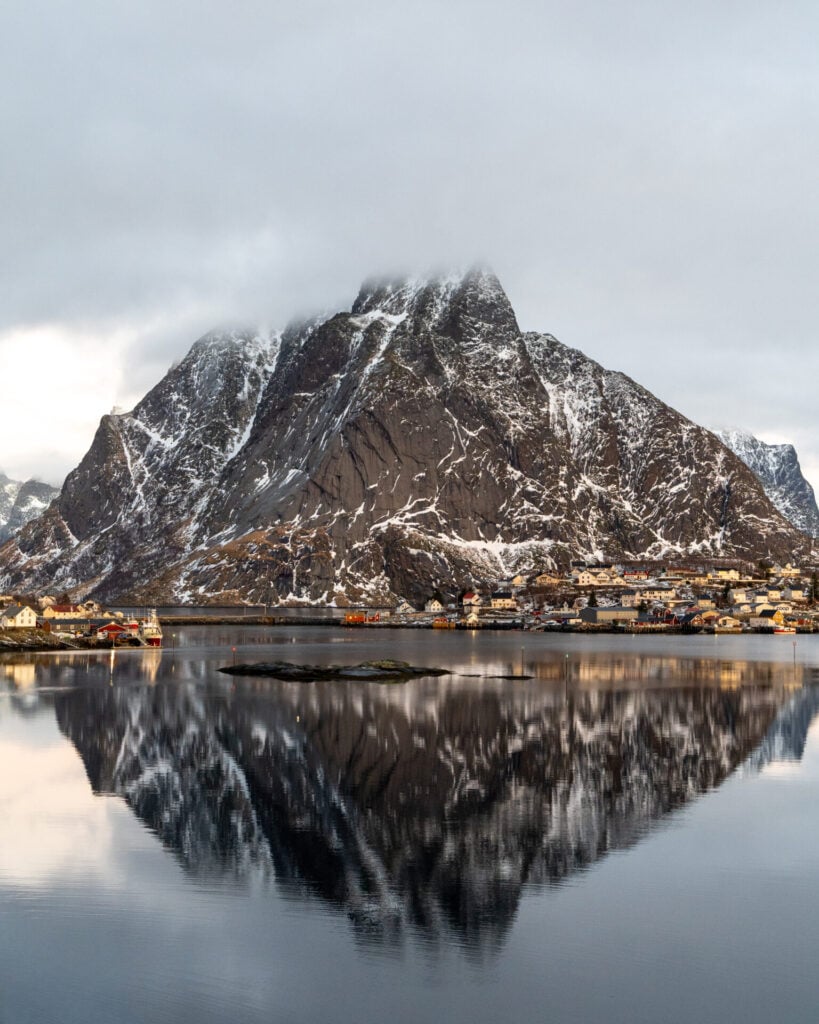
Reine Utsiktspunkt

On calm days, this viewpoint offers stunning reflections across the fjord, including Olstinden mirrored in the water. Walk around the corner to the right for an alternative angle with equally beautiful reflections. Close to: Tindstinden + Reinebringen
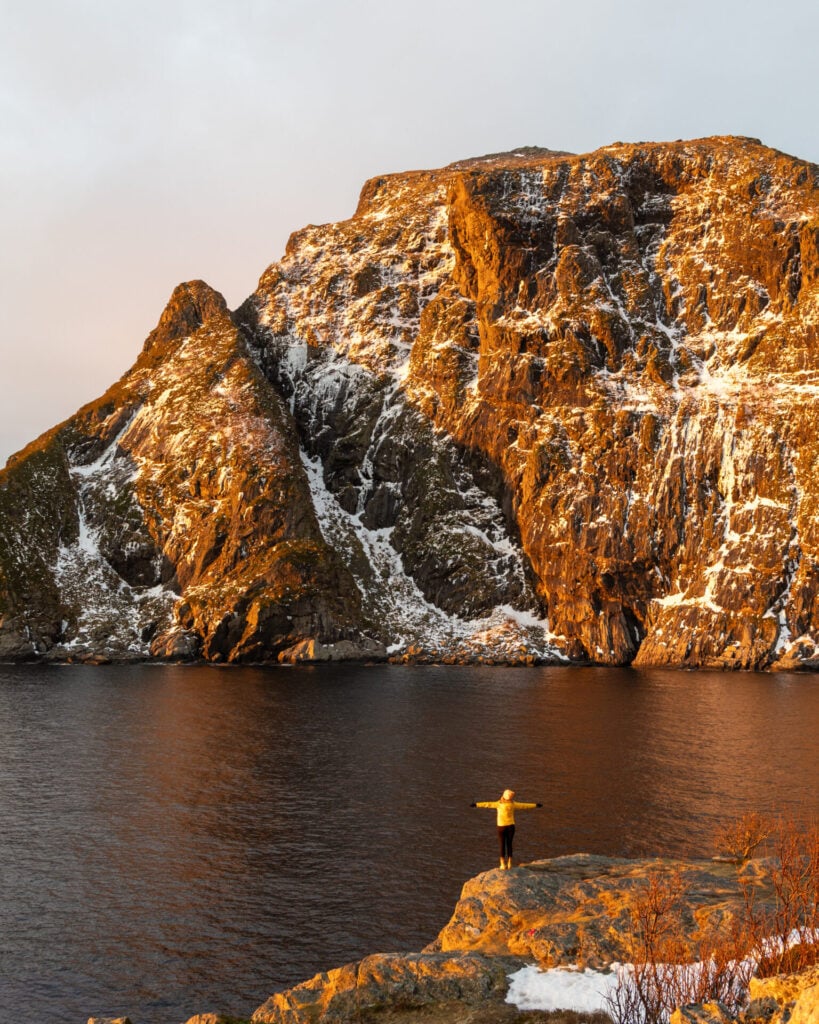
Utsiktspunkt Å

A beautiful viewpoint at the very end of the archipelago (the southernmost point in Lofoten accessible without a ferry) with expansive views over the village of Å, the open sea, and rugged mountains fading into the distance. Close to: Tindstinden + Reinebringen


Lofoten in winter can be rugged and demanding, but also wildly beautiful— a place where outdoor judgement and preparedness are rewarded with empty trails and unforgettable views. For experienced hikers willing to embrace the challenges of snow, wind, and limited daylight, this might just be the BEST time to experience Norway’s most iconic landscapes without the crowds. Happy exploring!

Read more about winter in Scandinavia

Lofoten winter packing list COMING SOON

Norway winter itinerary COMING SOON

Sweden winter itinerary COMING SOON

Finnish Lapland winter itinerary COMING SOON

TAGS:trail guidestravel guides
0 Comments
Share
brooke beyond

Hey, I'm Brooke and I'm obsessed with getting off the beaten path, exploring backcountry gems & travelling beyond the ordinary! I left Australia 5 years ago after finishing a PhD in Biomechanics & have been travelling the world full-time ever since (joined by my life/climbing partner, James). Whether it’s road-tripping through Mexico, climbing alpine peaks in the Andes, scuba diving in the Red Sea, or tackling epic via ferrata in the Dolomites, I hope this blog will inspire your future adventures & help you find wonder in every corner of the globe. xx bb

Leave a Comment Cancel Comment

You May Also Like

8 December 2016

Iceland Roadtrip Day 8: Blue Lagoon

29 November 2016

Poffertjes, Vespas & Anne Frank: A guide to visiting Amsterdam

9 July 2018

Wild Atlantic Way: Adventuring from the Cliffs of Moher to Galway city

hi, I’m brooke!

I'm obsessed with getting off the beaten path, exploring backcountry gems & travelling beyond the ordinary! I left Australia 5 years ago after finishing a PhD in Biomechanics & have been travelling the world full-time ever since (now joined by my life/climbing partner, James). I hope this blog will inspire your future adventures & help you find wonder in every corner of the globe. xx bb

read my story
currently exploring

currently exploring

iceland

read our gear guides

🥾 hiking boots

🎒 hiking backpacks

🌨️ cold-weather layers

⛺️ backpacking & alpine tents

🛌 sleeping bag & pads

🍪 backcountry food

📸 travel camera gear

✈️ travel clothing

trail guides

summit guides

itineraries

outdoor gear

GPS maps

recent posts

  • Ryten winter hike

    Best winter hikes in Lofoten: your guide to safe winter hiking in Arctic Norway

    30 January 2026
  • Laguna Humantay, Cusco Peru

    6 awesome day trips from Cusco, Peru

    24 November 2025
  • Adventure-ready picks from the REI Co-op Holiday Sale

    17 November 2025
  • 2-week Montenegro road-trip itinerary: epic hiking, Riviera beaches & wine country

    3 September 2025
  • 10-day Switzerland itinerary: Zermatt, Interlaken, Jungfrau & beyond!

    31 August 2025

@brookebeyond_
brooke ✨travel & mountain gal

@brookebeyond_

  • WINTER IN TROMSØ, NORWAY: MINI TRAVEL GUIDE ❄️✨

Above the Arctic Circle at 69.6° North, Tromsø is one of the best places in the world to experience a true Arctic winter— explosive northern lights, snow-covered mountains, dramatic fjords, and cozy saunas after a day in the cold. 

🐋 WHAT TO DO
- Snowshoe in the Lyngen Alps
- Vulkana Spa Boat
- Pust Floating Sauna
- RIB boat whale watching in Skjervøy
- Northern Lights tour
- Arctic Cathedral
- Fjellheisen cable car

🥘 WHERE TO EAT
- Mors Mat
- Nitty Gritty
- Bardus Bistro
- Fiskekompaniet
- Svermeri Kafé
- Vervet Bakeri

📆 WHEN TO GO
Tromsø experiences *polar night* (where the sun literally doesn’t rise) from 27 Nov - 15 Jan— this is the absolute best time to see the aurora AND you still get gorgeous sunset colours for several hours in the middle of the day, which can make for incredible photos! From Jan to March, daylight increases quickly, which is better for skiing and longer outdoor adventures. 

⏱️ HOW MANY DAYS
Accounting for the often extreme winter weather and limited daylight that will prevent you from doing more than 1 activity per day (and sometimes even cancel tours for several days at a time), one week is the minimum amount of time I’d recommend in Tromsø during the winter to really maximise your experience.

🚗 GETTING AROUND
With so much snow on the roads, we’d recommend skipping the rental car and instead staying within walking distance of the city centre + choosing a few worthwhile tours who will handle the transport logistics.

——
#norway #tromsø #arcticcircle #northernlights #aurora
  • hi from arctic Norway!!!!! 🇳🇴❄️

I’ve spent the last 5 years of full-time travel chasing summer + basically avoiding winter at all costs, but this year we decided to do something TOTALLY different: 3 months in Norway, Sweden, and Finland. Basically the most winter that winter can be.

And already a month into Scandinavia, we’ve been absolutely loving it!!! 

We arrived in Tromsø at the end of December to -15C blizzards and *polar night* (where the sun literally doesn’t come over the horizon), but despite being absolutely FREEZING and completely dark for 22hrs a day, it’s insanely beautiful for the few hours of glowing sunset lighting around midday and the northern lights are out in full force as early as 3pm. It is, quite simply, MAGIC ✨

We can’t wait to share more of our adventures as we hike, ski, sauna, dogsled, and romp with our cameras through the glorious Nordics over the next few months!

——
#norway #tromsø #arcticcircle #winterwonderland #tromso
  • A friend asked me recently if I’d noticed a shift in my follower demographic here on Instagram (as it had been my goal over the last year to reach more women). According to the data, not really— I still have a majority male followers— but I have absolutely FELT a shift in the quality of people who choose to interact with my account. 

There was a time when posting a photo in a swimsuit or a sports bra would trigger a flood of angry villagers sprinting to the comments to tell me that I needed to leave more to the imagination, that I was sexualising myself (and therefore couldn’t expect others not to), that I was a wh*re … simply for existing in the body that I was born in. 

And I’ve always pushed back against the notion that my only solution was to wear baggy t-shirts or turtlenecks simply to make others feel more comfortable with MY BODY. 

The reality is that a woman’s worth CANNOT come down to what she’s wearing, her cup size, her willingness to cover herself up so that others don’t feel tempted to treat her like an object... If you only respect a woman when her body is entirely hidden, do you really respect her??

It’s been difficult to cling to these ideals amidst disparaging + often disgusting comments from strangers online, but it felt important to keep showing up as myself, in whatever I felt comfortable in, saying whatever I needed to say, if only to prove that wearing a swimsuit doesn’t make me less of a person, just like wearing sports bra doesn’t make me less of a climber and having breasts doesn’t automatically invalidate my opinions as a travel blogger. 

And somewhere along the way (after many feminist rants that cleaned out the undesirables & quite a bit of good ol fashioned blocking), I felt the shift I’d been waiting for. Comments this past year have been more about the content of my posts and the recommendations I make than what I’m wearing, and it feels SO FJKING GOOD to have made even a small degree of progress in this tiny corner of the internet. 

So please comment below if you don’t agree with any this and want to continue judging me based on what I wear so that I can block your account & protect my inner peace 🥰✌🏼
  • IS IT SAFE TO TRAVEL TO ETHIOPIA?? 🇪🇹

Since falling in love with Ethiopia and sharing so many spectacular, unique experiences here on insta, I’ve received a small flood of DMs asking about traveller safety— especially considering the US currently lists Ethiopia as “Level 3: Reconsider Travel”

So here’s some context and our personal experience 👇🏻

From 2020 to 2022, Ethiopia experienced a brutal civil war centred in the northern Tigray region that spilled over into some of the surrounds. The conflict claimed hundreds of thousands of lives and displaced millions, but by the grace of a peace agreement signed in late 2022, communities across northern Ethiopia have been actively rebuilding in the years since.

We travelled through Ethiopia twice in 2025 for several weeks at a time, visiting many regions that were directly affected by the war and, with our own eyes, experienced a country that felt stable, welcoming, generous, and deeply grateful for visitors returning. 

Perhaps most importantly, tourism here has REAL power. Every guesthouse stay, home-cooked meal, and local service directly injects money into communities recovering from the conflict, helping families restore their livelihoods, put food on the table, and send their children to school.

We absolutely adore Ethiopia and the beautiful people we’ve met here, so we’re passionate about sharing these experiences with fellow travellers— especially at a time when tourism dollars mean life and opportunity for so many. 

PLEASE don’t trust everything you read online. I would strongly encourage you to come discover this warm, unique, resilient country for yourself WITH the support of a trusted local guide and/or driver, who will always prioritise your safety based on real risk, not fear-mongering.

If you need a recommendation for a great guide/driver anywhere in the country, talk to our local friend Kiros @lucyethiopiatours and he will absolutely take care of you 🙏🏼

—
#ethiopia #travelsafety #travelethiopia #tigray
  • One of our last destinations of 2025: Djibouti, a country that hardly anyone seems to know anything about (but that surprised and delighted us in many ways!)

Perched on the Horn of Africa, where tectonic plates split the earth and salt flats stretch to the horizon, Djibouti feels raw, otherworldly + wildly alive. It’s home to Africa’s lowest point on land, volcanic deserts, crater lakes, pink flamingos, whale sharks, and landscapes that look more like another planet.

But it’s not just the scenery. There’s a fascinating blend of cultures here: Afar & Somali traditions, strong tribal identity, and layers of French influence that linger in language, architecture, and daily life. Standing at a crossroads between Africa, the Middle East & the Red Sea, Djibouti is truly a place shaped by movement— of people, of plates, of history.

The 3rd photo illustrates this perfectly (and it’s one of my favourite captures of the year): Afar people travelling on foot with a camel caravan across the desert borderlands, hauling bundles of palm fronds + Djiboutian salt hundreds of kilometres back towards home to Ethiopia.

Because we’ve spent so much time in Ethiopia lately (and have 2 sold-out group trips running this year!), Djibouti just felt like the next natural frontier for us, and certainly didn’t disappoint. We spent 5 days road-tripping across wild landscapes, swimming with whale sharks in the bay, camping on empty beaches, and discovering this untouched gem. 

Have you ever thought about visiting Djibouti??

—
#djibouti #afar #lacabbe #hornofafrica #travelbeyond
  • an entire year of my full-time travel expenses (365 days on the road!), from flights & hotels to healthcare & entrance fees to SIM cards & Spotify ↯

** these numbers are a reflection of my PERSONAL spending in 2025— not representative of the absolute cheapest long-term travel style, just intended to show how much I was able to experience this year for less than rent in a major city

$7,172 ACCOMMODATION
🏡 apartments = $2,415
🏕️ campsites = $121
🏨 hotels + hostels = $4,446
🛖 mountain huts = $190

$5,167 ACTIVITIES
🎟️ entrance fees + permits = $218
⛵️ experiences + tours = $4,217
🔥 hot springs + sauna = $733

$8,244 FOOD & DRINKS
🍹 drinks = $2,088
🌮 eating out = $4,999
🧀 groceries = $1,156

$4,807 PERSONAL EXPENSES 
🧴 consumables (ex. shampoo) = $981
💊 healthcare = $3,042
🧺 laundry = $69
📲 mobile data = $216
🗺️ subscriptions (ex. Garmin In-Reach, Spotify) = $500

$8,719 TRANSPORTATION
✈️ airfare = $3,826
🚘 car hire = $2,970
⛽️ fuel + parking = $659
🚕 private transport (ex. Uber) = $635
🚃 public transport (ex. train) = $627

$1,744 TRAVEL LOGISTICS
🚫 change fees + cancellations = $355
🧳 baggage fees + luggage storage = $385
🪪 ID (ex. licence renewal) = $255
💳 credit card annual fees = $448
💰 insurance = $72
🛂 travel visas = $229

= $35,852USD TOTAL LIVING EXPENSES
($98 per day)

—
#fulltimetravel #travelbudget #travelexpenses
  • HAPPY ETHIOPIAN CHRISTMAS (GENA ገና ) ✞🕯️✨

We were lucky enough to experience these celebrations last January (Christmas falls on the 7th according to the orthodox calendar), and it was truly one of the most incredible travel moments we’ve EVER had 🥹

We only saw 4 other foreigners during our 3 days in Lalibela, and we were welcomed so warmly into the churches, the festivities, and the traditions of Christmas by friendly locals who delighted in the opportunity to share their culture + customs with a couple of curious ferenjis 🤍

———

#ethiopia #gena #ethiopianchristmas #travelbeyond #lalibela
  • our cost of living as full-time travellers came in at $98/day this year (JUST UNDER OUR $100 daily goal) 💃🏻🍾✨

→ $$$ per person based on sharing rooms + joint travel costs with my partner— AND YES, THIS IS EVERY SINGLE DOLLAR SPENT ALL YEAR

this was the most expensive year I’ve had since starting full-time travel more than 5 years ago (!!), but it was also atypical in many ways...
- I had knee surgery in Mexico, which we paid for out of pocket
- because of the slow & terrible recovery from said surgery, we had to cancel most of our big hiking plans for the year, which meant extremely little camping and a lot more city time (= expensive)
- we splurged on a $5000+ campervan rental in Iceland because I’ve been trying to convince James (successfully!) that we should do van life— some of you will recall that I lived in a van for 1.5 years previously, which I LOVED, and the only thing missing was James 👩🏼‍❤️‍💋‍👨🏻
- I got a new MacBook, a new iPhone, AND we upgraded 2x cameras in 2025 (looking forward to no big upgrades in 2026 😅)

I always love chatting travel finance, so by all means— hit me with your questions in the comments! 

———

#2025 #fulltimetravel #travelfinance #costofliving
  • another year of prioritising memories > things 🔥

if you’re new here, I’m Brooke 👋🏻 and I’ve been travelling full-time for over 5 years, sharing unique experiences around the world, detailed adventure itineraries, financial breakdowns, and stories from the road.

follow @brookebeyond_ for more adventures in 2026!

———

#2025 #2025season #fulltimetravel
follow @brookebeyond_

travel beyond the ordinary

Explore my travel guides, custom itineraries & blog posts with an interactive world map ✨

all destinations

  • WINTER IN TROMSØ, NORWAY: MINI TRAVEL GUIDE ❄️✨

Above the Arctic Circle at 69.6° North, Tromsø is one of the best places in the world to experience a true Arctic winter— explosive northern lights, snow-covered mountains, dramatic fjords, and cozy saunas after a day in the cold. 

🐋 WHAT TO DO
- Snowshoe in the Lyngen Alps
- Vulkana Spa Boat
- Pust Floating Sauna
- RIB boat whale watching in Skjervøy
- Northern Lights tour
- Arctic Cathedral
- Fjellheisen cable car

🥘 WHERE TO EAT
- Mors Mat
- Nitty Gritty
- Bardus Bistro
- Fiskekompaniet
- Svermeri Kafé
- Vervet Bakeri

📆 WHEN TO GO
Tromsø experiences *polar night* (where the sun literally doesn’t rise) from 27 Nov - 15 Jan— this is the absolute best time to see the aurora AND you still get gorgeous sunset colours for several hours in the middle of the day, which can make for incredible photos! From Jan to March, daylight increases quickly, which is better for skiing and longer outdoor adventures. 

⏱️ HOW MANY DAYS
Accounting for the often extreme winter weather and limited daylight that will prevent you from doing more than 1 activity per day (and sometimes even cancel tours for several days at a time), one week is the minimum amount of time I’d recommend in Tromsø during the winter to really maximise your experience.

🚗 GETTING AROUND
With so much snow on the roads, we’d recommend skipping the rental car and instead staying within walking distance of the city centre + choosing a few worthwhile tours who will handle the transport logistics.

——
#norway #tromsø #arcticcircle #northernlights #aurora
  • hi from arctic Norway!!!!! 🇳🇴❄️

I’ve spent the last 5 years of full-time travel chasing summer + basically avoiding winter at all costs, but this year we decided to do something TOTALLY different: 3 months in Norway, Sweden, and Finland. Basically the most winter that winter can be.

And already a month into Scandinavia, we’ve been absolutely loving it!!! 

We arrived in Tromsø at the end of December to -15C blizzards and *polar night* (where the sun literally doesn’t come over the horizon), but despite being absolutely FREEZING and completely dark for 22hrs a day, it’s insanely beautiful for the few hours of glowing sunset lighting around midday and the northern lights are out in full force as early as 3pm. It is, quite simply, MAGIC ✨

We can’t wait to share more of our adventures as we hike, ski, sauna, dogsled, and romp with our cameras through the glorious Nordics over the next few months!

——
#norway #tromsø #arcticcircle #winterwonderland #tromso
  • A friend asked me recently if I’d noticed a shift in my follower demographic here on Instagram (as it had been my goal over the last year to reach more women). According to the data, not really— I still have a majority male followers— but I have absolutely FELT a shift in the quality of people who choose to interact with my account. 

There was a time when posting a photo in a swimsuit or a sports bra would trigger a flood of angry villagers sprinting to the comments to tell me that I needed to leave more to the imagination, that I was sexualising myself (and therefore couldn’t expect others not to), that I was a wh*re … simply for existing in the body that I was born in. 

And I’ve always pushed back against the notion that my only solution was to wear baggy t-shirts or turtlenecks simply to make others feel more comfortable with MY BODY. 

The reality is that a woman’s worth CANNOT come down to what she’s wearing, her cup size, her willingness to cover herself up so that others don’t feel tempted to treat her like an object... If you only respect a woman when her body is entirely hidden, do you really respect her??

It’s been difficult to cling to these ideals amidst disparaging + often disgusting comments from strangers online, but it felt important to keep showing up as myself, in whatever I felt comfortable in, saying whatever I needed to say, if only to prove that wearing a swimsuit doesn’t make me less of a person, just like wearing sports bra doesn’t make me less of a climber and having breasts doesn’t automatically invalidate my opinions as a travel blogger. 

And somewhere along the way (after many feminist rants that cleaned out the undesirables & quite a bit of good ol fashioned blocking), I felt the shift I’d been waiting for. Comments this past year have been more about the content of my posts and the recommendations I make than what I’m wearing, and it feels SO FJKING GOOD to have made even a small degree of progress in this tiny corner of the internet. 

So please comment below if you don’t agree with any this and want to continue judging me based on what I wear so that I can block your account & protect my inner peace 🥰✌🏼
  • IS IT SAFE TO TRAVEL TO ETHIOPIA?? 🇪🇹

Since falling in love with Ethiopia and sharing so many spectacular, unique experiences here on insta, I’ve received a small flood of DMs asking about traveller safety— especially considering the US currently lists Ethiopia as “Level 3: Reconsider Travel”

So here’s some context and our personal experience 👇🏻

From 2020 to 2022, Ethiopia experienced a brutal civil war centred in the northern Tigray region that spilled over into some of the surrounds. The conflict claimed hundreds of thousands of lives and displaced millions, but by the grace of a peace agreement signed in late 2022, communities across northern Ethiopia have been actively rebuilding in the years since.

We travelled through Ethiopia twice in 2025 for several weeks at a time, visiting many regions that were directly affected by the war and, with our own eyes, experienced a country that felt stable, welcoming, generous, and deeply grateful for visitors returning. 

Perhaps most importantly, tourism here has REAL power. Every guesthouse stay, home-cooked meal, and local service directly injects money into communities recovering from the conflict, helping families restore their livelihoods, put food on the table, and send their children to school.

We absolutely adore Ethiopia and the beautiful people we’ve met here, so we’re passionate about sharing these experiences with fellow travellers— especially at a time when tourism dollars mean life and opportunity for so many. 

PLEASE don’t trust everything you read online. I would strongly encourage you to come discover this warm, unique, resilient country for yourself WITH the support of a trusted local guide and/or driver, who will always prioritise your safety based on real risk, not fear-mongering.

If you need a recommendation for a great guide/driver anywhere in the country, talk to our local friend Kiros @lucyethiopiatours and he will absolutely take care of you 🙏🏼

—
#ethiopia #travelsafety #travelethiopia #tigray
  • One of our last destinations of 2025: Djibouti, a country that hardly anyone seems to know anything about (but that surprised and delighted us in many ways!)

Perched on the Horn of Africa, where tectonic plates split the earth and salt flats stretch to the horizon, Djibouti feels raw, otherworldly + wildly alive. It’s home to Africa’s lowest point on land, volcanic deserts, crater lakes, pink flamingos, whale sharks, and landscapes that look more like another planet.

But it’s not just the scenery. There’s a fascinating blend of cultures here: Afar & Somali traditions, strong tribal identity, and layers of French influence that linger in language, architecture, and daily life. Standing at a crossroads between Africa, the Middle East & the Red Sea, Djibouti is truly a place shaped by movement— of people, of plates, of history.

The 3rd photo illustrates this perfectly (and it’s one of my favourite captures of the year): Afar people travelling on foot with a camel caravan across the desert borderlands, hauling bundles of palm fronds + Djiboutian salt hundreds of kilometres back towards home to Ethiopia.

Because we’ve spent so much time in Ethiopia lately (and have 2 sold-out group trips running this year!), Djibouti just felt like the next natural frontier for us, and certainly didn’t disappoint. We spent 5 days road-tripping across wild landscapes, swimming with whale sharks in the bay, camping on empty beaches, and discovering this untouched gem. 

Have you ever thought about visiting Djibouti??

—
#djibouti #afar #lacabbe #hornofafrica #travelbeyond
WINTER IN TROMSØ, NORWAY: MINI TRAVEL GUIDE ❄️✨

Above the Arctic Circle at 69.6° North, Tromsø is one of the best places in the world to experience a true Arctic winter— explosive northern lights, snow-covered mountains, dramatic fjords, and cozy saunas after a day in the cold. 

🐋 WHAT TO DO
- Snowshoe in the Lyngen Alps
- Vulkana Spa Boat
- Pust Floating Sauna
- RIB boat whale watching in Skjervøy
- Northern Lights tour
- Arctic Cathedral
- Fjellheisen cable car

🥘 WHERE TO EAT
- Mors Mat
- Nitty Gritty
- Bardus Bistro
- Fiskekompaniet
- Svermeri Kafé
- Vervet Bakeri

📆 WHEN TO GO
Tromsø experiences *polar night* (where the sun literally doesn’t rise) from 27 Nov - 15 Jan— this is the absolute best time to see the aurora AND you still get gorgeous sunset colours for several hours in the middle of the day, which can make for incredible photos! From Jan to March, daylight increases quickly, which is better for skiing and longer outdoor adventures. 

⏱️ HOW MANY DAYS
Accounting for the often extreme winter weather and limited daylight that will prevent you from doing more than 1 activity per day (and sometimes even cancel tours for several days at a time), one week is the minimum amount of time I’d recommend in Tromsø during the winter to really maximise your experience.

🚗 GETTING AROUND
With so much snow on the roads, we’d recommend skipping the rental car and instead staying within walking distance of the city centre + choosing a few worthwhile tours who will handle the transport logistics.

——
#norway #tromsø #arcticcircle #northernlights #aurora
WINTER IN TROMSØ, NORWAY: MINI TRAVEL GUIDE ❄️✨

Above the Arctic Circle at 69.6° North, Tromsø is one of the best places in the world to experience a true Arctic winter— explosive northern lights, snow-covered mountains, dramatic fjords, and cozy saunas after a day in the cold. 

🐋 WHAT TO DO
- Snowshoe in the Lyngen Alps
- Vulkana Spa Boat
- Pust Floating Sauna
- RIB boat whale watching in Skjervøy
- Northern Lights tour
- Arctic Cathedral
- Fjellheisen cable car

🥘 WHERE TO EAT
- Mors Mat
- Nitty Gritty
- Bardus Bistro
- Fiskekompaniet
- Svermeri Kafé
- Vervet Bakeri

📆 WHEN TO GO
Tromsø experiences *polar night* (where the sun literally doesn’t rise) from 27 Nov - 15 Jan— this is the absolute best time to see the aurora AND you still get gorgeous sunset colours for several hours in the middle of the day, which can make for incredible photos! From Jan to March, daylight increases quickly, which is better for skiing and longer outdoor adventures. 

⏱️ HOW MANY DAYS
Accounting for the often extreme winter weather and limited daylight that will prevent you from doing more than 1 activity per day (and sometimes even cancel tours for several days at a time), one week is the minimum amount of time I’d recommend in Tromsø during the winter to really maximise your experience.

🚗 GETTING AROUND
With so much snow on the roads, we’d recommend skipping the rental car and instead staying within walking distance of the city centre + choosing a few worthwhile tours who will handle the transport logistics.

——
#norway #tromsø #arcticcircle #northernlights #aurora
WINTER IN TROMSØ, NORWAY: MINI TRAVEL GUIDE ❄️✨

Above the Arctic Circle at 69.6° North, Tromsø is one of the best places in the world to experience a true Arctic winter— explosive northern lights, snow-covered mountains, dramatic fjords, and cozy saunas after a day in the cold. 

🐋 WHAT TO DO
- Snowshoe in the Lyngen Alps
- Vulkana Spa Boat
- Pust Floating Sauna
- RIB boat whale watching in Skjervøy
- Northern Lights tour
- Arctic Cathedral
- Fjellheisen cable car

🥘 WHERE TO EAT
- Mors Mat
- Nitty Gritty
- Bardus Bistro
- Fiskekompaniet
- Svermeri Kafé
- Vervet Bakeri

📆 WHEN TO GO
Tromsø experiences *polar night* (where the sun literally doesn’t rise) from 27 Nov - 15 Jan— this is the absolute best time to see the aurora AND you still get gorgeous sunset colours for several hours in the middle of the day, which can make for incredible photos! From Jan to March, daylight increases quickly, which is better for skiing and longer outdoor adventures. 

⏱️ HOW MANY DAYS
Accounting for the often extreme winter weather and limited daylight that will prevent you from doing more than 1 activity per day (and sometimes even cancel tours for several days at a time), one week is the minimum amount of time I’d recommend in Tromsø during the winter to really maximise your experience.

🚗 GETTING AROUND
With so much snow on the roads, we’d recommend skipping the rental car and instead staying within walking distance of the city centre + choosing a few worthwhile tours who will handle the transport logistics.

——
#norway #tromsø #arcticcircle #northernlights #aurora
WINTER IN TROMSØ, NORWAY: MINI TRAVEL GUIDE ❄️✨

Above the Arctic Circle at 69.6° North, Tromsø is one of the best places in the world to experience a true Arctic winter— explosive northern lights, snow-covered mountains, dramatic fjords, and cozy saunas after a day in the cold. 

🐋 WHAT TO DO
- Snowshoe in the Lyngen Alps
- Vulkana Spa Boat
- Pust Floating Sauna
- RIB boat whale watching in Skjervøy
- Northern Lights tour
- Arctic Cathedral
- Fjellheisen cable car

🥘 WHERE TO EAT
- Mors Mat
- Nitty Gritty
- Bardus Bistro
- Fiskekompaniet
- Svermeri Kafé
- Vervet Bakeri

📆 WHEN TO GO
Tromsø experiences *polar night* (where the sun literally doesn’t rise) from 27 Nov - 15 Jan— this is the absolute best time to see the aurora AND you still get gorgeous sunset colours for several hours in the middle of the day, which can make for incredible photos! From Jan to March, daylight increases quickly, which is better for skiing and longer outdoor adventures. 

⏱️ HOW MANY DAYS
Accounting for the often extreme winter weather and limited daylight that will prevent you from doing more than 1 activity per day (and sometimes even cancel tours for several days at a time), one week is the minimum amount of time I’d recommend in Tromsø during the winter to really maximise your experience.

🚗 GETTING AROUND
With so much snow on the roads, we’d recommend skipping the rental car and instead staying within walking distance of the city centre + choosing a few worthwhile tours who will handle the transport logistics.

——
#norway #tromsø #arcticcircle #northernlights #aurora
WINTER IN TROMSØ, NORWAY: MINI TRAVEL GUIDE ❄️✨

Above the Arctic Circle at 69.6° North, Tromsø is one of the best places in the world to experience a true Arctic winter— explosive northern lights, snow-covered mountains, dramatic fjords, and cozy saunas after a day in the cold. 

🐋 WHAT TO DO
- Snowshoe in the Lyngen Alps
- Vulkana Spa Boat
- Pust Floating Sauna
- RIB boat whale watching in Skjervøy
- Northern Lights tour
- Arctic Cathedral
- Fjellheisen cable car

🥘 WHERE TO EAT
- Mors Mat
- Nitty Gritty
- Bardus Bistro
- Fiskekompaniet
- Svermeri Kafé
- Vervet Bakeri

📆 WHEN TO GO
Tromsø experiences *polar night* (where the sun literally doesn’t rise) from 27 Nov - 15 Jan— this is the absolute best time to see the aurora AND you still get gorgeous sunset colours for several hours in the middle of the day, which can make for incredible photos! From Jan to March, daylight increases quickly, which is better for skiing and longer outdoor adventures. 

⏱️ HOW MANY DAYS
Accounting for the often extreme winter weather and limited daylight that will prevent you from doing more than 1 activity per day (and sometimes even cancel tours for several days at a time), one week is the minimum amount of time I’d recommend in Tromsø during the winter to really maximise your experience.

🚗 GETTING AROUND
With so much snow on the roads, we’d recommend skipping the rental car and instead staying within walking distance of the city centre + choosing a few worthwhile tours who will handle the transport logistics.

——
#norway #tromsø #arcticcircle #northernlights #aurora
WINTER IN TROMSØ, NORWAY: MINI TRAVEL GUIDE ❄️✨

Above the Arctic Circle at 69.6° North, Tromsø is one of the best places in the world to experience a true Arctic winter— explosive northern lights, snow-covered mountains, dramatic fjords, and cozy saunas after a day in the cold. 

🐋 WHAT TO DO
- Snowshoe in the Lyngen Alps
- Vulkana Spa Boat
- Pust Floating Sauna
- RIB boat whale watching in Skjervøy
- Northern Lights tour
- Arctic Cathedral
- Fjellheisen cable car

🥘 WHERE TO EAT
- Mors Mat
- Nitty Gritty
- Bardus Bistro
- Fiskekompaniet
- Svermeri Kafé
- Vervet Bakeri

📆 WHEN TO GO
Tromsø experiences *polar night* (where the sun literally doesn’t rise) from 27 Nov - 15 Jan— this is the absolute best time to see the aurora AND you still get gorgeous sunset colours for several hours in the middle of the day, which can make for incredible photos! From Jan to March, daylight increases quickly, which is better for skiing and longer outdoor adventures. 

⏱️ HOW MANY DAYS
Accounting for the often extreme winter weather and limited daylight that will prevent you from doing more than 1 activity per day (and sometimes even cancel tours for several days at a time), one week is the minimum amount of time I’d recommend in Tromsø during the winter to really maximise your experience.

🚗 GETTING AROUND
With so much snow on the roads, we’d recommend skipping the rental car and instead staying within walking distance of the city centre + choosing a few worthwhile tours who will handle the transport logistics.

——
#norway #tromsø #arcticcircle #northernlights #aurora
WINTER IN TROMSØ, NORWAY: MINI TRAVEL GUIDE ❄️✨

Above the Arctic Circle at 69.6° North, Tromsø is one of the best places in the world to experience a true Arctic winter— explosive northern lights, snow-covered mountains, dramatic fjords, and cozy saunas after a day in the cold. 

🐋 WHAT TO DO
- Snowshoe in the Lyngen Alps
- Vulkana Spa Boat
- Pust Floating Sauna
- RIB boat whale watching in Skjervøy
- Northern Lights tour
- Arctic Cathedral
- Fjellheisen cable car

🥘 WHERE TO EAT
- Mors Mat
- Nitty Gritty
- Bardus Bistro
- Fiskekompaniet
- Svermeri Kafé
- Vervet Bakeri

📆 WHEN TO GO
Tromsø experiences *polar night* (where the sun literally doesn’t rise) from 27 Nov - 15 Jan— this is the absolute best time to see the aurora AND you still get gorgeous sunset colours for several hours in the middle of the day, which can make for incredible photos! From Jan to March, daylight increases quickly, which is better for skiing and longer outdoor adventures. 

⏱️ HOW MANY DAYS
Accounting for the often extreme winter weather and limited daylight that will prevent you from doing more than 1 activity per day (and sometimes even cancel tours for several days at a time), one week is the minimum amount of time I’d recommend in Tromsø during the winter to really maximise your experience.

🚗 GETTING AROUND
With so much snow on the roads, we’d recommend skipping the rental car and instead staying within walking distance of the city centre + choosing a few worthwhile tours who will handle the transport logistics.

——
#norway #tromsø #arcticcircle #northernlights #aurora
WINTER IN TROMSØ, NORWAY: MINI TRAVEL GUIDE ❄️✨

Above the Arctic Circle at 69.6° North, Tromsø is one of the best places in the world to experience a true Arctic winter— explosive northern lights, snow-covered mountains, dramatic fjords, and cozy saunas after a day in the cold. 

🐋 WHAT TO DO
- Snowshoe in the Lyngen Alps
- Vulkana Spa Boat
- Pust Floating Sauna
- RIB boat whale watching in Skjervøy
- Northern Lights tour
- Arctic Cathedral
- Fjellheisen cable car

🥘 WHERE TO EAT
- Mors Mat
- Nitty Gritty
- Bardus Bistro
- Fiskekompaniet
- Svermeri Kafé
- Vervet Bakeri

📆 WHEN TO GO
Tromsø experiences *polar night* (where the sun literally doesn’t rise) from 27 Nov - 15 Jan— this is the absolute best time to see the aurora AND you still get gorgeous sunset colours for several hours in the middle of the day, which can make for incredible photos! From Jan to March, daylight increases quickly, which is better for skiing and longer outdoor adventures. 

⏱️ HOW MANY DAYS
Accounting for the often extreme winter weather and limited daylight that will prevent you from doing more than 1 activity per day (and sometimes even cancel tours for several days at a time), one week is the minimum amount of time I’d recommend in Tromsø during the winter to really maximise your experience.

🚗 GETTING AROUND
With so much snow on the roads, we’d recommend skipping the rental car and instead staying within walking distance of the city centre + choosing a few worthwhile tours who will handle the transport logistics.

——
#norway #tromsø #arcticcircle #northernlights #aurora
@brookebeyond_
@brookebeyond_
•
Follow
WINTER IN TROMSØ, NORWAY: MINI TRAVEL GUIDE ❄️✨ Above the Arctic Circle at 69.6° North, Tromsø is one of the best places in the world to experience a true Arctic winter— explosive northern lights, snow-covered mountains, dramatic fjords, and cozy saunas after a day in the cold. 🐋 WHAT TO DO - Snowshoe in the Lyngen Alps - Vulkana Spa Boat - Pust Floating Sauna - RIB boat whale watching in Skjervøy - Northern Lights tour - Arctic Cathedral - Fjellheisen cable car 🥘 WHERE TO EAT - Mors Mat - Nitty Gritty - Bardus Bistro - Fiskekompaniet - Svermeri Kafé - Vervet Bakeri 📆 WHEN TO GO Tromsø experiences *polar night* (where the sun literally doesn’t rise) from 27 Nov - 15 Jan— this is the absolute best time to see the aurora AND you still get gorgeous sunset colours for several hours in the middle of the day, which can make for incredible photos! From Jan to March, daylight increases quickly, which is better for skiing and longer outdoor adventures. ⏱️ HOW MANY DAYS Accounting for the often extreme winter weather and limited daylight that will prevent you from doing more than 1 activity per day (and sometimes even cancel tours for several days at a time), one week is the minimum amount of time I’d recommend in Tromsø during the winter to really maximise your experience. 🚗 GETTING AROUND With so much snow on the roads, we’d recommend skipping the rental car and instead staying within walking distance of the city centre + choosing a few worthwhile tours who will handle the transport logistics. —— #norway #tromsø #arcticcircle #northernlights #aurora
3 days ago
View on Instagram |
1/5
hi from arctic Norway!!!!! 🇳🇴❄️

I’ve spent the last 5 years of full-time travel chasing summer + basically avoiding winter at all costs, but this year we decided to do something TOTALLY different: 3 months in Norway, Sweden, and Finland. Basically the most winter that winter can be.

And already a month into Scandinavia, we’ve been absolutely loving it!!! 

We arrived in Tromsø at the end of December to -15C blizzards and *polar night* (where the sun literally doesn’t come over the horizon), but despite being absolutely FREEZING and completely dark for 22hrs a day, it’s insanely beautiful for the few hours of glowing sunset lighting around midday and the northern lights are out in full force as early as 3pm. It is, quite simply, MAGIC ✨

We can’t wait to share more of our adventures as we hike, ski, sauna, dogsled, and romp with our cameras through the glorious Nordics over the next few months!

——
#norway #tromsø #arcticcircle #winterwonderland #tromso
hi from arctic Norway!!!!! 🇳🇴❄️

I’ve spent the last 5 years of full-time travel chasing summer + basically avoiding winter at all costs, but this year we decided to do something TOTALLY different: 3 months in Norway, Sweden, and Finland. Basically the most winter that winter can be.

And already a month into Scandinavia, we’ve been absolutely loving it!!! 

We arrived in Tromsø at the end of December to -15C blizzards and *polar night* (where the sun literally doesn’t come over the horizon), but despite being absolutely FREEZING and completely dark for 22hrs a day, it’s insanely beautiful for the few hours of glowing sunset lighting around midday and the northern lights are out in full force as early as 3pm. It is, quite simply, MAGIC ✨

We can’t wait to share more of our adventures as we hike, ski, sauna, dogsled, and romp with our cameras through the glorious Nordics over the next few months!

——
#norway #tromsø #arcticcircle #winterwonderland #tromso
@brookebeyond_
@brookebeyond_
•
Follow
hi from arctic Norway!!!!! 🇳🇴❄️ I’ve spent the last 5 years of full-time travel chasing summer + basically avoiding winter at all costs, but this year we decided to do something TOTALLY different: 3 months in Norway, Sweden, and Finland. Basically the most winter that winter can be. And already a month into Scandinavia, we’ve been absolutely loving it!!! We arrived in Tromsø at the end of December to -15C blizzards and *polar night* (where the sun literally doesn’t come over the horizon), but despite being absolutely FREEZING and completely dark for 22hrs a day, it’s insanely beautiful for the few hours of glowing sunset lighting around midday and the northern lights are out in full force as early as 3pm. It is, quite simply, MAGIC ✨ We can’t wait to share more of our adventures as we hike, ski, sauna, dogsled, and romp with our cameras through the glorious Nordics over the next few months! —— #norway #tromsø #arcticcircle #winterwonderland #tromso
4 days ago
View on Instagram |
2/5
A friend asked me recently if I’d noticed a shift in my follower demographic here on Instagram (as it had been my goal over the last year to reach more women). According to the data, not really— I still have a majority male followers— but I have absolutely FELT a shift in the quality of people who choose to interact with my account. 

There was a time when posting a photo in a swimsuit or a sports bra would trigger a flood of angry villagers sprinting to the comments to tell me that I needed to leave more to the imagination, that I was sexualising myself (and therefore couldn’t expect others not to), that I was a wh*re … simply for existing in the body that I was born in. 

And I’ve always pushed back against the notion that my only solution was to wear baggy t-shirts or turtlenecks simply to make others feel more comfortable with MY BODY. 

The reality is that a woman’s worth CANNOT come down to what she’s wearing, her cup size, her willingness to cover herself up so that others don’t feel tempted to treat her like an object... If you only respect a woman when her body is entirely hidden, do you really respect her??

It’s been difficult to cling to these ideals amidst disparaging + often disgusting comments from strangers online, but it felt important to keep showing up as myself, in whatever I felt comfortable in, saying whatever I needed to say, if only to prove that wearing a swimsuit doesn’t make me less of a person, just like wearing sports bra doesn’t make me less of a climber and having breasts doesn’t automatically invalidate my opinions as a travel blogger. 

And somewhere along the way (after many feminist rants that cleaned out the undesirables & quite a bit of good ol fashioned blocking), I felt the shift I’d been waiting for. Comments this past year have been more about the content of my posts and the recommendations I make than what I’m wearing, and it feels SO FJKING GOOD to have made even a small degree of progress in this tiny corner of the internet. 

So please comment below if you don’t agree with any this and want to continue judging me based on what I wear so that I can block your account & protect my inner peace 🥰✌🏼
A friend asked me recently if I’d noticed a shift in my follower demographic here on Instagram (as it had been my goal over the last year to reach more women). According to the data, not really— I still have a majority male followers— but I have absolutely FELT a shift in the quality of people who choose to interact with my account. 

There was a time when posting a photo in a swimsuit or a sports bra would trigger a flood of angry villagers sprinting to the comments to tell me that I needed to leave more to the imagination, that I was sexualising myself (and therefore couldn’t expect others not to), that I was a wh*re … simply for existing in the body that I was born in. 

And I’ve always pushed back against the notion that my only solution was to wear baggy t-shirts or turtlenecks simply to make others feel more comfortable with MY BODY. 

The reality is that a woman’s worth CANNOT come down to what she’s wearing, her cup size, her willingness to cover herself up so that others don’t feel tempted to treat her like an object... If you only respect a woman when her body is entirely hidden, do you really respect her??

It’s been difficult to cling to these ideals amidst disparaging + often disgusting comments from strangers online, but it felt important to keep showing up as myself, in whatever I felt comfortable in, saying whatever I needed to say, if only to prove that wearing a swimsuit doesn’t make me less of a person, just like wearing sports bra doesn’t make me less of a climber and having breasts doesn’t automatically invalidate my opinions as a travel blogger. 

And somewhere along the way (after many feminist rants that cleaned out the undesirables & quite a bit of good ol fashioned blocking), I felt the shift I’d been waiting for. Comments this past year have been more about the content of my posts and the recommendations I make than what I’m wearing, and it feels SO FJKING GOOD to have made even a small degree of progress in this tiny corner of the internet. 

So please comment below if you don’t agree with any this and want to continue judging me based on what I wear so that I can block your account & protect my inner peace 🥰✌🏼
A friend asked me recently if I’d noticed a shift in my follower demographic here on Instagram (as it had been my goal over the last year to reach more women). According to the data, not really— I still have a majority male followers— but I have absolutely FELT a shift in the quality of people who choose to interact with my account. 

There was a time when posting a photo in a swimsuit or a sports bra would trigger a flood of angry villagers sprinting to the comments to tell me that I needed to leave more to the imagination, that I was sexualising myself (and therefore couldn’t expect others not to), that I was a wh*re … simply for existing in the body that I was born in. 

And I’ve always pushed back against the notion that my only solution was to wear baggy t-shirts or turtlenecks simply to make others feel more comfortable with MY BODY. 

The reality is that a woman’s worth CANNOT come down to what she’s wearing, her cup size, her willingness to cover herself up so that others don’t feel tempted to treat her like an object... If you only respect a woman when her body is entirely hidden, do you really respect her??

It’s been difficult to cling to these ideals amidst disparaging + often disgusting comments from strangers online, but it felt important to keep showing up as myself, in whatever I felt comfortable in, saying whatever I needed to say, if only to prove that wearing a swimsuit doesn’t make me less of a person, just like wearing sports bra doesn’t make me less of a climber and having breasts doesn’t automatically invalidate my opinions as a travel blogger. 

And somewhere along the way (after many feminist rants that cleaned out the undesirables & quite a bit of good ol fashioned blocking), I felt the shift I’d been waiting for. Comments this past year have been more about the content of my posts and the recommendations I make than what I’m wearing, and it feels SO FJKING GOOD to have made even a small degree of progress in this tiny corner of the internet. 

So please comment below if you don’t agree with any this and want to continue judging me based on what I wear so that I can block your account & protect my inner peace 🥰✌🏼
A friend asked me recently if I’d noticed a shift in my follower demographic here on Instagram (as it had been my goal over the last year to reach more women). According to the data, not really— I still have a majority male followers— but I have absolutely FELT a shift in the quality of people who choose to interact with my account. 

There was a time when posting a photo in a swimsuit or a sports bra would trigger a flood of angry villagers sprinting to the comments to tell me that I needed to leave more to the imagination, that I was sexualising myself (and therefore couldn’t expect others not to), that I was a wh*re … simply for existing in the body that I was born in. 

And I’ve always pushed back against the notion that my only solution was to wear baggy t-shirts or turtlenecks simply to make others feel more comfortable with MY BODY. 

The reality is that a woman’s worth CANNOT come down to what she’s wearing, her cup size, her willingness to cover herself up so that others don’t feel tempted to treat her like an object... If you only respect a woman when her body is entirely hidden, do you really respect her??

It’s been difficult to cling to these ideals amidst disparaging + often disgusting comments from strangers online, but it felt important to keep showing up as myself, in whatever I felt comfortable in, saying whatever I needed to say, if only to prove that wearing a swimsuit doesn’t make me less of a person, just like wearing sports bra doesn’t make me less of a climber and having breasts doesn’t automatically invalidate my opinions as a travel blogger. 

And somewhere along the way (after many feminist rants that cleaned out the undesirables & quite a bit of good ol fashioned blocking), I felt the shift I’d been waiting for. Comments this past year have been more about the content of my posts and the recommendations I make than what I’m wearing, and it feels SO FJKING GOOD to have made even a small degree of progress in this tiny corner of the internet. 

So please comment below if you don’t agree with any this and want to continue judging me based on what I wear so that I can block your account & protect my inner peace 🥰✌🏼
A friend asked me recently if I’d noticed a shift in my follower demographic here on Instagram (as it had been my goal over the last year to reach more women). According to the data, not really— I still have a majority male followers— but I have absolutely FELT a shift in the quality of people who choose to interact with my account. 

There was a time when posting a photo in a swimsuit or a sports bra would trigger a flood of angry villagers sprinting to the comments to tell me that I needed to leave more to the imagination, that I was sexualising myself (and therefore couldn’t expect others not to), that I was a wh*re … simply for existing in the body that I was born in. 

And I’ve always pushed back against the notion that my only solution was to wear baggy t-shirts or turtlenecks simply to make others feel more comfortable with MY BODY. 

The reality is that a woman’s worth CANNOT come down to what she’s wearing, her cup size, her willingness to cover herself up so that others don’t feel tempted to treat her like an object... If you only respect a woman when her body is entirely hidden, do you really respect her??

It’s been difficult to cling to these ideals amidst disparaging + often disgusting comments from strangers online, but it felt important to keep showing up as myself, in whatever I felt comfortable in, saying whatever I needed to say, if only to prove that wearing a swimsuit doesn’t make me less of a person, just like wearing sports bra doesn’t make me less of a climber and having breasts doesn’t automatically invalidate my opinions as a travel blogger. 

And somewhere along the way (after many feminist rants that cleaned out the undesirables & quite a bit of good ol fashioned blocking), I felt the shift I’d been waiting for. Comments this past year have been more about the content of my posts and the recommendations I make than what I’m wearing, and it feels SO FJKING GOOD to have made even a small degree of progress in this tiny corner of the internet. 

So please comment below if you don’t agree with any this and want to continue judging me based on what I wear so that I can block your account & protect my inner peace 🥰✌🏼
A friend asked me recently if I’d noticed a shift in my follower demographic here on Instagram (as it had been my goal over the last year to reach more women). According to the data, not really— I still have a majority male followers— but I have absolutely FELT a shift in the quality of people who choose to interact with my account. 

There was a time when posting a photo in a swimsuit or a sports bra would trigger a flood of angry villagers sprinting to the comments to tell me that I needed to leave more to the imagination, that I was sexualising myself (and therefore couldn’t expect others not to), that I was a wh*re … simply for existing in the body that I was born in. 

And I’ve always pushed back against the notion that my only solution was to wear baggy t-shirts or turtlenecks simply to make others feel more comfortable with MY BODY. 

The reality is that a woman’s worth CANNOT come down to what she’s wearing, her cup size, her willingness to cover herself up so that others don’t feel tempted to treat her like an object... If you only respect a woman when her body is entirely hidden, do you really respect her??

It’s been difficult to cling to these ideals amidst disparaging + often disgusting comments from strangers online, but it felt important to keep showing up as myself, in whatever I felt comfortable in, saying whatever I needed to say, if only to prove that wearing a swimsuit doesn’t make me less of a person, just like wearing sports bra doesn’t make me less of a climber and having breasts doesn’t automatically invalidate my opinions as a travel blogger. 

And somewhere along the way (after many feminist rants that cleaned out the undesirables & quite a bit of good ol fashioned blocking), I felt the shift I’d been waiting for. Comments this past year have been more about the content of my posts and the recommendations I make than what I’m wearing, and it feels SO FJKING GOOD to have made even a small degree of progress in this tiny corner of the internet. 

So please comment below if you don’t agree with any this and want to continue judging me based on what I wear so that I can block your account & protect my inner peace 🥰✌🏼
A friend asked me recently if I’d noticed a shift in my follower demographic here on Instagram (as it had been my goal over the last year to reach more women). According to the data, not really— I still have a majority male followers— but I have absolutely FELT a shift in the quality of people who choose to interact with my account. 

There was a time when posting a photo in a swimsuit or a sports bra would trigger a flood of angry villagers sprinting to the comments to tell me that I needed to leave more to the imagination, that I was sexualising myself (and therefore couldn’t expect others not to), that I was a wh*re … simply for existing in the body that I was born in. 

And I’ve always pushed back against the notion that my only solution was to wear baggy t-shirts or turtlenecks simply to make others feel more comfortable with MY BODY. 

The reality is that a woman’s worth CANNOT come down to what she’s wearing, her cup size, her willingness to cover herself up so that others don’t feel tempted to treat her like an object... If you only respect a woman when her body is entirely hidden, do you really respect her??

It’s been difficult to cling to these ideals amidst disparaging + often disgusting comments from strangers online, but it felt important to keep showing up as myself, in whatever I felt comfortable in, saying whatever I needed to say, if only to prove that wearing a swimsuit doesn’t make me less of a person, just like wearing sports bra doesn’t make me less of a climber and having breasts doesn’t automatically invalidate my opinions as a travel blogger. 

And somewhere along the way (after many feminist rants that cleaned out the undesirables & quite a bit of good ol fashioned blocking), I felt the shift I’d been waiting for. Comments this past year have been more about the content of my posts and the recommendations I make than what I’m wearing, and it feels SO FJKING GOOD to have made even a small degree of progress in this tiny corner of the internet. 

So please comment below if you don’t agree with any this and want to continue judging me based on what I wear so that I can block your account & protect my inner peace 🥰✌🏼
A friend asked me recently if I’d noticed a shift in my follower demographic here on Instagram (as it had been my goal over the last year to reach more women). According to the data, not really— I still have a majority male followers— but I have absolutely FELT a shift in the quality of people who choose to interact with my account. 

There was a time when posting a photo in a swimsuit or a sports bra would trigger a flood of angry villagers sprinting to the comments to tell me that I needed to leave more to the imagination, that I was sexualising myself (and therefore couldn’t expect others not to), that I was a wh*re … simply for existing in the body that I was born in. 

And I’ve always pushed back against the notion that my only solution was to wear baggy t-shirts or turtlenecks simply to make others feel more comfortable with MY BODY. 

The reality is that a woman’s worth CANNOT come down to what she’s wearing, her cup size, her willingness to cover herself up so that others don’t feel tempted to treat her like an object... If you only respect a woman when her body is entirely hidden, do you really respect her??

It’s been difficult to cling to these ideals amidst disparaging + often disgusting comments from strangers online, but it felt important to keep showing up as myself, in whatever I felt comfortable in, saying whatever I needed to say, if only to prove that wearing a swimsuit doesn’t make me less of a person, just like wearing sports bra doesn’t make me less of a climber and having breasts doesn’t automatically invalidate my opinions as a travel blogger. 

And somewhere along the way (after many feminist rants that cleaned out the undesirables & quite a bit of good ol fashioned blocking), I felt the shift I’d been waiting for. Comments this past year have been more about the content of my posts and the recommendations I make than what I’m wearing, and it feels SO FJKING GOOD to have made even a small degree of progress in this tiny corner of the internet. 

So please comment below if you don’t agree with any this and want to continue judging me based on what I wear so that I can block your account & protect my inner peace 🥰✌🏼
A friend asked me recently if I’d noticed a shift in my follower demographic here on Instagram (as it had been my goal over the last year to reach more women). According to the data, not really— I still have a majority male followers— but I have absolutely FELT a shift in the quality of people who choose to interact with my account. 

There was a time when posting a photo in a swimsuit or a sports bra would trigger a flood of angry villagers sprinting to the comments to tell me that I needed to leave more to the imagination, that I was sexualising myself (and therefore couldn’t expect others not to), that I was a wh*re … simply for existing in the body that I was born in. 

And I’ve always pushed back against the notion that my only solution was to wear baggy t-shirts or turtlenecks simply to make others feel more comfortable with MY BODY. 

The reality is that a woman’s worth CANNOT come down to what she’s wearing, her cup size, her willingness to cover herself up so that others don’t feel tempted to treat her like an object... If you only respect a woman when her body is entirely hidden, do you really respect her??

It’s been difficult to cling to these ideals amidst disparaging + often disgusting comments from strangers online, but it felt important to keep showing up as myself, in whatever I felt comfortable in, saying whatever I needed to say, if only to prove that wearing a swimsuit doesn’t make me less of a person, just like wearing sports bra doesn’t make me less of a climber and having breasts doesn’t automatically invalidate my opinions as a travel blogger. 

And somewhere along the way (after many feminist rants that cleaned out the undesirables & quite a bit of good ol fashioned blocking), I felt the shift I’d been waiting for. Comments this past year have been more about the content of my posts and the recommendations I make than what I’m wearing, and it feels SO FJKING GOOD to have made even a small degree of progress in this tiny corner of the internet. 

So please comment below if you don’t agree with any this and want to continue judging me based on what I wear so that I can block your account & protect my inner peace 🥰✌🏼
@brookebeyond_
@brookebeyond_
•
Follow
A friend asked me recently if I’d noticed a shift in my follower demographic here on Instagram (as it had been my goal over the last year to reach more women). According to the data, not really— I still have a majority male followers— but I have absolutely FELT a shift in the quality of people who choose to interact with my account. There was a time when posting a photo in a swimsuit or a sports bra would trigger a flood of angry villagers sprinting to the comments to tell me that I needed to leave more to the imagination, that I was sexualising myself (and therefore couldn’t expect others not to), that I was a wh*re … simply for existing in the body that I was born in. And I’ve always pushed back against the notion that my only solution was to wear baggy t-shirts or turtlenecks simply to make others feel more comfortable with MY BODY. The reality is that a woman’s worth CANNOT come down to what she’s wearing, her cup size, her willingness to cover herself up so that others don’t feel tempted to treat her like an object... If you only respect a woman when her body is entirely hidden, do you really respect her?? It’s been difficult to cling to these ideals amidst disparaging + often disgusting comments from strangers online, but it felt important to keep showing up as myself, in whatever I felt comfortable in, saying whatever I needed to say, if only to prove that wearing a swimsuit doesn’t make me less of a person, just like wearing sports bra doesn’t make me less of a climber and having breasts doesn’t automatically invalidate my opinions as a travel blogger. And somewhere along the way (after many feminist rants that cleaned out the undesirables & quite a bit of good ol fashioned blocking), I felt the shift I’d been waiting for. Comments this past year have been more about the content of my posts and the recommendations I make than what I’m wearing, and it feels SO FJKING GOOD to have made even a small degree of progress in this tiny corner of the internet. So please comment below if you don’t agree with any this and want to continue judging me based on what I wear so that I can block your account & protect my inner peace 🥰✌🏼
2 weeks ago
View on Instagram |
3/5
IS IT SAFE TO TRAVEL TO ETHIOPIA?? 🇪🇹

Since falling in love with Ethiopia and sharing so many spectacular, unique experiences here on insta, I’ve received a small flood of DMs asking about traveller safety— especially considering the US currently lists Ethiopia as “Level 3: Reconsider Travel”

So here’s some context and our personal experience 👇🏻

From 2020 to 2022, Ethiopia experienced a brutal civil war centred in the northern Tigray region that spilled over into some of the surrounds. The conflict claimed hundreds of thousands of lives and displaced millions, but by the grace of a peace agreement signed in late 2022, communities across northern Ethiopia have been actively rebuilding in the years since.

We travelled through Ethiopia twice in 2025 for several weeks at a time, visiting many regions that were directly affected by the war and, with our own eyes, experienced a country that felt stable, welcoming, generous, and deeply grateful for visitors returning. 

Perhaps most importantly, tourism here has REAL power. Every guesthouse stay, home-cooked meal, and local service directly injects money into communities recovering from the conflict, helping families restore their livelihoods, put food on the table, and send their children to school.

We absolutely adore Ethiopia and the beautiful people we’ve met here, so we’re passionate about sharing these experiences with fellow travellers— especially at a time when tourism dollars mean life and opportunity for so many. 

PLEASE don’t trust everything you read online. I would strongly encourage you to come discover this warm, unique, resilient country for yourself WITH the support of a trusted local guide and/or driver, who will always prioritise your safety based on real risk, not fear-mongering.

If you need a recommendation for a great guide/driver anywhere in the country, talk to our local friend Kiros @lucyethiopiatours and he will absolutely take care of you 🙏🏼

—
#ethiopia #travelsafety #travelethiopia #tigray
IS IT SAFE TO TRAVEL TO ETHIOPIA?? 🇪🇹

Since falling in love with Ethiopia and sharing so many spectacular, unique experiences here on insta, I’ve received a small flood of DMs asking about traveller safety— especially considering the US currently lists Ethiopia as “Level 3: Reconsider Travel”

So here’s some context and our personal experience 👇🏻

From 2020 to 2022, Ethiopia experienced a brutal civil war centred in the northern Tigray region that spilled over into some of the surrounds. The conflict claimed hundreds of thousands of lives and displaced millions, but by the grace of a peace agreement signed in late 2022, communities across northern Ethiopia have been actively rebuilding in the years since.

We travelled through Ethiopia twice in 2025 for several weeks at a time, visiting many regions that were directly affected by the war and, with our own eyes, experienced a country that felt stable, welcoming, generous, and deeply grateful for visitors returning. 

Perhaps most importantly, tourism here has REAL power. Every guesthouse stay, home-cooked meal, and local service directly injects money into communities recovering from the conflict, helping families restore their livelihoods, put food on the table, and send their children to school.

We absolutely adore Ethiopia and the beautiful people we’ve met here, so we’re passionate about sharing these experiences with fellow travellers— especially at a time when tourism dollars mean life and opportunity for so many. 

PLEASE don’t trust everything you read online. I would strongly encourage you to come discover this warm, unique, resilient country for yourself WITH the support of a trusted local guide and/or driver, who will always prioritise your safety based on real risk, not fear-mongering.

If you need a recommendation for a great guide/driver anywhere in the country, talk to our local friend Kiros @lucyethiopiatours and he will absolutely take care of you 🙏🏼

—
#ethiopia #travelsafety #travelethiopia #tigray
IS IT SAFE TO TRAVEL TO ETHIOPIA?? 🇪🇹

Since falling in love with Ethiopia and sharing so many spectacular, unique experiences here on insta, I’ve received a small flood of DMs asking about traveller safety— especially considering the US currently lists Ethiopia as “Level 3: Reconsider Travel”

So here’s some context and our personal experience 👇🏻

From 2020 to 2022, Ethiopia experienced a brutal civil war centred in the northern Tigray region that spilled over into some of the surrounds. The conflict claimed hundreds of thousands of lives and displaced millions, but by the grace of a peace agreement signed in late 2022, communities across northern Ethiopia have been actively rebuilding in the years since.

We travelled through Ethiopia twice in 2025 for several weeks at a time, visiting many regions that were directly affected by the war and, with our own eyes, experienced a country that felt stable, welcoming, generous, and deeply grateful for visitors returning. 

Perhaps most importantly, tourism here has REAL power. Every guesthouse stay, home-cooked meal, and local service directly injects money into communities recovering from the conflict, helping families restore their livelihoods, put food on the table, and send their children to school.

We absolutely adore Ethiopia and the beautiful people we’ve met here, so we’re passionate about sharing these experiences with fellow travellers— especially at a time when tourism dollars mean life and opportunity for so many. 

PLEASE don’t trust everything you read online. I would strongly encourage you to come discover this warm, unique, resilient country for yourself WITH the support of a trusted local guide and/or driver, who will always prioritise your safety based on real risk, not fear-mongering.

If you need a recommendation for a great guide/driver anywhere in the country, talk to our local friend Kiros @lucyethiopiatours and he will absolutely take care of you 🙏🏼

—
#ethiopia #travelsafety #travelethiopia #tigray
IS IT SAFE TO TRAVEL TO ETHIOPIA?? 🇪🇹

Since falling in love with Ethiopia and sharing so many spectacular, unique experiences here on insta, I’ve received a small flood of DMs asking about traveller safety— especially considering the US currently lists Ethiopia as “Level 3: Reconsider Travel”

So here’s some context and our personal experience 👇🏻

From 2020 to 2022, Ethiopia experienced a brutal civil war centred in the northern Tigray region that spilled over into some of the surrounds. The conflict claimed hundreds of thousands of lives and displaced millions, but by the grace of a peace agreement signed in late 2022, communities across northern Ethiopia have been actively rebuilding in the years since.

We travelled through Ethiopia twice in 2025 for several weeks at a time, visiting many regions that were directly affected by the war and, with our own eyes, experienced a country that felt stable, welcoming, generous, and deeply grateful for visitors returning. 

Perhaps most importantly, tourism here has REAL power. Every guesthouse stay, home-cooked meal, and local service directly injects money into communities recovering from the conflict, helping families restore their livelihoods, put food on the table, and send their children to school.

We absolutely adore Ethiopia and the beautiful people we’ve met here, so we’re passionate about sharing these experiences with fellow travellers— especially at a time when tourism dollars mean life and opportunity for so many. 

PLEASE don’t trust everything you read online. I would strongly encourage you to come discover this warm, unique, resilient country for yourself WITH the support of a trusted local guide and/or driver, who will always prioritise your safety based on real risk, not fear-mongering.

If you need a recommendation for a great guide/driver anywhere in the country, talk to our local friend Kiros @lucyethiopiatours and he will absolutely take care of you 🙏🏼

—
#ethiopia #travelsafety #travelethiopia #tigray
IS IT SAFE TO TRAVEL TO ETHIOPIA?? 🇪🇹

Since falling in love with Ethiopia and sharing so many spectacular, unique experiences here on insta, I’ve received a small flood of DMs asking about traveller safety— especially considering the US currently lists Ethiopia as “Level 3: Reconsider Travel”

So here’s some context and our personal experience 👇🏻

From 2020 to 2022, Ethiopia experienced a brutal civil war centred in the northern Tigray region that spilled over into some of the surrounds. The conflict claimed hundreds of thousands of lives and displaced millions, but by the grace of a peace agreement signed in late 2022, communities across northern Ethiopia have been actively rebuilding in the years since.

We travelled through Ethiopia twice in 2025 for several weeks at a time, visiting many regions that were directly affected by the war and, with our own eyes, experienced a country that felt stable, welcoming, generous, and deeply grateful for visitors returning. 

Perhaps most importantly, tourism here has REAL power. Every guesthouse stay, home-cooked meal, and local service directly injects money into communities recovering from the conflict, helping families restore their livelihoods, put food on the table, and send their children to school.

We absolutely adore Ethiopia and the beautiful people we’ve met here, so we’re passionate about sharing these experiences with fellow travellers— especially at a time when tourism dollars mean life and opportunity for so many. 

PLEASE don’t trust everything you read online. I would strongly encourage you to come discover this warm, unique, resilient country for yourself WITH the support of a trusted local guide and/or driver, who will always prioritise your safety based on real risk, not fear-mongering.

If you need a recommendation for a great guide/driver anywhere in the country, talk to our local friend Kiros @lucyethiopiatours and he will absolutely take care of you 🙏🏼

—
#ethiopia #travelsafety #travelethiopia #tigray
IS IT SAFE TO TRAVEL TO ETHIOPIA?? 🇪🇹

Since falling in love with Ethiopia and sharing so many spectacular, unique experiences here on insta, I’ve received a small flood of DMs asking about traveller safety— especially considering the US currently lists Ethiopia as “Level 3: Reconsider Travel”

So here’s some context and our personal experience 👇🏻

From 2020 to 2022, Ethiopia experienced a brutal civil war centred in the northern Tigray region that spilled over into some of the surrounds. The conflict claimed hundreds of thousands of lives and displaced millions, but by the grace of a peace agreement signed in late 2022, communities across northern Ethiopia have been actively rebuilding in the years since.

We travelled through Ethiopia twice in 2025 for several weeks at a time, visiting many regions that were directly affected by the war and, with our own eyes, experienced a country that felt stable, welcoming, generous, and deeply grateful for visitors returning. 

Perhaps most importantly, tourism here has REAL power. Every guesthouse stay, home-cooked meal, and local service directly injects money into communities recovering from the conflict, helping families restore their livelihoods, put food on the table, and send their children to school.

We absolutely adore Ethiopia and the beautiful people we’ve met here, so we’re passionate about sharing these experiences with fellow travellers— especially at a time when tourism dollars mean life and opportunity for so many. 

PLEASE don’t trust everything you read online. I would strongly encourage you to come discover this warm, unique, resilient country for yourself WITH the support of a trusted local guide and/or driver, who will always prioritise your safety based on real risk, not fear-mongering.

If you need a recommendation for a great guide/driver anywhere in the country, talk to our local friend Kiros @lucyethiopiatours and he will absolutely take care of you 🙏🏼

—
#ethiopia #travelsafety #travelethiopia #tigray
IS IT SAFE TO TRAVEL TO ETHIOPIA?? 🇪🇹

Since falling in love with Ethiopia and sharing so many spectacular, unique experiences here on insta, I’ve received a small flood of DMs asking about traveller safety— especially considering the US currently lists Ethiopia as “Level 3: Reconsider Travel”

So here’s some context and our personal experience 👇🏻

From 2020 to 2022, Ethiopia experienced a brutal civil war centred in the northern Tigray region that spilled over into some of the surrounds. The conflict claimed hundreds of thousands of lives and displaced millions, but by the grace of a peace agreement signed in late 2022, communities across northern Ethiopia have been actively rebuilding in the years since.

We travelled through Ethiopia twice in 2025 for several weeks at a time, visiting many regions that were directly affected by the war and, with our own eyes, experienced a country that felt stable, welcoming, generous, and deeply grateful for visitors returning. 

Perhaps most importantly, tourism here has REAL power. Every guesthouse stay, home-cooked meal, and local service directly injects money into communities recovering from the conflict, helping families restore their livelihoods, put food on the table, and send their children to school.

We absolutely adore Ethiopia and the beautiful people we’ve met here, so we’re passionate about sharing these experiences with fellow travellers— especially at a time when tourism dollars mean life and opportunity for so many. 

PLEASE don’t trust everything you read online. I would strongly encourage you to come discover this warm, unique, resilient country for yourself WITH the support of a trusted local guide and/or driver, who will always prioritise your safety based on real risk, not fear-mongering.

If you need a recommendation for a great guide/driver anywhere in the country, talk to our local friend Kiros @lucyethiopiatours and he will absolutely take care of you 🙏🏼

—
#ethiopia #travelsafety #travelethiopia #tigray
IS IT SAFE TO TRAVEL TO ETHIOPIA?? 🇪🇹

Since falling in love with Ethiopia and sharing so many spectacular, unique experiences here on insta, I’ve received a small flood of DMs asking about traveller safety— especially considering the US currently lists Ethiopia as “Level 3: Reconsider Travel”

So here’s some context and our personal experience 👇🏻

From 2020 to 2022, Ethiopia experienced a brutal civil war centred in the northern Tigray region that spilled over into some of the surrounds. The conflict claimed hundreds of thousands of lives and displaced millions, but by the grace of a peace agreement signed in late 2022, communities across northern Ethiopia have been actively rebuilding in the years since.

We travelled through Ethiopia twice in 2025 for several weeks at a time, visiting many regions that were directly affected by the war and, with our own eyes, experienced a country that felt stable, welcoming, generous, and deeply grateful for visitors returning. 

Perhaps most importantly, tourism here has REAL power. Every guesthouse stay, home-cooked meal, and local service directly injects money into communities recovering from the conflict, helping families restore their livelihoods, put food on the table, and send their children to school.

We absolutely adore Ethiopia and the beautiful people we’ve met here, so we’re passionate about sharing these experiences with fellow travellers— especially at a time when tourism dollars mean life and opportunity for so many. 

PLEASE don’t trust everything you read online. I would strongly encourage you to come discover this warm, unique, resilient country for yourself WITH the support of a trusted local guide and/or driver, who will always prioritise your safety based on real risk, not fear-mongering.

If you need a recommendation for a great guide/driver anywhere in the country, talk to our local friend Kiros @lucyethiopiatours and he will absolutely take care of you 🙏🏼

—
#ethiopia #travelsafety #travelethiopia #tigray
IS IT SAFE TO TRAVEL TO ETHIOPIA?? 🇪🇹

Since falling in love with Ethiopia and sharing so many spectacular, unique experiences here on insta, I’ve received a small flood of DMs asking about traveller safety— especially considering the US currently lists Ethiopia as “Level 3: Reconsider Travel”

So here’s some context and our personal experience 👇🏻

From 2020 to 2022, Ethiopia experienced a brutal civil war centred in the northern Tigray region that spilled over into some of the surrounds. The conflict claimed hundreds of thousands of lives and displaced millions, but by the grace of a peace agreement signed in late 2022, communities across northern Ethiopia have been actively rebuilding in the years since.

We travelled through Ethiopia twice in 2025 for several weeks at a time, visiting many regions that were directly affected by the war and, with our own eyes, experienced a country that felt stable, welcoming, generous, and deeply grateful for visitors returning. 

Perhaps most importantly, tourism here has REAL power. Every guesthouse stay, home-cooked meal, and local service directly injects money into communities recovering from the conflict, helping families restore their livelihoods, put food on the table, and send their children to school.

We absolutely adore Ethiopia and the beautiful people we’ve met here, so we’re passionate about sharing these experiences with fellow travellers— especially at a time when tourism dollars mean life and opportunity for so many. 

PLEASE don’t trust everything you read online. I would strongly encourage you to come discover this warm, unique, resilient country for yourself WITH the support of a trusted local guide and/or driver, who will always prioritise your safety based on real risk, not fear-mongering.

If you need a recommendation for a great guide/driver anywhere in the country, talk to our local friend Kiros @lucyethiopiatours and he will absolutely take care of you 🙏🏼

—
#ethiopia #travelsafety #travelethiopia #tigray
IS IT SAFE TO TRAVEL TO ETHIOPIA?? 🇪🇹

Since falling in love with Ethiopia and sharing so many spectacular, unique experiences here on insta, I’ve received a small flood of DMs asking about traveller safety— especially considering the US currently lists Ethiopia as “Level 3: Reconsider Travel”

So here’s some context and our personal experience 👇🏻

From 2020 to 2022, Ethiopia experienced a brutal civil war centred in the northern Tigray region that spilled over into some of the surrounds. The conflict claimed hundreds of thousands of lives and displaced millions, but by the grace of a peace agreement signed in late 2022, communities across northern Ethiopia have been actively rebuilding in the years since.

We travelled through Ethiopia twice in 2025 for several weeks at a time, visiting many regions that were directly affected by the war and, with our own eyes, experienced a country that felt stable, welcoming, generous, and deeply grateful for visitors returning. 

Perhaps most importantly, tourism here has REAL power. Every guesthouse stay, home-cooked meal, and local service directly injects money into communities recovering from the conflict, helping families restore their livelihoods, put food on the table, and send their children to school.

We absolutely adore Ethiopia and the beautiful people we’ve met here, so we’re passionate about sharing these experiences with fellow travellers— especially at a time when tourism dollars mean life and opportunity for so many. 

PLEASE don’t trust everything you read online. I would strongly encourage you to come discover this warm, unique, resilient country for yourself WITH the support of a trusted local guide and/or driver, who will always prioritise your safety based on real risk, not fear-mongering.

If you need a recommendation for a great guide/driver anywhere in the country, talk to our local friend Kiros @lucyethiopiatours and he will absolutely take care of you 🙏🏼

—
#ethiopia #travelsafety #travelethiopia #tigray
IS IT SAFE TO TRAVEL TO ETHIOPIA?? 🇪🇹

Since falling in love with Ethiopia and sharing so many spectacular, unique experiences here on insta, I’ve received a small flood of DMs asking about traveller safety— especially considering the US currently lists Ethiopia as “Level 3: Reconsider Travel”

So here’s some context and our personal experience 👇🏻

From 2020 to 2022, Ethiopia experienced a brutal civil war centred in the northern Tigray region that spilled over into some of the surrounds. The conflict claimed hundreds of thousands of lives and displaced millions, but by the grace of a peace agreement signed in late 2022, communities across northern Ethiopia have been actively rebuilding in the years since.

We travelled through Ethiopia twice in 2025 for several weeks at a time, visiting many regions that were directly affected by the war and, with our own eyes, experienced a country that felt stable, welcoming, generous, and deeply grateful for visitors returning. 

Perhaps most importantly, tourism here has REAL power. Every guesthouse stay, home-cooked meal, and local service directly injects money into communities recovering from the conflict, helping families restore their livelihoods, put food on the table, and send their children to school.

We absolutely adore Ethiopia and the beautiful people we’ve met here, so we’re passionate about sharing these experiences with fellow travellers— especially at a time when tourism dollars mean life and opportunity for so many. 

PLEASE don’t trust everything you read online. I would strongly encourage you to come discover this warm, unique, resilient country for yourself WITH the support of a trusted local guide and/or driver, who will always prioritise your safety based on real risk, not fear-mongering.

If you need a recommendation for a great guide/driver anywhere in the country, talk to our local friend Kiros @lucyethiopiatours and he will absolutely take care of you 🙏🏼

—
#ethiopia #travelsafety #travelethiopia #tigray
IS IT SAFE TO TRAVEL TO ETHIOPIA?? 🇪🇹

Since falling in love with Ethiopia and sharing so many spectacular, unique experiences here on insta, I’ve received a small flood of DMs asking about traveller safety— especially considering the US currently lists Ethiopia as “Level 3: Reconsider Travel”

So here’s some context and our personal experience 👇🏻

From 2020 to 2022, Ethiopia experienced a brutal civil war centred in the northern Tigray region that spilled over into some of the surrounds. The conflict claimed hundreds of thousands of lives and displaced millions, but by the grace of a peace agreement signed in late 2022, communities across northern Ethiopia have been actively rebuilding in the years since.

We travelled through Ethiopia twice in 2025 for several weeks at a time, visiting many regions that were directly affected by the war and, with our own eyes, experienced a country that felt stable, welcoming, generous, and deeply grateful for visitors returning. 

Perhaps most importantly, tourism here has REAL power. Every guesthouse stay, home-cooked meal, and local service directly injects money into communities recovering from the conflict, helping families restore their livelihoods, put food on the table, and send their children to school.

We absolutely adore Ethiopia and the beautiful people we’ve met here, so we’re passionate about sharing these experiences with fellow travellers— especially at a time when tourism dollars mean life and opportunity for so many. 

PLEASE don’t trust everything you read online. I would strongly encourage you to come discover this warm, unique, resilient country for yourself WITH the support of a trusted local guide and/or driver, who will always prioritise your safety based on real risk, not fear-mongering.

If you need a recommendation for a great guide/driver anywhere in the country, talk to our local friend Kiros @lucyethiopiatours and he will absolutely take care of you 🙏🏼

—
#ethiopia #travelsafety #travelethiopia #tigray
@brookebeyond_
@brookebeyond_
•
Follow
IS IT SAFE TO TRAVEL TO ETHIOPIA?? 🇪🇹 Since falling in love with Ethiopia and sharing so many spectacular, unique experiences here on insta, I’ve received a small flood of DMs asking about traveller safety— especially considering the US currently lists Ethiopia as “Level 3: Reconsider Travel” So here’s some context and our personal experience 👇🏻 From 2020 to 2022, Ethiopia experienced a brutal civil war centred in the northern Tigray region that spilled over into some of the surrounds. The conflict claimed hundreds of thousands of lives and displaced millions, but by the grace of a peace agreement signed in late 2022, communities across northern Ethiopia have been actively rebuilding in the years since. We travelled through Ethiopia twice in 2025 for several weeks at a time, visiting many regions that were directly affected by the war and, with our own eyes, experienced a country that felt stable, welcoming, generous, and deeply grateful for visitors returning. Perhaps most importantly, tourism here has REAL power. Every guesthouse stay, home-cooked meal, and local service directly injects money into communities recovering from the conflict, helping families restore their livelihoods, put food on the table, and send their children to school. We absolutely adore Ethiopia and the beautiful people we’ve met here, so we’re passionate about sharing these experiences with fellow travellers— especially at a time when tourism dollars mean life and opportunity for so many. PLEASE don’t trust everything you read online. I would strongly encourage you to come discover this warm, unique, resilient country for yourself WITH the support of a trusted local guide and/or driver, who will always prioritise your safety based on real risk, not fear-mongering. If you need a recommendation for a great guide/driver anywhere in the country, talk to our local friend Kiros @lucyethiopiatours and he will absolutely take care of you 🙏🏼 — #ethiopia #travelsafety #travelethiopia #tigray
2 weeks ago
View on Instagram |
4/5
One of our last destinations of 2025: Djibouti, a country that hardly anyone seems to know anything about (but that surprised and delighted us in many ways!)

Perched on the Horn of Africa, where tectonic plates split the earth and salt flats stretch to the horizon, Djibouti feels raw, otherworldly + wildly alive. It’s home to Africa’s lowest point on land, volcanic deserts, crater lakes, pink flamingos, whale sharks, and landscapes that look more like another planet.

But it’s not just the scenery. There’s a fascinating blend of cultures here: Afar & Somali traditions, strong tribal identity, and layers of French influence that linger in language, architecture, and daily life. Standing at a crossroads between Africa, the Middle East & the Red Sea, Djibouti is truly a place shaped by movement— of people, of plates, of history.

The 3rd photo illustrates this perfectly (and it’s one of my favourite captures of the year): Afar people travelling on foot with a camel caravan across the desert borderlands, hauling bundles of palm fronds + Djiboutian salt hundreds of kilometres back towards home to Ethiopia.

Because we’ve spent so much time in Ethiopia lately (and have 2 sold-out group trips running this year!), Djibouti just felt like the next natural frontier for us, and certainly didn’t disappoint. We spent 5 days road-tripping across wild landscapes, swimming with whale sharks in the bay, camping on empty beaches, and discovering this untouched gem. 

Have you ever thought about visiting Djibouti??

—
#djibouti #afar #lacabbe #hornofafrica #travelbeyond
One of our last destinations of 2025: Djibouti, a country that hardly anyone seems to know anything about (but that surprised and delighted us in many ways!)

Perched on the Horn of Africa, where tectonic plates split the earth and salt flats stretch to the horizon, Djibouti feels raw, otherworldly + wildly alive. It’s home to Africa’s lowest point on land, volcanic deserts, crater lakes, pink flamingos, whale sharks, and landscapes that look more like another planet.

But it’s not just the scenery. There’s a fascinating blend of cultures here: Afar & Somali traditions, strong tribal identity, and layers of French influence that linger in language, architecture, and daily life. Standing at a crossroads between Africa, the Middle East & the Red Sea, Djibouti is truly a place shaped by movement— of people, of plates, of history.

The 3rd photo illustrates this perfectly (and it’s one of my favourite captures of the year): Afar people travelling on foot with a camel caravan across the desert borderlands, hauling bundles of palm fronds + Djiboutian salt hundreds of kilometres back towards home to Ethiopia.

Because we’ve spent so much time in Ethiopia lately (and have 2 sold-out group trips running this year!), Djibouti just felt like the next natural frontier for us, and certainly didn’t disappoint. We spent 5 days road-tripping across wild landscapes, swimming with whale sharks in the bay, camping on empty beaches, and discovering this untouched gem. 

Have you ever thought about visiting Djibouti??

—
#djibouti #afar #lacabbe #hornofafrica #travelbeyond
One of our last destinations of 2025: Djibouti, a country that hardly anyone seems to know anything about (but that surprised and delighted us in many ways!)

Perched on the Horn of Africa, where tectonic plates split the earth and salt flats stretch to the horizon, Djibouti feels raw, otherworldly + wildly alive. It’s home to Africa’s lowest point on land, volcanic deserts, crater lakes, pink flamingos, whale sharks, and landscapes that look more like another planet.

But it’s not just the scenery. There’s a fascinating blend of cultures here: Afar & Somali traditions, strong tribal identity, and layers of French influence that linger in language, architecture, and daily life. Standing at a crossroads between Africa, the Middle East & the Red Sea, Djibouti is truly a place shaped by movement— of people, of plates, of history.

The 3rd photo illustrates this perfectly (and it’s one of my favourite captures of the year): Afar people travelling on foot with a camel caravan across the desert borderlands, hauling bundles of palm fronds + Djiboutian salt hundreds of kilometres back towards home to Ethiopia.

Because we’ve spent so much time in Ethiopia lately (and have 2 sold-out group trips running this year!), Djibouti just felt like the next natural frontier for us, and certainly didn’t disappoint. We spent 5 days road-tripping across wild landscapes, swimming with whale sharks in the bay, camping on empty beaches, and discovering this untouched gem. 

Have you ever thought about visiting Djibouti??

—
#djibouti #afar #lacabbe #hornofafrica #travelbeyond
One of our last destinations of 2025: Djibouti, a country that hardly anyone seems to know anything about (but that surprised and delighted us in many ways!)

Perched on the Horn of Africa, where tectonic plates split the earth and salt flats stretch to the horizon, Djibouti feels raw, otherworldly + wildly alive. It’s home to Africa’s lowest point on land, volcanic deserts, crater lakes, pink flamingos, whale sharks, and landscapes that look more like another planet.

But it’s not just the scenery. There’s a fascinating blend of cultures here: Afar & Somali traditions, strong tribal identity, and layers of French influence that linger in language, architecture, and daily life. Standing at a crossroads between Africa, the Middle East & the Red Sea, Djibouti is truly a place shaped by movement— of people, of plates, of history.

The 3rd photo illustrates this perfectly (and it’s one of my favourite captures of the year): Afar people travelling on foot with a camel caravan across the desert borderlands, hauling bundles of palm fronds + Djiboutian salt hundreds of kilometres back towards home to Ethiopia.

Because we’ve spent so much time in Ethiopia lately (and have 2 sold-out group trips running this year!), Djibouti just felt like the next natural frontier for us, and certainly didn’t disappoint. We spent 5 days road-tripping across wild landscapes, swimming with whale sharks in the bay, camping on empty beaches, and discovering this untouched gem. 

Have you ever thought about visiting Djibouti??

—
#djibouti #afar #lacabbe #hornofafrica #travelbeyond
One of our last destinations of 2025: Djibouti, a country that hardly anyone seems to know anything about (but that surprised and delighted us in many ways!)

Perched on the Horn of Africa, where tectonic plates split the earth and salt flats stretch to the horizon, Djibouti feels raw, otherworldly + wildly alive. It’s home to Africa’s lowest point on land, volcanic deserts, crater lakes, pink flamingos, whale sharks, and landscapes that look more like another planet.

But it’s not just the scenery. There’s a fascinating blend of cultures here: Afar & Somali traditions, strong tribal identity, and layers of French influence that linger in language, architecture, and daily life. Standing at a crossroads between Africa, the Middle East & the Red Sea, Djibouti is truly a place shaped by movement— of people, of plates, of history.

The 3rd photo illustrates this perfectly (and it’s one of my favourite captures of the year): Afar people travelling on foot with a camel caravan across the desert borderlands, hauling bundles of palm fronds + Djiboutian salt hundreds of kilometres back towards home to Ethiopia.

Because we’ve spent so much time in Ethiopia lately (and have 2 sold-out group trips running this year!), Djibouti just felt like the next natural frontier for us, and certainly didn’t disappoint. We spent 5 days road-tripping across wild landscapes, swimming with whale sharks in the bay, camping on empty beaches, and discovering this untouched gem. 

Have you ever thought about visiting Djibouti??

—
#djibouti #afar #lacabbe #hornofafrica #travelbeyond
One of our last destinations of 2025: Djibouti, a country that hardly anyone seems to know anything about (but that surprised and delighted us in many ways!)

Perched on the Horn of Africa, where tectonic plates split the earth and salt flats stretch to the horizon, Djibouti feels raw, otherworldly + wildly alive. It’s home to Africa’s lowest point on land, volcanic deserts, crater lakes, pink flamingos, whale sharks, and landscapes that look more like another planet.

But it’s not just the scenery. There’s a fascinating blend of cultures here: Afar & Somali traditions, strong tribal identity, and layers of French influence that linger in language, architecture, and daily life. Standing at a crossroads between Africa, the Middle East & the Red Sea, Djibouti is truly a place shaped by movement— of people, of plates, of history.

The 3rd photo illustrates this perfectly (and it’s one of my favourite captures of the year): Afar people travelling on foot with a camel caravan across the desert borderlands, hauling bundles of palm fronds + Djiboutian salt hundreds of kilometres back towards home to Ethiopia.

Because we’ve spent so much time in Ethiopia lately (and have 2 sold-out group trips running this year!), Djibouti just felt like the next natural frontier for us, and certainly didn’t disappoint. We spent 5 days road-tripping across wild landscapes, swimming with whale sharks in the bay, camping on empty beaches, and discovering this untouched gem. 

Have you ever thought about visiting Djibouti??

—
#djibouti #afar #lacabbe #hornofafrica #travelbeyond
One of our last destinations of 2025: Djibouti, a country that hardly anyone seems to know anything about (but that surprised and delighted us in many ways!)

Perched on the Horn of Africa, where tectonic plates split the earth and salt flats stretch to the horizon, Djibouti feels raw, otherworldly + wildly alive. It’s home to Africa’s lowest point on land, volcanic deserts, crater lakes, pink flamingos, whale sharks, and landscapes that look more like another planet.

But it’s not just the scenery. There’s a fascinating blend of cultures here: Afar & Somali traditions, strong tribal identity, and layers of French influence that linger in language, architecture, and daily life. Standing at a crossroads between Africa, the Middle East & the Red Sea, Djibouti is truly a place shaped by movement— of people, of plates, of history.

The 3rd photo illustrates this perfectly (and it’s one of my favourite captures of the year): Afar people travelling on foot with a camel caravan across the desert borderlands, hauling bundles of palm fronds + Djiboutian salt hundreds of kilometres back towards home to Ethiopia.

Because we’ve spent so much time in Ethiopia lately (and have 2 sold-out group trips running this year!), Djibouti just felt like the next natural frontier for us, and certainly didn’t disappoint. We spent 5 days road-tripping across wild landscapes, swimming with whale sharks in the bay, camping on empty beaches, and discovering this untouched gem. 

Have you ever thought about visiting Djibouti??

—
#djibouti #afar #lacabbe #hornofafrica #travelbeyond
One of our last destinations of 2025: Djibouti, a country that hardly anyone seems to know anything about (but that surprised and delighted us in many ways!)

Perched on the Horn of Africa, where tectonic plates split the earth and salt flats stretch to the horizon, Djibouti feels raw, otherworldly + wildly alive. It’s home to Africa’s lowest point on land, volcanic deserts, crater lakes, pink flamingos, whale sharks, and landscapes that look more like another planet.

But it’s not just the scenery. There’s a fascinating blend of cultures here: Afar & Somali traditions, strong tribal identity, and layers of French influence that linger in language, architecture, and daily life. Standing at a crossroads between Africa, the Middle East & the Red Sea, Djibouti is truly a place shaped by movement— of people, of plates, of history.

The 3rd photo illustrates this perfectly (and it’s one of my favourite captures of the year): Afar people travelling on foot with a camel caravan across the desert borderlands, hauling bundles of palm fronds + Djiboutian salt hundreds of kilometres back towards home to Ethiopia.

Because we’ve spent so much time in Ethiopia lately (and have 2 sold-out group trips running this year!), Djibouti just felt like the next natural frontier for us, and certainly didn’t disappoint. We spent 5 days road-tripping across wild landscapes, swimming with whale sharks in the bay, camping on empty beaches, and discovering this untouched gem. 

Have you ever thought about visiting Djibouti??

—
#djibouti #afar #lacabbe #hornofafrica #travelbeyond
One of our last destinations of 2025: Djibouti, a country that hardly anyone seems to know anything about (but that surprised and delighted us in many ways!)

Perched on the Horn of Africa, where tectonic plates split the earth and salt flats stretch to the horizon, Djibouti feels raw, otherworldly + wildly alive. It’s home to Africa’s lowest point on land, volcanic deserts, crater lakes, pink flamingos, whale sharks, and landscapes that look more like another planet.

But it’s not just the scenery. There’s a fascinating blend of cultures here: Afar & Somali traditions, strong tribal identity, and layers of French influence that linger in language, architecture, and daily life. Standing at a crossroads between Africa, the Middle East & the Red Sea, Djibouti is truly a place shaped by movement— of people, of plates, of history.

The 3rd photo illustrates this perfectly (and it’s one of my favourite captures of the year): Afar people travelling on foot with a camel caravan across the desert borderlands, hauling bundles of palm fronds + Djiboutian salt hundreds of kilometres back towards home to Ethiopia.

Because we’ve spent so much time in Ethiopia lately (and have 2 sold-out group trips running this year!), Djibouti just felt like the next natural frontier for us, and certainly didn’t disappoint. We spent 5 days road-tripping across wild landscapes, swimming with whale sharks in the bay, camping on empty beaches, and discovering this untouched gem. 

Have you ever thought about visiting Djibouti??

—
#djibouti #afar #lacabbe #hornofafrica #travelbeyond
One of our last destinations of 2025: Djibouti, a country that hardly anyone seems to know anything about (but that surprised and delighted us in many ways!)

Perched on the Horn of Africa, where tectonic plates split the earth and salt flats stretch to the horizon, Djibouti feels raw, otherworldly + wildly alive. It’s home to Africa’s lowest point on land, volcanic deserts, crater lakes, pink flamingos, whale sharks, and landscapes that look more like another planet.

But it’s not just the scenery. There’s a fascinating blend of cultures here: Afar & Somali traditions, strong tribal identity, and layers of French influence that linger in language, architecture, and daily life. Standing at a crossroads between Africa, the Middle East & the Red Sea, Djibouti is truly a place shaped by movement— of people, of plates, of history.

The 3rd photo illustrates this perfectly (and it’s one of my favourite captures of the year): Afar people travelling on foot with a camel caravan across the desert borderlands, hauling bundles of palm fronds + Djiboutian salt hundreds of kilometres back towards home to Ethiopia.

Because we’ve spent so much time in Ethiopia lately (and have 2 sold-out group trips running this year!), Djibouti just felt like the next natural frontier for us, and certainly didn’t disappoint. We spent 5 days road-tripping across wild landscapes, swimming with whale sharks in the bay, camping on empty beaches, and discovering this untouched gem. 

Have you ever thought about visiting Djibouti??

—
#djibouti #afar #lacabbe #hornofafrica #travelbeyond
One of our last destinations of 2025: Djibouti, a country that hardly anyone seems to know anything about (but that surprised and delighted us in many ways!)

Perched on the Horn of Africa, where tectonic plates split the earth and salt flats stretch to the horizon, Djibouti feels raw, otherworldly + wildly alive. It’s home to Africa’s lowest point on land, volcanic deserts, crater lakes, pink flamingos, whale sharks, and landscapes that look more like another planet.

But it’s not just the scenery. There’s a fascinating blend of cultures here: Afar & Somali traditions, strong tribal identity, and layers of French influence that linger in language, architecture, and daily life. Standing at a crossroads between Africa, the Middle East & the Red Sea, Djibouti is truly a place shaped by movement— of people, of plates, of history.

The 3rd photo illustrates this perfectly (and it’s one of my favourite captures of the year): Afar people travelling on foot with a camel caravan across the desert borderlands, hauling bundles of palm fronds + Djiboutian salt hundreds of kilometres back towards home to Ethiopia.

Because we’ve spent so much time in Ethiopia lately (and have 2 sold-out group trips running this year!), Djibouti just felt like the next natural frontier for us, and certainly didn’t disappoint. We spent 5 days road-tripping across wild landscapes, swimming with whale sharks in the bay, camping on empty beaches, and discovering this untouched gem. 

Have you ever thought about visiting Djibouti??

—
#djibouti #afar #lacabbe #hornofafrica #travelbeyond
One of our last destinations of 2025: Djibouti, a country that hardly anyone seems to know anything about (but that surprised and delighted us in many ways!)

Perched on the Horn of Africa, where tectonic plates split the earth and salt flats stretch to the horizon, Djibouti feels raw, otherworldly + wildly alive. It’s home to Africa’s lowest point on land, volcanic deserts, crater lakes, pink flamingos, whale sharks, and landscapes that look more like another planet.

But it’s not just the scenery. There’s a fascinating blend of cultures here: Afar & Somali traditions, strong tribal identity, and layers of French influence that linger in language, architecture, and daily life. Standing at a crossroads between Africa, the Middle East & the Red Sea, Djibouti is truly a place shaped by movement— of people, of plates, of history.

The 3rd photo illustrates this perfectly (and it’s one of my favourite captures of the year): Afar people travelling on foot with a camel caravan across the desert borderlands, hauling bundles of palm fronds + Djiboutian salt hundreds of kilometres back towards home to Ethiopia.

Because we’ve spent so much time in Ethiopia lately (and have 2 sold-out group trips running this year!), Djibouti just felt like the next natural frontier for us, and certainly didn’t disappoint. We spent 5 days road-tripping across wild landscapes, swimming with whale sharks in the bay, camping on empty beaches, and discovering this untouched gem. 

Have you ever thought about visiting Djibouti??

—
#djibouti #afar #lacabbe #hornofafrica #travelbeyond
One of our last destinations of 2025: Djibouti, a country that hardly anyone seems to know anything about (but that surprised and delighted us in many ways!)

Perched on the Horn of Africa, where tectonic plates split the earth and salt flats stretch to the horizon, Djibouti feels raw, otherworldly + wildly alive. It’s home to Africa’s lowest point on land, volcanic deserts, crater lakes, pink flamingos, whale sharks, and landscapes that look more like another planet.

But it’s not just the scenery. There’s a fascinating blend of cultures here: Afar & Somali traditions, strong tribal identity, and layers of French influence that linger in language, architecture, and daily life. Standing at a crossroads between Africa, the Middle East & the Red Sea, Djibouti is truly a place shaped by movement— of people, of plates, of history.

The 3rd photo illustrates this perfectly (and it’s one of my favourite captures of the year): Afar people travelling on foot with a camel caravan across the desert borderlands, hauling bundles of palm fronds + Djiboutian salt hundreds of kilometres back towards home to Ethiopia.

Because we’ve spent so much time in Ethiopia lately (and have 2 sold-out group trips running this year!), Djibouti just felt like the next natural frontier for us, and certainly didn’t disappoint. We spent 5 days road-tripping across wild landscapes, swimming with whale sharks in the bay, camping on empty beaches, and discovering this untouched gem. 

Have you ever thought about visiting Djibouti??

—
#djibouti #afar #lacabbe #hornofafrica #travelbeyond
One of our last destinations of 2025: Djibouti, a country that hardly anyone seems to know anything about (but that surprised and delighted us in many ways!)

Perched on the Horn of Africa, where tectonic plates split the earth and salt flats stretch to the horizon, Djibouti feels raw, otherworldly + wildly alive. It’s home to Africa’s lowest point on land, volcanic deserts, crater lakes, pink flamingos, whale sharks, and landscapes that look more like another planet.

But it’s not just the scenery. There’s a fascinating blend of cultures here: Afar & Somali traditions, strong tribal identity, and layers of French influence that linger in language, architecture, and daily life. Standing at a crossroads between Africa, the Middle East & the Red Sea, Djibouti is truly a place shaped by movement— of people, of plates, of history.

The 3rd photo illustrates this perfectly (and it’s one of my favourite captures of the year): Afar people travelling on foot with a camel caravan across the desert borderlands, hauling bundles of palm fronds + Djiboutian salt hundreds of kilometres back towards home to Ethiopia.

Because we’ve spent so much time in Ethiopia lately (and have 2 sold-out group trips running this year!), Djibouti just felt like the next natural frontier for us, and certainly didn’t disappoint. We spent 5 days road-tripping across wild landscapes, swimming with whale sharks in the bay, camping on empty beaches, and discovering this untouched gem. 

Have you ever thought about visiting Djibouti??

—
#djibouti #afar #lacabbe #hornofafrica #travelbeyond
One of our last destinations of 2025: Djibouti, a country that hardly anyone seems to know anything about (but that surprised and delighted us in many ways!)

Perched on the Horn of Africa, where tectonic plates split the earth and salt flats stretch to the horizon, Djibouti feels raw, otherworldly + wildly alive. It’s home to Africa’s lowest point on land, volcanic deserts, crater lakes, pink flamingos, whale sharks, and landscapes that look more like another planet.

But it’s not just the scenery. There’s a fascinating blend of cultures here: Afar & Somali traditions, strong tribal identity, and layers of French influence that linger in language, architecture, and daily life. Standing at a crossroads between Africa, the Middle East & the Red Sea, Djibouti is truly a place shaped by movement— of people, of plates, of history.

The 3rd photo illustrates this perfectly (and it’s one of my favourite captures of the year): Afar people travelling on foot with a camel caravan across the desert borderlands, hauling bundles of palm fronds + Djiboutian salt hundreds of kilometres back towards home to Ethiopia.

Because we’ve spent so much time in Ethiopia lately (and have 2 sold-out group trips running this year!), Djibouti just felt like the next natural frontier for us, and certainly didn’t disappoint. We spent 5 days road-tripping across wild landscapes, swimming with whale sharks in the bay, camping on empty beaches, and discovering this untouched gem. 

Have you ever thought about visiting Djibouti??

—
#djibouti #afar #lacabbe #hornofafrica #travelbeyond
@brookebeyond_
@brookebeyond_
•
Follow
One of our last destinations of 2025: Djibouti, a country that hardly anyone seems to know anything about (but that surprised and delighted us in many ways!) Perched on the Horn of Africa, where tectonic plates split the earth and salt flats stretch to the horizon, Djibouti feels raw, otherworldly + wildly alive. It’s home to Africa’s lowest point on land, volcanic deserts, crater lakes, pink flamingos, whale sharks, and landscapes that look more like another planet. But it’s not just the scenery. There’s a fascinating blend of cultures here: Afar & Somali traditions, strong tribal identity, and layers of French influence that linger in language, architecture, and daily life. Standing at a crossroads between Africa, the Middle East & the Red Sea, Djibouti is truly a place shaped by movement— of people, of plates, of history. The 3rd photo illustrates this perfectly (and it’s one of my favourite captures of the year): Afar people travelling on foot with a camel caravan across the desert borderlands, hauling bundles of palm fronds + Djiboutian salt hundreds of kilometres back towards home to Ethiopia. Because we’ve spent so much time in Ethiopia lately (and have 2 sold-out group trips running this year!), Djibouti just felt like the next natural frontier for us, and certainly didn’t disappoint. We spent 5 days road-tripping across wild landscapes, swimming with whale sharks in the bay, camping on empty beaches, and discovering this untouched gem. Have you ever thought about visiting Djibouti?? — #djibouti #afar #lacabbe #hornofafrica #travelbeyond
2 weeks ago
View on Instagram |
5/5

  • start here
  • about
  • group trips
  • destinations
  • hiking guides
  • outdoor gear
  • custom GPS maps
  • privacy
  • contact

COPYRIGHT © 2025 BROOKE BEYOND. TRAVEL BEYOND THE ORDINARY. Site Powered by Pix & Hue.


Loading Comments...