
10 best temples in Egypt: must-see ancient sites from Luxor to Aswan
Last Updated on 5 October 2026
Egypt is home to some of the most spectacular ancient temples ever built, but with so many diverse sites across the country vying for your attention, it can be genuinely overwhelming to decide which are worth prioritising in a limited itinerary!
Thankfully, the vast majority of Egypt’s excavated temples are concentrated along the Nile between Luxor and Aswan, which makes it easy to explore the best sites on day trips from either city, as part of a classic Nile cruise, or a combination of both.
I’ve been to Egypt a whopping FIVE times, visited a huge number of temples (most of them multiple times), and more recently started running my own custom Egypt group trips to share the very best of this region with the support of our favourite local guides. This post brings together my top picks for the BEST, most iconic, and most unique temples in Egypt, along with practical advice to help you decide which to prioritise for your own trip!
>>> Read all of my detailed Egypt travel guides & itineraries!
This post contains affiliate links, which means I may earn a small commission if you book something I recommend, at no extra cost to you. I ONLY recommend tours, rentals and places I’ve personally used (or would happily book again) — your support helps keep this site going and the adventures rolling!
1 | Abu Simbel
- Location: Lake Nasser (3hrs south of Aswan)
- Best time to visit: 11am-12pm, a magical pocket of time after the sunrise visitors depart but before the flight crowd arrives
- What makes it special: the tallest pharaonic statues in Egypt (20 metres!)
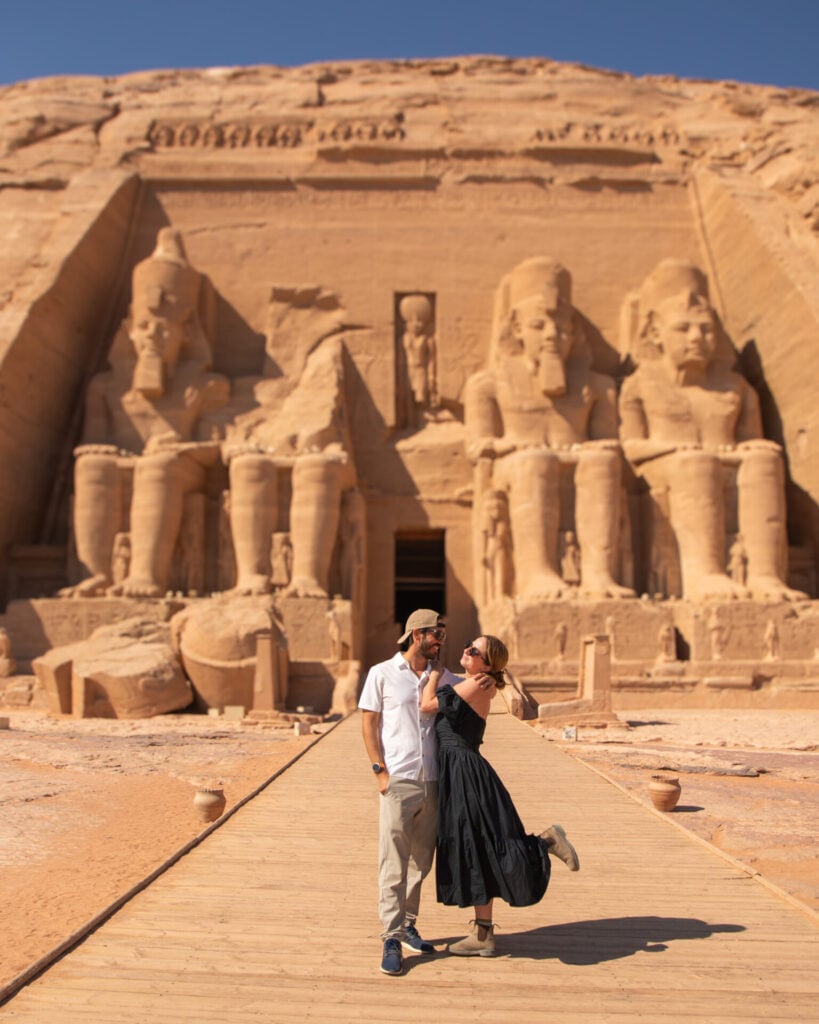
Set on the shores of Lake Nasser near Egypt’s southern border with Sudan, Abu Simbel is one of the most iconic temple complexes in the entire country. It’s a long day trip from Aswan (involving 6hrs in the car or return domestic flights), but if you can time your arrival to avoid the crowds, I honestly think Abu Simbel is worth the effort!
To that end, this is one of my top recommendations: skip the classic 5am tour bus departure from Aswan! Instead, leave around 8am so you can get to the site at 11am, after the majority of early visitors have left but before the domestic flight crowd arrives.
All of the photos I’ve shared here were taken from 11am-midday (notice the lack of people!), while the photo with the lake and increasing crowds (below) was taken around 12.15pm as the site started to pick up again. Chat to a local guide to confirm seasonal timing of this mid-morning lull so you can enjoy the temple without crowds!
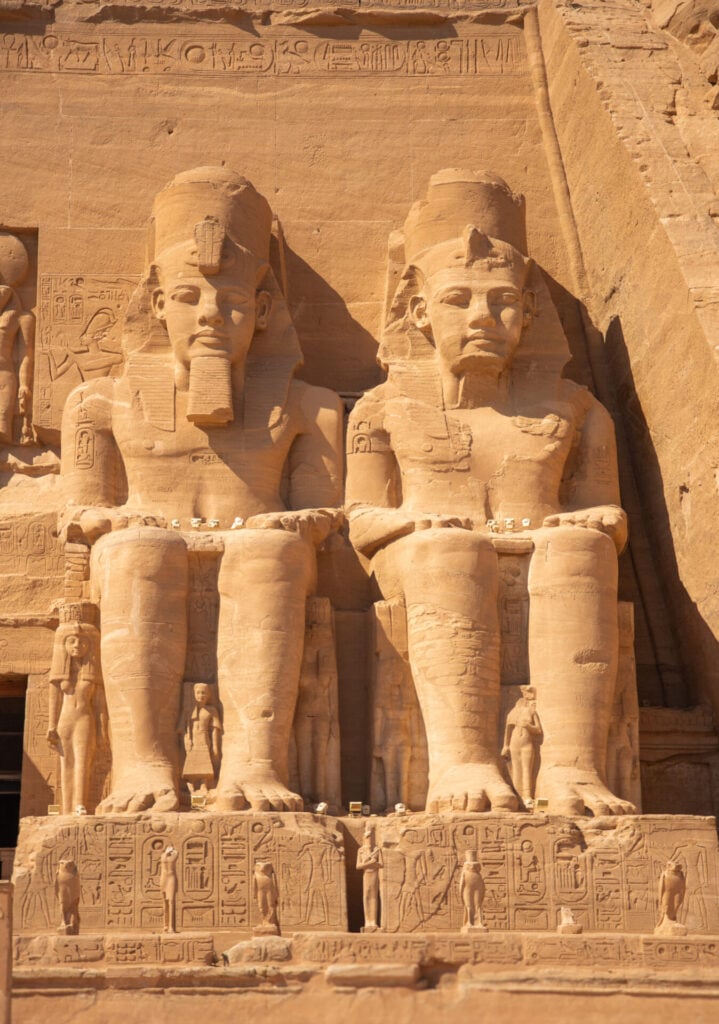
Built by Ramesses II in 1260 BCE, Abu Simbel is instantly recognisable for its four colossal 20m-tall statues of the pharaoh carved directly into the rock face— a display of power designed to intimidate anyone approaching from the south.
During his 66-year reign, Ramesses II built more monuments and temples than ANY other pharaoh, and you’ll see his likeness plastered all over ancient Egypt, including six 18m-tall statues at Luxor Temple and an 83-ton granite statue now housed in the foyer of the Grand Egyptian Museum in Giza. He’s one of the best-known and most iconic pharaohs of ancient Egypt, remembered also for transforming Egypt into a military and political superpower during the height of the New Kingdom.
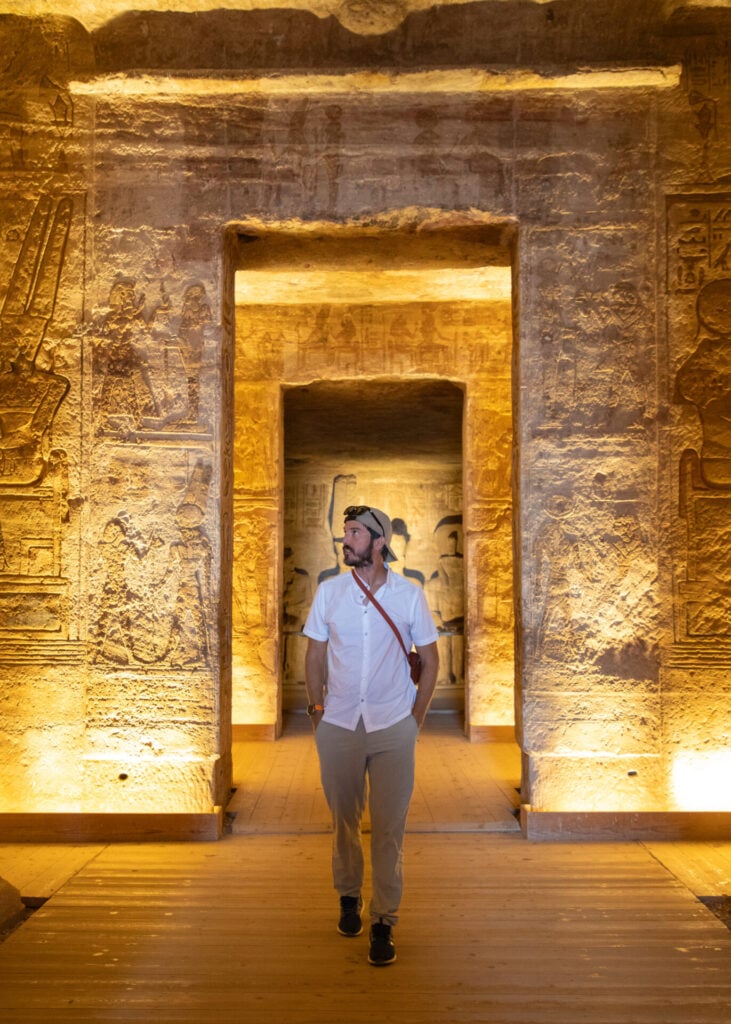
Beyond the dramatic façade, Abu Simbel is a remarkable example of ancient Egyptian astronomical mastery. The entire temple was aligned so that, on just two days each year (believed by some to be Ramesses II’s birthday and coronation day), the rising sun penetrates the inner sanctuary, illuminating the gods within— all except for Ptah, god of the underworld, who remains in darkness.
You can visit during this alignment to witness it for yourself, but the Holy of the Holies is also visible (unilluminated) every day of the year.
📐 RELOCATION OF ABU SIMBEL IN THE 1960s
When the construction of the Aswan High Dam threatened to submerge Abu Simbel beneath the rising waters of Lake Nasser, engineers and archaeologists from more than 50 countries came together to dismantle the entire complex, cut it into thousands of massive blocks, and then painstakingly reassemble it 200m inland.
This 4-year UNESCO-led project is widely considered one of the greatest archaeological rescue efforts in history. And yet, even with modern engineering, the famous solar alignment now occurs about one day later than it used to— a testament to the incredible precision achieved by the original builders more than 3,000 years ago!
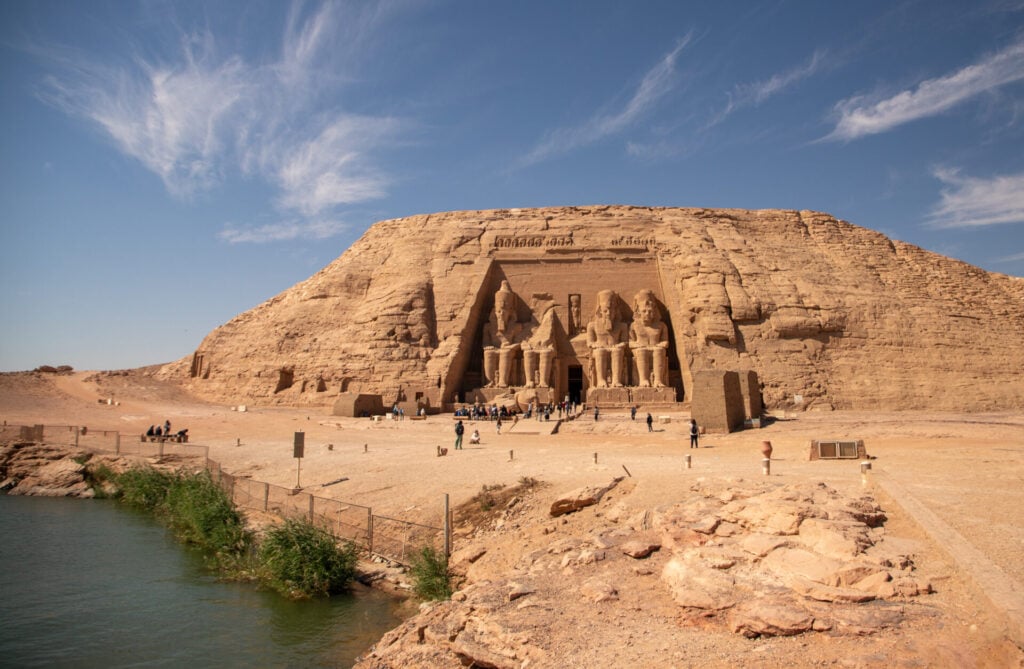


Abu Simbel highlights
- Great Temple façade: the four colossal statues of Ramesses II carved directly into the cliff are the tallest standing pharaonic statues in Egypt (at 20m!)
- Holy of the Holies: the sacred inner chamber is precisely aligned so that sunlight penetrates deep into the temple on just two days each year, illuminating the statues of Ra-Horakhty, Amun-Ra, and Ramesses II (deified as a god), while the god of the underworld, Ptah, remains in darkness— a remarkable astronomical accomplishment
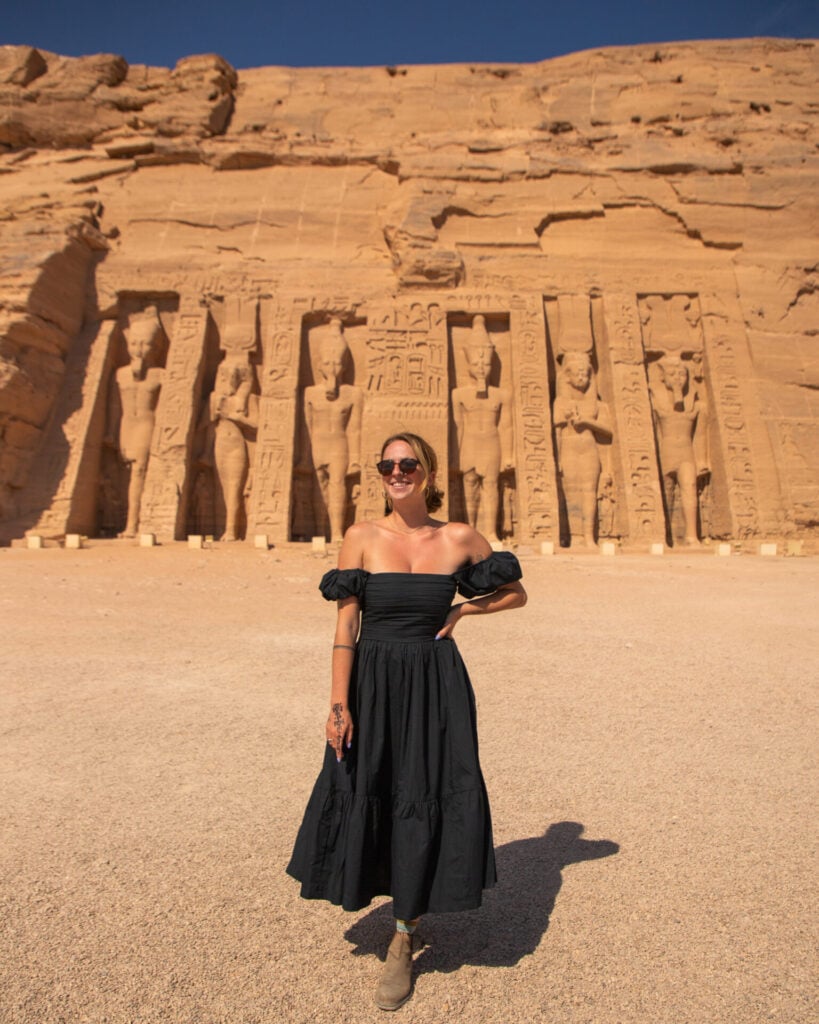
- Temple of Nefertari: this smaller temple adjacent to the Great Temple was dedicated to Queen Nefertari, Ramesses II’s most beloved wife, and is one of very few temples in Egypt built to honour a royal wife alongside a pharaoh
2 | Esna Temple
- Location: Esna (1hr south of Luxor)
- When to visit: anytime
- What makes it special: the most vibrant, colourful interior of any temple
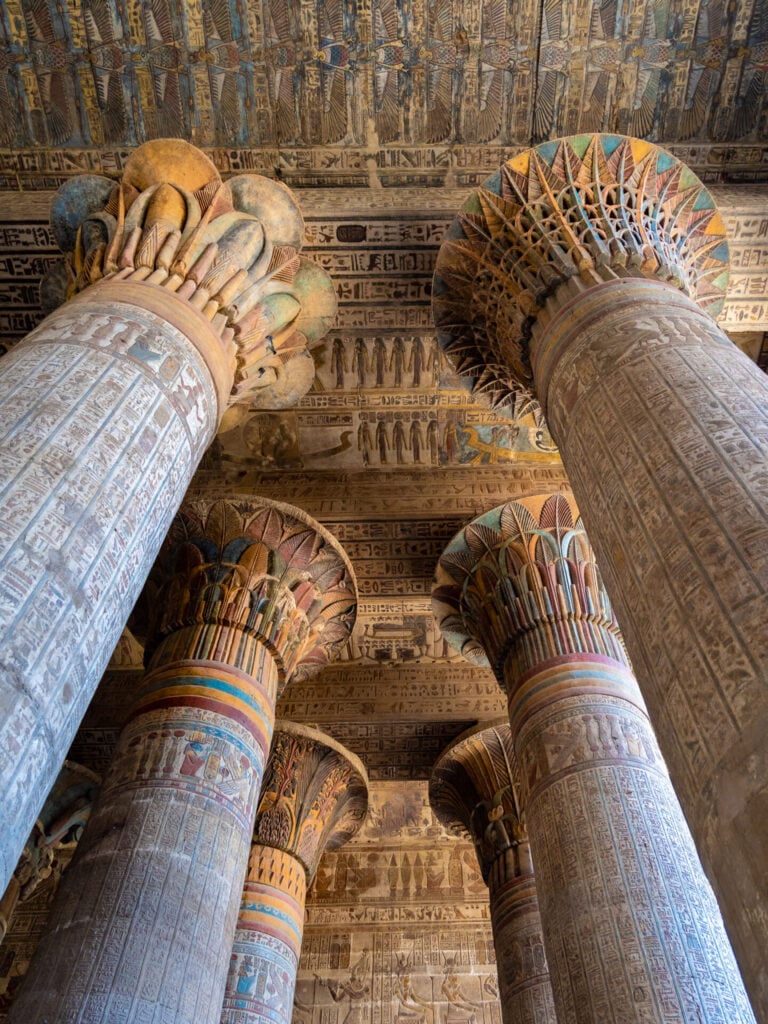
Overlooked by tour groups and blissfully off the classic Nile Cruise route, the Temple of Khnum in Esna receives hardly any visitors— but it boasts the most vibrant original colours of ANY Egyptian temple and offers a rare glimpse into what these spaces would have looked like thousands of years ago. Although small, Esna Temple is a true hidden gem and one of my all-time favourites!


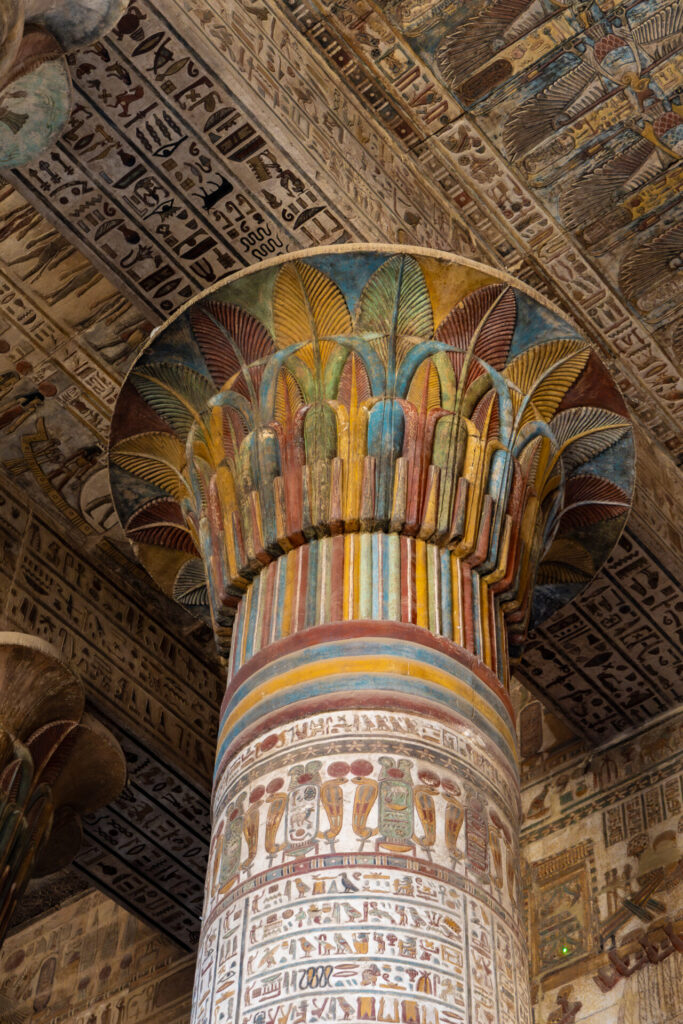
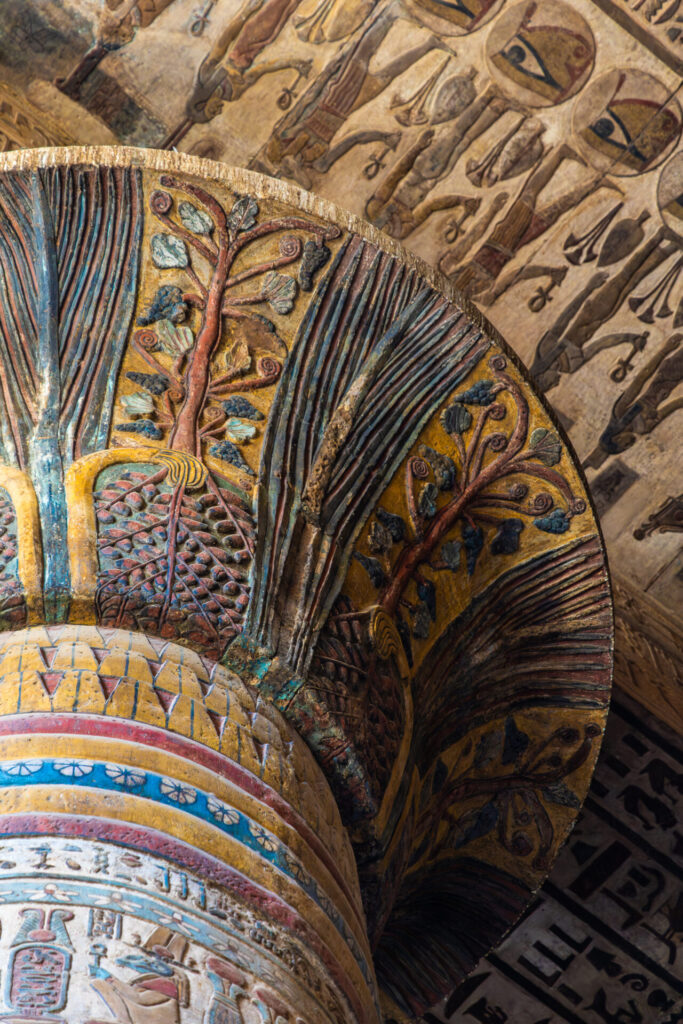
Dedicated to Khnum, the ram-headed god of creation, Esna is famous for its richly decorated ceiling and the ornate floral capitals crowning each column of the Hypostyle Hall. The original temple complex was far larger, but only this magnificent hall remains visible today, with the rest buried beneath the modern town of Esna.
>>> Esna isn’t included on classic Nile Cruise itineraries, but it IS featured on trips with Nour el Nil! Read my review of this incredible luxury sailing trip from Esna to Aswan.
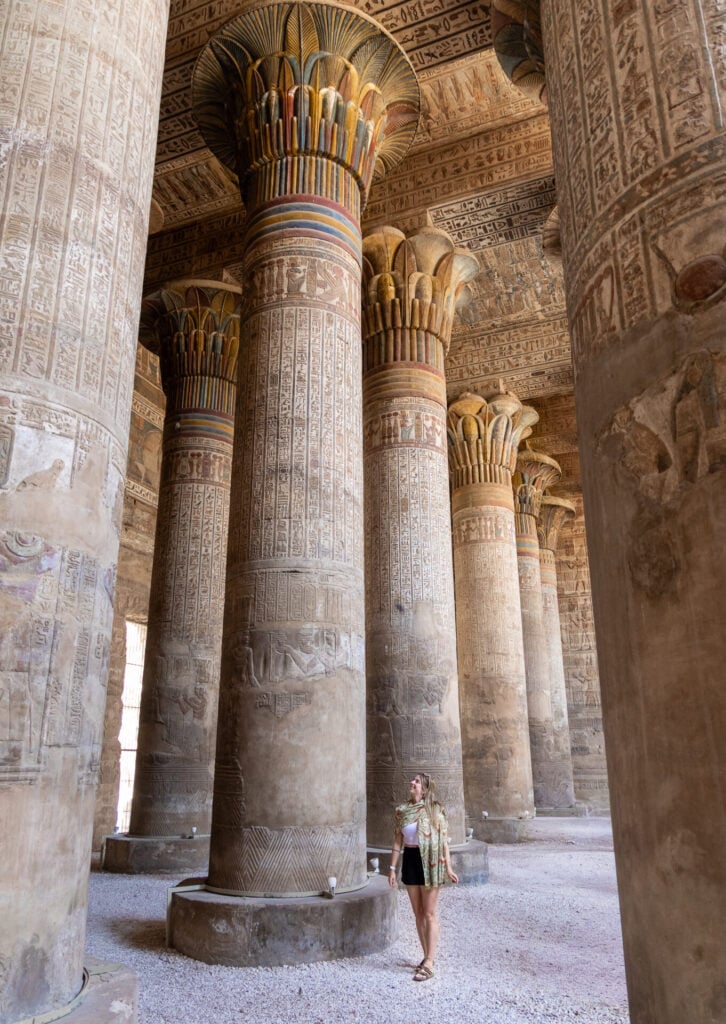
During their original construction, nearly all of the temples in Egypt were decorated in rich colours, produced by grinding colourful minerals such as malachite, turquoise, and ochre into fine powders and mixing them with eggs to form paint. And yet, thousands of years of sun exposure, flooding, accumulated soot, and general neglect have stripped most sites of their once-vibrant appearance.
This is what makes Esna so unique: recent restoration work successfully removed centuries of dust and grime to reveal vivid blues, fiery reds, brilliant yellows, and intricate astronomical scenes that had been hidden for generations, and which truly have no equal anywhere in modern Egypt!
Esna Temple highlights
- Hypostyle Hall: the only excavated structure from the once-enormous Esna Temple is its courtyard, supported by 24 massive columns, each topped with uniquely decorated capitals and covered in detailed hieroglyphic inscriptions
- Esna Zodiac: look UP in the Hypostyle Hall to see the richly restored astronomical scenes in vibrant colours that make this temple so unique, including zodiac constellations, planets, and celestial deities
3 | Karnak Temple
- Location: Luxor (East Bank)
- When to visit: 6-8am for lowest crowds + best lighting
- What makes it special: the largest religious complex in the entire world
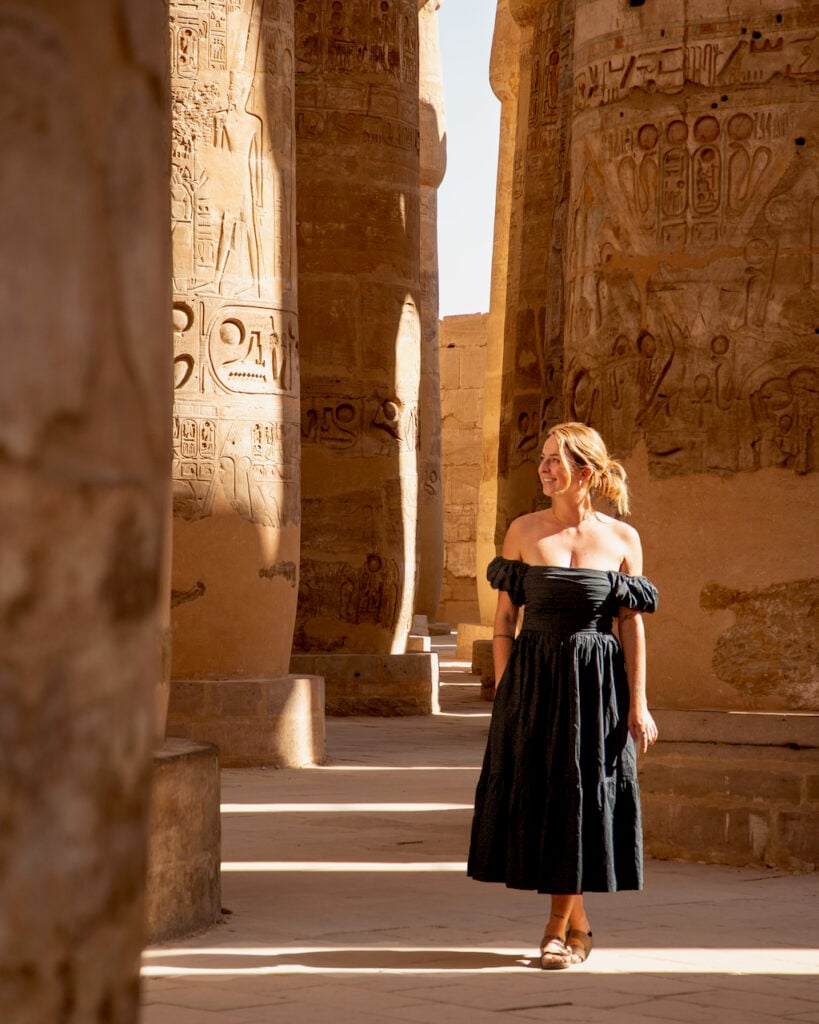
Karnak Temple was the most important religious site in ancient Egypt, dedicated primarily to the god Amun-Ra, and is still today the largest religious complex EVER constructed anywhere in the world!
This is not just a single temple, but a vast complex of sanctuaries, pylons, and chapels originally built 4,000 years ago (c. 2000 BCE) and continually expanded over a period of more than 2,000 years by as many as 30 different pharaohs.
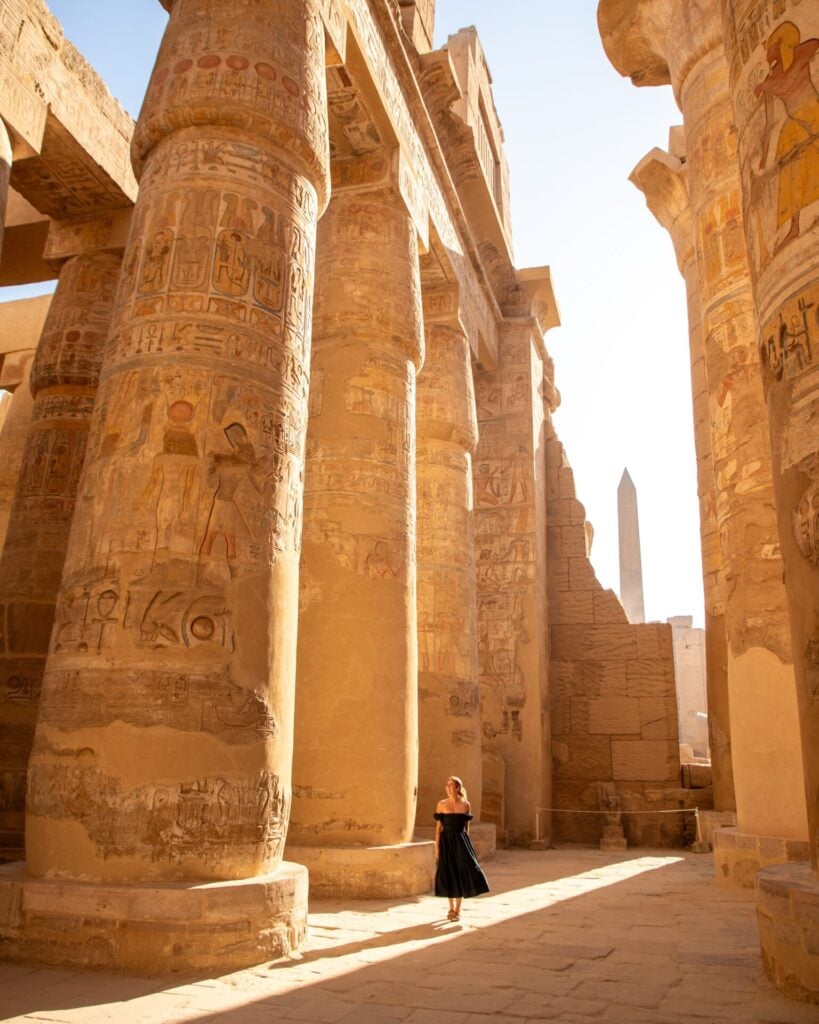
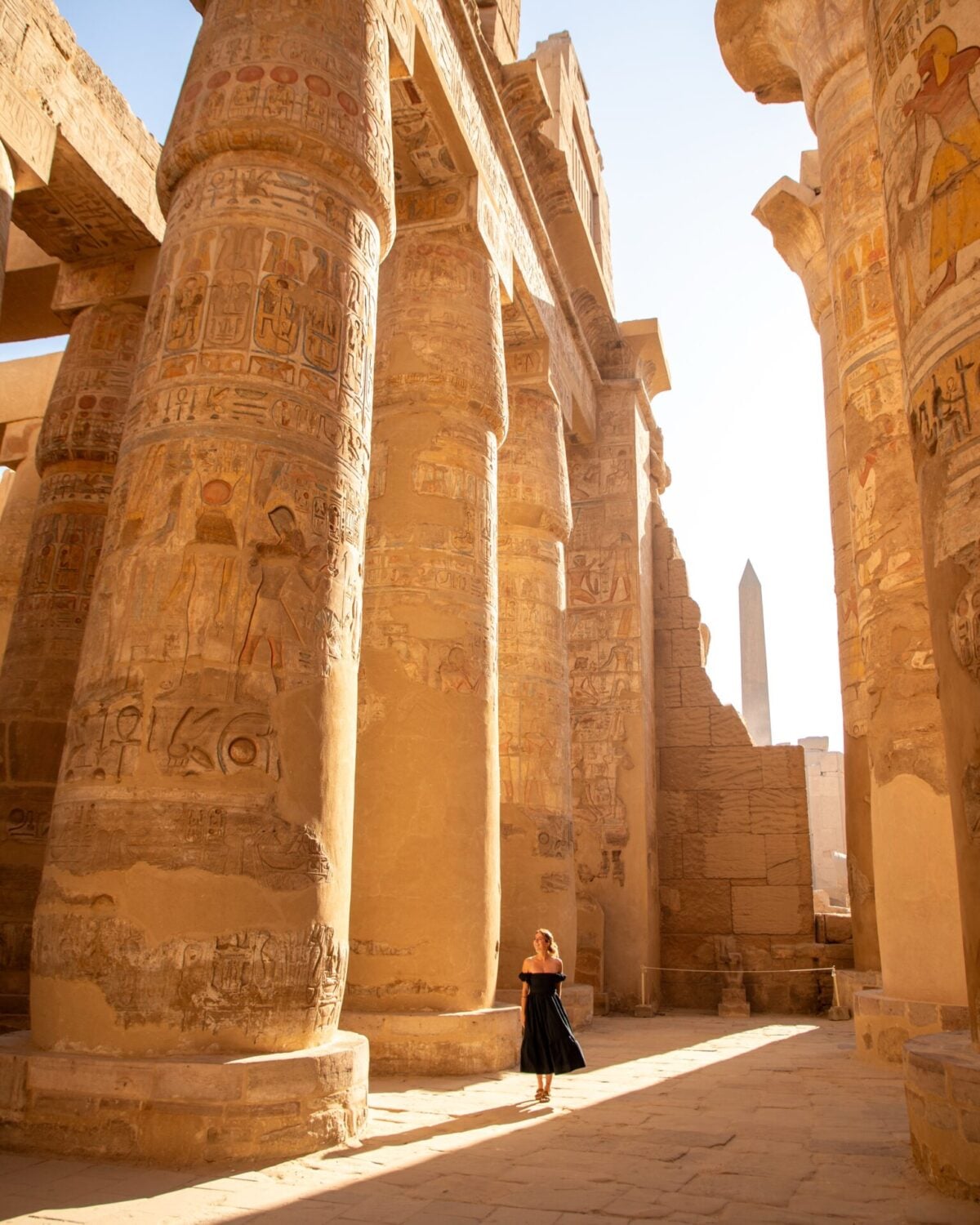
Easily one of the most breathtaking sites in Egypt and an obvious favourite among photographers, Karnak Temple is immense in scale, yet still remarkably intricate and well preserved. The Hypostyle Hall is its crown jewel, with 134 towering columns arranged in a monumental forest of stone unlike anything else in Egypt— if you want photos here without the crowds, aim to arrive before 8am.
>>> Read my complete Luxor travel guide for recommendations on the best temples and tombs to visit, where to stay in Luxor, and how to hire a local guide!


Karnak Temple highlights
- Great Hypostyle Hall: the highlight of Karnak and one of the most extraordinary architectural spaces in the world, this vast hall contains 134 massive columns, each reaching over 20m high and covered in intricate carvings and hieroglyphs
- Obelisk of Hatshepsut: carved from a single piece of red granite, this 30m obelisk erected 3,500 years ago by Queen Hatshepsut is the tallest ancient obelisk still standing in Egypt, meant to symbolise the connection between the gods and the pharaohs
- Sacred Lake: a large ceremonial lake used by priests for ritual purification, offering a quieter and more reflective corner of the temple complex
- Scarab of Amenhotep III: near the Sacred Lake, this large stone scarab is associated with the morning form of the sun god, Atum-Khepri— walk 10 anticlockwise circles around the beetle for luck!
4 | Kom Ombo
- Location: Kom Ombo (on the standard Nile Cruise route and Nour El Nil)
- When to visit: sunset/after-dark to see the temple dramatically illuminated
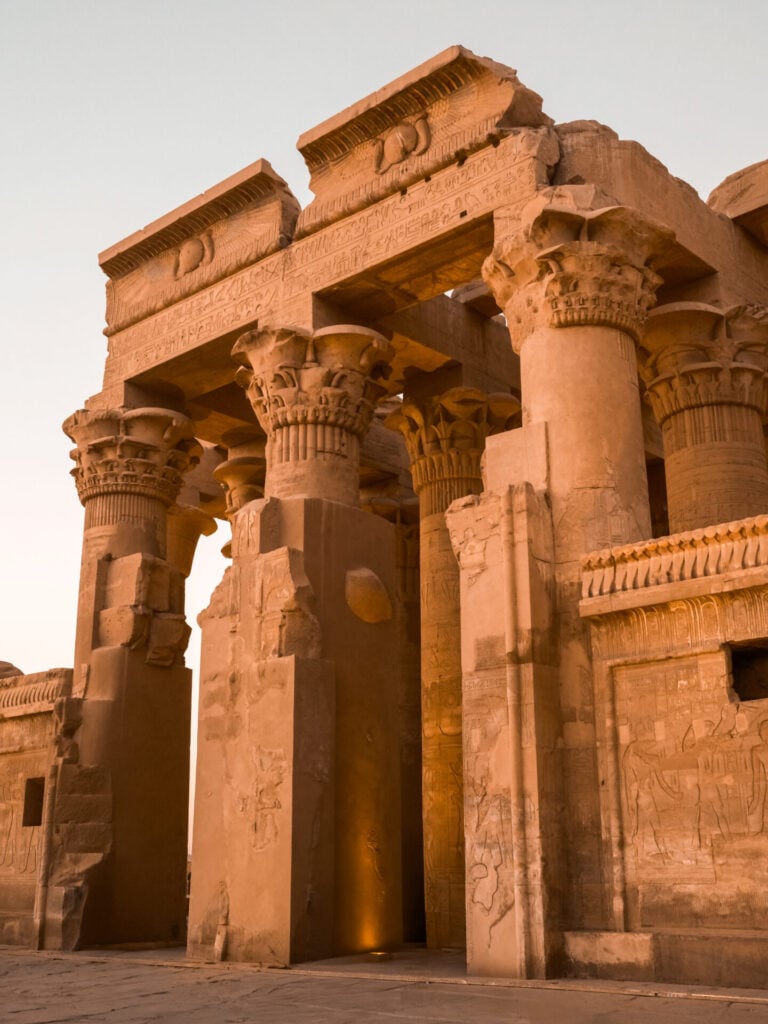
- What makes it special: a perfectly symmetrical double temple dedicated to two gods
Set right on the banks of the Nile and featured on almost every river cruise itinerary, Kom Ombo is the only temple in Egypt dedicated to two gods: Sobek, the crocodile god associated with the Nile and fertility, and Horus the Elder, the falcon-headed god of kingship.
The entire temple is built in a perfectly mirrored layout, with two entrances, two hypostyle halls, and two sanctuaries running side by side, and it’s richly decorated with some of the most striking engravings in Egypt.
>>> We’ve done 3 different Nile Cruises in the last 3 years— read my complete guide to choosing the BEST Nile Cruise experience and my detailed review of sailing in a dahabiya with Nour El Nil!
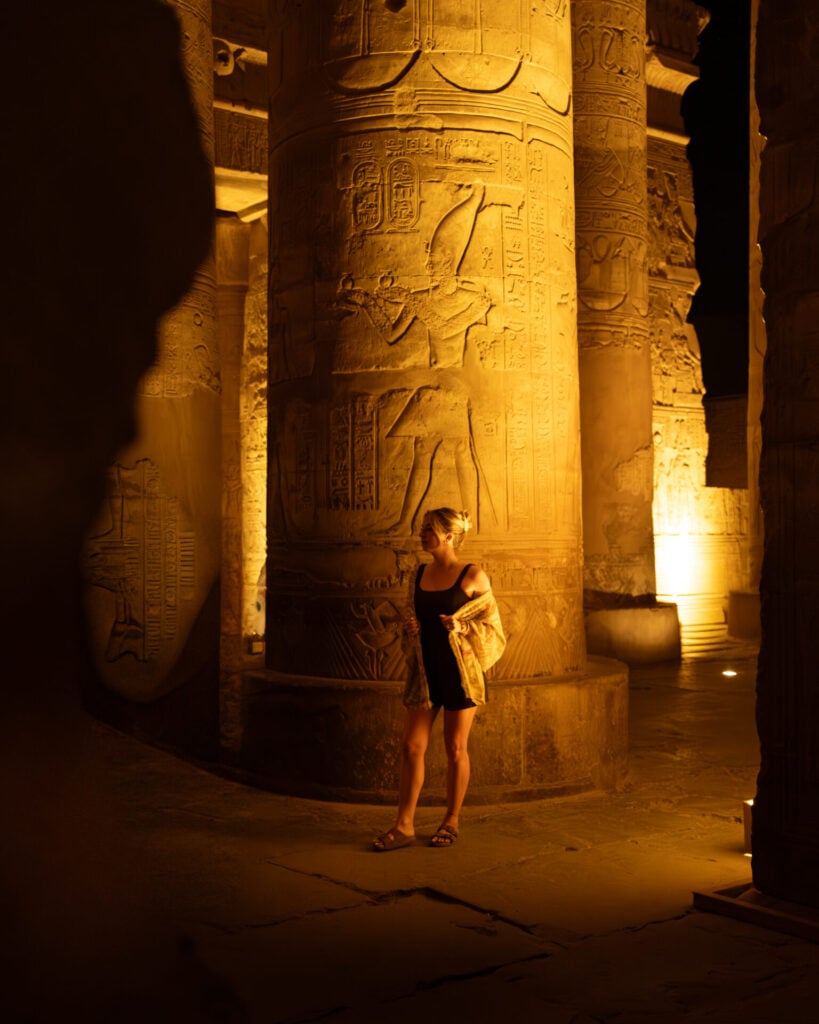
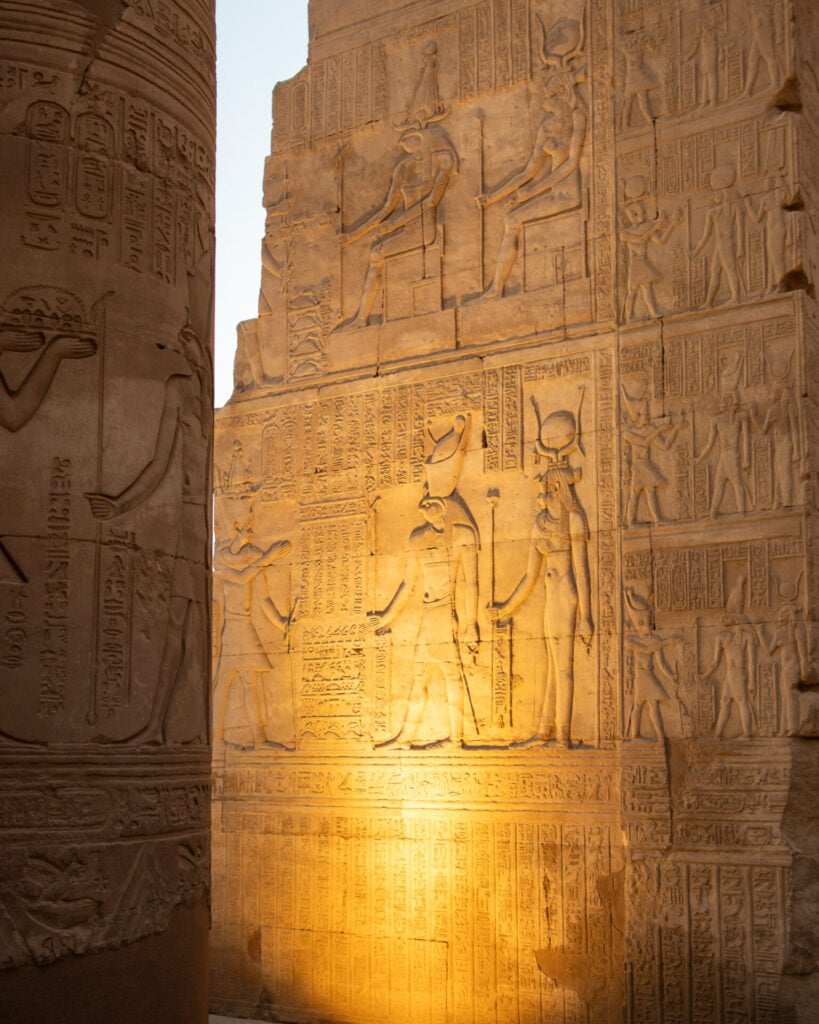
Though it can get painfully busy during high season, it’s one of our favourite temples in Egypt for the details of daily life preserved so beautifully on its walls, including a detailed festival calendar, descriptions of medical instruments used by the ancient Egyptians, and countless depictions of Sobek, the crocodile god.
When lit from below after dark, the inscriptions are thrown into dramatic relief and the stories seem to pop right off the stone!


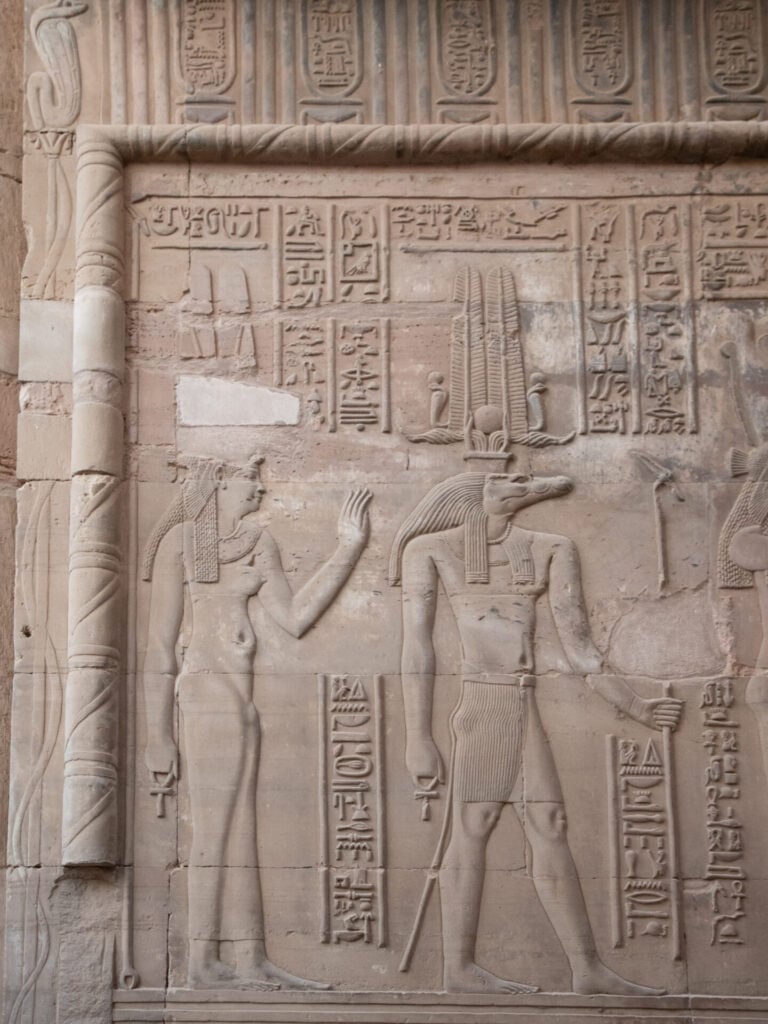
Ancient life in Egypt was almost entirely shaped by the rhythms of the Nile, its floods bringing both sustenance and destruction— and that duality is beautifully reflected throughout Kom Ombo. Even its construction on this particular stretch of the Nile, once inhabited by crocodiles, was intended to honour the crocodile god Sobek who was both revered AND feared as a symbol of the river’s life-giving force.
The river giveth and the river taketh away, the ancient Egyptians may have said.


Kom Ombo highlights
- Outer Hypostyle Hall: a dramatic columned entrance with a rare symmetrical layout featuring mirrored halls dedicated separately to Sobek and Horus
- Festive calendar: an elaborately carved 360-day calendar structured around the Nile’s three seasons (flooding, growing, and harvest) that offers insight into the rhythm of daily life 3,000 years ago
- Medical reliefs: at the back of the temple, intricate carvings depicting surgical instruments and medical tools are some of the earliest known representations of medicine in ancient Egypt
- Crocodile Museum: make sure to check out the small on-site museum displaying dozens of mummified crocodiles, highlighting the worship of Sobek and the temple’s connection to the Nile
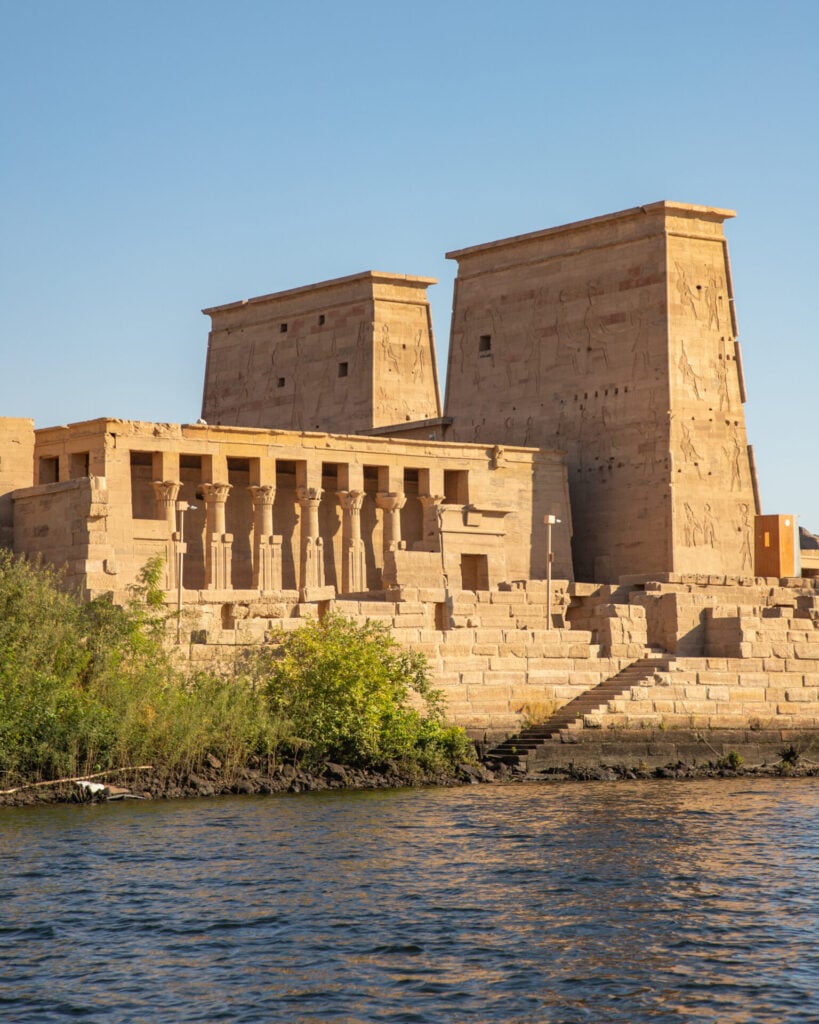
5 | Philae Temple
- Location: Aswan (Agilkia Island)
- When to visit: early morning or late afternoon for softer light + fewer crowds
- What makes it special: island temple accessible only by small wooden boats
Set on a lush island in the middle of the Nile, Philae is one of the most visually striking temple settings in Egypt. Approaching by water feels positively cinematic, with the temple rising from the river amidst palm trees and granite boulders, and it offers a completely different experience than other temples on this list!
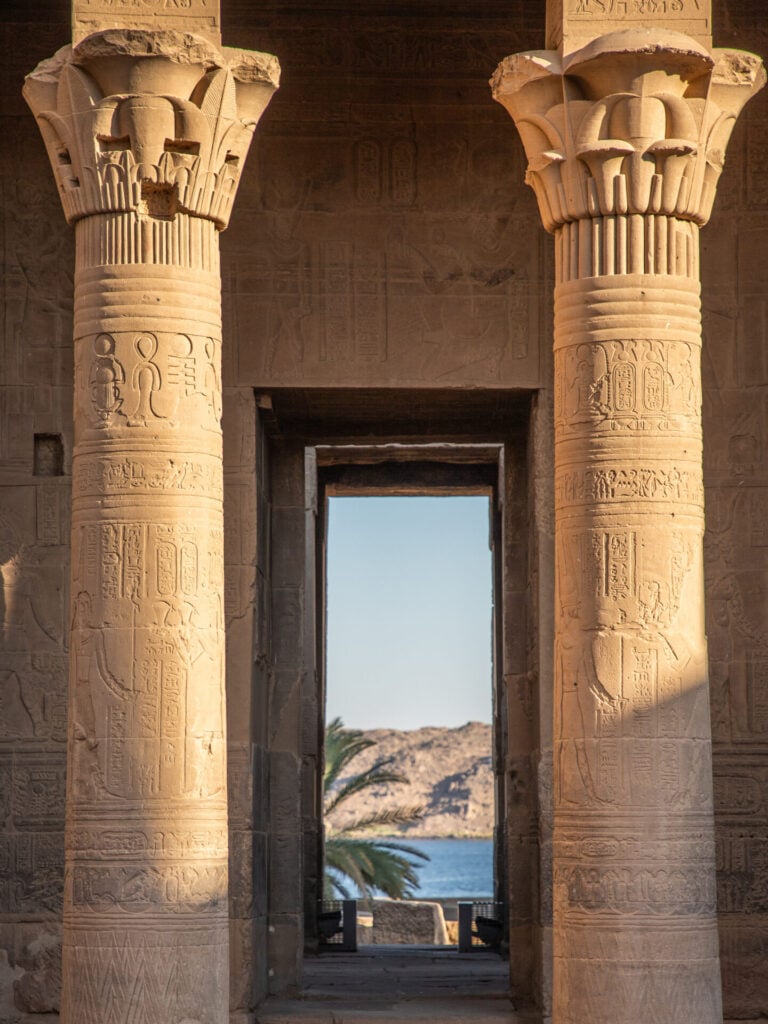
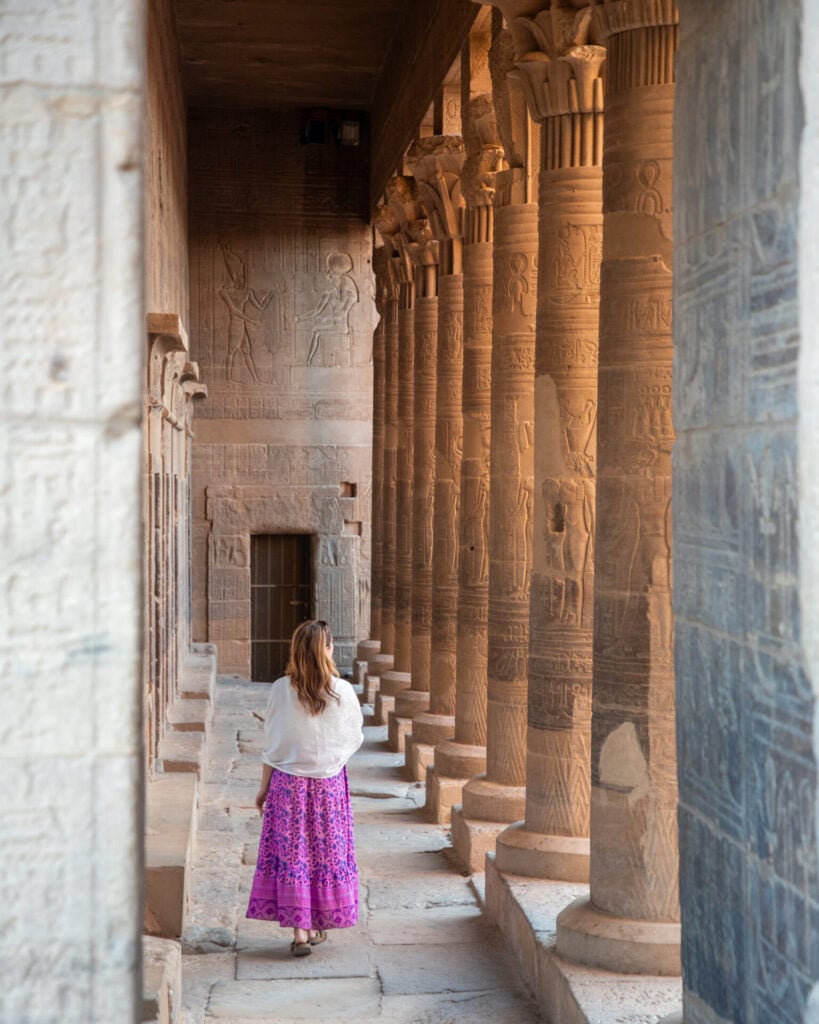
Dedicated to Isis, goddess of magic, motherhood, and healing, Philae was one of the last active religious centres in ancient Egypt. Even today, the temple is considered one of the world’s great “energy centres” among a very specific crowd of reiki healers.
As Christianity spread across Egypt in the 5th–6th centuries, many of the temple’s carvings of Isis were deliberately defaced (as in the left photo below), and you can still see crosses etched into the stone walls from this period (right photo below). This isn’t unique to Philae, and it’s honestly heartbreaking to see how early Christianity endeavoured to erase Egyptian polytheism, defacing its gods and repurposing its temples in an effort to stamp out older belief systems.


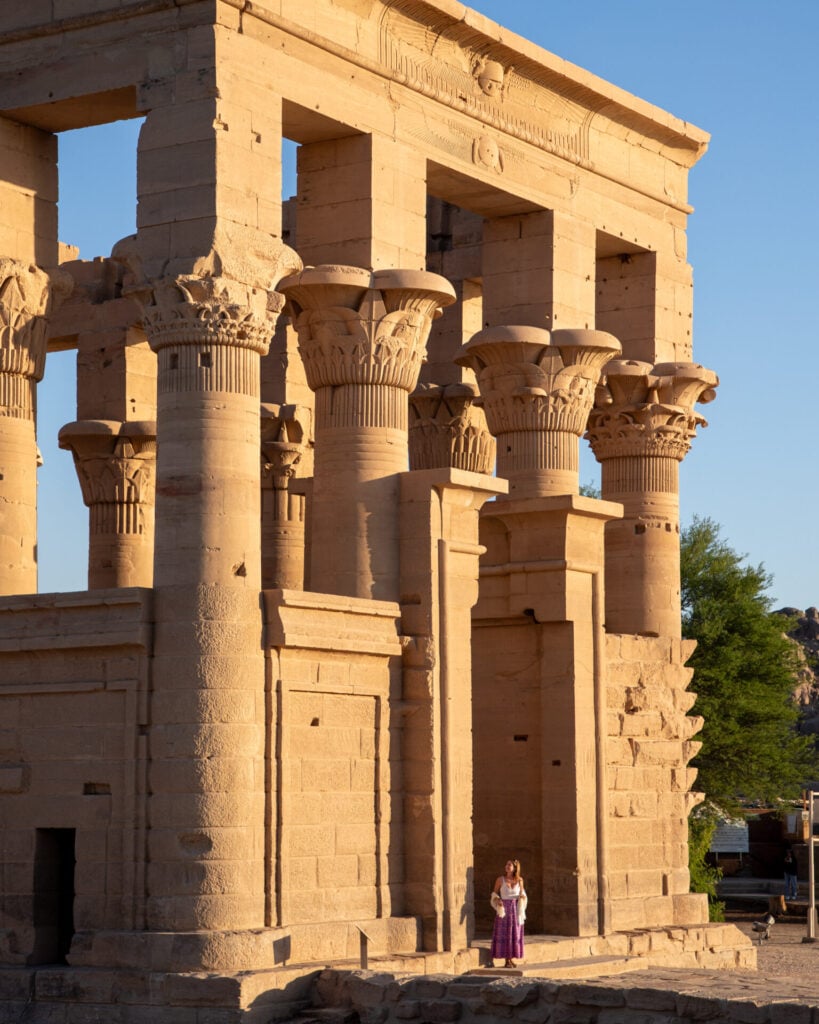
Like Abu Simbel, Philae was also relocated in the 20th century to save it from flooding after the construction of the Aswan High Dam. The entire complex was carefully moved from its original home on Philae Island to nearby Agilkia Island, where it sits today.


Philae Temple highlights
- Temple of Isis: the main sanctuary of Philae is dedicated to the goddess Isis and contains beautifully preserved reliefs depicting the myth of Isis and Osiris
- Colonnade: a shaded walkway of intricately carved columns leading towards the inner sanctuary
- Kiosk of Trajan: an elegant Roman-era riverside pavilion, likely used as a ceremonial landing point for sacred processions— this is a gorgeous spot for photos!
6 | Dendera Temple of Hathor
- Location: Dendera (1hr north of Luxor)
- When to visit: mid-morning offers the best lighting
- What makes it special: the most vivid and best-preserved temple artwork in Egypt
Outside of Luxor and off the Nile Cruise route, the 2,000-year-old Dendera Temple is something of a hidden gem— yet it’s one of the best-preserved temples in Egypt and one of my absolute favourites!
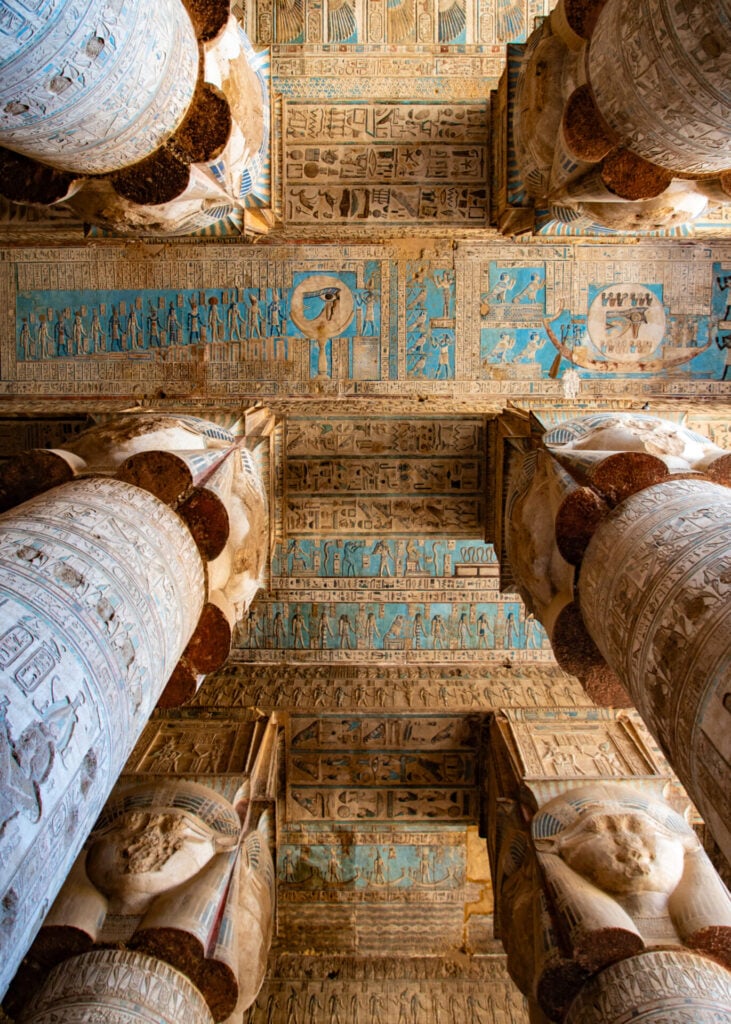
Second only to Esna Temple, Dendera still retains remarkably vivid colours dating back to its original construction, especially on the ceilings and upper walls. But unlike Esna, this is a truly massive site that contains dozens of chapels, chambers, sanctuaries, and even an unrivalled network of crypts that are ALL covered with spectacular detail!
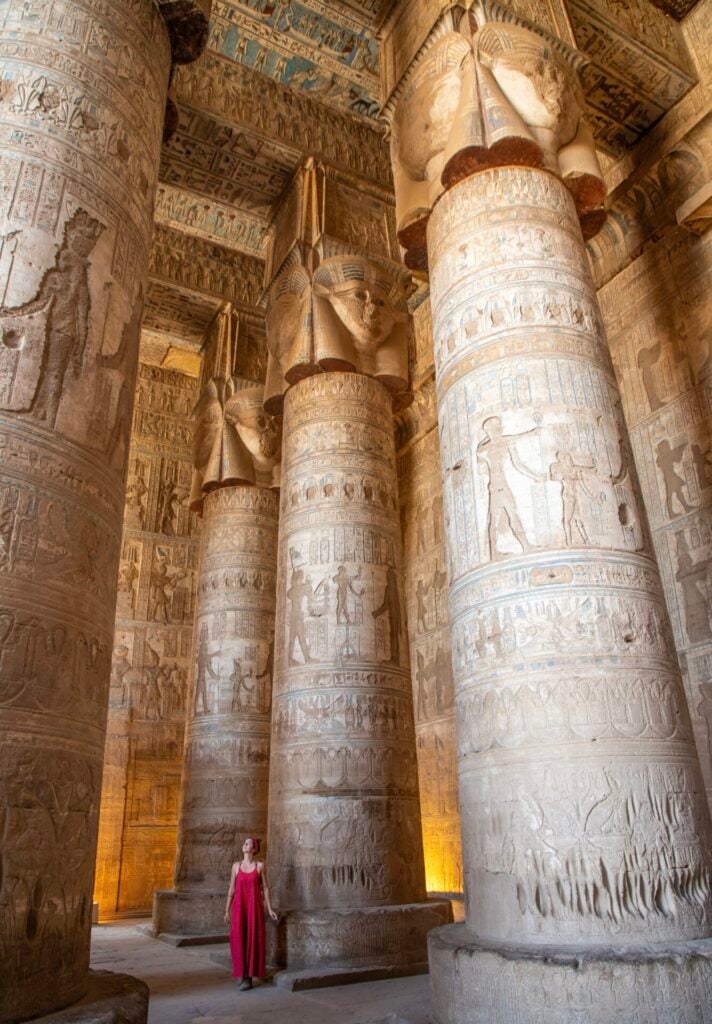
Dendera’s main temple is dedicated to the goddess Hathor, and she appears throughout as a serene, round-faced woman with cow ears, symbolising motherhood, protection, and divine femininity.
Beyond her imagery, the complex is filled with heaps of beautifully preserved artwork, and exploring Dendera feels interactive (like a giant playground for adults who are obsessed with ancient Egypt) and totally unique from other temples on this list!
Even Edfu, which is widely credited as the “best preserved” temple in Egypt, doesn’t compare in terms of the quantity and quality of art spread across hidden crypts, rooftop chapels, and a spectacular ceremonial staircase.


Dendera Temple highlights
- Hypostyle Hall: the spectacular entrance hall features massive columns topped by Hathor-headed capitals and ceilings covered in vibrant astronomical scenes—one of the most colourful temple interiors you’ll see anywhere in Egypt!
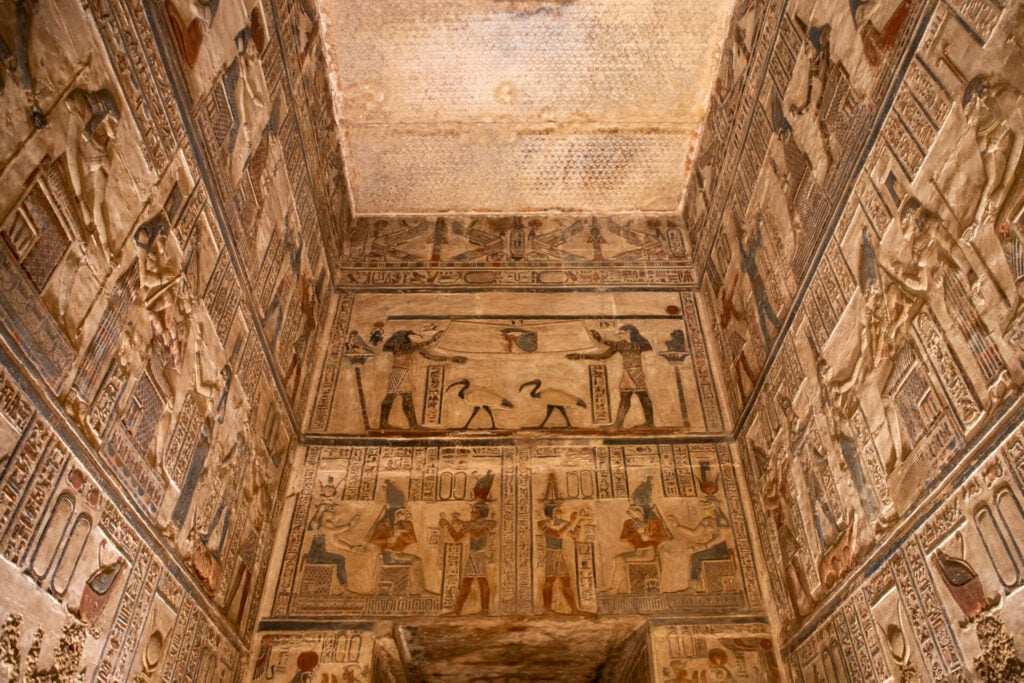
- Inner Chamber reliefs: beyond the main hall, explore a series of smaller, semi-enclosed chambers that are completely covered in carvings and hieroglyphs
- Dendera Crypts: a network of hidden underground chambers and narrow passages also decorated with elaborate reliefs— you’ll need to crawl through a narrow entryway to access some of the crypts, but once inside, it’s comfortable to stand
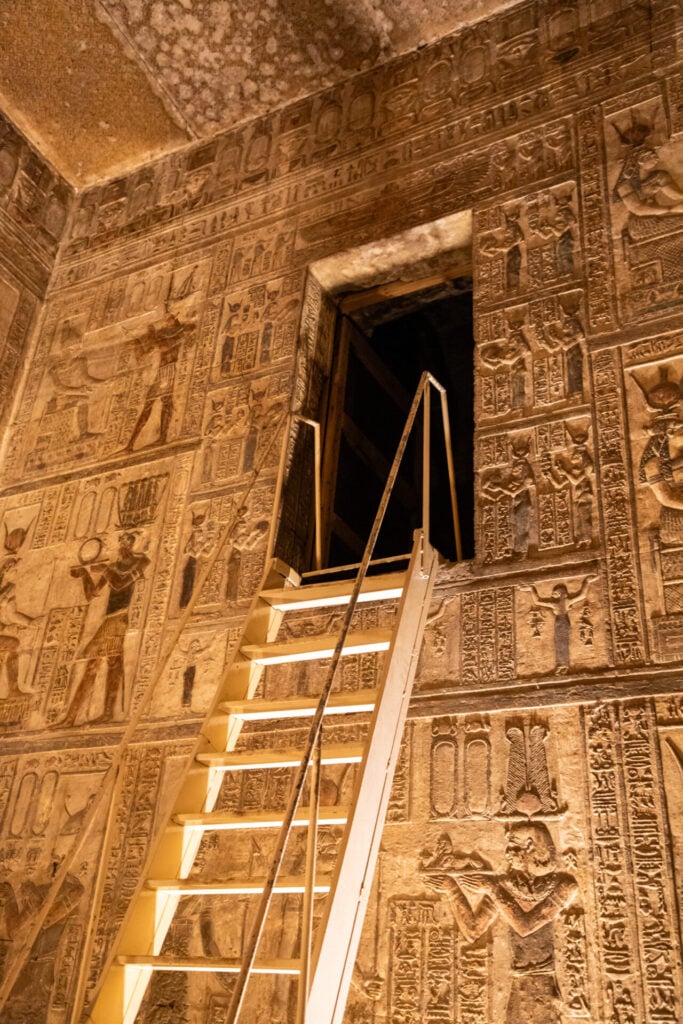
- Processional staircases: one of the most unique features of the temple is an enclosed staircase leading to the temple roof, its walls decorated in detailed scenes of sacred rites
- Dendera Zodiac: in a small chapel dedicated to Osiris on the roof of the temple, the ceiling is covered by a detailed astronomical relief depicting constellations and zodiac signs— the artwork is incredible, but the version you see here is a actually replica, as the original was removed illegally in the 19th century and is now housed in the Louvre in Paris
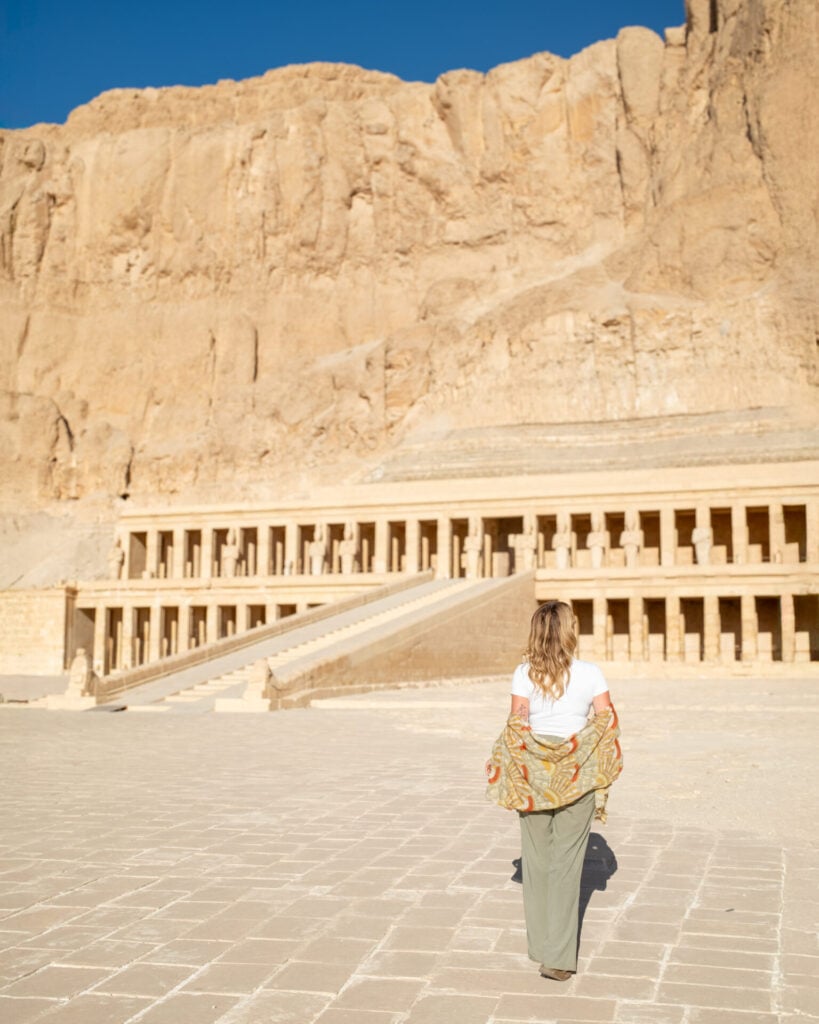
7 | Temple of Hatshepsut
- Location: Luxor (West Bank)
- When to visit: early morning for fewer crowds
- What makes it special: a striking terraced temple built for Egypt’s most powerful female pharaoh
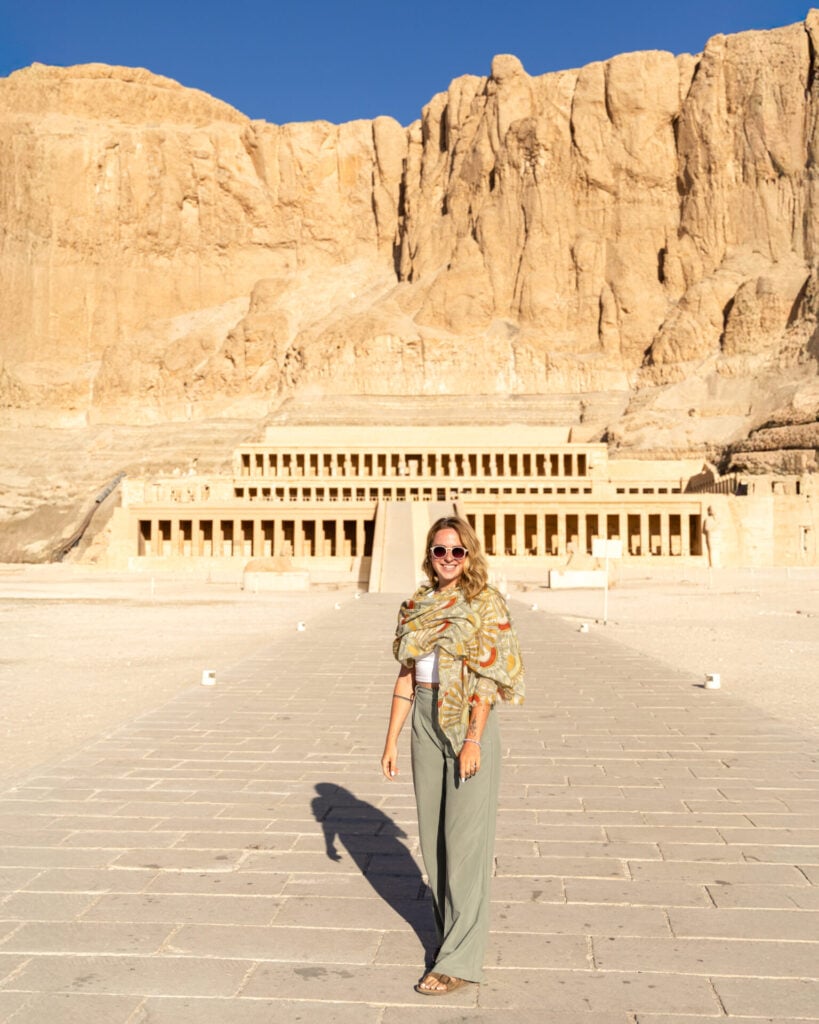
Set dramatically against the mountains of Deir al-Bahari, the Mortuary Temple of Hatshepsut is one of the most visually striking monuments in Egypt and instantly recognisable for its unique 3-terraced architectural style.
The temple is equally remarkable for the ruler it was built to honour: Hatshepsut, a powerful queen who assumed the throne as Egypt’s most powerful female pharaoh in 1473 BCE.
Throughout her 20-year reign, Hatshepsut deliberately portrayed herself in monuments and inscriptions as a male king to align with the established image of pharaonic power.
And although much of Hatshepsut’s legacy was systematically dismantled by her successors in an effort to reinforce traditional male succession, archaeologists were able to reconstruct her story in the 19th century after deciphering new hieroglyphs and uncovering her name across monuments that had been deliberately defaced. Nice try, kings!


For the power structures she subverted (and the all-too-familiar erasure she faced even after death), Hatshepsut has become something of a modern feminist icon. Come for the spectacular architecture, but stay for one of the most compelling stories of female power in ancient history!
>>> Read my complete Luxor travel guide for more recommendations on which temples and tombs to visit, where to stay in Luxor, and how to hire a local guide!
Temple of Hatshepsut highlights
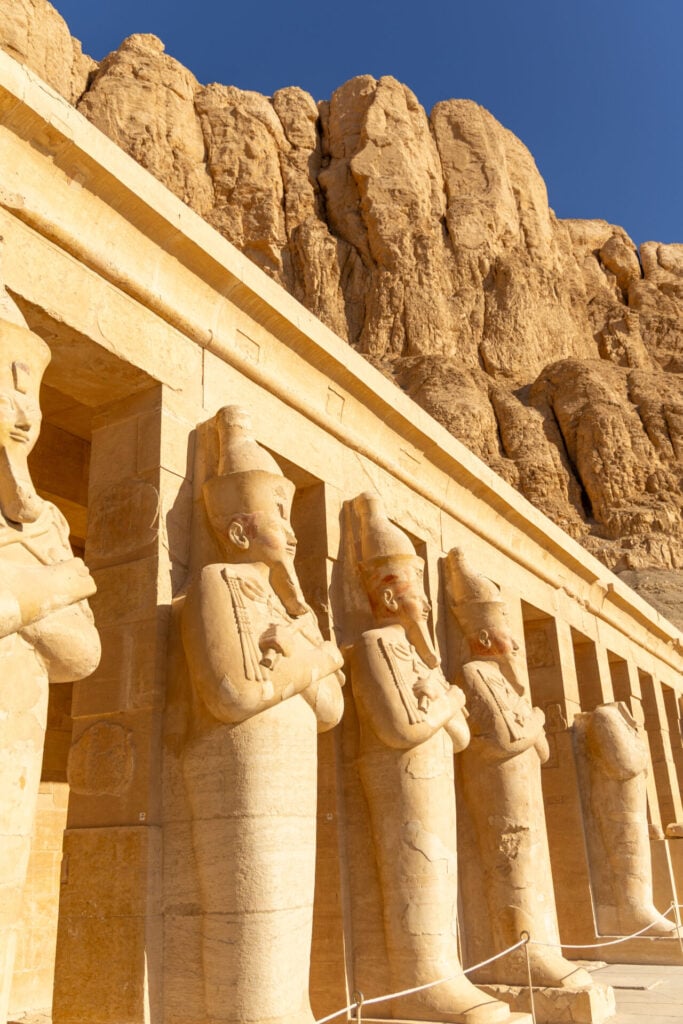
- Osiride Statues of Hatshepsut: the upper terrace features a long row of statues (only 10 remain of the original 26) depicting Hatshepsut standing with her arms crossed as a mummy, symbolising her union with Osiris, god of the underworld and resurrection
- Sanctuary of Amun: carved into the cliff on the upper terrace, this inner sanctuary features a few significant remnants of the vibrant painted reliefs and celestial ceilings that once covered the entire interior
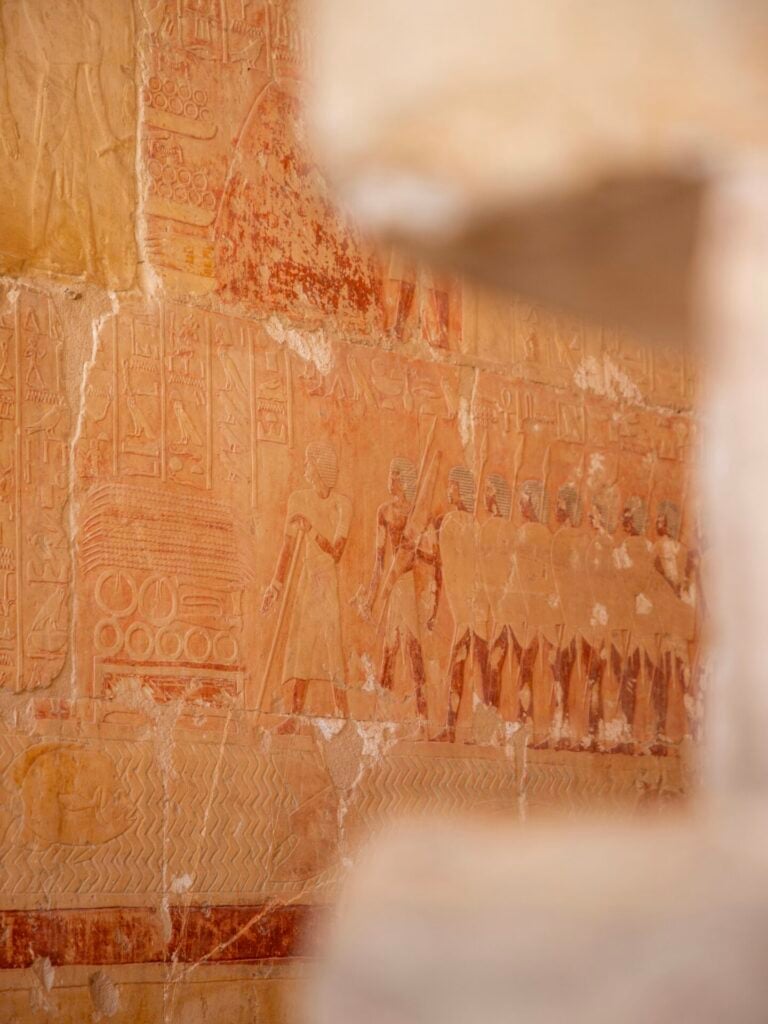
- Reliefs of the Divine Birth & Punt Expedition: these detailed wall carvings on the middle terrace depict Hatshepsut’s divine origin story and her famous trading expedition to the Land of Punt, including ships, incense trees, and exotic goods— some of the most vivid scenes in Egyptian art!
- Hathor Chapel: a small hypostyle hall on the left of the middle terrace is dedicated to Hathor, goddess of love, fertility, and joy— there are some beautifully preserved capitals here depicting Hathor as a round, smiling woman’s face with cow ears (you’ll see her similarly represented at Dendera and Philae)
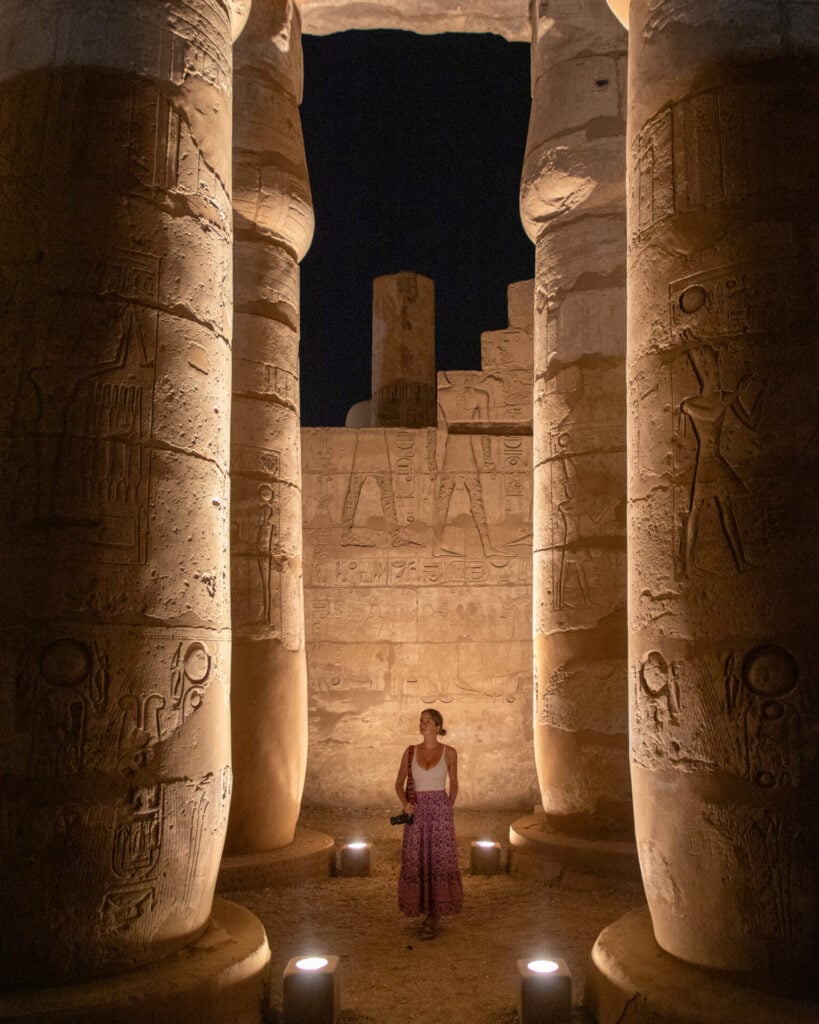
8 | Luxor Temple
- Location: Luxor (East Bank)
- When to visit: 6-8pm when the temple is illuminated after dark
- What makes it special: colossal statues of Ramesses II beautifully lit after dark
Located in the centre of modern Luxor, Luxor Temple is smaller than Karnak but offers a completely different experience. It’s one of only two temples on this list open after sunset (the other is Kom Ombo), and visiting after dark is by far the best way to experience it— the entire complex is dramatically illuminated, creating a far more atmospheric setting!
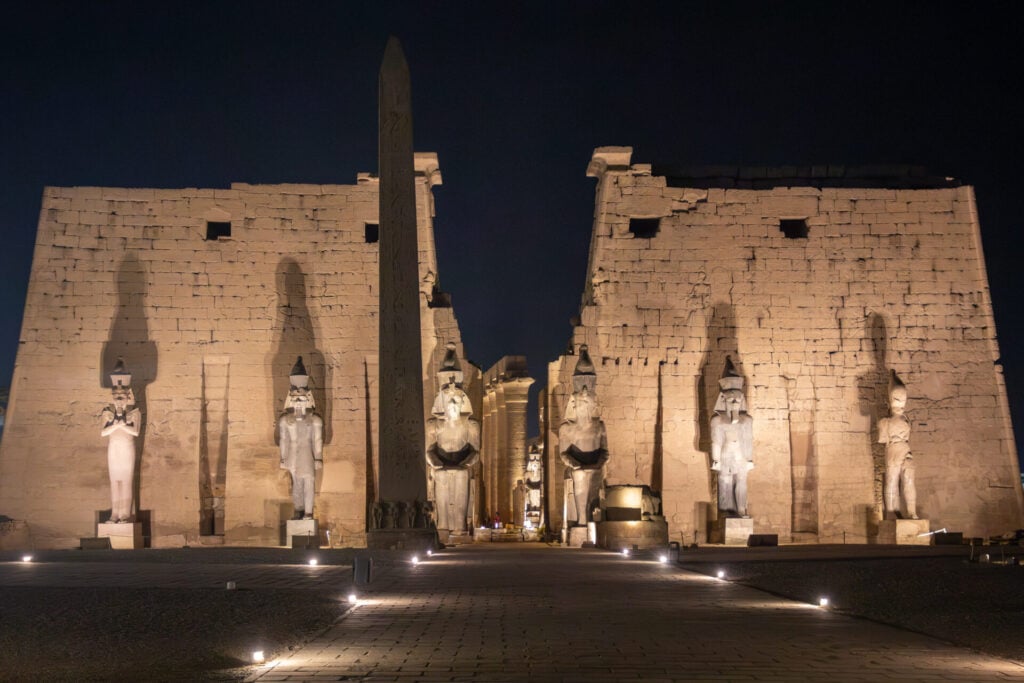
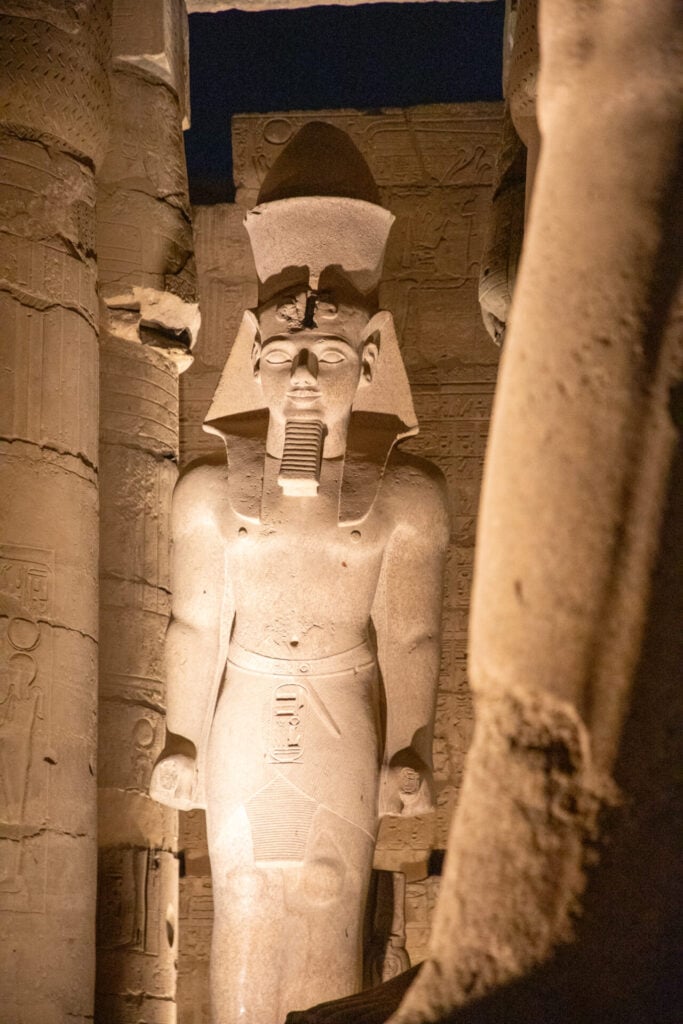
Built primarily by Amenhotep III (c. 1400 BCE) and expanded by Ramesses II, the temple was dedicated to the rejuvenation of kingship rather than a single god. You may recall that Ramesses II built more temples and monuments than any other pharaoh, and Abu Simbel and Luxor Temple are two major contributions to the surviving legacy of ancient Egypt.
Perhaps fittingly, the temple was continuously reused over the centuries, with a Roman-era shrine, a Byzantine church, and later the Abu Haggag Mosque built directly into its structure. This is either a compelling example of a sacred site evolving or a more sinister story of religious and cultural erasure, depending on how you choose to see it.
Luxor Temple highlights
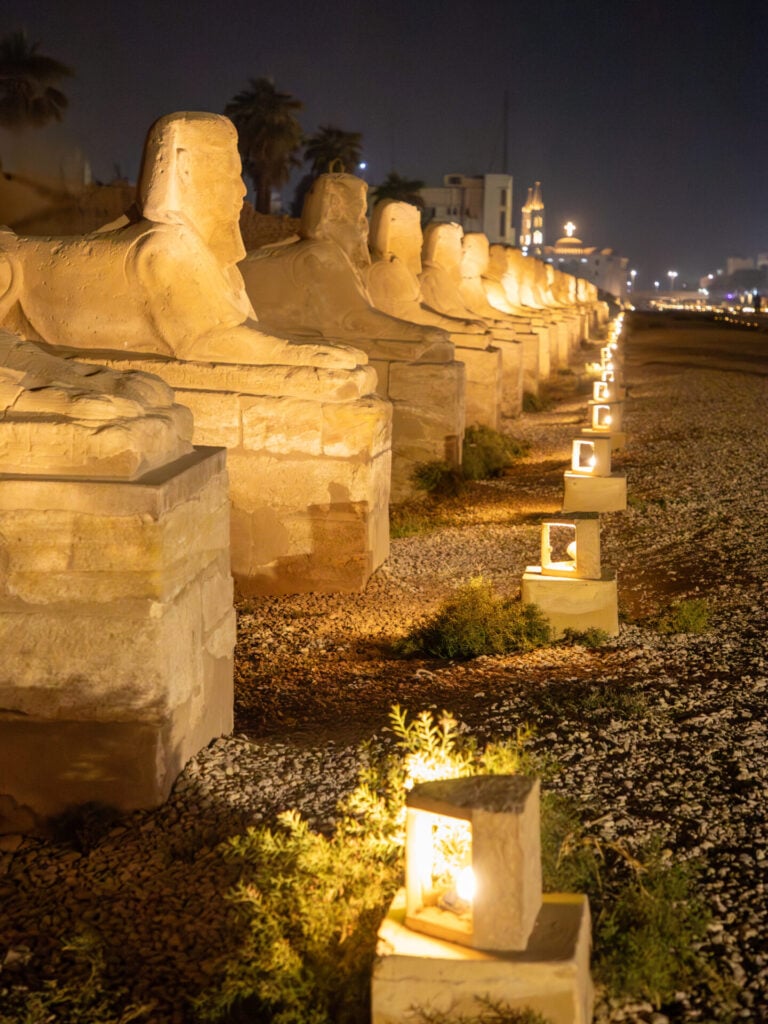
- Avenue of Sphinxes: a 3km ceremonial road connecting Karnak and Luxor, lined with over 1,000 sphinx statues, including ram-headed criosphinxes (associated with the sun god, Amun) and human-headed androsphinxes (representing royal power)— the thoroughfare underwent a massive decades-long restoration project that finally concluded in 2021, but the better-preserved statues are closer to Luxor
- Colossi of Ramesses II: the entrance to Luxor Temple is dominated by six 14m-tall statues of Ramesses II (two seated and four standing), with additional statues and towering columns continuing into the first courtyard
- Amenhotep III Court: the rear courtyard at Luxor contains a scenic perimeter of double columns and two square gardens of 16 columns each— this is a fantastic area to photograph after dark!
- Byzantine-era church frescoes: at the rear of the temple, you can spot faded Christian paintings from a church built here during the Roman/Byzantine period, layered directly over the original Egyptian reliefs
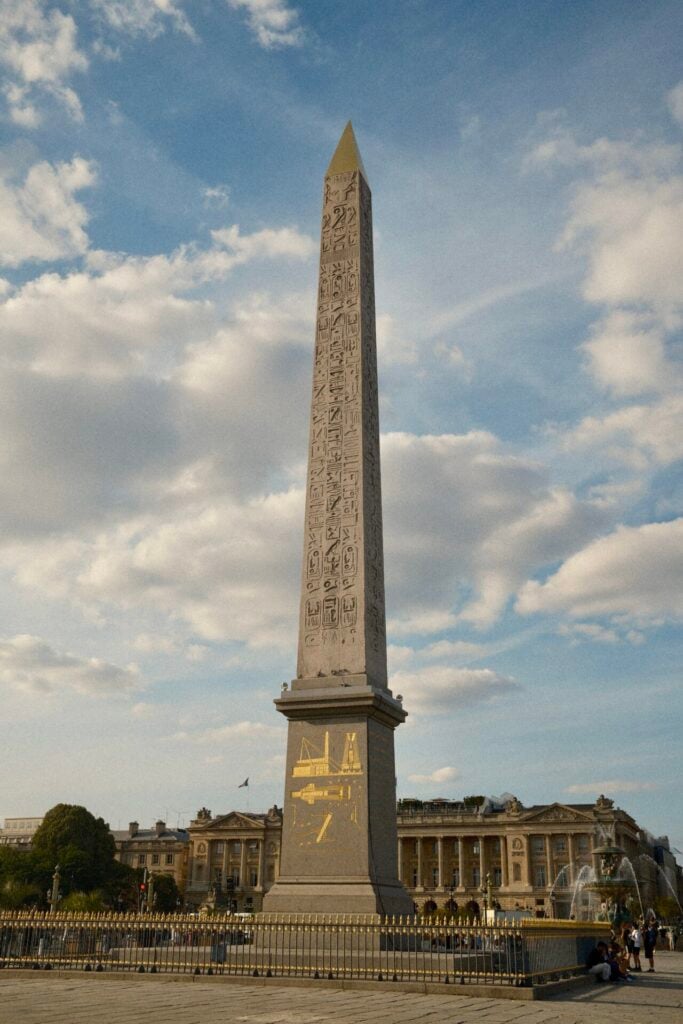
🇫🇷 WHERE IS THE 2nd OBELISK AT LUXOR TEMPLE?
Ancient Egyptians traditionally constructed and erected obelisks in pairs, but you might notice the asymmetrical façade of Luxor Temple and wonder ‘what happened to the 2nd obelisk?!’ At the time of its initial construction by Ramesses II around 1250 BCE, Luxor Temple did indeed have two 25m-tall granite obelisks, but in the early 1800s, the right obelisk was gifted to France as a diplomatic gesture and now stands in the Place de la Concorde in Paris!
We stumbled across the obelisk wandering through Paris last year, and it was so cool to see the missing twin in his new home— thankfully gifted and not stolen, unlike many other Egyptian artifacts.
>>> Sign the international petition to repatriate stolen Egyptian artefacts like the Bust of Nefertiti, Rosetta Stone, and Dendera Zodiac back to Egypt
9 | Medinet Habu
- Location: Luxor (West Bank)
- When to visit: 1-2hrs before sunset
- What makes it special: enormous temple without crowds
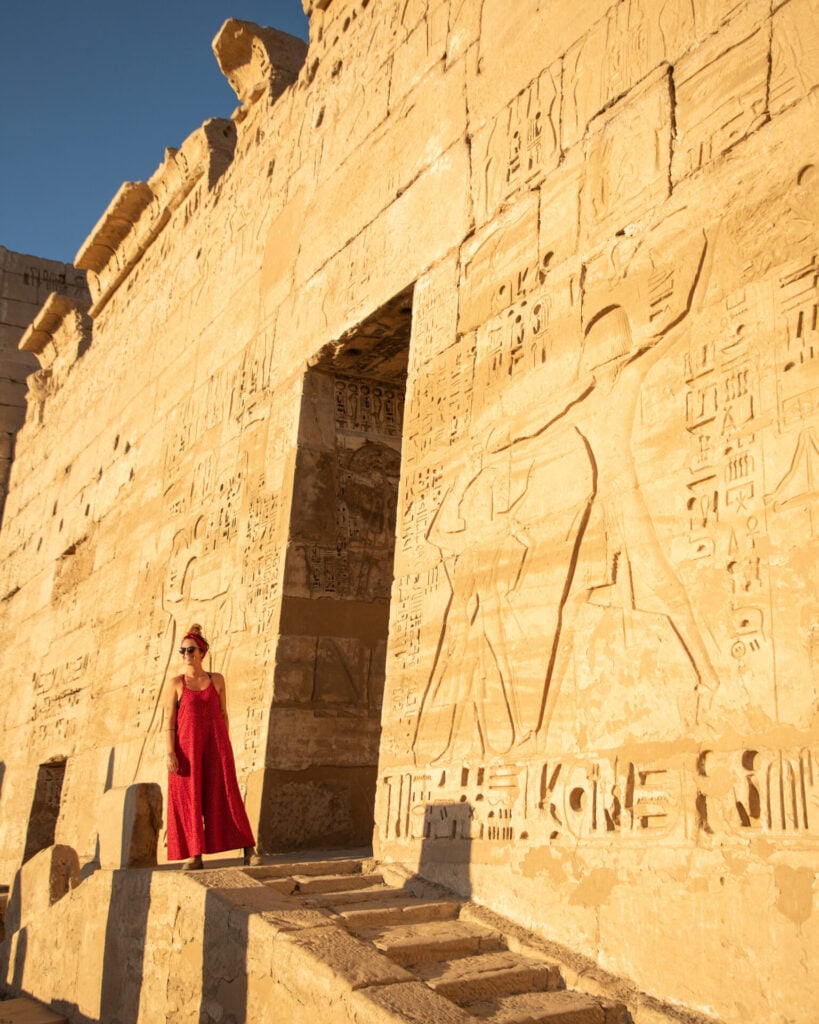
Often overlooked in favour of Luxor’s more famous temples, Medinet Habu is one of the most impressive sites on the West Bank and still something of a hidden gem. Built around 1180 BCE by Ramesses III, this VAST mortuary temple is remarkably well preserved and offers a far more immersive, crowd-free experience than the headline sites.
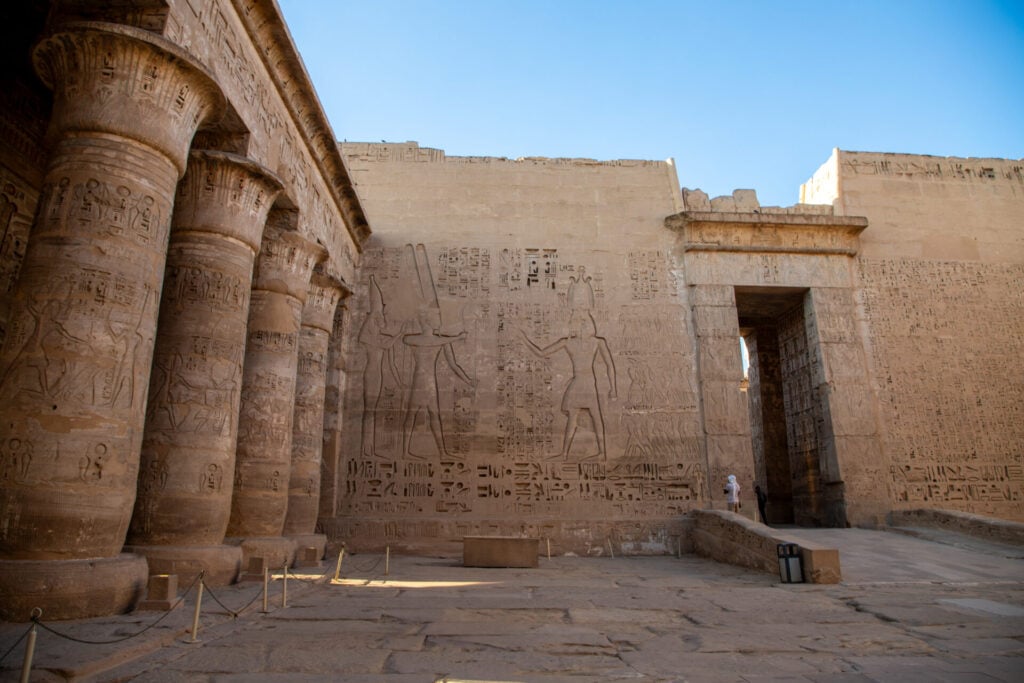
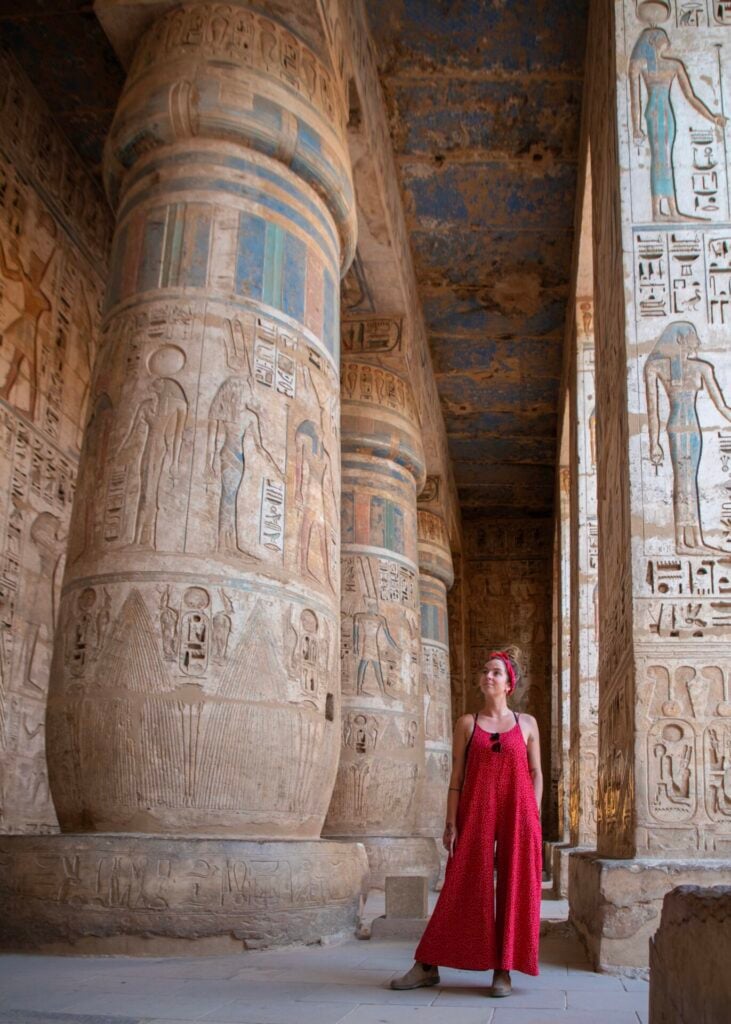
What sets Medinet Habu apart is the level of detail: the walls are covered in deeply carved reliefs that still retain traces of colour, depicting military victories, religious rituals, and scenes of daily life with incredible clarity.
If you want to see something a little more off the beaten path or even explore a temple at your own relaxed pace (without a guide or group), we highly recommend a golden hour visit to Medinet Habu! You can easily walk here from our favourite boutique hotel in Luxor, Malkata House, and spend an hour wandering the grounds and admiring the colourful artwork.


Medinet Habu highlights
- First Pylon: the temple’s rectangular entrance gateway is covered in detailed reliefs of Ramesses III’s military victories
- Peristyle Hall: an open courtyard lined with columns and Osiride statues of Ramesses III (portraying the pharaoh in the form of Osiris, god of the afterlife, was meant to symbolise eternal rebirth)— this is where you’ll find some of the most vivid surviving colour on the ceilings and upper reliefs!
- Migdol Tower: a rare fortified entrance structure inspired by Syrian military architecture, giving the temple a fortress-like appearance unlike most others in Egypt
10 | Edfu Temple
- Location: Edfu (on the standard Nile Cruise route and Nour El Nil)
- When to visit: early morning or afternoon to avoid the 8-11am cruise crowds
- What makes it special: Egypt’s most complete and best-preserved temple complex
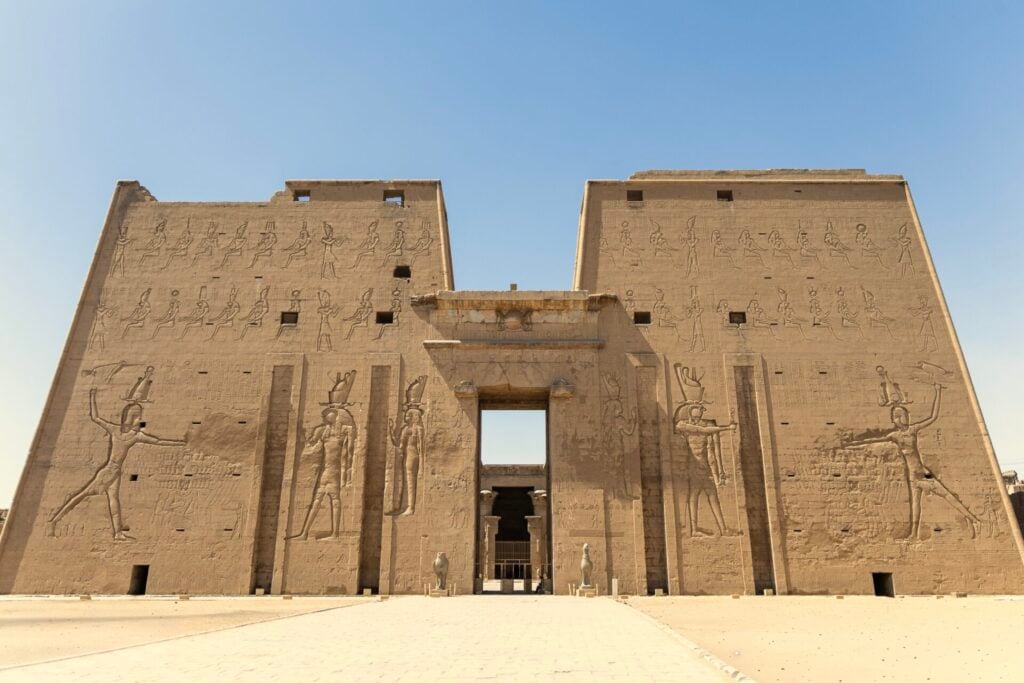
Buried under desert sand until the 1860s and therefore shielded from centuries of erosion and vandalism faced by other ancient structures, Edfu Temple is one of the most complete and best-preserved temples in all of Egypt. Its discovery was pivotal in shaping our current understanding of how Egyptian temples were organised, how religious rituals were performed, and how worshippers interacted with these sacred spaces more than 2,000 years ago!


Built during the Ptolemaic period (237–57 BCE) and dedicated to Horus, the falcon-headed god of kingship and protection, it offers a near-perfect example of a Egyptian temple design, from the monumental entrance pylons and open courtyard to the progressively darker inner halls leading to the sanctuary, where only priests were permitted to enter.
Much like Dendera, Edfu is a spectacular maze of offering rooms covered in detailed artwork. Organised like a spoke around the grand public spaces of the temple, these chambers served as the operational heart of the cult, where priests prepared offerings and ritual equipment before presenting them to Horus in the sanctuary.
Edfu Temple is classic stop along the Nile Cruise route, but because it’s located a short distance off the water, most visitors are transported to the temple by horse-drawn carriage. Unfortunately, conditions for the animals are often poor, particularly in the heat, so we’d highly recommend walking (15–20min) or arranging a private transfer instead!
>>> We’ve done 3 different Nile Cruises in the last 3 years— read my complete guide to choosing the BEST Nile Cruise experience!
Edfu Temple highlights
- First Pylon: a massive, perfectly preserved gateway covered in reliefs of Horus defeating his enemies, leading into a grand open courtyard at the front of the temple
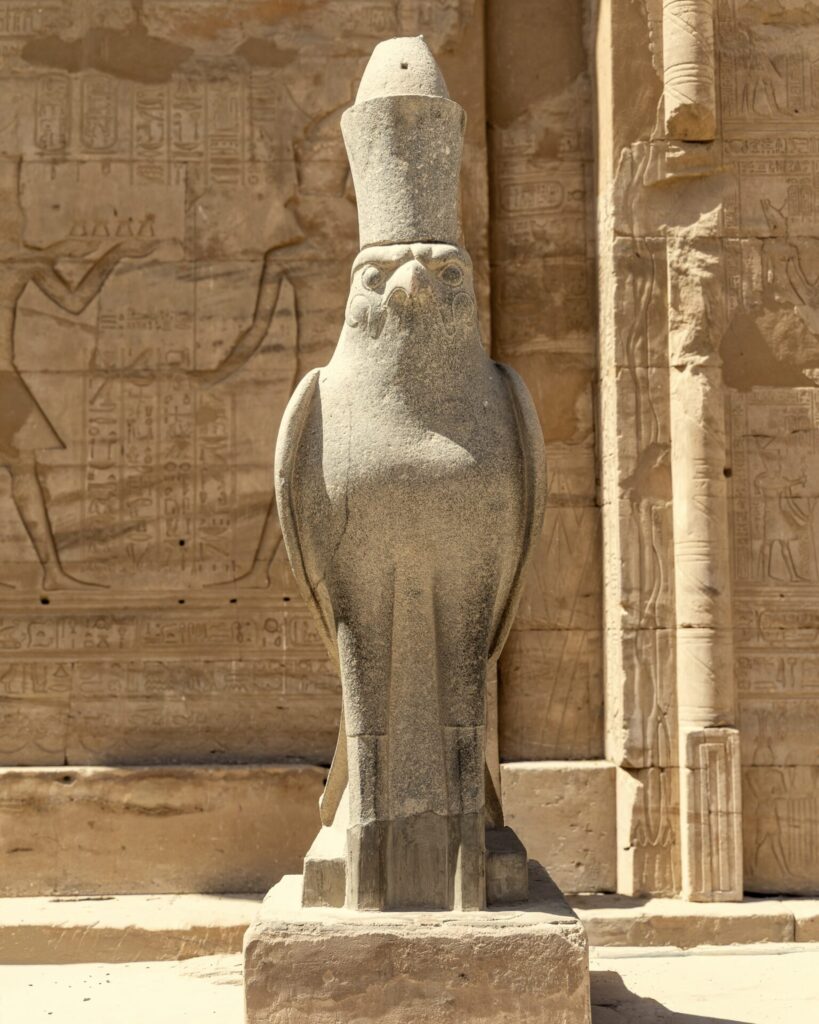
- Statue of Horus: striking black granite falcons stand guard on either side of the 1st and 2nd pylons as you enter the temple— the statue to the left of the 2nd pylon is the best preserved displaying Horus wearing the white crown of Upper Egypt
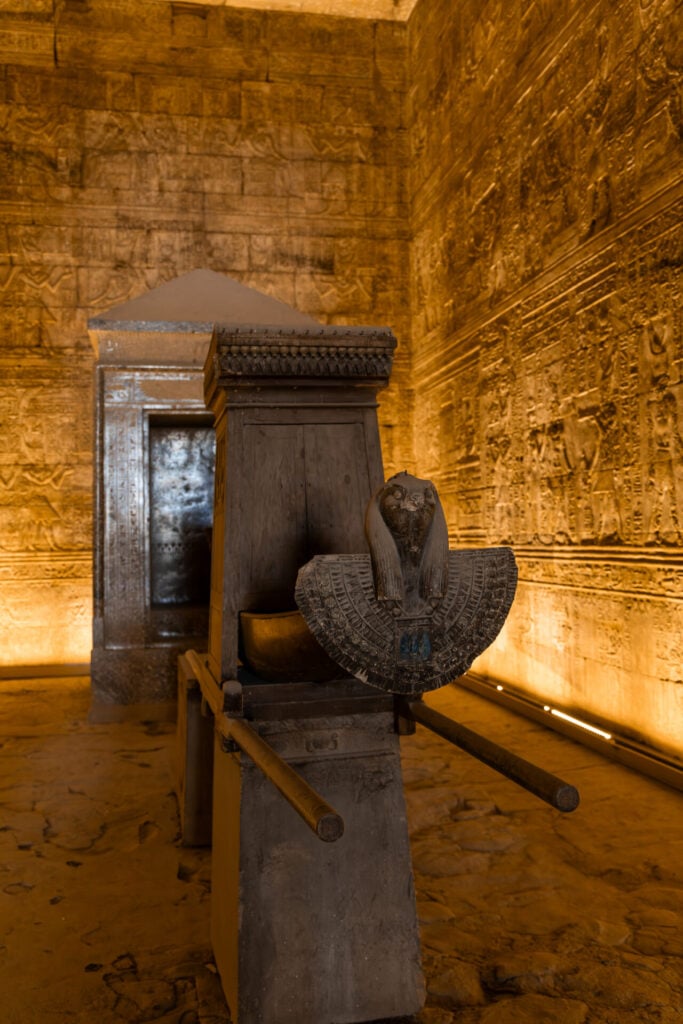
- Inner Sanctuary & Barque Shrine: the most sacred chamber within Edfu Temple, housing a granite shrine and (replica of the original) ceremonial barque used to carry Horus during religious festivals— most notably the Festival of the Beautiful Reunion, when the god was believed to sail down the Nile to visit Hathor at Dendera
- Reliefs of the Horus myth: detailed carvings throughout the temple depict the battle between Horus and Seth, in which Horus avenges his father Osiris and defeats Seth to claim the throne of Egypt
Practical info for visiting Egyptian temples
Opening hours
Most archaeological sites in Egypt open around 6am and close around 6pm, with last entry an hour before. Unless specifically noted that a temple is open after dark (like Luxor Temple or Kom Ombo, which are both open until around 8.30pm), you can safely assume opening hours will roughly align to seasonal sunset times.


Entrance fees
Temple entrance fees are generally very reasonable, ranging from 200EGP to 820 EGP ($4-16USD). Visiting all 10 temples on this list would cost approximately 4,500 EGP ($85 USD), but note that entrance fees are included for any of the sites you visit as part of a Nile cruise.
Tickets can be purchased in advance on the official Ministry of Tourism and Antiquities website (Egymonuments) OR via credit card directly at each site entrance. As of 2026, no cash is accepted for ticket purchases.
Photography fees
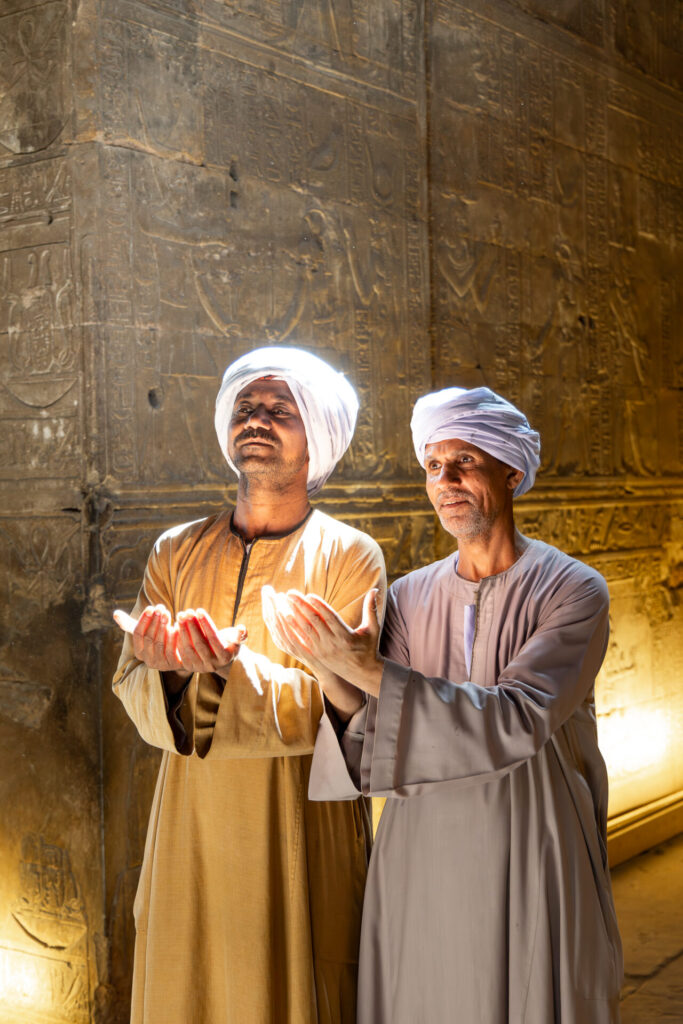
It was once necessary to pay “photography fees” to bring a DSLR camera into the temples (even for personal use), but I’m happy to report that the government decided to do away with these fees several years ago and it’s now completely free to bring ANY camera into the temples of Egypt.
Tripods are officially banned (with limited enforcement), but solo travellers will rarely have trouble finding an enterprising local willing to take your photo for a modest tip (50EGP/$1USD is usually plenty).
What to wear to an Egyptian temple
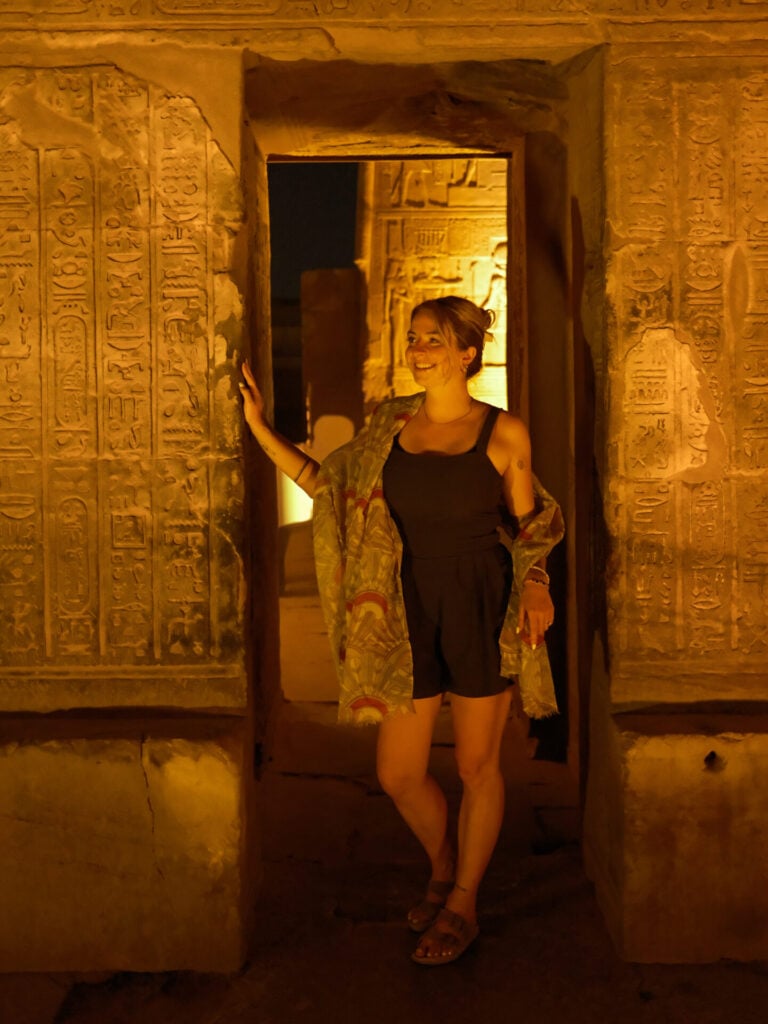
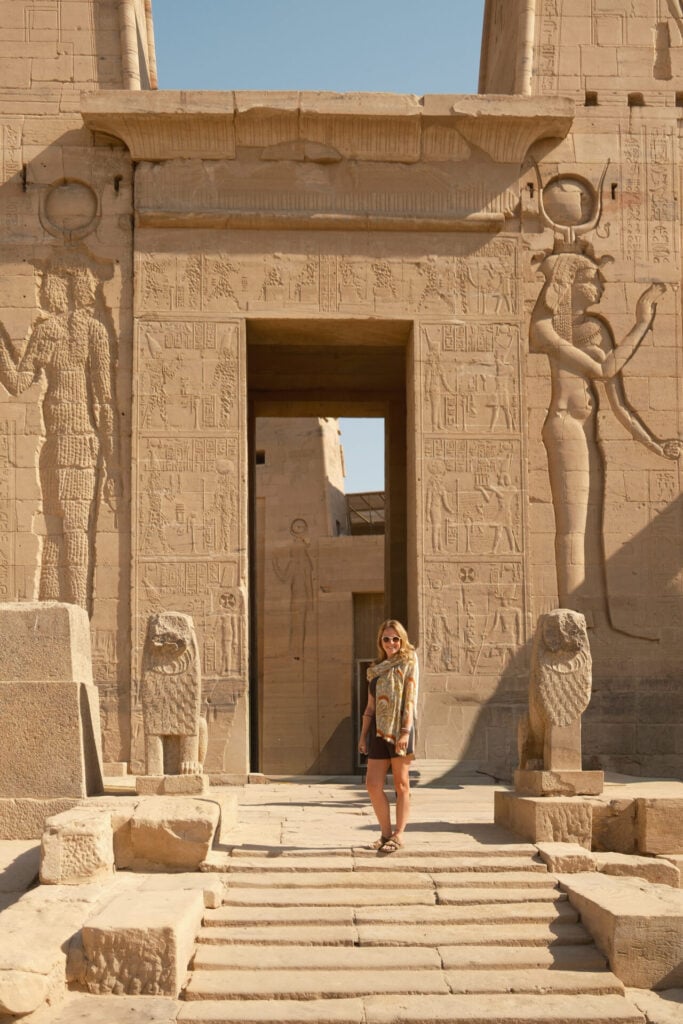
As these are ancient sites rather than active religious spaces, there’s no strict dress code for visiting temples in Egypt. Some degree of modesty is appreciated (much like everywhere in the country), but shoulders and knees don’t need to be covered— sun protection is usually the bigger concern.
And to that end, most temples in Egypt enjoy a lot of direct sun exposure, so a hat, lightweight long-sleeve, or a scarf is highly recommended to keep yourself from cooking alive while exploring. Comfortable footwear is equally important for the uneven ground. You’ll notice from these photos that I usually wear Birkenstock sandals or Blundstone boots, while James prefers a general running shoe.
On our most recent group trip to Egypt (which was 40C/105F in late May), we bought these small portable fans for all of our guests and they were life-saving!
Read all of my Egypt travel guides
- Luxor travel guide: best temples & tombs of the East & West Bank
- Perfect 1 & 2-week Egypt itinerary: Giza, Luxor, Aswan & the Red Sea
- Detailed 3-day Cairo & Giza itinerary for first-time visitors
- Nour El Nil review: sailing from Luxor to Aswan on a luxury dahabiya
- Choosing the best Nile Cruise in Egypt: absolutely everything you need to know
- What to do in Dahab: a guide to Egypt’s coolest beach town
