• start here
  • about
  • itineraries
  • brooke beyond

  • hiking guides
  • outdoor gear
    • hiking boots
    • hiking backpacks
    • cold-weather layers
    • backpacking tent
    • outdoor sleep system
    • backcountry food
    • day-hike packing list
    • hut-to-hut packing list
    • via ferrata packing list
    • backpacking packing list
    • mountaineering packing list

brooke beyond

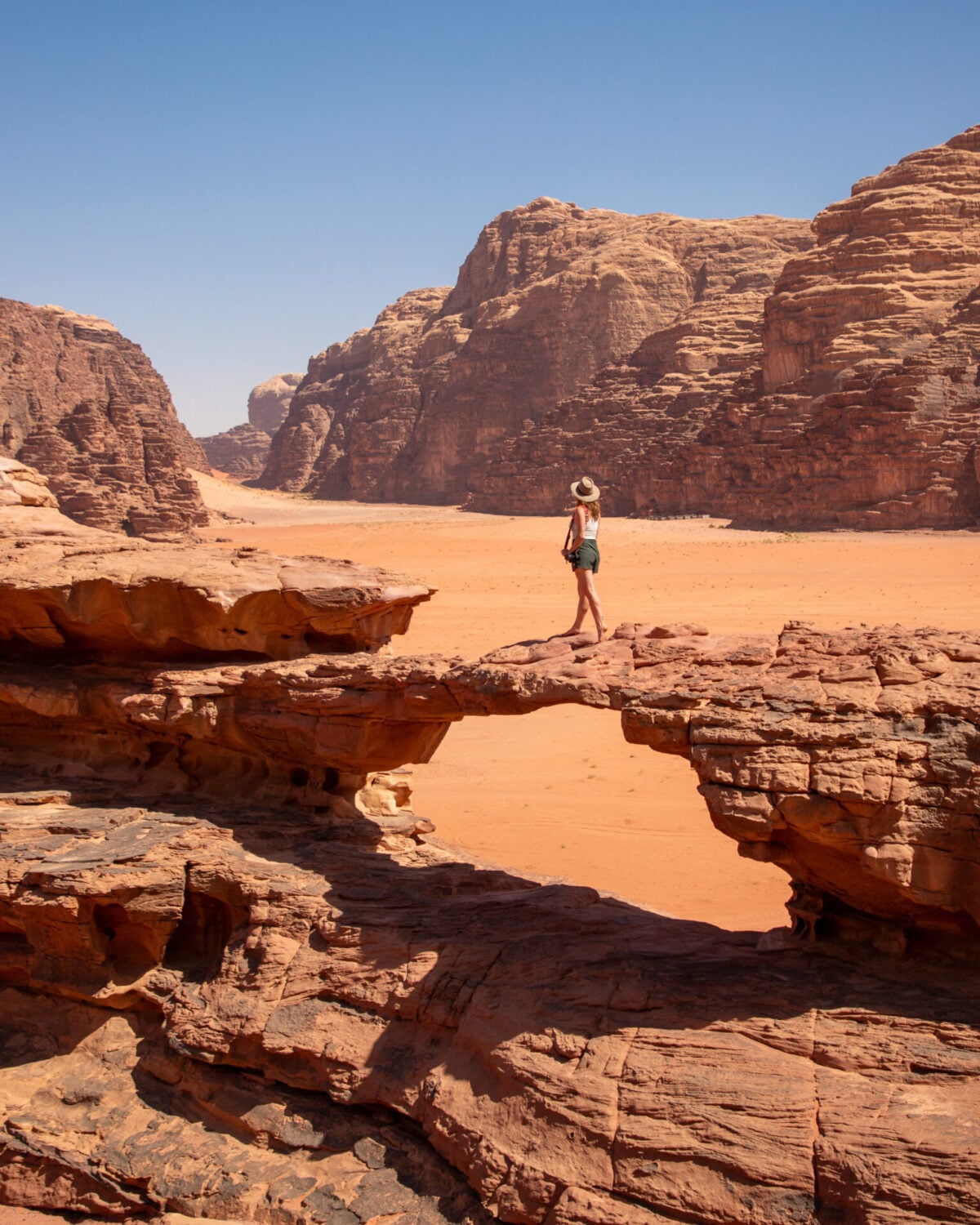
Little Bridge, Wadi Rum
Jordan / Middle East

Wadi Rum adventure guide: how to plan an epic trip to Jordan’s red desert

2 April 2026

With its vast red dunes, towering sandstone cliffs, and rich Bedouin heritage, Wadi Rum is easily one of the most spectacular destinations in Jordan. Whether you’re a hiker, climber, photographer, or just an intrepid explorer looking to discover authentic culture and cinematic landscapes, Wadi Rum deserves multiple days in your Jordan itinerary!

We’ve spent several WEEKS exploring Wadi Rum across multiple trips, staying in everything from Bedouin caves to luxury desert domes and sampling a huge range of activities as research for our group adventure trips— so we feel uniquely qualified to help you plan the BEST possible visit based on extensive personal experience! This guide covers how to get to Wadi Rum, entrance fees, where to stay, what to do, and heaps of other practical information to ensure an awesome trip no matter your travel style.

✨ Planning a trip to Jordan? Read my 2-week Jordan road-trip itinerary for adventures from Wadi Rum and Petra to the Dead Sea and Aqaba! COMING SOON

What's in this guide

Toggle
  • About Wadi Rum Protected Area
    • Is Wadi Rum worth visiting?
    • How many days to spend in Wadi Rum?
  • Getting to Wadi Rum
    • Driving to Wadi Rum 
    • Free parking near Wadi Rum
    • Buses to Wadi Rum
    • Wadi Rum Entrance Fees
    • Transport from Wadi Rum Village to the desert
  • Where to stay in Wadi Rum
    • Tips for booking accommodation in Wadi Rum
    • Best Bedouin Camp: Arabian Nights
    • Best Authentic Bedouin Experience: Wadi Rum Cave Camping
    • Best Bubble Camp: Hasan Zawaideh Camp
  • The best activities in Wadi Rum
    • Hiking & scrambling in Wadi Rum
    • Climbing in Wadi Rum
    • Jeep tour in Wadi Rum
    • Camel rides in Wadi Rum
    • Wadi Rum Camel Racing Festival

About Wadi Rum Protected Area

Located in southern Jordan near the Saudi border, Wadi Rum Protected Area spans more than 700 km2 of dramatic desert landscape, an otherworldly expanse of red sand, granite mountains, narrow canyons, and natural rock arches. Designated as a protected area in 1998 and later recognised as a UNESCO World Heritage Site, Wadi Rum is one of the most ecologically and culturally significant regions in the Middle East, in addition to being a haven for adventure!

Wadi Rum’s surreal terrain has also made it a favourite filming location for movies like The Martian, Dune, and Lawrence of Arabia— and standing among these sandstone formations, it honestly does feel more like Mars than Earth.

Beyond the landscapes, Wadi Rum is home to nomadic Bedouin communities who’ve lived and travelled through this desert for centuries. Many families now operate camps, guide tours, and share their traditions with visitors from around the world. This is one of the best places in Jordan to connect with authentic Bedouin culture in a meaningful and sustainable way, adding depth to any visit.

Burdah Bridge best hike in Wadi Rum
Camel in Wadi Rum
Sunset tour in Wadi Rum
Rock climbing in Wadi Rum
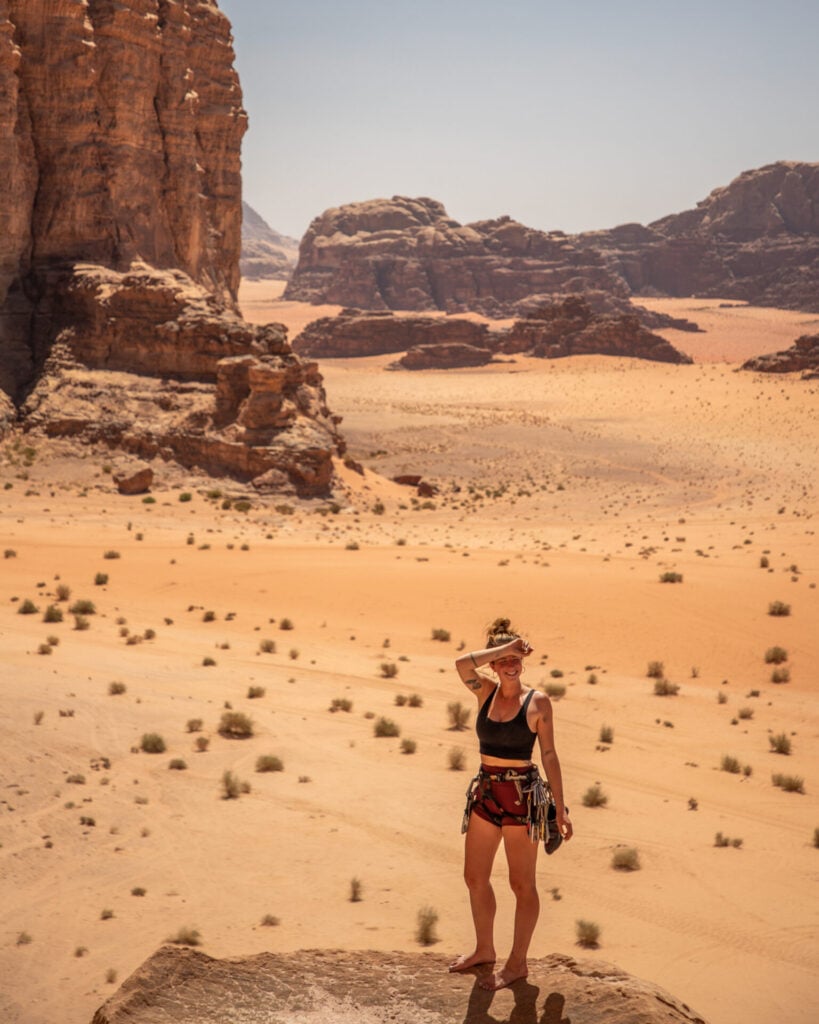
Wadi Rum is a paradise for hikers and climbers!

Is Wadi Rum worth visiting?

You’ll quickly realise from this post that I absolutely LOVE Wadi Rum— it’s one of my all-time favourite places, a highlight of the adventure group trips we run in Jordan, and truly unlike anywhere else in the world.

That said, Wadi Rum isn’t for every type of traveller. Even the most luxurious camps are set in the middle of a sandy desert, and amenities simply aren’t Four Seasons-level. It’s also a long drive from other parts of Jordan, and if you’re not into hiking, rugged landscapes, or bouncing around in a 4WD for hours at a time… you might not get enough out of the experience to justify coming all the way out here.

So who SHOULD visit Wadi Rum? 

  • curious adventurers interesting in learning more about Bedouin culture
  • hikers and scramblers who want their minds blown by rugged desert terrain
  • climbers keen to explore one of the best sport and trad climbing areas in the world
  • photographers looking to capture enormous, cinematic landscapes 

How many days to spend in Wadi Rum?

Wadi Rum is one of the most spectacular places in Jordan— easily the most impressive desert I’ve ever visited (and we’ve travelled extensively throughout the Middle East!), and it deserves so much more than the rushed single day that many travellers allocate here.

I get it: not everyone has a month to road-trip through Jordan, so if a single night is all you can spare, it’s still absolutely worth going! But I’d HIGHLY recommend a minimum of 2 nights and ideally 3-4 days to properly explore Wadi Rum and experience what makes this red desert so special.
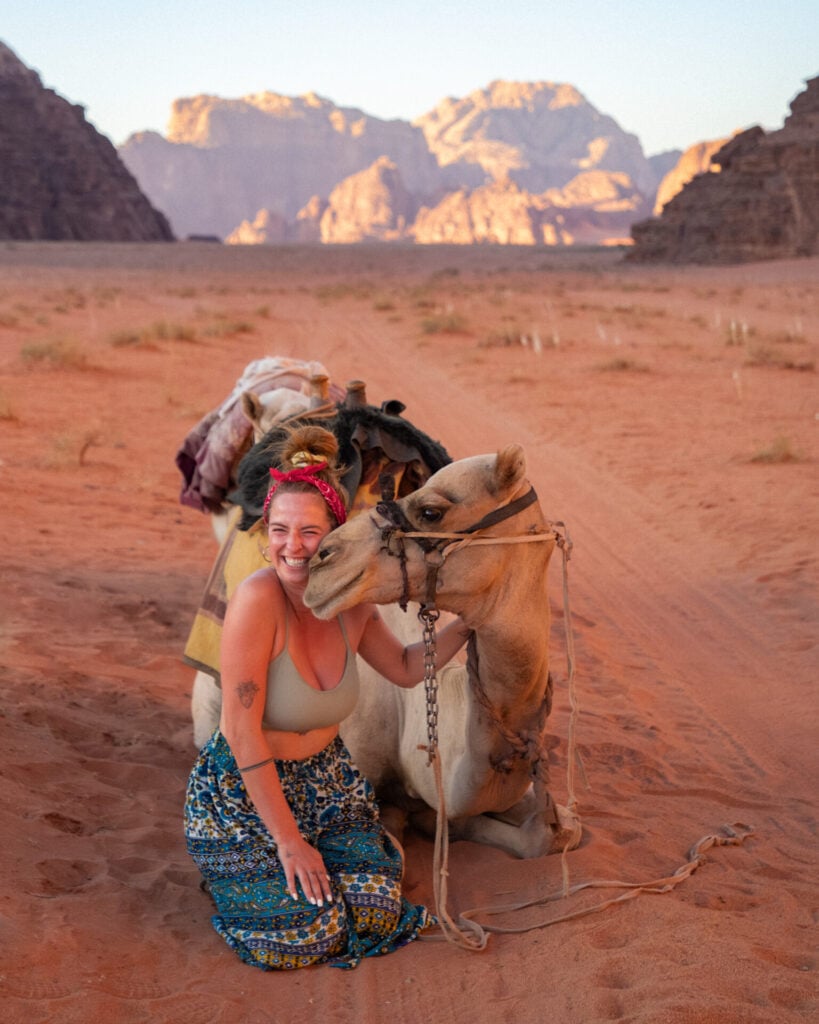
Camel riding in Wadi Rum
Camels are an everyday part of life in Wadi Rum

Getting to Wadi Rum

Driving to Wadi Rum 

The quickest and simplest way to reach Wadi Rum is by hiring a car and driving yourself! The Wadi Rum Visitor Centre is about 4hrs from Amman OR from the Dead Sea; 1.5hrs from Petra (Wadi Musa); and just 1hr from Aqaba, making it an easy addition to most Jordan itineraries.

Once you arrive at the Visitor Centre, you’ll leave your car and transfer into the desert by 4WD with your camp or guide, as independent driving beyond this point isn’t permitted.

We always use DiscoverCars to find the best deals on car rental whenever we travel— in Jordan, we hired a tiny little car for just $12/day through MonteCarlo/RightCars. This small local company offers a free airport shuttle to the off-site rental office and was super easy to work with, so we’re happy to recommend!

Free parking near Wadi Rum

There’s a large free parking area between the Visitor Centre and Wadi Rum Village, and some camps also offer secure private parking in Wadi Rum Village. Camp staff will typically meet you at the Visitor Centre to assist with registration and direct you to the appropriate parking location before transferring you into the desert by 4WD.

✅ IS IT SAFE TO LEAVE LUGGAGE IN YOUR CAR IN WADI RUM?
 
We personally left a fair bit of luggage behind in our car for over a week with no issues, and although this ultimately comes down to individual risk tolerance, Wadi Rum operates as a close-knit tourism community where livelihoods are closely tied to visitor trust— there’s a strong shared understanding that petty theft would harm everyone. It’s always a good idea to carry your valuables with you (passport, laptop, camera), but suitcases or other backpacks should be reasonably safe within your car for several nights.  

*If you don’t like the idea of leaving your rental car unattended overnight, I’d recommend staying in Disah (Ad Disah), a small village on the NE edge of Wadi Rum Protected Area— you can drive directly to the hotels here! More details under WHERE TO STAY below.

Buses to Wadi Rum

Jett Bus operates several routes to Wadi Rum, including direct buses from Amman, Petra (Wadi Musa), and Aqaba. Most of these buses arrive at the Wadi Rum Visitor Centre, where you’ll then transfer into the desert with your camp or guide.

You can check the full schedule on the JETT website— we’ve taken several of their buses over the years and found them to be comfortable, air-conditioned, and generally reliable. It’s an easy, budget-friendly option if you’re not planning to rent a car!

Wadi Rum Entrance Fees

There is a 5JOD ($7USD) fee to enter Wadi Rum Protected Area, but this fee is entirely covered by the Jordan Pass!

The Jordan Pass packages together entrance to nearly all of the historical landmarks in Jordan (Petra, Amman Citadel, Jerash, Wadi Rum, etc) AND waives the cost of a Jordan visa, which is otherwise 40JOD ($60USD). The Jordan Pass costs 70JOD ($100USD) and will save you HEAPS on entry fees across your trip!

2026 Jordan Pass pricing

Transport from Wadi Rum Village to the desert

You’ll need 4WD transport from the Wadi Rum Visitor Centre (or the parking area in Wadi Rum Village) to reach your camp in the vast desert beyond! Thankfully, this is almost always included in the cost of your accommodation (beware the $10/night camps on Booking, as you’ll end up spending as much for unavoidable transport and food costs as you could have spent on a better camp experience).

All the Bedouin camps I recommend below include transportation in the advertised price. If you’re booking elsewhere, make sure you specifically ask about transportation costs before arriving in Wadi Rum.

Transport is typically in the back of a well-worn Toyota 4WD, converted into an open-air safari vehicle with bench seating (and sometimes a sun-shade). Depending on your camp’s location, the ride may take 15-30min or even more, but this is one of the true highlights of visiting Wadi Rum— a scenic ride through the desert, usually in beautiful afternoon/sunset lighting, that acts as the perfect introduction to the wild landscapes you’ll explore in the coming days!
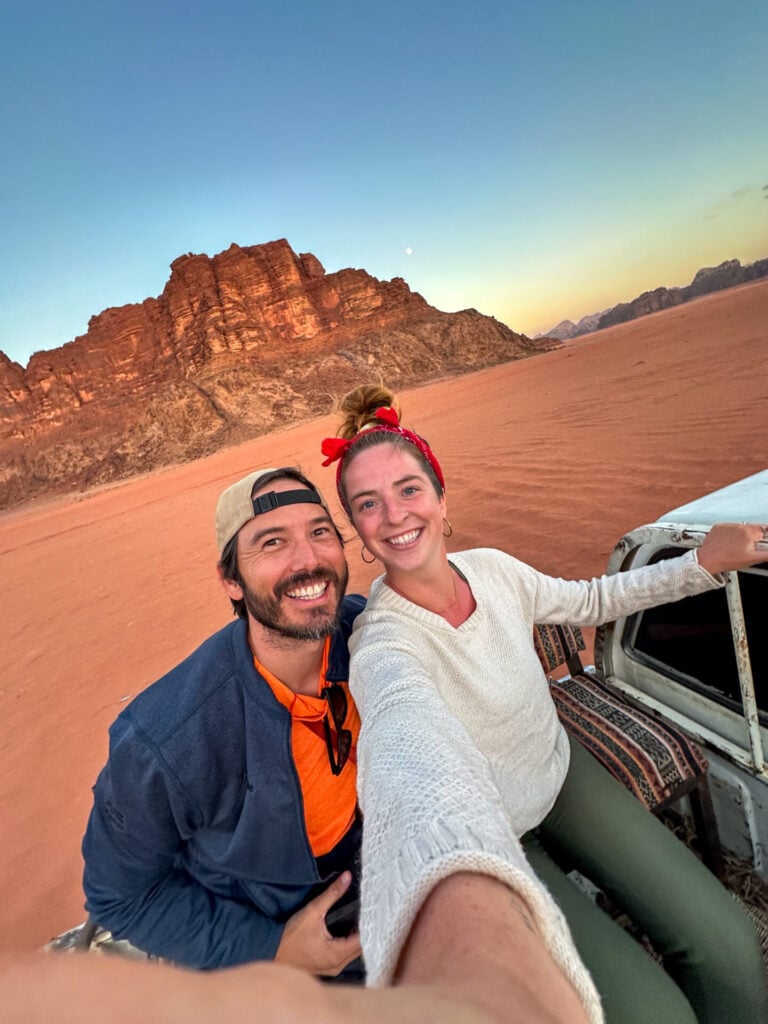
4WD transfer to Wadi Rum desert camp
The transfer into Wadi Rum is such a highlight!

Where to stay in Wadi Rum

One of the decisions that will impact your experience in Wadi Rum MOST is where you choose to stay, but with hundreds of listings (and almost no standardisation around what’s included in the advertised nightly rate), it can feel seriously overwhelming. We’ve personally spent several weeks in Wadi Rum across numerous trips, and these are the camps we’d recommend for the absolute best experience:

BEST PLACES TO STAY IN WADI RUM

⭐️ Best Bedouin Camp: Arabian Nights
⭐️ Best Authentic Bedouin Experience: Wadi Rum Cave Camping
⭐️ Best Bubble Camp: Hasan Zawaideh Camp

Keep reading for heaps more detail on each of these stays ↯

Tips for booking accommodation in Wadi Rum

Before diving into specific recommendations, here are a few key things to understand about accommodation in Wadi Rum:

  • Nearly all accommodation in Wadi Rum is in the form of tented Bedouin camps— these range from simple tents with shared hostel-style bathrooms to king-sized luxury tents with a full ensuite bathroom and AC (and sometimes you’ll find both styles available within the same camp).
  • Your camp provides transport into the desert, three meals a day, and guided activities— whether these are included or an additional cost depends on the camp, so it can be very misleading to compare a bare-bones $10/night camp to $100/night camp that packages absolutely everything into the rate.
  • Camp size also varies significantly, from a handful of tents to full “villages” in the sand— we’ve found that the best experience comes from small to mid-sized camps, which tend to offer better facilities and meal variety without ever feeling crowded or overly commercial.
  • The location of your Bedouin camp can also have a big impact on your experience, particularly if it’s located in a busy area with many other nearby camps— have a look on Google Maps to check out the surrounding area (but also bear in mind that there are WAY more camps in Wadi Rum than are actually operational at any given time; it’s common for them to open and close based on reservation or even shut for the entire season during low periods).
  • Desert temperatures in Wadi Rum vary dramatically by season (and even from midday to sunset)— in hotter months, basic tents can feel like full-on sweat lodges, holding heat well into the night, while in colder months, poorly insulated tents can be brutally cold. If comfort is a priority, it’s worth upgrading to a higher-end tent with proper insulation and a split heating/cooling unit.
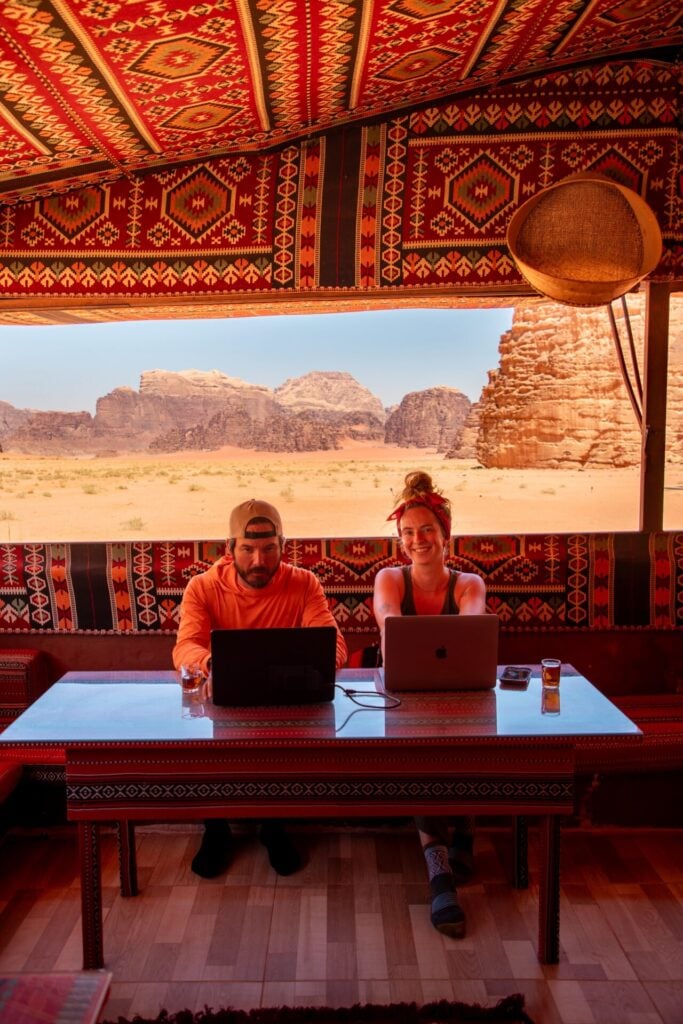
  • Most camps are solar-powered, so electricity is limited and may only be available at certain times. Charging is almost always possible, but hot water is a luxury (only available at some camps) and WiFi is rare to nonexistent.
Arabian Nights Wadi Rum Camp
Editing photos in the communal dining tent at Arabian Nights

Best Bedouin Camp: Arabian Nights

My favourite overall experience in Wadi Rum is Arabian Nights Camp, owned by the friendly Shaker and supported by his wife, uncle, and cousins. This is the camp we use for our adventure groups, since it offers the best blend of traditional Bedouin hospitality and upgraded desert luxury in an absolutely jaw-dropping private setting against the mountains!

The camp features:

  • 6x luxury tents with king beds, ensuite bathrooms, and AC (80JOD/night for 2 people sharing)
  • 6x traditional tents (small goat-hair box tents) that utilise a shared hostel-style bathroom block (45JOD/night for 2 people sharing)
  • A small dormitory tent (18JOD/night for a single bed)

All stays include transportation within the Protected Area, plus a delicious breakfast and dinner spread; when you book activities through the camp, lunch is included (otherwise it’s just 5JOD to eat in the camp itself). We’ve stayed in the luxury tent and traditional tent across different visits, and while both are comfortable, we’d definitely recommend the upgrade to the luxury tent if your budget allows!

Arabian Nights Camp Wadi Rum
Luxury tents at Arabian Nights Camp Wadi Rum
Arabian Nights Camp Wadi Rum

I truly can’t say enough good things about Arabian Nights, which offers phenomenal value compared to other camps in Wadi Rum. The atmosphere is welcoming and intimate (we’ve experienced everything from a private stay to ~20 guests), and yet still manages to deliver an excellent program of optional activities and some of the BEST food in Jordan— especially the zarb, a traditional Bedouin barbecue cooked under the sand!

If you’re looking for the best all-around Bedouin camp experience, particularly with an interest in hiking, scrambling, and/or climbing in Wadi Rum, Shaker and Arabian Nights can organise literally anything and coordinate directly with expert guides across the desert to ensure a smooth itinerary!

>> Check out more details about guided tours and room types on the Arabian Nights website.
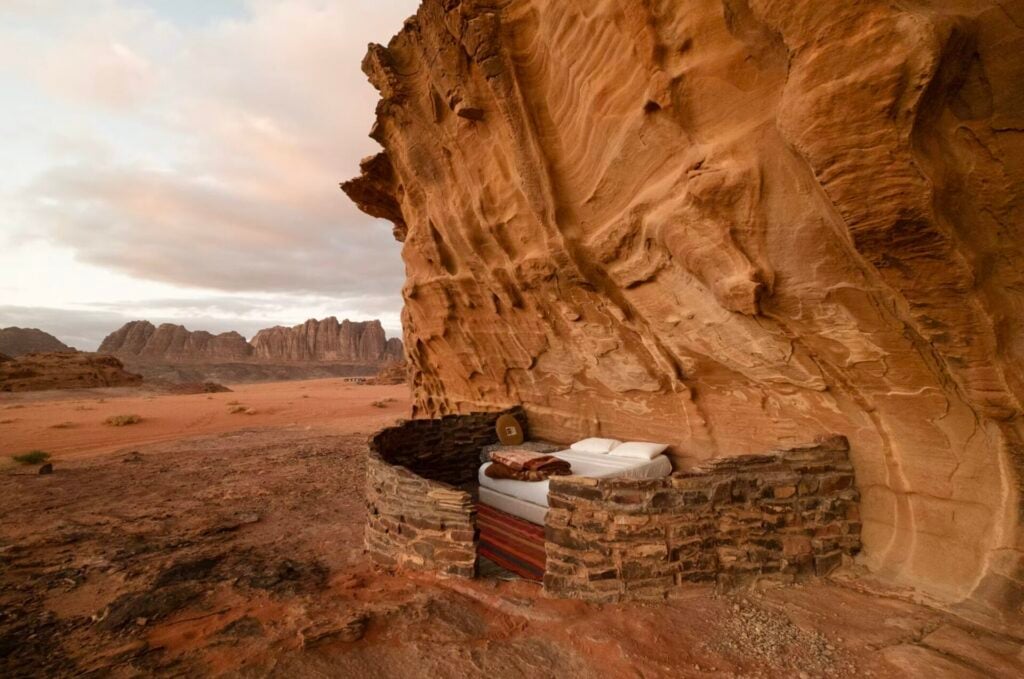
Wadi Rum Cave Camping
Camping in a Bedouin cave is one of the coolest ways to experience Wadi Rum!

Best Authentic Bedouin Experience: Wadi Rum Cave Camping

For a truly unique and authentic experience in Wadi Rum, consider spending the night in a Bedouin cave— easily one of the most memorable stays we’ve ever had! For centuries, nomadic tribes have relied on natural caves for shelter as they moved across the desert, and Wadi Rum Cave Camping is a rare opportunity to experience a glimpse of that traditional way of life.

When we first booked our cave stay with Mohammad, a young Bedouin passionate about sharing his culture with a new generation of adventure travellers, it was just a few simple cots in 2 caves. He’s since expanded and upgraded the amenities (much nicer beds and flushing toilets), but the experience remains beautifully true to its roots: Bedouin coffee cooked over the campfire, a traditional zarb (underground barbecue), stories shared in the communal dining cave, and ultimately the opportunity to learn more about this rich and enduring culture that has shaped so much of modern Jordanian heritage.

Wadi Rum Cave Camping

A night in the caves starts at 55JOD per person (about $170USD for 2 people), with all transport and meals included. Mohammad can also help you organise a range of activities in the desert!

If you have at least 2 nights in Wadi Rum, we’d highly recommend splitting your stay: spend the first night at Wadi Rum Cave Camping for the million-star experience, then move to Arabian Nights for a more classic tented stay. The Bedouin community is very close-knit, so if you let each camp know your plans, they can easily coordinate transport between locations for you.

>> Check out the new camping upgrades and cave options on the Wadi Rum Cave Camping website.
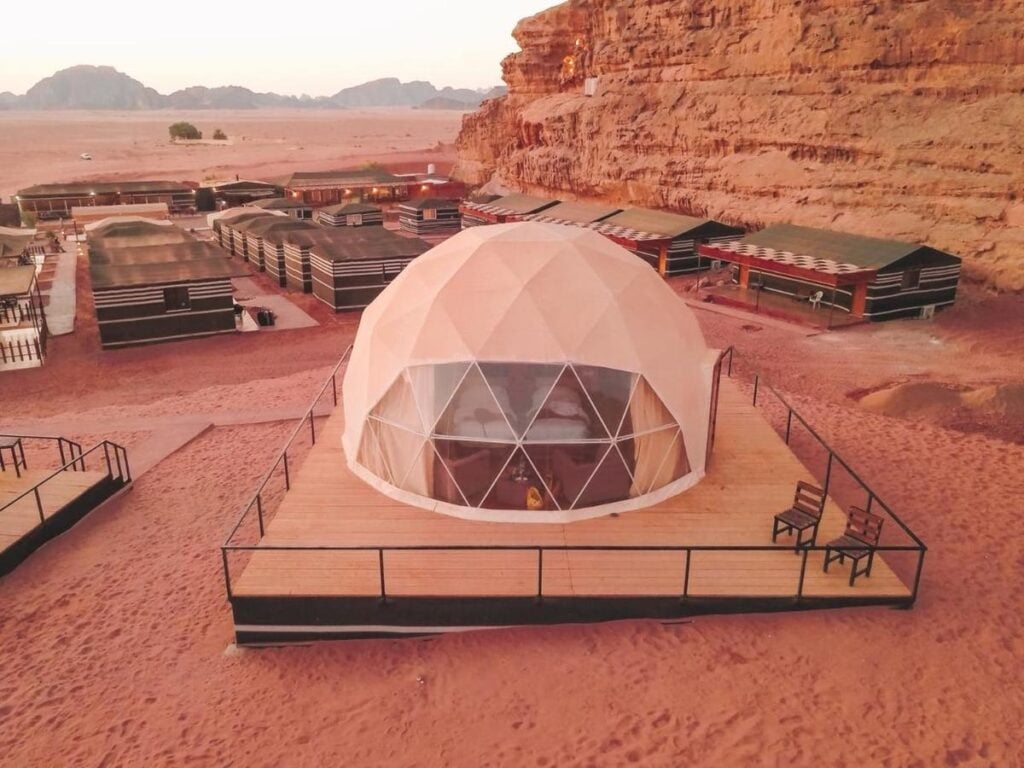
Hasan Zawaideh Camp Martian Tents in Wadi Rum
Martian Tents at Hasan Zawaideh Camp

Best Bubble Camp: Hasan Zawaideh Camp

An otherworldly camp full of Martian domes and luxury tents located on the edge of the desert, near the village of Disah, Hasan Zawaideh Camp is one of the few accommodations in Wadi Rum that you can actually drive to (accessible with a 2WD). It’s a fairly large camp with significantly more infrastructure (wifi etc) and offers a range of rooming options for every budget and group size.

We really enjoyed our stay here for the contrast— I’d describe the atmosphere as very festive and a lot more local (it was mostly Jordanian and Arab families), with plentiful shisha and live music + dancing every evening. The owner Hasan is lovely and, consistent with all my other recommendations here, the entire vibe is very welcoming.

Martian Tents at Hasan Zawaideh Camp in Wadi Rum

Martian tents start at just 80JOD ($110USD) +18JOD per person for full-board, with incredible views straight out into the desert from the clear dome! There are other tents starting at just 45JOD per night, so we felt the camp is very competitively priced for what it offers. You can still arrange jeep tours and camel rides, just note that travel times are slightly longer since you’re based on the edge of the desert.

I’d especially recommend Hasan Zawaideh Camp if you’re driving yourself to Wadi Rum just 1 night (no need to coordinate 4WD transfers); if you’re travelling with children and/or older family members who might want a little more comfort or accessibility; OR if you’re specifically drawn to the bubble tent experience at a more reasonable price point.

>> Check out more details about room types and guided tours on the Hasan Zaweideh Camp website.
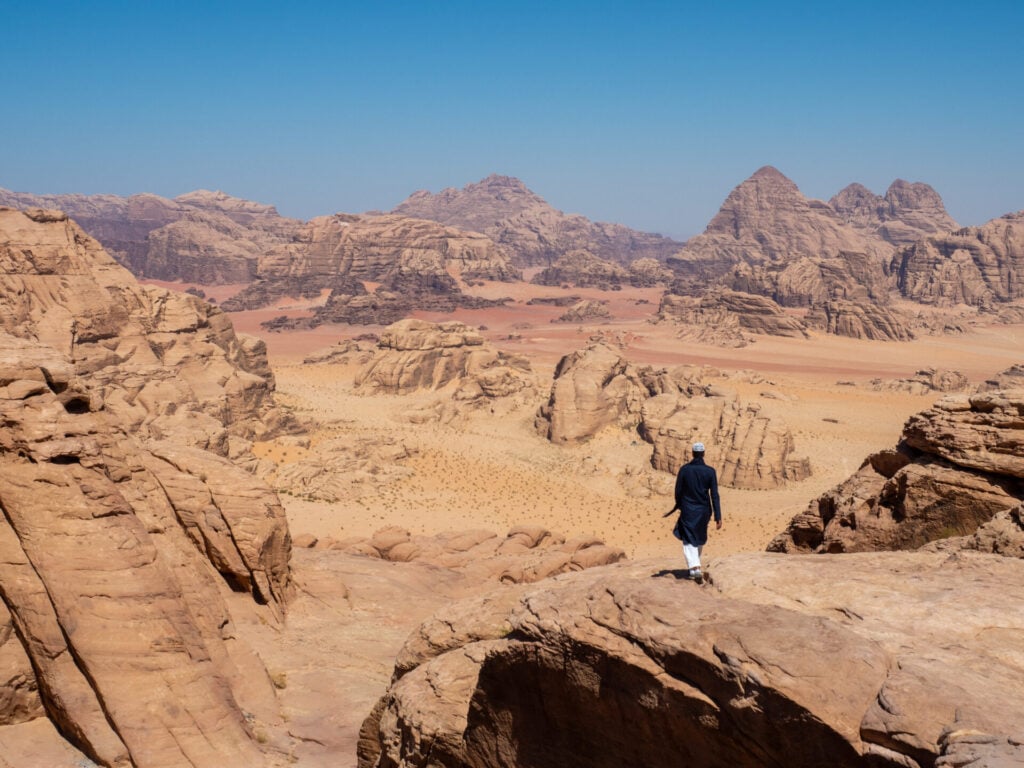
Burdah Bridge hike in Wadi Rum
Incredible views from the half-way point to Burdah Bridge

The best activities in Wadi Rum

You’ll get the most out of your experience in Wadi Rum on a rapid-fire program of guided tours, ranging from hiking and climbing to the classic Jeep tour and camel rides. After MANY days spent exploring the desert, these are our favourite high-value things to do in Wadi Rum!

Hiking & scrambling in Wadi Rum

If this post convinces you of anything, let it be this: don’t just jeep around Wadi Rum, get out and scramble through it. Clambering up these sandstone mountains is, in our opinion, the single BEST way to experience the desert— and it’s borderline criminal how many travellers totally miss this!

Wadi Rum’s mountains rise dramatically from the desert floor (many peaks reach 1,200–1,700m), and a surprising number of summits, arches, and viewpoints are accessible via half-day scrambling routes. These are not marked trails, so route-finding is complex, access points are hard to locate, and many sections involve exposed scrambling. Book a local Bedouin hiking guide directly through your camp; Arabian Nights offers half-day hiking and scrambling trips at just 30-40JOD per person!

Burdah Bridge hike in Wadi Rum

Best hiking & scrambling routes in Wadi Rum:

  • Burdah Bridge: our personal favourite scramble route to a beautiful natural rock arch and insane views over the desert landscape; mostly Class 2 with a few sections of Class 3 (and some exposure), so you’ll need a solid head for heights and confidence using hands and feet
  • Jebel Al Hash: one of the best summit hikes in Wadi Rum (considered fairly easy, with less exposure than Burdah), offering sweeping views across the desert and into Saudi Arabia
  • Jebel Umm ad Dami: a mix of hiking and easy scrambling to reach the highest point in Jordan (1,854m), where the sense of scale and remoteness is incredible!

Want something more vertical? There’s also phenomenal sport and trad climbing in Wadi Rum ↯
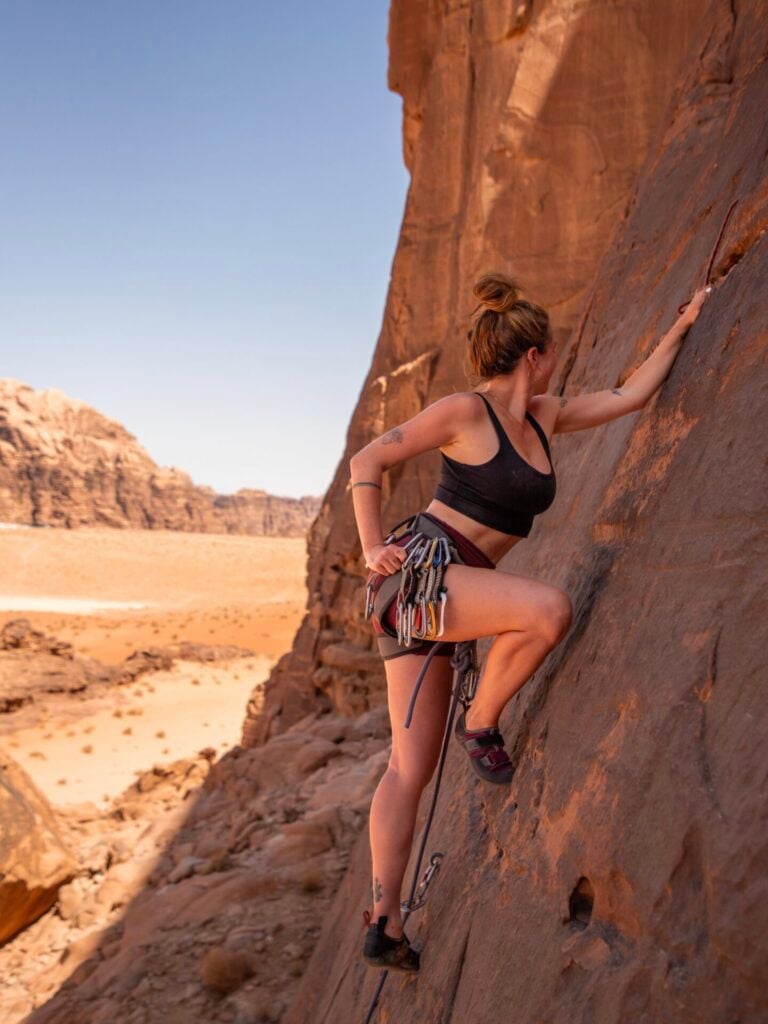
Rock climbing in Wadi Rum
New sport climbing routes are being bolted in Wadi Rum every year!
Rock climbing in Wadi Rum
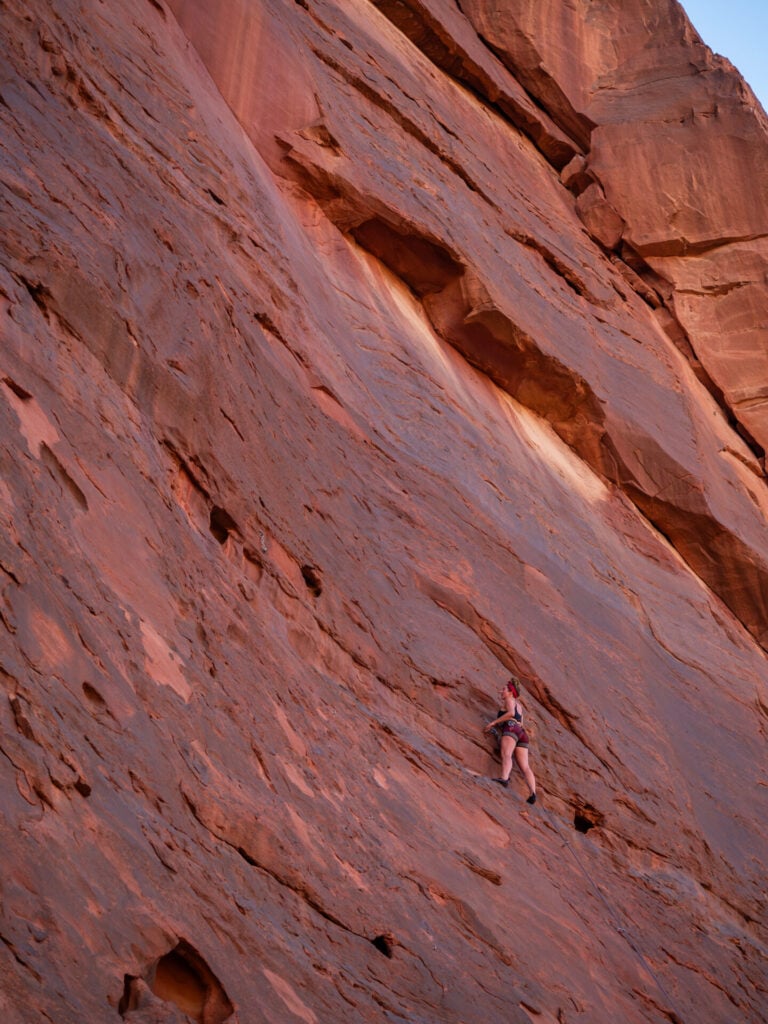
The red sandstone cliffs of Wadi Rum are awesome for climbing

Climbing in Wadi Rum

Although well-regarded in hardcore climbing circles, Wadi Rum remains a wildly underrated climbing destination overall— but between the high-quality sandstone, spectacular scenery, and total lack of crowds (we saw ZERO other people at the crag), it’s seriously one of the coolest places we’ve ever climbed!

International climbers have been exploring these red sandstone cliffs since the 1980s, when a few European legends teamed up with local Bedouin guides to establish routes across the desert. Today, there are 30–40 impeccably-bolted sport routes, a few spectacular multi-pitch climbs, and an entire universe of trad in Wadi Rum.

Routes aren’t neatly mapped in a guidebook (and navigating the vast desert to find crags is very much a local’s game), so even experienced climbers are likely to benefit from the support of a local guide. We spent several days climbing with Hussein, who totally let us run the show in terms of difficulty and skill-building— James learned to lead belay me AND put up his own first-ever lead climb in Wadi Rum!

Rock climbing in Wadi Rum

We organised everything through the delightful Rakan (who is, by pure coincidence, first-cousins with Shaker from Arabian Nights) and we’d HIGHLY recommend contacting Rakan directly to discuss your experience and coordinate local climbing guides, transport to the crag, lunch, and any required gear.

Whether you’re a complete beginner interested in top-roping for an afternoon or an experienced trad climber looking to bust onto the local scene, Wadi Rum offers one of the most scenic and memorable climbing environments in the world!
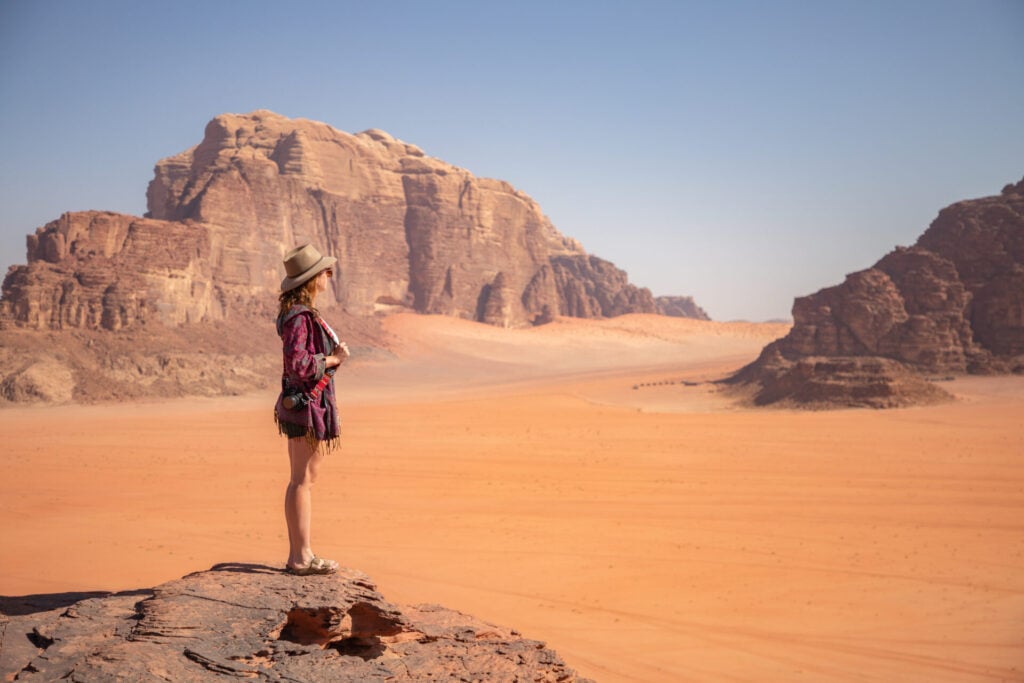
Red Sand Dune in Wadi Rum
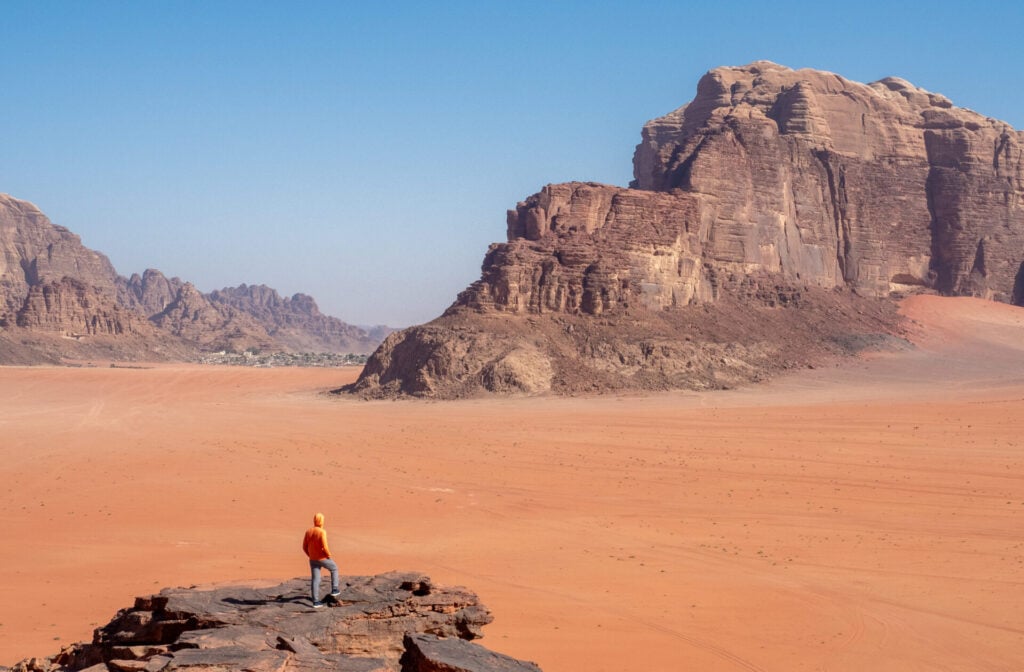
View from the Red Sand Dune
James looking out over Wadi Rum

Jeep tour in Wadi Rum

A jeep tour is the quintessential Wadi Rum experience and something I’d recommend to every single visitor as the best way to appreciate the scale and diversity of the desert landscape! Tours are conducted in open-air 4WD jeeps, usually with bench seating in the back and a sunshade overhead. You’ll drive between major landmarks, with time to get out, explore, scramble, and take photos at each stop, combining short walks, rock formations, cultural sites, and epic viewpoints.

Tours are typically offered as either a half-day (4-5hrs) or full-day (8-10hrs) excursion, and after doing both versions personally, we’d recommend the half-day tour for most travellers, while the full-day is best suited to photographers who want extra time at each stop, a longer sunset window, and a couple extra stops you miss out on during the half-day rush.

Little Bridge in Wadi Rum
best Wadi Rum Jeep Tours

Typical stops on a Wadi Rum Jeep Tour:

  • Red Sand Dune: a large dune formed from sandstone high in iron oxide— climb to the top for expansive views of Wadi Rum!
  • Khazali Canyon: narrow sandstone canyon featuring ancient Thamudic inscriptions and petroglyphs, offering a glimpse into the region’s early inhabitants
  • Little Bridge: a natural rock arch you can easily climb for one of the best photos
  • Lawrence’s House: a set of Nabataean ruins often associated withLawrence of Arabia, but more notable for the surrounding desert views than the structure itself
  • Mushroom Rock + picnic lunch spot *full-day tour only
  • Abu Khashaba Canyon: walk through the narrow canyon for beautiful scenery and sand-boarding on a steep dune at the end
  • Um Frouth Rock Bridge: fun scramble up to the top of this natural rock arch *full-day tour only
  • Burdah Bridge viewpoint: quick stop to look up at a natural rock arch (one of the best half-day scramble routes in Wadi Rum) *full-day tour only
  • sunset viewpoint: the guide will find a quiet spot to enjoy the sunset, typically near a small mountain you can scramble for better aerial views

Tours can be booked directly through your camp as either small-group or private— group tours are cheaper and can be fun for social travellers, but photographers should absolutely opt for private to control timing and lighting. Expect to pay around 25–35 JOD for a half-day or 40–60 JOD for a full-day tour including water, tea, and lunch.
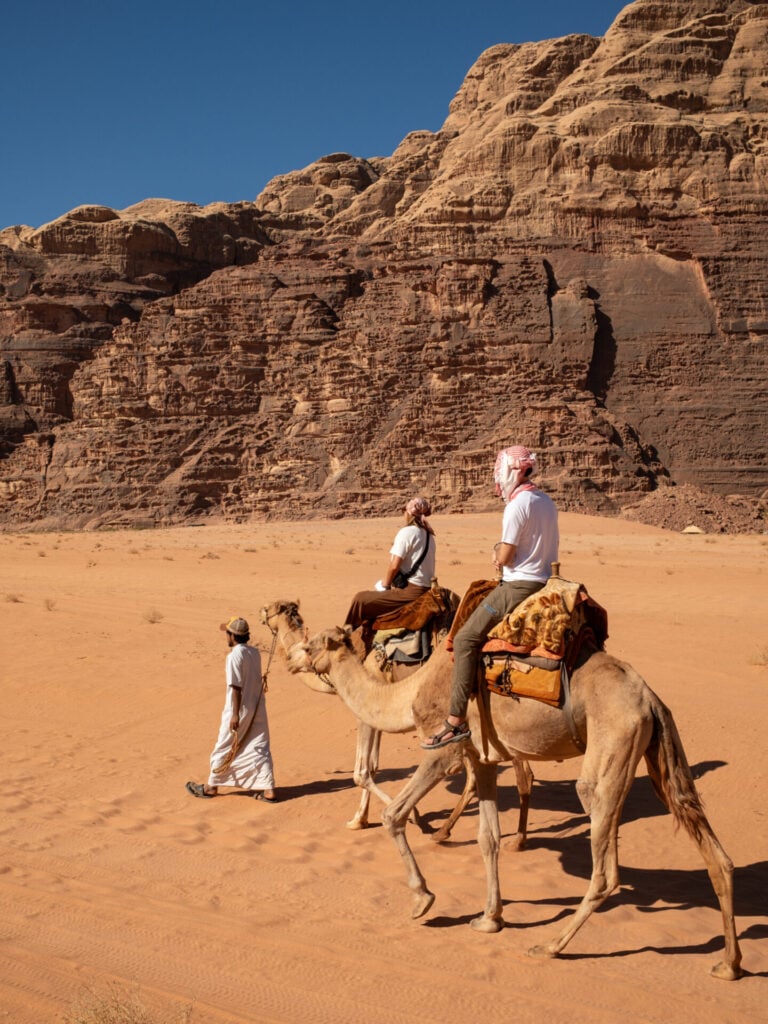
Riding camels in Wadi Rum
Wadi Rum is one of the best places in the world for ethical camel rides!

Camel rides in Wadi Rum

Throughout history, camels have played a vital role in nomadic Bedouin life— used to transport food, water, and belongings across the desert, carry people over long distances, and provide milk. If you’ve been dreaming of riding a camel through the desert à la Lawrence of Arabia, Wadi Rum is one of the best places in the Middle East to engage with camel culture in a responsible way!

Riding camels in Wadi Rum

Unlike more commercial sites like Petra, camel tourism in Wadi Rum is shaped by the traditional relationship and deep respect between Bedouins and their animals. Camels here are privately owned by local families, enjoy a largely free-range lifestyle, and are used for short, infrequent rides rather than continuous daily work.

Camel rides can be arranged through most any desert camp, with a local Bedouin owner bringing the camels directly to you for a peaceful 1 hour ride through the desert with incredible views of the surrounding sandstone mountains. Expect to pay 15–25 JOD per person, and while I usually rail against modern tipping culture, this is one instance where a generous tip directly supports both the owner and a high standard of care for the camels!
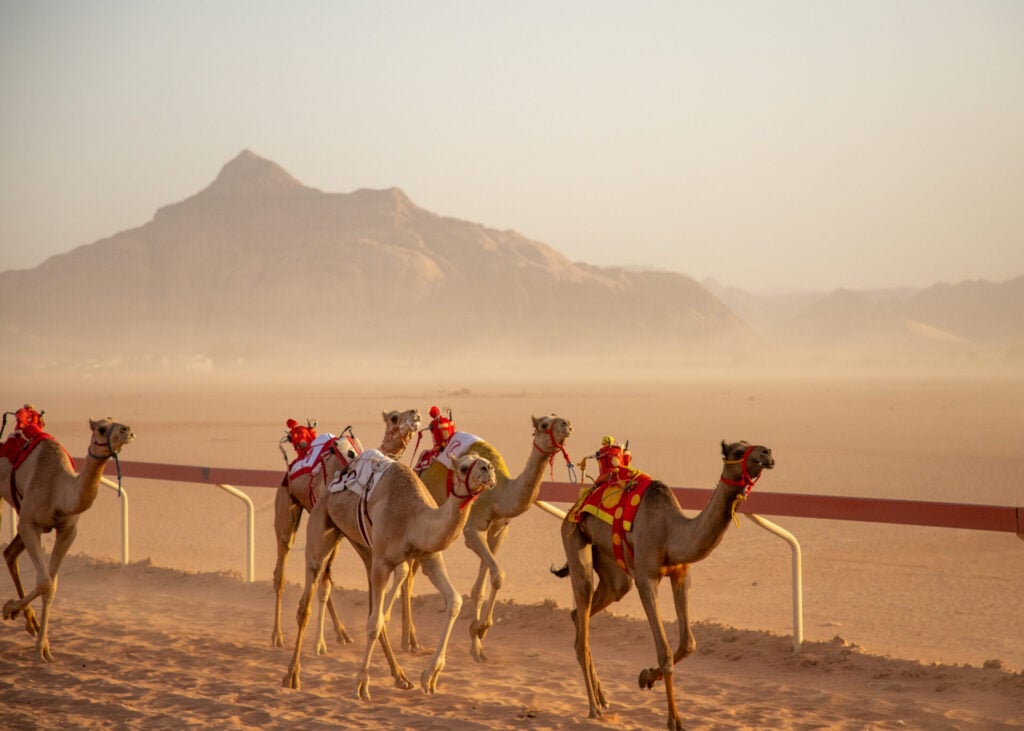
Wadi Rum Camel Racing Festival
the 2024 Wadi Rum Camel Racing Festival!

Wadi Rum Camel Racing Festival

If you happen to be in Wadi Rum during the autumn, you might be lucky enough to catch one of the region’s most incredible cultural events: the Wadi Rum Camel Racing Festival held annually in Disah.

Recognised by UNESCO for its intangible cultural heritage, camel racing is a sport with more than 1,400 years of history and a tradition still celebrated by Bedouin tribes across the Middle East. Many camels are trained for years specifically for racing, with successful racers used to breed future generations.

The races take place at a dedicated “cameldrome”, where camels sprint at speeds of up to 65km/hr—guided not by human jockeys, but by tiny robot riders (I can’t make this up). Owners drive alongside the track in trucks, shouting commands and controlling the robots remotely, while some events are even live-streamed!

Wadi Rum Camel Racing Festival

The fanfare surrounding the event is a huge part of what makes it so special, with hundreds of camels (and their owners) gathering from across the region. Dates aren’t widely advertised online, but local Bedouins always know when it’s happening— we attended the festival on 20–21 September 2024, and it’s hard to express just how incredible it was being the only foreigners spectating on this long-standing tradition!

If it’s a must for you, contact one of the local camps to ask about upcoming camel race dates in Wadi Rum. And watch our Camel Racing Festival video!


Between the towering sandstone mountains, rich Bedouin culture, and endless desert views, Wadi Rum is truly one of the most unforgettable places in Jordan. For more on how to spend the perfect 3 days in Wadi Rum, check out my 2-week Jordan road-trip itinerary! COMING SOON

Best sunset spots in Wadi Rum
Camels in Wadi Rum
Best hikes in Wadi Rum

Read more about Jordan

The ultimate 2-week Jordan road-trip itinerary COMING SOON

Hiking Petra in 2 days: Backdoor Trail & the secret Al Madras Trail

Hiking the Jordan Trail from Dana to Petra: Jordan’s best 5-day hike

Amman city guide: what to do + where to eat in Jordan’s hipster capital COMING SOON

TAGS:travel guides
0 Comments
Share
brooke beyond

Hey, I'm Brooke and I'm obsessed with getting off the beaten path, exploring backcountry gems & travelling beyond the ordinary! I left Australia 6 years ago after finishing a PhD in Biomechanics & have been travelling the world full-time ever since (joined by my husband/climbing partner, James). Whether it’s road-tripping through Mexico, climbing alpine peaks in the Andes, scuba diving in the Red Sea, or tackling epic via ferrata in the Dolomites, I hope this blog will inspire your future adventures & help you find wonder in every corner of the globe. xx bb

Leave a Comment Cancel Comment

You May Also Like

16 November 2024

Hiking Petra in 2 days: Backdoor Trail & the secret Al Madras Trail

5 October 2024

Hiking the Jordan Trail from Dana to Petra: Jordan’s best 5-day hike

7 February 2025

Socotra travel journal: our epic 8-day roadtrip in Yemen

hi, I’m brooke!

I'm obsessed with getting off the beaten path, exploring backcountry gems & travelling beyond the ordinary! I left Australia 6 years ago after finishing a PhD in Biomechanics & have been travelling the world full-time ever since (now joined by my husband/climbing partner, James). I hope this blog will inspire your future adventures & help you find wonder in every corner of the globe. xx bb

read my story
currently exploring

currently exploring

finland

read our gear guides

🥾 hiking boots

🎒 hiking backpacks

🌨️ cold-weather layers

⛺️ backpacking & alpine tents

🛌 sleeping bag & pads

🍪 backcountry food

📸 travel camera gear

trail guides

summit guides

itineraries

outdoor gear

GPS maps

recent posts

  • Little Bridge, Wadi Rum

    Wadi Rum adventure guide: how to plan an epic trip to Jordan’s red desert

    2 April 2026
  • 2-week Norway winter itinerary: Arctic Circle to southern fjords

    20 February 2026
  • Tjeldbergtind winter hike

    Complete Lofoten winter packing list: what to wear for hiking in Arctic Norway

    8 February 2026
  • Ryten winter hike

    Best winter hikes in Lofoten: your guide to safe winter hiking in Arctic Norway

    30 January 2026
  • Laguna Humantay, Cusco Peru

    6 awesome day trips from Cusco, Peru

    24 November 2025

@brookebeyond_
brooke ✨travel & mountain gal

@brookebeyond_

  • A few snapshots from one of our most unique adventures: a 4-day dogsledding trip through Sámi country (Sápmi) in Northern Sweden ❄️

For thousands of years, dogsledding has been an essential form of Arctic transport for Indigenous communities, used to travel, hunt, and survive in some of the harshest conditions on earth. Huskies are bred specifically for this environment, capable of running for hours across frozen landscapes + hauling several hundred kilos as a team.

To experience it for ourselves, we took a 15hr train from Stockholm to Kiruna, drove 2hrs deep into the wilderness, and then caught a snowmobile the final kilometres to reach a remote kennel with about 50 dogs. Our first day was spent learning the basics: how to harness the huskies, attach them to the sled, and steer + brake properly. 

And then, we set off into the wilderness with our team of 6 dogs, travelling through snowy forests + across frozen lakes. 

James + I shared the sled, taking turns driving while the other sat bundled up inside, eyelashes freezing into icicles in the -30°C (-22°F) chill for hours at a time.

It was unbelievably remote, the conditions were challenging, and the cold was brutal, but through it all, we formed a real bond with our team— particularly surprising given that I’m usually very scared of dogs (pictured several times here is my beloved Reisling, the best doggie 🐕🖤)

It was a surprising + unexpected adventure, but such a special way to experience wild + beautiful Sápmi*

*we learned that Sápmi is the traditional + often preferred term (over “Lapland”) for the region of northern Norway, Sweden, Finland, and Russia inhabited by the Indigenous Sámi people

—
#sweden #kiruna #dogsledding #sápmi #lapland
  • magical winter lighting delivering midday sunrises and northern lights before dinner ✨ 

—
#lofoten #winter #norway #northernlights #polarnight
  • With sufficient outdoor experience, sound judgement, and reasonable conditions, these 10 hikes are an excellent choice for safe winter hiking in Lofoten!

We personally completed all of these hikes in January 2026 with just microspikes + trekking poles (and no other technical climbing equipment), though it should be noted that conditions vary winter to winter— and even week to week. In the event of heavy snowfall, some trails may become impassable without snowshoes or simply unsafe altogether.

**It should ALSO go without saying that you are responsible for yourself in the outdoors; this list is based on our own personal experience and must be interpreted within the bounds of your own experience and current winter conditions.

For more on winter hiking safety and details on these 10 amazing winter hikes, check out my post 🔗 brookebeyond.com/lofoten-winter-hiking
  • a collection of some mind-blowing aurora moments from our 5 weeks in Norway 🤯 

*watch the videos with sound to hear me & @flyingcrepes screaming like it’s our first day on earth lol

—
#norway #northernlights #aurora #northernlightsphotos
  • The exact layers I wore for chilly winter hiking all through January in Lofoten ☃️

see the complete list at 🔗 brookebeyond.com/lofoten-winter-packing-list

——
#norway #lofoten #winterhiking #layering #winterstyle
  • Everything we spent for 2 people travelling around Norway for 5 weeks in January 2026:

**this is not meant to represent the cheapest way to explore Norway in winter, it’s just what we personally spent for one of the best trips of our whole lives!!

$6,388 ACCOMMODATION
🏡35 nights in apartments/cabins = $6,388

$2,785 TRANSPORTATION
✈️ airfare = $647
🚘 car hire = $1,807
⛽️ fuel + parking = $113
🚕 private transport (Uber) = $111
🚃 public transport (train) = $107

$1,699 FOOD & DRINKS
🧁 bakery treats = $103
🍹 drinks = $152
🌮 eating out = $611
🧀 groceries = $833

$1,155 ACTIVITIES
🔥 sauna entry = $302
🐋 tours = $853

$27 TRAVEL LOGISTICS
📲 eSIM = $27

TOTAL…
—> $12,054 USD for 2 people over 35 days
—> an average of $172/day per person

Is this more or less than you expected??

———
#norway #norwaytravel #lofoten #tromsø #travelbudget
  • Although sauna culture is shared across much of the Nordic region, Norway has put its own spin on the tradition with thousands of floating, fjord-side saunas (that I am truly obsessed with).

In many coastal towns, these wood-fired saunas are moored right in the harbour, with a hatch or ladder that drops straight into the icy fjord for a cold plunge. The result is a distinctly Norwegian winter ritual: alternating intense heat and 3C seawater while surrounded by dramatic mountain and fjord scenery 😍

a few of our favourite floating saunas in Norway:
📍 Fjordsauna, Flåm @fjordsauna 
📍 Vulkana Arctic Spa Boat, Tromsø @vulkana.adventure 
📍 Pust Lavvo Sauna, Tromsø @pust.lifestyle 
📍 KOK Langkaia, Oslo @kokoslo.no 
📍 Soria Moria Sauna, Dalen @dalenhotel 

———
#sauna #floatingsauna #norway #scandinavia #winterescape
  • Nearly 2,000 stone steps (installed by a Nepalese Sherpa team in 2021) have transformed Reinebringen from a notoriously dangerous ascent into a straightforward hike to the most iconic viewpoint in all of Lofoten!

In good winter conditions, it’s a steep but spectacular ~45min push.

But in POOR winter conditions? Or with no experience + insufficient winter gear?? It’s a drain on the Norwegian search & rescue teams who keep having to haul tourists off the mountain.

I’m expecting some criticism for even posting about hiking Reinebringen in winter, but I believe strongly in personal accountability + responsibility in the outdoors, so I hope this empowers you to make an informed decision, whether that means tackling routes like Reinebringen or finding equally beautiful but easier + safer hikes around the islands!

——
#lofoten #norway #reinebringen #reine #winterhiking
  • *me frantically sending Lofoten photos to every group chat I’m part of*

We spent the last 3 weeks exploring this dramatic archipelago off the northwestern coast of Norway, high above the Arctic Circle & almost never considered a winter destination.

Yet we turned to each other no less than 10 times a day to announce that THIS IS ONE OF THE BEST TRIPS WE’VE EVER TAKEN.

We hiked to empty summits without seeing another person, snapped photos on windy ridges, watched the aurora on 20 different nights, ate soup in the hot tub at 5am while it snowed around us, baked cardamom buns with our favourite friends, ran out of the sauna in towels to witness the strongest solar storm in 20 years, and had a lifetime worth of wow-moments in the span of just 22 days.

It was the kind of trip where everything just feels ✨special✨, like you already know you’re going to remember it forever.

——
#lofoten #norway #aurora #northernlights #arcticcircle
follow @brookebeyond_

travel beyond the ordinary

Explore my travel guides, custom itineraries & blog posts with an interactive world map ✨

all destinations

  • A few snapshots from one of our most unique adventures: a 4-day dogsledding trip through Sámi country (Sápmi) in Northern Sweden ❄️

For thousands of years, dogsledding has been an essential form of Arctic transport for Indigenous communities, used to travel, hunt, and survive in some of the harshest conditions on earth. Huskies are bred specifically for this environment, capable of running for hours across frozen landscapes + hauling several hundred kilos as a team.

To experience it for ourselves, we took a 15hr train from Stockholm to Kiruna, drove 2hrs deep into the wilderness, and then caught a snowmobile the final kilometres to reach a remote kennel with about 50 dogs. Our first day was spent learning the basics: how to harness the huskies, attach them to the sled, and steer + brake properly. 

And then, we set off into the wilderness with our team of 6 dogs, travelling through snowy forests + across frozen lakes. 

James + I shared the sled, taking turns driving while the other sat bundled up inside, eyelashes freezing into icicles in the -30°C (-22°F) chill for hours at a time.

It was unbelievably remote, the conditions were challenging, and the cold was brutal, but through it all, we formed a real bond with our team— particularly surprising given that I’m usually very scared of dogs (pictured several times here is my beloved Reisling, the best doggie 🐕🖤)

It was a surprising + unexpected adventure, but such a special way to experience wild + beautiful Sápmi*

*we learned that Sápmi is the traditional + often preferred term (over “Lapland”) for the region of northern Norway, Sweden, Finland, and Russia inhabited by the Indigenous Sámi people

—
#sweden #kiruna #dogsledding #sápmi #lapland
  • magical winter lighting delivering midday sunrises and northern lights before dinner ✨ 

—
#lofoten #winter #norway #northernlights #polarnight
  • With sufficient outdoor experience, sound judgement, and reasonable conditions, these 10 hikes are an excellent choice for safe winter hiking in Lofoten!

We personally completed all of these hikes in January 2026 with just microspikes + trekking poles (and no other technical climbing equipment), though it should be noted that conditions vary winter to winter— and even week to week. In the event of heavy snowfall, some trails may become impassable without snowshoes or simply unsafe altogether.

**It should ALSO go without saying that you are responsible for yourself in the outdoors; this list is based on our own personal experience and must be interpreted within the bounds of your own experience and current winter conditions.

For more on winter hiking safety and details on these 10 amazing winter hikes, check out my post 🔗 brookebeyond.com/lofoten-winter-hiking
  • a collection of some mind-blowing aurora moments from our 5 weeks in Norway 🤯 

*watch the videos with sound to hear me & @flyingcrepes screaming like it’s our first day on earth lol

—
#norway #northernlights #aurora #northernlightsphotos
  • The exact layers I wore for chilly winter hiking all through January in Lofoten ☃️

see the complete list at 🔗 brookebeyond.com/lofoten-winter-packing-list

——
#norway #lofoten #winterhiking #layering #winterstyle
A few snapshots from one of our most unique adventures: a 4-day dogsledding trip through Sámi country (Sápmi) in Northern Sweden ❄️

For thousands of years, dogsledding has been an essential form of Arctic transport for Indigenous communities, used to travel, hunt, and survive in some of the harshest conditions on earth. Huskies are bred specifically for this environment, capable of running for hours across frozen landscapes + hauling several hundred kilos as a team.

To experience it for ourselves, we took a 15hr train from Stockholm to Kiruna, drove 2hrs deep into the wilderness, and then caught a snowmobile the final kilometres to reach a remote kennel with about 50 dogs. Our first day was spent learning the basics: how to harness the huskies, attach them to the sled, and steer + brake properly. 

And then, we set off into the wilderness with our team of 6 dogs, travelling through snowy forests + across frozen lakes. 

James + I shared the sled, taking turns driving while the other sat bundled up inside, eyelashes freezing into icicles in the -30°C (-22°F) chill for hours at a time.

It was unbelievably remote, the conditions were challenging, and the cold was brutal, but through it all, we formed a real bond with our team— particularly surprising given that I’m usually very scared of dogs (pictured several times here is my beloved Reisling, the best doggie 🐕🖤)

It was a surprising + unexpected adventure, but such a special way to experience wild + beautiful Sápmi*

*we learned that Sápmi is the traditional + often preferred term (over “Lapland”) for the region of northern Norway, Sweden, Finland, and Russia inhabited by the Indigenous Sámi people

—
#sweden #kiruna #dogsledding #sápmi #lapland
A few snapshots from one of our most unique adventures: a 4-day dogsledding trip through Sámi country (Sápmi) in Northern Sweden ❄️

For thousands of years, dogsledding has been an essential form of Arctic transport for Indigenous communities, used to travel, hunt, and survive in some of the harshest conditions on earth. Huskies are bred specifically for this environment, capable of running for hours across frozen landscapes + hauling several hundred kilos as a team.

To experience it for ourselves, we took a 15hr train from Stockholm to Kiruna, drove 2hrs deep into the wilderness, and then caught a snowmobile the final kilometres to reach a remote kennel with about 50 dogs. Our first day was spent learning the basics: how to harness the huskies, attach them to the sled, and steer + brake properly. 

And then, we set off into the wilderness with our team of 6 dogs, travelling through snowy forests + across frozen lakes. 

James + I shared the sled, taking turns driving while the other sat bundled up inside, eyelashes freezing into icicles in the -30°C (-22°F) chill for hours at a time.

It was unbelievably remote, the conditions were challenging, and the cold was brutal, but through it all, we formed a real bond with our team— particularly surprising given that I’m usually very scared of dogs (pictured several times here is my beloved Reisling, the best doggie 🐕🖤)

It was a surprising + unexpected adventure, but such a special way to experience wild + beautiful Sápmi*

*we learned that Sápmi is the traditional + often preferred term (over “Lapland”) for the region of northern Norway, Sweden, Finland, and Russia inhabited by the Indigenous Sámi people

—
#sweden #kiruna #dogsledding #sápmi #lapland
A few snapshots from one of our most unique adventures: a 4-day dogsledding trip through Sámi country (Sápmi) in Northern Sweden ❄️

For thousands of years, dogsledding has been an essential form of Arctic transport for Indigenous communities, used to travel, hunt, and survive in some of the harshest conditions on earth. Huskies are bred specifically for this environment, capable of running for hours across frozen landscapes + hauling several hundred kilos as a team.

To experience it for ourselves, we took a 15hr train from Stockholm to Kiruna, drove 2hrs deep into the wilderness, and then caught a snowmobile the final kilometres to reach a remote kennel with about 50 dogs. Our first day was spent learning the basics: how to harness the huskies, attach them to the sled, and steer + brake properly. 

And then, we set off into the wilderness with our team of 6 dogs, travelling through snowy forests + across frozen lakes. 

James + I shared the sled, taking turns driving while the other sat bundled up inside, eyelashes freezing into icicles in the -30°C (-22°F) chill for hours at a time.

It was unbelievably remote, the conditions were challenging, and the cold was brutal, but through it all, we formed a real bond with our team— particularly surprising given that I’m usually very scared of dogs (pictured several times here is my beloved Reisling, the best doggie 🐕🖤)

It was a surprising + unexpected adventure, but such a special way to experience wild + beautiful Sápmi*

*we learned that Sápmi is the traditional + often preferred term (over “Lapland”) for the region of northern Norway, Sweden, Finland, and Russia inhabited by the Indigenous Sámi people

—
#sweden #kiruna #dogsledding #sápmi #lapland
A few snapshots from one of our most unique adventures: a 4-day dogsledding trip through Sámi country (Sápmi) in Northern Sweden ❄️

For thousands of years, dogsledding has been an essential form of Arctic transport for Indigenous communities, used to travel, hunt, and survive in some of the harshest conditions on earth. Huskies are bred specifically for this environment, capable of running for hours across frozen landscapes + hauling several hundred kilos as a team.

To experience it for ourselves, we took a 15hr train from Stockholm to Kiruna, drove 2hrs deep into the wilderness, and then caught a snowmobile the final kilometres to reach a remote kennel with about 50 dogs. Our first day was spent learning the basics: how to harness the huskies, attach them to the sled, and steer + brake properly. 

And then, we set off into the wilderness with our team of 6 dogs, travelling through snowy forests + across frozen lakes. 

James + I shared the sled, taking turns driving while the other sat bundled up inside, eyelashes freezing into icicles in the -30°C (-22°F) chill for hours at a time.

It was unbelievably remote, the conditions were challenging, and the cold was brutal, but through it all, we formed a real bond with our team— particularly surprising given that I’m usually very scared of dogs (pictured several times here is my beloved Reisling, the best doggie 🐕🖤)

It was a surprising + unexpected adventure, but such a special way to experience wild + beautiful Sápmi*

*we learned that Sápmi is the traditional + often preferred term (over “Lapland”) for the region of northern Norway, Sweden, Finland, and Russia inhabited by the Indigenous Sámi people

—
#sweden #kiruna #dogsledding #sápmi #lapland
A few snapshots from one of our most unique adventures: a 4-day dogsledding trip through Sámi country (Sápmi) in Northern Sweden ❄️

For thousands of years, dogsledding has been an essential form of Arctic transport for Indigenous communities, used to travel, hunt, and survive in some of the harshest conditions on earth. Huskies are bred specifically for this environment, capable of running for hours across frozen landscapes + hauling several hundred kilos as a team.

To experience it for ourselves, we took a 15hr train from Stockholm to Kiruna, drove 2hrs deep into the wilderness, and then caught a snowmobile the final kilometres to reach a remote kennel with about 50 dogs. Our first day was spent learning the basics: how to harness the huskies, attach them to the sled, and steer + brake properly. 

And then, we set off into the wilderness with our team of 6 dogs, travelling through snowy forests + across frozen lakes. 

James + I shared the sled, taking turns driving while the other sat bundled up inside, eyelashes freezing into icicles in the -30°C (-22°F) chill for hours at a time.

It was unbelievably remote, the conditions were challenging, and the cold was brutal, but through it all, we formed a real bond with our team— particularly surprising given that I’m usually very scared of dogs (pictured several times here is my beloved Reisling, the best doggie 🐕🖤)

It was a surprising + unexpected adventure, but such a special way to experience wild + beautiful Sápmi*

*we learned that Sápmi is the traditional + often preferred term (over “Lapland”) for the region of northern Norway, Sweden, Finland, and Russia inhabited by the Indigenous Sámi people

—
#sweden #kiruna #dogsledding #sápmi #lapland
A few snapshots from one of our most unique adventures: a 4-day dogsledding trip through Sámi country (Sápmi) in Northern Sweden ❄️

For thousands of years, dogsledding has been an essential form of Arctic transport for Indigenous communities, used to travel, hunt, and survive in some of the harshest conditions on earth. Huskies are bred specifically for this environment, capable of running for hours across frozen landscapes + hauling several hundred kilos as a team.

To experience it for ourselves, we took a 15hr train from Stockholm to Kiruna, drove 2hrs deep into the wilderness, and then caught a snowmobile the final kilometres to reach a remote kennel with about 50 dogs. Our first day was spent learning the basics: how to harness the huskies, attach them to the sled, and steer + brake properly. 

And then, we set off into the wilderness with our team of 6 dogs, travelling through snowy forests + across frozen lakes. 

James + I shared the sled, taking turns driving while the other sat bundled up inside, eyelashes freezing into icicles in the -30°C (-22°F) chill for hours at a time.

It was unbelievably remote, the conditions were challenging, and the cold was brutal, but through it all, we formed a real bond with our team— particularly surprising given that I’m usually very scared of dogs (pictured several times here is my beloved Reisling, the best doggie 🐕🖤)

It was a surprising + unexpected adventure, but such a special way to experience wild + beautiful Sápmi*

*we learned that Sápmi is the traditional + often preferred term (over “Lapland”) for the region of northern Norway, Sweden, Finland, and Russia inhabited by the Indigenous Sámi people

—
#sweden #kiruna #dogsledding #sápmi #lapland
A few snapshots from one of our most unique adventures: a 4-day dogsledding trip through Sámi country (Sápmi) in Northern Sweden ❄️

For thousands of years, dogsledding has been an essential form of Arctic transport for Indigenous communities, used to travel, hunt, and survive in some of the harshest conditions on earth. Huskies are bred specifically for this environment, capable of running for hours across frozen landscapes + hauling several hundred kilos as a team.

To experience it for ourselves, we took a 15hr train from Stockholm to Kiruna, drove 2hrs deep into the wilderness, and then caught a snowmobile the final kilometres to reach a remote kennel with about 50 dogs. Our first day was spent learning the basics: how to harness the huskies, attach them to the sled, and steer + brake properly. 

And then, we set off into the wilderness with our team of 6 dogs, travelling through snowy forests + across frozen lakes. 

James + I shared the sled, taking turns driving while the other sat bundled up inside, eyelashes freezing into icicles in the -30°C (-22°F) chill for hours at a time.

It was unbelievably remote, the conditions were challenging, and the cold was brutal, but through it all, we formed a real bond with our team— particularly surprising given that I’m usually very scared of dogs (pictured several times here is my beloved Reisling, the best doggie 🐕🖤)

It was a surprising + unexpected adventure, but such a special way to experience wild + beautiful Sápmi*

*we learned that Sápmi is the traditional + often preferred term (over “Lapland”) for the region of northern Norway, Sweden, Finland, and Russia inhabited by the Indigenous Sámi people

—
#sweden #kiruna #dogsledding #sápmi #lapland
A few snapshots from one of our most unique adventures: a 4-day dogsledding trip through Sámi country (Sápmi) in Northern Sweden ❄️

For thousands of years, dogsledding has been an essential form of Arctic transport for Indigenous communities, used to travel, hunt, and survive in some of the harshest conditions on earth. Huskies are bred specifically for this environment, capable of running for hours across frozen landscapes + hauling several hundred kilos as a team.

To experience it for ourselves, we took a 15hr train from Stockholm to Kiruna, drove 2hrs deep into the wilderness, and then caught a snowmobile the final kilometres to reach a remote kennel with about 50 dogs. Our first day was spent learning the basics: how to harness the huskies, attach them to the sled, and steer + brake properly. 

And then, we set off into the wilderness with our team of 6 dogs, travelling through snowy forests + across frozen lakes. 

James + I shared the sled, taking turns driving while the other sat bundled up inside, eyelashes freezing into icicles in the -30°C (-22°F) chill for hours at a time.

It was unbelievably remote, the conditions were challenging, and the cold was brutal, but through it all, we formed a real bond with our team— particularly surprising given that I’m usually very scared of dogs (pictured several times here is my beloved Reisling, the best doggie 🐕🖤)

It was a surprising + unexpected adventure, but such a special way to experience wild + beautiful Sápmi*

*we learned that Sápmi is the traditional + often preferred term (over “Lapland”) for the region of northern Norway, Sweden, Finland, and Russia inhabited by the Indigenous Sámi people

—
#sweden #kiruna #dogsledding #sápmi #lapland
A few snapshots from one of our most unique adventures: a 4-day dogsledding trip through Sámi country (Sápmi) in Northern Sweden ❄️

For thousands of years, dogsledding has been an essential form of Arctic transport for Indigenous communities, used to travel, hunt, and survive in some of the harshest conditions on earth. Huskies are bred specifically for this environment, capable of running for hours across frozen landscapes + hauling several hundred kilos as a team.

To experience it for ourselves, we took a 15hr train from Stockholm to Kiruna, drove 2hrs deep into the wilderness, and then caught a snowmobile the final kilometres to reach a remote kennel with about 50 dogs. Our first day was spent learning the basics: how to harness the huskies, attach them to the sled, and steer + brake properly. 

And then, we set off into the wilderness with our team of 6 dogs, travelling through snowy forests + across frozen lakes. 

James + I shared the sled, taking turns driving while the other sat bundled up inside, eyelashes freezing into icicles in the -30°C (-22°F) chill for hours at a time.

It was unbelievably remote, the conditions were challenging, and the cold was brutal, but through it all, we formed a real bond with our team— particularly surprising given that I’m usually very scared of dogs (pictured several times here is my beloved Reisling, the best doggie 🐕🖤)

It was a surprising + unexpected adventure, but such a special way to experience wild + beautiful Sápmi*

*we learned that Sápmi is the traditional + often preferred term (over “Lapland”) for the region of northern Norway, Sweden, Finland, and Russia inhabited by the Indigenous Sámi people

—
#sweden #kiruna #dogsledding #sápmi #lapland
A few snapshots from one of our most unique adventures: a 4-day dogsledding trip through Sámi country (Sápmi) in Northern Sweden ❄️

For thousands of years, dogsledding has been an essential form of Arctic transport for Indigenous communities, used to travel, hunt, and survive in some of the harshest conditions on earth. Huskies are bred specifically for this environment, capable of running for hours across frozen landscapes + hauling several hundred kilos as a team.

To experience it for ourselves, we took a 15hr train from Stockholm to Kiruna, drove 2hrs deep into the wilderness, and then caught a snowmobile the final kilometres to reach a remote kennel with about 50 dogs. Our first day was spent learning the basics: how to harness the huskies, attach them to the sled, and steer + brake properly. 

And then, we set off into the wilderness with our team of 6 dogs, travelling through snowy forests + across frozen lakes. 

James + I shared the sled, taking turns driving while the other sat bundled up inside, eyelashes freezing into icicles in the -30°C (-22°F) chill for hours at a time.

It was unbelievably remote, the conditions were challenging, and the cold was brutal, but through it all, we formed a real bond with our team— particularly surprising given that I’m usually very scared of dogs (pictured several times here is my beloved Reisling, the best doggie 🐕🖤)

It was a surprising + unexpected adventure, but such a special way to experience wild + beautiful Sápmi*

*we learned that Sápmi is the traditional + often preferred term (over “Lapland”) for the region of northern Norway, Sweden, Finland, and Russia inhabited by the Indigenous Sámi people

—
#sweden #kiruna #dogsledding #sápmi #lapland
@brookebeyond_
@brookebeyond_
•
Follow
A few snapshots from one of our most unique adventures: a 4-day dogsledding trip through Sámi country (Sápmi) in Northern Sweden ❄️ For thousands of years, dogsledding has been an essential form of Arctic transport for Indigenous communities, used to travel, hunt, and survive in some of the harshest conditions on earth. Huskies are bred specifically for this environment, capable of running for hours across frozen landscapes + hauling several hundred kilos as a team. To experience it for ourselves, we took a 15hr train from Stockholm to Kiruna, drove 2hrs deep into the wilderness, and then caught a snowmobile the final kilometres to reach a remote kennel with about 50 dogs. Our first day was spent learning the basics: how to harness the huskies, attach them to the sled, and steer + brake properly. And then, we set off into the wilderness with our team of 6 dogs, travelling through snowy forests + across frozen lakes. James + I shared the sled, taking turns driving while the other sat bundled up inside, eyelashes freezing into icicles in the -30°C (-22°F) chill for hours at a time. It was unbelievably remote, the conditions were challenging, and the cold was brutal, but through it all, we formed a real bond with our team— particularly surprising given that I’m usually very scared of dogs (pictured several times here is my beloved Reisling, the best doggie 🐕🖤) It was a surprising + unexpected adventure, but such a special way to experience wild + beautiful Sápmi* *we learned that Sápmi is the traditional + often preferred term (over “Lapland”) for the region of northern Norway, Sweden, Finland, and Russia inhabited by the Indigenous Sámi people — #sweden #kiruna #dogsledding #sápmi #lapland
2 weeks ago
View on Instagram |
1/5
magical winter lighting delivering midday sunrises and northern lights before dinner ✨ 

—
#lofoten #winter #norway #northernlights #polarnight
magical winter lighting delivering midday sunrises and northern lights before dinner ✨ 

—
#lofoten #winter #norway #northernlights #polarnight
magical winter lighting delivering midday sunrises and northern lights before dinner ✨ 

—
#lofoten #winter #norway #northernlights #polarnight
magical winter lighting delivering midday sunrises and northern lights before dinner ✨ 

—
#lofoten #winter #norway #northernlights #polarnight
magical winter lighting delivering midday sunrises and northern lights before dinner ✨ 

—
#lofoten #winter #norway #northernlights #polarnight
magical winter lighting delivering midday sunrises and northern lights before dinner ✨ 

—
#lofoten #winter #norway #northernlights #polarnight
magical winter lighting delivering midday sunrises and northern lights before dinner ✨ 

—
#lofoten #winter #norway #northernlights #polarnight
magical winter lighting delivering midday sunrises and northern lights before dinner ✨ 

—
#lofoten #winter #norway #northernlights #polarnight
magical winter lighting delivering midday sunrises and northern lights before dinner ✨ 

—
#lofoten #winter #norway #northernlights #polarnight
magical winter lighting delivering midday sunrises and northern lights before dinner ✨ 

—
#lofoten #winter #norway #northernlights #polarnight
magical winter lighting delivering midday sunrises and northern lights before dinner ✨ 

—
#lofoten #winter #norway #northernlights #polarnight
magical winter lighting delivering midday sunrises and northern lights before dinner ✨ 

—
#lofoten #winter #norway #northernlights #polarnight
magical winter lighting delivering midday sunrises and northern lights before dinner ✨ 

—
#lofoten #winter #norway #northernlights #polarnight
@brookebeyond_
@brookebeyond_
•
Follow
magical winter lighting delivering midday sunrises and northern lights before dinner ✨ — #lofoten #winter #norway #northernlights #polarnight
2 weeks ago
View on Instagram |
2/5
With sufficient outdoor experience, sound judgement, and reasonable conditions, these 10 hikes are an excellent choice for safe winter hiking in Lofoten!

We personally completed all of these hikes in January 2026 with just microspikes + trekking poles (and no other technical climbing equipment), though it should be noted that conditions vary winter to winter— and even week to week. In the event of heavy snowfall, some trails may become impassable without snowshoes or simply unsafe altogether.

**It should ALSO go without saying that you are responsible for yourself in the outdoors; this list is based on our own personal experience and must be interpreted within the bounds of your own experience and current winter conditions.

For more on winter hiking safety and details on these 10 amazing winter hikes, check out my post 🔗 brookebeyond.com/lofoten-winter-hiking
With sufficient outdoor experience, sound judgement, and reasonable conditions, these 10 hikes are an excellent choice for safe winter hiking in Lofoten!

We personally completed all of these hikes in January 2026 with just microspikes + trekking poles (and no other technical climbing equipment), though it should be noted that conditions vary winter to winter— and even week to week. In the event of heavy snowfall, some trails may become impassable without snowshoes or simply unsafe altogether.

**It should ALSO go without saying that you are responsible for yourself in the outdoors; this list is based on our own personal experience and must be interpreted within the bounds of your own experience and current winter conditions.

For more on winter hiking safety and details on these 10 amazing winter hikes, check out my post 🔗 brookebeyond.com/lofoten-winter-hiking
With sufficient outdoor experience, sound judgement, and reasonable conditions, these 10 hikes are an excellent choice for safe winter hiking in Lofoten!

We personally completed all of these hikes in January 2026 with just microspikes + trekking poles (and no other technical climbing equipment), though it should be noted that conditions vary winter to winter— and even week to week. In the event of heavy snowfall, some trails may become impassable without snowshoes or simply unsafe altogether.

**It should ALSO go without saying that you are responsible for yourself in the outdoors; this list is based on our own personal experience and must be interpreted within the bounds of your own experience and current winter conditions.

For more on winter hiking safety and details on these 10 amazing winter hikes, check out my post 🔗 brookebeyond.com/lofoten-winter-hiking
With sufficient outdoor experience, sound judgement, and reasonable conditions, these 10 hikes are an excellent choice for safe winter hiking in Lofoten!

We personally completed all of these hikes in January 2026 with just microspikes + trekking poles (and no other technical climbing equipment), though it should be noted that conditions vary winter to winter— and even week to week. In the event of heavy snowfall, some trails may become impassable without snowshoes or simply unsafe altogether.

**It should ALSO go without saying that you are responsible for yourself in the outdoors; this list is based on our own personal experience and must be interpreted within the bounds of your own experience and current winter conditions.

For more on winter hiking safety and details on these 10 amazing winter hikes, check out my post 🔗 brookebeyond.com/lofoten-winter-hiking
With sufficient outdoor experience, sound judgement, and reasonable conditions, these 10 hikes are an excellent choice for safe winter hiking in Lofoten!

We personally completed all of these hikes in January 2026 with just microspikes + trekking poles (and no other technical climbing equipment), though it should be noted that conditions vary winter to winter— and even week to week. In the event of heavy snowfall, some trails may become impassable without snowshoes or simply unsafe altogether.

**It should ALSO go without saying that you are responsible for yourself in the outdoors; this list is based on our own personal experience and must be interpreted within the bounds of your own experience and current winter conditions.

For more on winter hiking safety and details on these 10 amazing winter hikes, check out my post 🔗 brookebeyond.com/lofoten-winter-hiking
With sufficient outdoor experience, sound judgement, and reasonable conditions, these 10 hikes are an excellent choice for safe winter hiking in Lofoten!

We personally completed all of these hikes in January 2026 with just microspikes + trekking poles (and no other technical climbing equipment), though it should be noted that conditions vary winter to winter— and even week to week. In the event of heavy snowfall, some trails may become impassable without snowshoes or simply unsafe altogether.

**It should ALSO go without saying that you are responsible for yourself in the outdoors; this list is based on our own personal experience and must be interpreted within the bounds of your own experience and current winter conditions.

For more on winter hiking safety and details on these 10 amazing winter hikes, check out my post 🔗 brookebeyond.com/lofoten-winter-hiking
With sufficient outdoor experience, sound judgement, and reasonable conditions, these 10 hikes are an excellent choice for safe winter hiking in Lofoten!

We personally completed all of these hikes in January 2026 with just microspikes + trekking poles (and no other technical climbing equipment), though it should be noted that conditions vary winter to winter— and even week to week. In the event of heavy snowfall, some trails may become impassable without snowshoes or simply unsafe altogether.

**It should ALSO go without saying that you are responsible for yourself in the outdoors; this list is based on our own personal experience and must be interpreted within the bounds of your own experience and current winter conditions.

For more on winter hiking safety and details on these 10 amazing winter hikes, check out my post 🔗 brookebeyond.com/lofoten-winter-hiking
With sufficient outdoor experience, sound judgement, and reasonable conditions, these 10 hikes are an excellent choice for safe winter hiking in Lofoten!

We personally completed all of these hikes in January 2026 with just microspikes + trekking poles (and no other technical climbing equipment), though it should be noted that conditions vary winter to winter— and even week to week. In the event of heavy snowfall, some trails may become impassable without snowshoes or simply unsafe altogether.

**It should ALSO go without saying that you are responsible for yourself in the outdoors; this list is based on our own personal experience and must be interpreted within the bounds of your own experience and current winter conditions.

For more on winter hiking safety and details on these 10 amazing winter hikes, check out my post 🔗 brookebeyond.com/lofoten-winter-hiking
With sufficient outdoor experience, sound judgement, and reasonable conditions, these 10 hikes are an excellent choice for safe winter hiking in Lofoten!

We personally completed all of these hikes in January 2026 with just microspikes + trekking poles (and no other technical climbing equipment), though it should be noted that conditions vary winter to winter— and even week to week. In the event of heavy snowfall, some trails may become impassable without snowshoes or simply unsafe altogether.

**It should ALSO go without saying that you are responsible for yourself in the outdoors; this list is based on our own personal experience and must be interpreted within the bounds of your own experience and current winter conditions.

For more on winter hiking safety and details on these 10 amazing winter hikes, check out my post 🔗 brookebeyond.com/lofoten-winter-hiking
With sufficient outdoor experience, sound judgement, and reasonable conditions, these 10 hikes are an excellent choice for safe winter hiking in Lofoten!

We personally completed all of these hikes in January 2026 with just microspikes + trekking poles (and no other technical climbing equipment), though it should be noted that conditions vary winter to winter— and even week to week. In the event of heavy snowfall, some trails may become impassable without snowshoes or simply unsafe altogether.

**It should ALSO go without saying that you are responsible for yourself in the outdoors; this list is based on our own personal experience and must be interpreted within the bounds of your own experience and current winter conditions.

For more on winter hiking safety and details on these 10 amazing winter hikes, check out my post 🔗 brookebeyond.com/lofoten-winter-hiking
With sufficient outdoor experience, sound judgement, and reasonable conditions, these 10 hikes are an excellent choice for safe winter hiking in Lofoten!

We personally completed all of these hikes in January 2026 with just microspikes + trekking poles (and no other technical climbing equipment), though it should be noted that conditions vary winter to winter— and even week to week. In the event of heavy snowfall, some trails may become impassable without snowshoes or simply unsafe altogether.

**It should ALSO go without saying that you are responsible for yourself in the outdoors; this list is based on our own personal experience and must be interpreted within the bounds of your own experience and current winter conditions.

For more on winter hiking safety and details on these 10 amazing winter hikes, check out my post 🔗 brookebeyond.com/lofoten-winter-hiking
With sufficient outdoor experience, sound judgement, and reasonable conditions, these 10 hikes are an excellent choice for safe winter hiking in Lofoten!

We personally completed all of these hikes in January 2026 with just microspikes + trekking poles (and no other technical climbing equipment), though it should be noted that conditions vary winter to winter— and even week to week. In the event of heavy snowfall, some trails may become impassable without snowshoes or simply unsafe altogether.

**It should ALSO go without saying that you are responsible for yourself in the outdoors; this list is based on our own personal experience and must be interpreted within the bounds of your own experience and current winter conditions.

For more on winter hiking safety and details on these 10 amazing winter hikes, check out my post 🔗 brookebeyond.com/lofoten-winter-hiking
With sufficient outdoor experience, sound judgement, and reasonable conditions, these 10 hikes are an excellent choice for safe winter hiking in Lofoten!

We personally completed all of these hikes in January 2026 with just microspikes + trekking poles (and no other technical climbing equipment), though it should be noted that conditions vary winter to winter— and even week to week. In the event of heavy snowfall, some trails may become impassable without snowshoes or simply unsafe altogether.

**It should ALSO go without saying that you are responsible for yourself in the outdoors; this list is based on our own personal experience and must be interpreted within the bounds of your own experience and current winter conditions.

For more on winter hiking safety and details on these 10 amazing winter hikes, check out my post 🔗 brookebeyond.com/lofoten-winter-hiking
@brookebeyond_
@brookebeyond_
•
Follow
With sufficient outdoor experience, sound judgement, and reasonable conditions, these 10 hikes are an excellent choice for safe winter hiking in Lofoten! We personally completed all of these hikes in January 2026 with just microspikes + trekking poles (and no other technical climbing equipment), though it should be noted that conditions vary winter to winter— and even week to week. In the event of heavy snowfall, some trails may become impassable without snowshoes or simply unsafe altogether. **It should ALSO go without saying that you are responsible for yourself in the outdoors; this list is based on our own personal experience and must be interpreted within the bounds of your own experience and current winter conditions. For more on winter hiking safety and details on these 10 amazing winter hikes, check out my post 🔗 brookebeyond.com/lofoten-winter-hiking
1 month ago
View on Instagram |
3/5
a collection of some mind-blowing aurora moments from our 5 weeks in Norway 🤯 

*watch the videos with sound to hear me & @flyingcrepes screaming like it’s our first day on earth lol

—
#norway #northernlights #aurora #northernlightsphotos
a collection of some mind-blowing aurora moments from our 5 weeks in Norway 🤯 

*watch the videos with sound to hear me & @flyingcrepes screaming like it’s our first day on earth lol

—
#norway #northernlights #aurora #northernlightsphotos
a collection of some mind-blowing aurora moments from our 5 weeks in Norway 🤯 

*watch the videos with sound to hear me & @flyingcrepes screaming like it’s our first day on earth lol

—
#norway #northernlights #aurora #northernlightsphotos
a collection of some mind-blowing aurora moments from our 5 weeks in Norway 🤯 

*watch the videos with sound to hear me & @flyingcrepes screaming like it’s our first day on earth lol

—
#norway #northernlights #aurora #northernlightsphotos
a collection of some mind-blowing aurora moments from our 5 weeks in Norway 🤯 

*watch the videos with sound to hear me & @flyingcrepes screaming like it’s our first day on earth lol

—
#norway #northernlights #aurora #northernlightsphotos
a collection of some mind-blowing aurora moments from our 5 weeks in Norway 🤯 

*watch the videos with sound to hear me & @flyingcrepes screaming like it’s our first day on earth lol

—
#norway #northernlights #aurora #northernlightsphotos
a collection of some mind-blowing aurora moments from our 5 weeks in Norway 🤯 

*watch the videos with sound to hear me & @flyingcrepes screaming like it’s our first day on earth lol

—
#norway #northernlights #aurora #northernlightsphotos
a collection of some mind-blowing aurora moments from our 5 weeks in Norway 🤯 

*watch the videos with sound to hear me & @flyingcrepes screaming like it’s our first day on earth lol

—
#norway #northernlights #aurora #northernlightsphotos
a collection of some mind-blowing aurora moments from our 5 weeks in Norway 🤯 

*watch the videos with sound to hear me & @flyingcrepes screaming like it’s our first day on earth lol

—
#norway #northernlights #aurora #northernlightsphotos
a collection of some mind-blowing aurora moments from our 5 weeks in Norway 🤯 

*watch the videos with sound to hear me & @flyingcrepes screaming like it’s our first day on earth lol

—
#norway #northernlights #aurora #northernlightsphotos
@brookebeyond_
@brookebeyond_
•
Follow
a collection of some mind-blowing aurora moments from our 5 weeks in Norway 🤯 *watch the videos with sound to hear me & @flyingcrepes screaming like it’s our first day on earth lol — #norway #northernlights #aurora #northernlightsphotos
2 months ago
View on Instagram |
4/5
@brookebeyond_
@brookebeyond_
•
Follow
The exact layers I wore for chilly winter hiking all through January in Lofoten ☃️ see the complete list at 🔗 brookebeyond.com/lofoten-winter-packing-list —— #norway #lofoten #winterhiking #layering #winterstyle
2 months ago
View on Instagram |
5/5

  • start here
  • about
  • group trips
  • destinations
  • hiking guides
  • outdoor gear
  • custom GPS maps
  • privacy
  • contact

COPYRIGHT © 2025 BROOKE BEYOND. TRAVEL BEYOND THE ORDINARY. Site Powered by Pix & Hue.


Loading Comments...