
Last Updated on 5 June 2026
Egypt is one of the most captivating travel destinations in the world, home to 5,000-year-old temples and tombs, vibrant coral reefs along the Red Sea, rugged desert landscapes like Mt Sinai, and remote oases hidden deep in the Western Desert. Few places offer such a dramatic contrast between ancient history and raw natural beauty, all within a single trip!
I’ve been to Egypt 5 times now and it’s one of my all-time favourite countries— more recently, we’ve even started running small-group trips with custom itineraries that expertly balance the classic highlights with spectacular hidden gems. And it’s been such a joy to share our favourite experiences with other travellers!
From the ancient pyramids of Giza and a bucket-list Nile Cruise from Luxor to Aswan, to the colourful reefs of the Red Sea and the remote deserts of Siwa Oasis, this itinerary outlines a detailed day-by-day plan showing exactly how we’d recommend spending 2 weeks in Egypt (and how to adapt it if you only have 7–10 days).
>>> Read all of my detailed Egypt travel guides & itineraries!
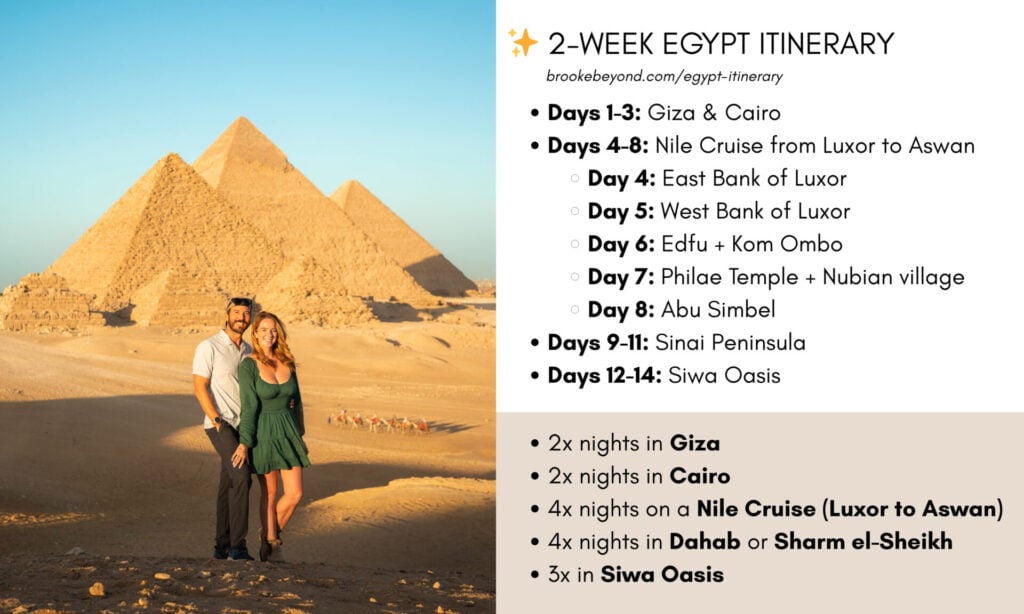
Itinerary map
In just 2 weeks, this itinerary explores four distinct regions of the country:
- Cairo and Giza, home to the country’s most iconic pyramids and best museum;
- the Nile Valley, where ancient tombs and temples line the river from Luxor to Aswan;
- the Sinai Peninsula, with some of the Red Sea’s best beaches and diving; and
- the remote Western Desert, where Siwa Oasis conceals lush palm groves and turquoise salt lakes.
My goal in designing this itinerary is to give you a deeper appreciation for Egypt’s ancient history, its evolution through many millennia, and the diverse natural wonders that so many visitors overlook!


Quick trip logistics
Best time to visit Egypt
The best time to travel around Egypt is in spring (March–May) or autumn (September–November), when temperatures are warm but still manageable across the country. This also lines up beautifully with the best diving conditions in the Red Sea, with warm water and superb visibility! We’ve been to Egypt several times in September, across November/December, and most recently in May, so here’s what we’d recommend:
- September: temps begin to drop after peak summer heat, but crowds are still relatively low— this can be a great balance overall, though we’ve experienced one September that was absolutely scorching, so it does vary year to year
- October–November: temps cool even further as autumn progresses, and despite falling within “peak season”, we didn’t experience heavy crowds in late November— this is definitely our favourite time to be in Egypt!
- Late December–February: winter brings the coolest temperatures but also the largest crowds, particularly right around the holidays
- March–May: spring offers another excellent travel window, with warm days and moderate crowds— we most recently travelled in May and found it a great overall experience, just with the caveat of avoiding midday activities because of the heat
- June–August: summer temps in Egypt regularly exceed 45°C (113°F), so it’s the quietest time of the year in terms of tourism— but unless you’re a photographer who prioritises low crowds over literally everything else, this is a truly miserable time to be sightseeing and we’d recommend avoiding!
Is it safe to visit Egypt?
Egypt is generally very safe for tourists, especially within the well-established destinations included in this itinerary, where tourism infrastructure is strong and security presence is high.
Most visits are completely trouble-free, but you should expect persistent touts in local markets and high-tourist areas like the Giza Plateau, the East Bank of Luxor, and popular Nile Cruise stops. These interactions are usually more annoying than dangerous— just stay polite but firm and avoid engaging if you’re not interest. That said, we’ve been pleasantly surprised by how much the intensity has been dialled back in recent years, and you’ll now see a lot of vendors in Egypt advertising “hassle-free shopping”— it’s another sales tactic, sure, but we’re not mad about it!
As with any destination, practise basic common sense in Egypt: keep your valuables secure, use a private driver or rideshare app, and stay aware of your surroundings. If you stick to the standard tourist circuit and plan sensibly, Egypt is a safe and incredibly rewarding place to explore!

Getting to Egypt
This itinerary begins and ends in Cairo, which makes international arrival and departure simple. For those who want to follow the 1-week version (ending in Aswan) or 10-day version of this itinerary (ending in Sharm el-Sheikh), simply connect back to Cairo for onward travel.
- Starting & ending point: Cairo International Airport (CAI)
Getting around Egypt
This itinerary makes use of several different transport modes across the country:
- private drivers and Uber/taxis in Cairo & Giza
- domestic flight or overnight train from Cairo to Luxor
- Nile Cruise from Luxor to Aswan
- domestic flight from Aswan to Sharm el-Sheikh
- private driver or bus from Cairo to Siwa Oasis
Getting around Egypt is generally straightforward, and in many cases, we recommend hiring a private driver to transport you between locations to reduce the need for taxis, buses, or other less reliable modes of transportation. Luckily, private drivers are both widely available and very affordable in Egypt— we’d recommend asking your hotel to help coordinate a driver for a few key days of this itinerary, or you can email me and I’ll send you some of our personal recs!
Where to stay in Egypt
This itinerary includes a diverse mix of accommodation, from boutique hotels in Cairo and a 4-night Nile Cruise to beachfront stays on the Sinai Peninsula and a rustic Berber guesthouse in the remote Siwa Oasis. There are excellent options in every destination, but these are the places we’re confident recommending:
- Giza (2 nights): View Delta Hotel (budget hotel with amazing rooftop view) or La Boutique Hôtel Vue des Pyramides (trendy boutique hotel close to pyramids entrance)
- Cairo (2 nights): 22 by spacey (a collection of $50/night upscale apartments in central Maadi, our favourite neighbourhood) or Hilton Nile Cairo Maadi (high-end hotel with huge rooms)
- Nile Cruise (4 nights): our favourite of the classic Nile Cruise boats is Le Fayan II, but I’d recommend contacting our friends at Egylust who can access better prices than direct booking (and also recommend similar boats within your budget)
- Dahab or Sharm el-Sheik (4 nights): Sindbad Camp (rustic, waterfront hotel in Dahab) or Camel Dive Club (excellent package dive & stay deals in Sharm) or Sunrise Remal Resort (high-value, all-inclusive resort in Sharm)
- Siwa Oasis (3 nights): WAFLA or Sleep in Siwa (both charming, mud-brick guesthouses with excellent service)
🗺️ TRAVEL TIPS FOR EGYPT
→ Language: Arabic is the official language, but English is widely spoken in cities and tourist areas; language barrier is minimal for English-speakers
→ Currency: Egyptian Pound (EGP), converting at roughly 50EGP ≈ $1 USD for the last several years— cash is useful for tips and local restaurants
→ Tourist visa: Most nationalities require a visa, which can be obtained online or MUCH more simply as a visa on arrival at the airport— it’s quick and easy, just bring $25USD in cash
→ SIM card: install an eSIM for Egypt via Airalo; service is reliable throughout most of the country, but gets very spotty in Dahab
→ Packing list: lightweight, loose-fitting shirts and pants to manage the heat; throughout tourist areas, shorts and t-shirts are perfectly acceptable, just know more skin exposure will always attract more attention
→ Essential apps: Google Maps (download for offline use); inDrive (local alternative to Uber that works more reliably in Cairo); Google Translate (to decipher Arabic menus)


*Detailed Egypt itinerary
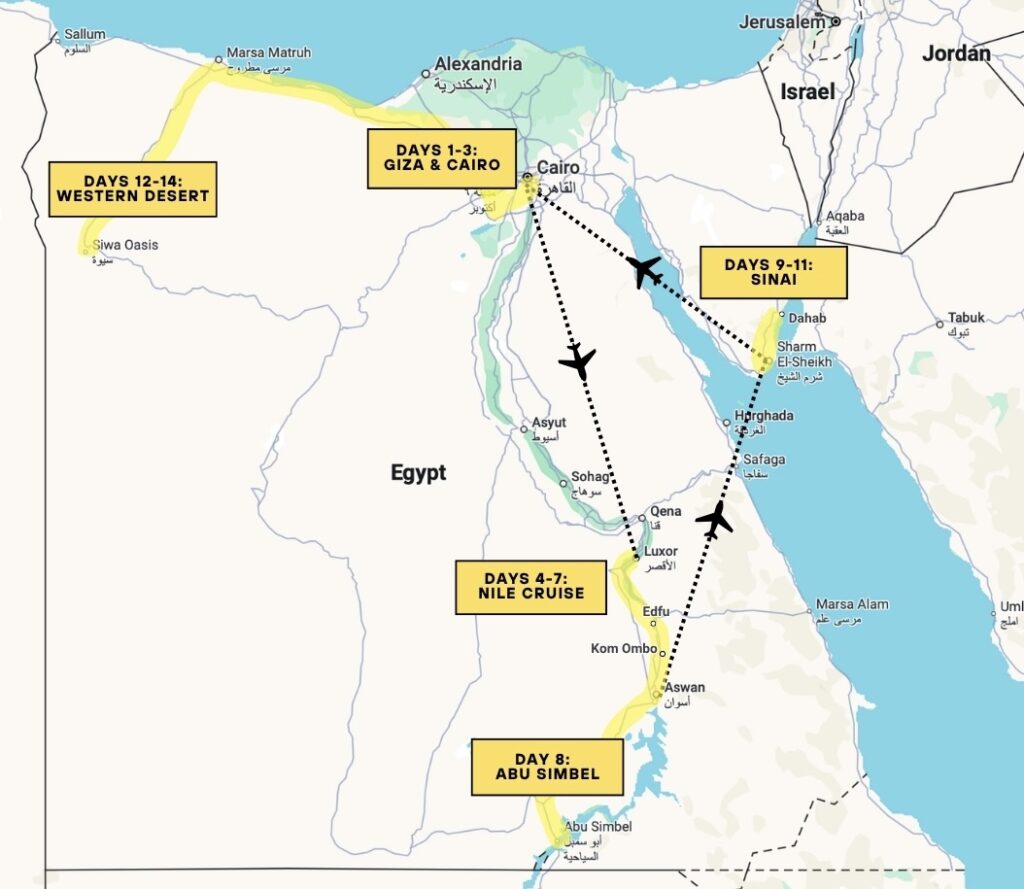
- Days 1-3: Giza & Cairo
- Days 4-8: Nile Cruise from Luxor to Aswan
- Day 4: East Bank of Luxor
- Day 5: West Bank of Luxor
- Day 6: Edfu + Kom Ombo
- Day 7: Philae Temple + Nubian village
- Day 8: Abu Simbel
- Days 9-11: Dahab or Sharm el-Sheikh
- Days 12-14: Siwa Oasis
Days 1-3: Giza & Cairo
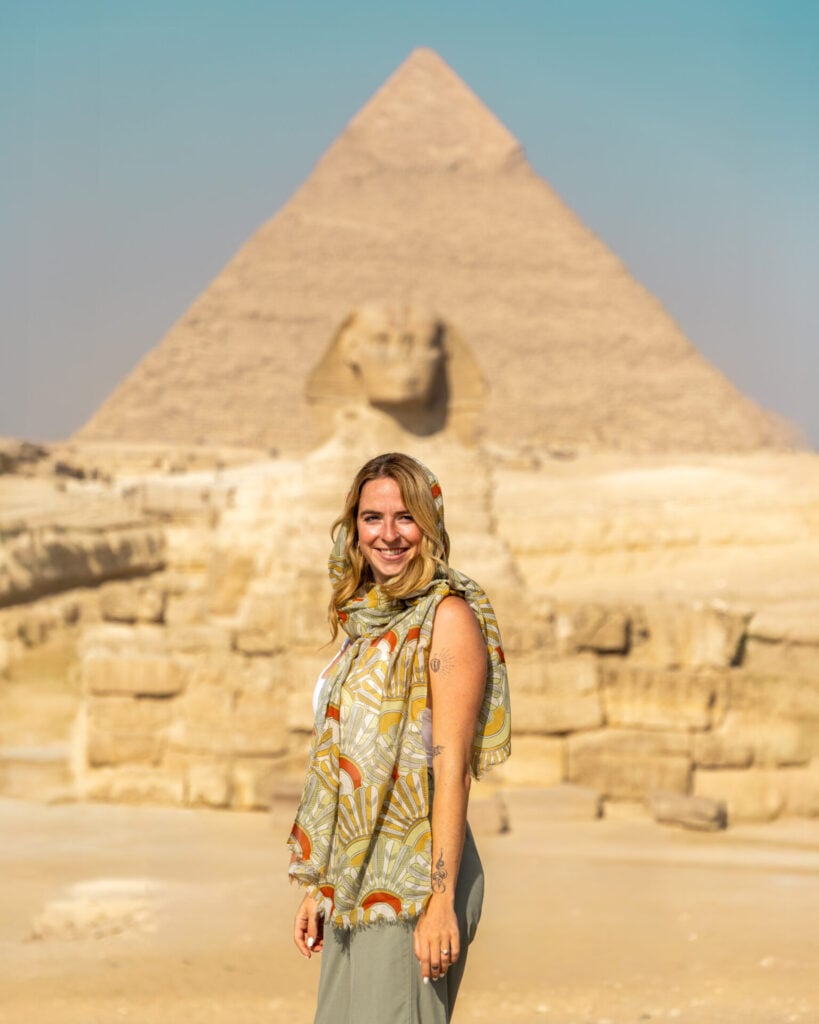
Egypt’s sprawling capital is the perfect place to begin your trip— not just for the convenient arrival, but for the extraordinary breadth of history on display! Within just a few days, you can stand beneath the 4,600-year-old pyramids of the Old Kingdom, explore the world’s largest archaeological museum, and trace the city’s cultural evolution through ancient Egyptian polytheism, early Christianity, and finally Islam.
>>> I’ve written an incredibly detailed 3-day Cairo itinerary— this section will highlight my general recommendations, but you should refer to that post for specifics!


3-day Giza & Cairo itinerary
This is how I recommend structuring your 3 days in Cairo, splitting your time between Giza and a few ancient sites nearby and Old Cairo:
- (overnight in Giza)
- Day 1: full-day tour of Saqqara, Dahshur & Giza pyramids (overnight in Giza)
- Day 2: Grand Egyptian Museum & Khan el-Khalili Bazaar (overnight in Cairo)
- Day 3: full-day tour of Coptic & Islamic Cairo (overnight in Cairo)
**If you only have time for 2 days in Cairo: combine Saqqara, Giza, and the GEM into one day (skipping Dahshur) and visit Khan el-Khalili on the same day as Islamic & Coptic Cairo. It’s more rushed and you’ll miss a few awesome sites, but still doable if you’re short on days!
Saqqara, Dahshur & Giza pyramids
Everyone visits the famous pyramids of Giza (as they well should), but I strongly recommend hiring a local guide and dedicating a full day to exploring the evolution of pyramid design across three key sites: Saqqara, Dahshur, and finally Giza!
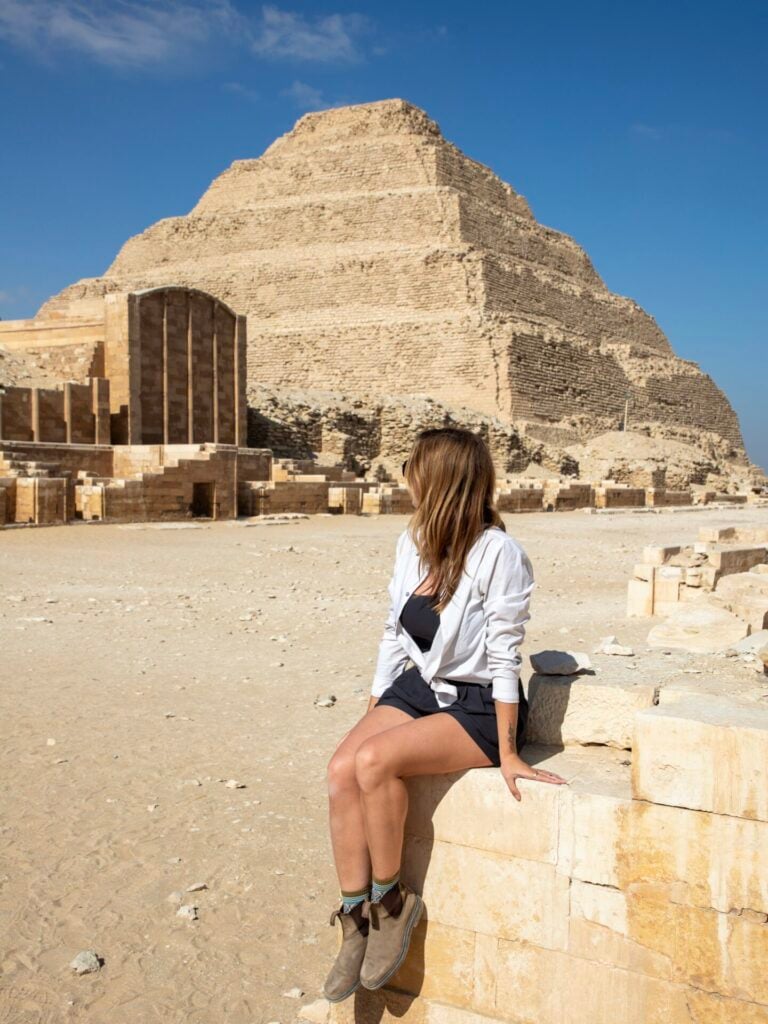
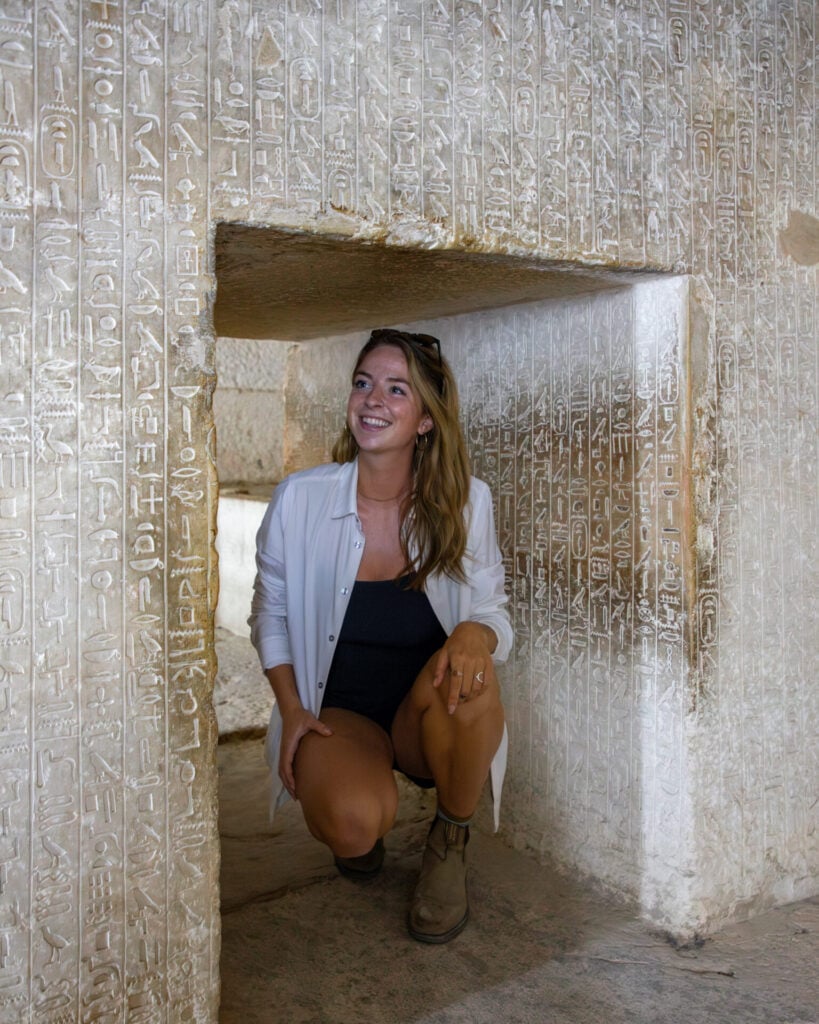
Start at Saqqara, home to the Step Pyramid of Djoser, the first pyramid ever constructed and widely considered the first large-scale stone building in human history. Within the complex, the richly decorated Tomb of Mereruka is one of the finest tombs outside of Luxor, while the Pyramid of Teti contains some of the oldest known religious inscriptions in existence.
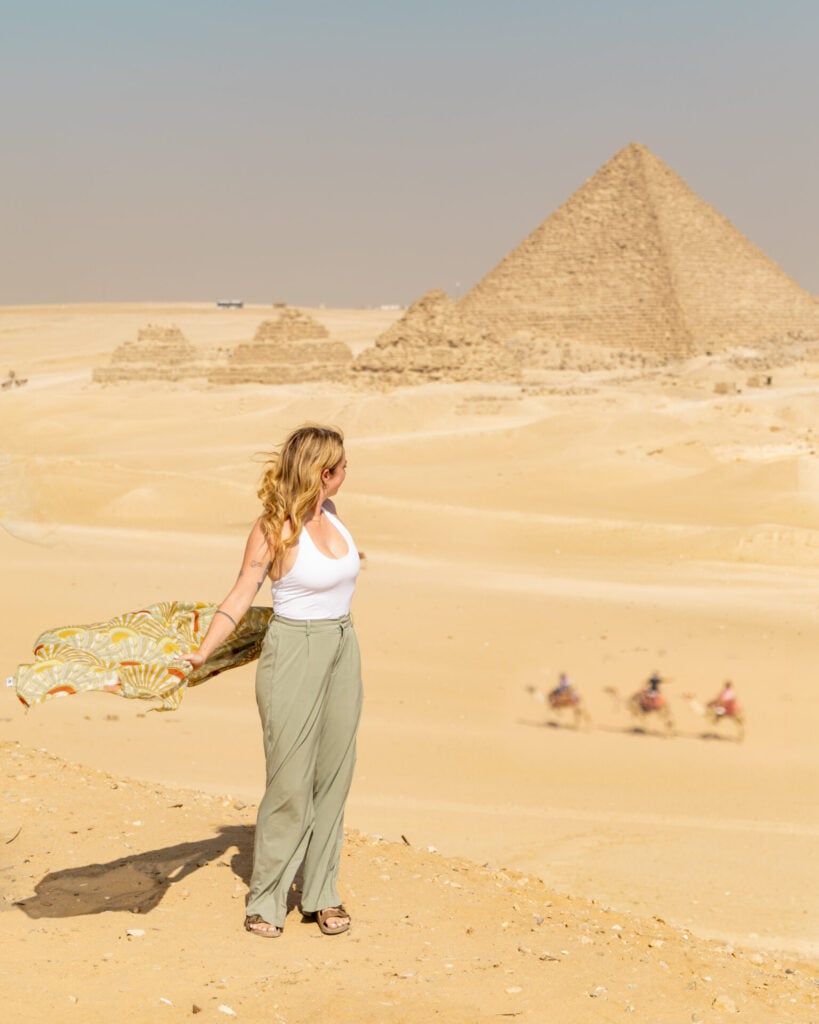
Continue a few decades forward to see the Bent Pyramid, a failed attempt at a smooth-sided pyramid, and the subsequent Red Pyramid, the first true pyramid ever constructed. Finish the day at the Giza Necropolis, home to nine pyramids, including the Great Pyramid of Khufu— the largest pyramid ever constructed and the tallest man-made structure on Earth for nearly 4,000 years!
>>> Read my 3-day Giza & Cairo itinerary for heaps more detail about what to see at Saqqara, Dahshur, and Giza!
Grand Egyptian Museum
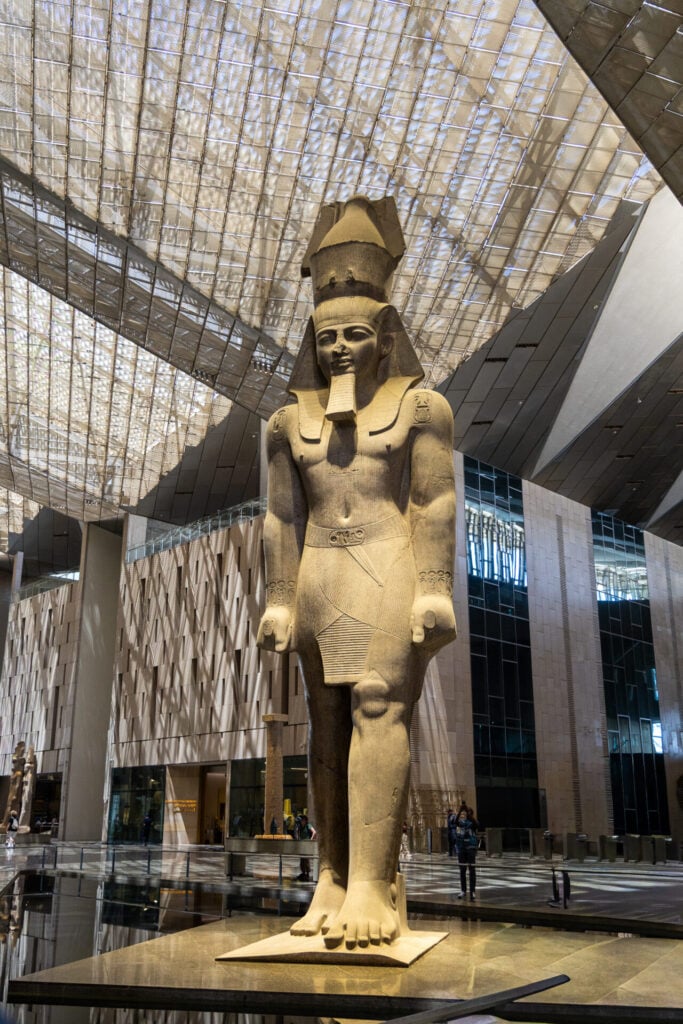
After nearly 20 years of construction, the Grand Egyptian Museum (GEM) finally opened in 2025 as the largest archaeological museum in the world. You’ll need about 4hrs to properly explore the GEM, which houses more than 100,000 artefacts spanning Egyptian history from the Predynastic period (before 3100 BCE) through the Greco-Roman era.


The headline attraction is the complete contents of Tutankhamun’s tomb (c. 1323 BCE), the most intact royal burial ever discovered in Egypt—and it’s truly spectacular to witness this collection exhibited together for the first time since its original discovery in 1902!
>>> See WAY more photos and specific recommendations of what to see at the GEM in my Cairo/Giza itinerary!
Khan el-Khalili Bazaar
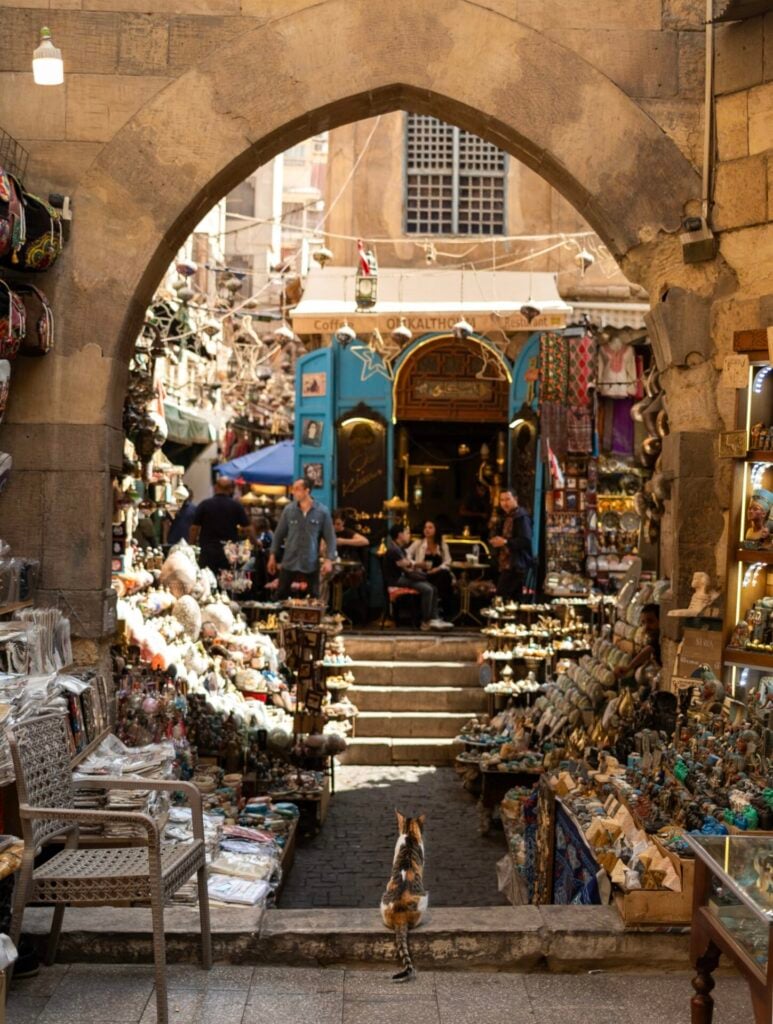
Across the city in Islamic Cairo, Khan el-Khalili is Cairo’s most famous market, continuously operating for more than 600 years. You can easily spend hours wandering its maze of narrow alleyways, browsing everything from spices and perfumes to textiles, jewellery, lanterns, and souvenirs— it’s as much about the atmosphere and cultural experience as it is about shopping!


Coptic & Islamic Cairo
Spend another complete day in Cairo exploring the city’s layered religious history, from some of the oldest Christian sites in the world to the grand mosques of Islamic Cairo. This is where the city’s transition from ancient polytheism to Christianity (1st century CE) and later Islam (from 641 CE) becomes most tangible, so we highly recommend hiring a private guide who can provide important context!
>>> Read my 3-day Giza & Cairo itinerary for specific recommendations of what to see in Coptic & Islamic Cairo, including the little-known Cave Church in Garbage City (cooler than it sounds)!
Where to stay in Giza & Cairo
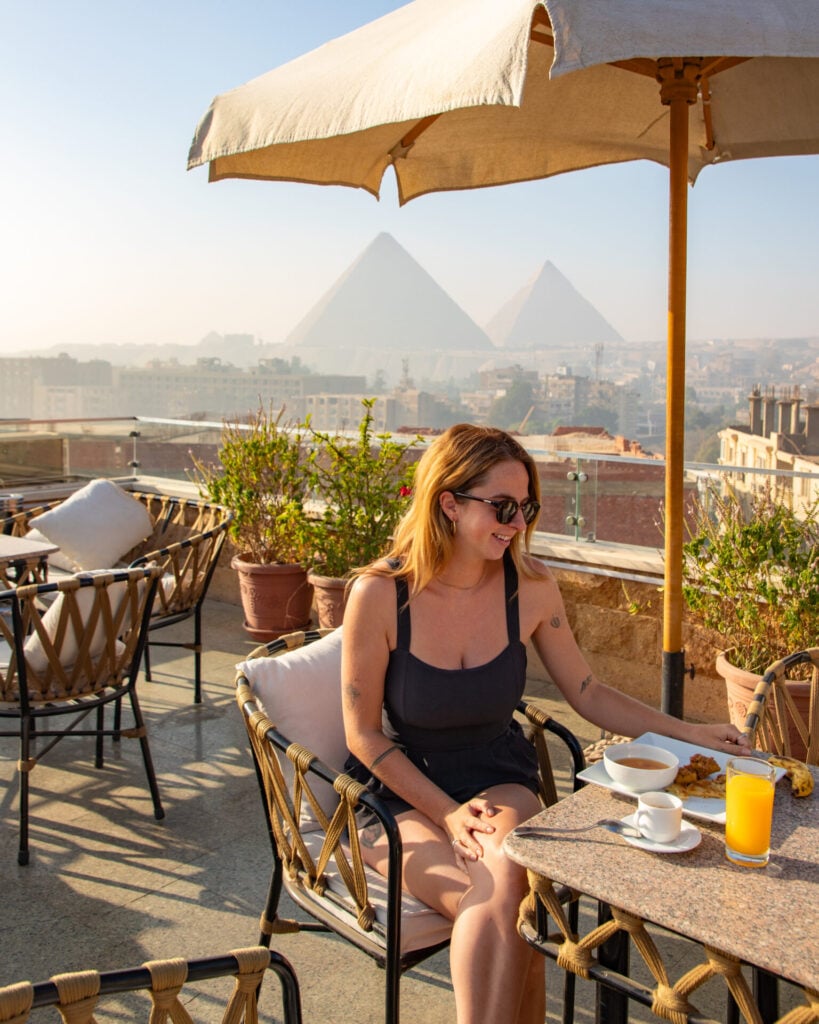
Following my recommended itinerary, start with 2 nights Giza (Nights 0 & 1), giving you easy access to Saqqara, Dahshur, and the Giza Plateau, plus a convenient visit to the GEM on the morning of Day 2. Both of our favourite hotels in Giza have a rooftop terrace with pyramid views and a free breakfast:
- View Delta Hotel— budget hotel with amazing staff and a great view
- La Boutique Hôtel Vue des Pyramides— trendy boutique hotel with a more upscale vibe
For Night 2 & 3, relocate to central Cairo, positioning yourself closer to the city’s historical and cultural sites. Our favourite area is Maadi, a trendy, upscale neighbourhood along the Nile with excellent restaurants, cafés, and a much calmer atmosphere than Old Cairo. Here are my top picks:
- 22 by spacey— a collection of upscale apartments in central Maadi, walking distance from our favourite hotels and amazingly just $50/night
- Hilton Nile Cairo Maadi— high-end hotel with huge rooms, beloved by our recent group trip (though I personally prefer the pick above)
Days 4-8: Nile Cruise from Luxor to Aswan
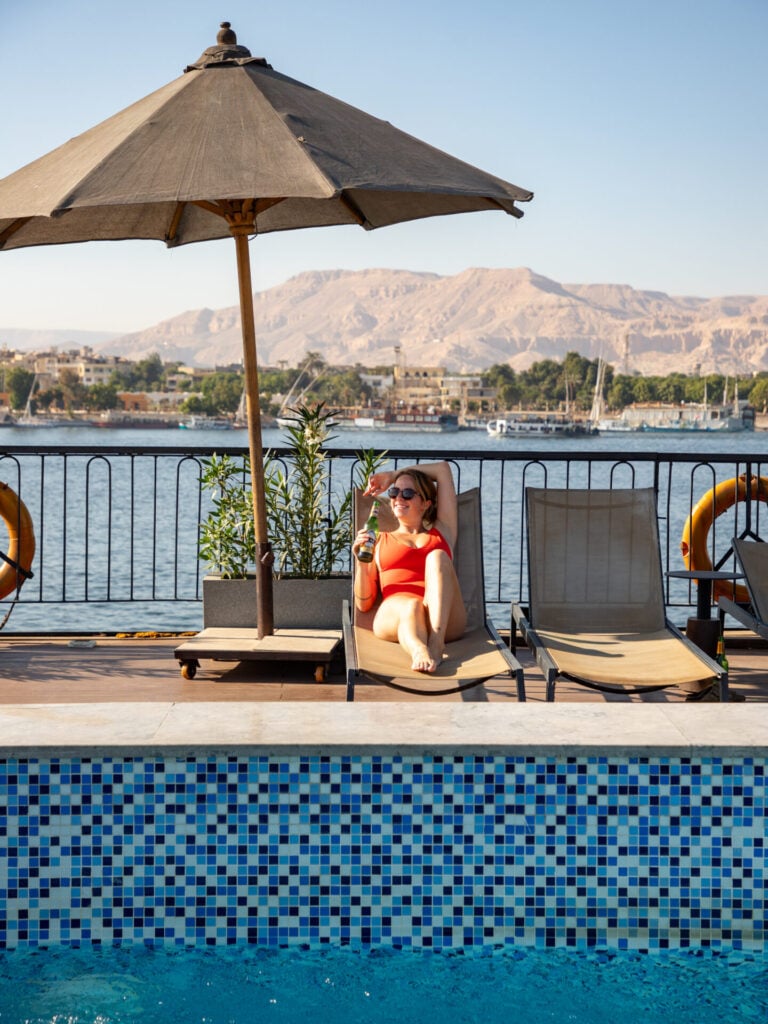
Flying (or taking the overnight train) from Cairo to Luxor, the next segment of this itinerary leads you through the heart of ancient Egypt on a scenic 5-day Nile Cruise. Even if you’re not a “cruise person”, this is hands-down the BEST way to experience the temples between Luxor and Aswan, as well as the simple beauty of river!
A Nile Cruise packages together transport, accommodation, 3 meals per day, all temple entrance fees, and a private guide in each destination. You can book a mid-range cruise for as little as $500USD per person, which includes all the major highlights between Luxor and Aswan. Cruises run in both directions over 3, 4, or 7 nights, but for the purposes of this itinerary, I highly recommend a 5-day/4-night cruise starting in Luxor!


>>> We’ve taken 3 Nile Cruises in the last couple years (obsessed, much?), so I’ve put together a detailed guide covering exactly what to expect, boat quality, itinerary variations, and how to choose the right option for your trip!
Nearly every boat follows a similar route, so here’s what a classic 5-day Nile Cruise looks like:
East Bank of Luxor (1st day of the cruise)
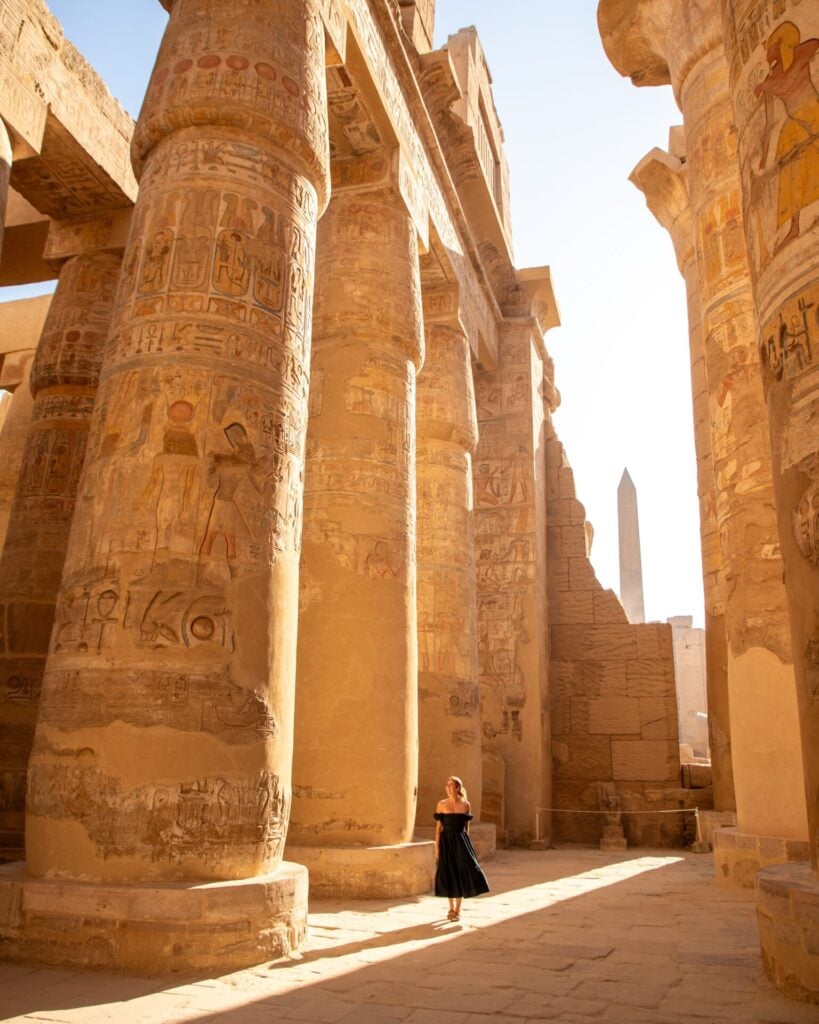
Boarding your cruise in the modern city of Luxor, you’ll typically spend your first afternoon exploring the highlights of the East Bank, which includes two grand temples: Karnak and Luxor.
Dedicated to the sun god Amun-Ra, Karnak Temple was the most important religious site in ancient Egypt and remains the largest religious complex EVER constructed in the entire world. Just 3km away along an ancient processional path lined with more than a thousand sphinx statues, Luxor Temple is famous for its six 14m-tall statues of Pharaoh Ramesses II, who built more monuments and temples than any other pharaoh during his 66-year reign.
The cruise typically remains docked on Luxor’s East Bank overnight, so we highly recommend visiting Karnak Temple in the afternoon and Luxor Temple after dark (~6-8pm) when it’s dramatically illuminated.
>>> Luxor is my absolute favourite place in Egypt, a veritable treasure trove of temples, tombs, and ancients sites dating back as far as 4,000 years ago. If you want to visit Luxor without a cruise, I highly recommend reading my detailed 3-day Luxor itinerary & travel guide! We’ve personally been to Luxor 3x in just the last 3 years, so we know this area well and can give you heaps of recommendations.
West Bank of Luxor (2nd day of the cruise)
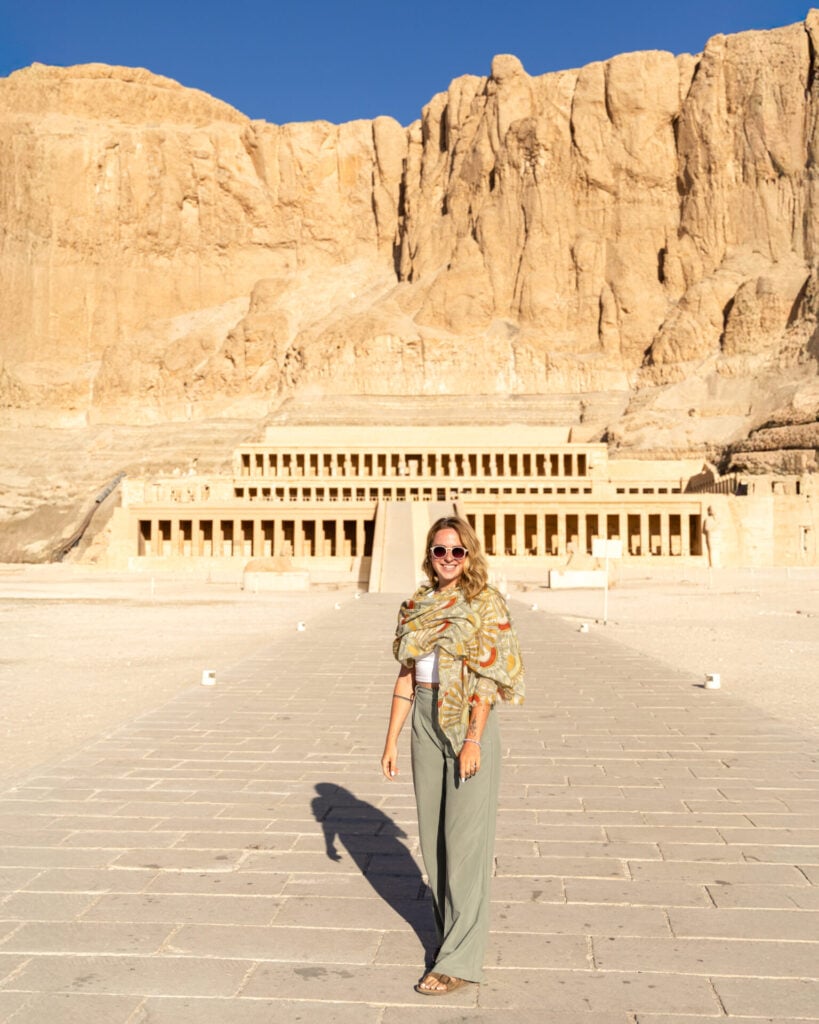
Wake up early for a full morning of exploring Luxor’s West Bank, classically associated with the afterlife, and home to vast mortuary complexes and ancient tombs that have preserved 3,500 years of Egyptian artistry.


We highly recommend paying extra for the sunrise hot air balloon over the West Bank (one of the few activities not included in the price of the cruise), and then continuing your guided exploration through the Temple of Hatsehpsut, Colossi of Memnon, and Valley of the Kings.
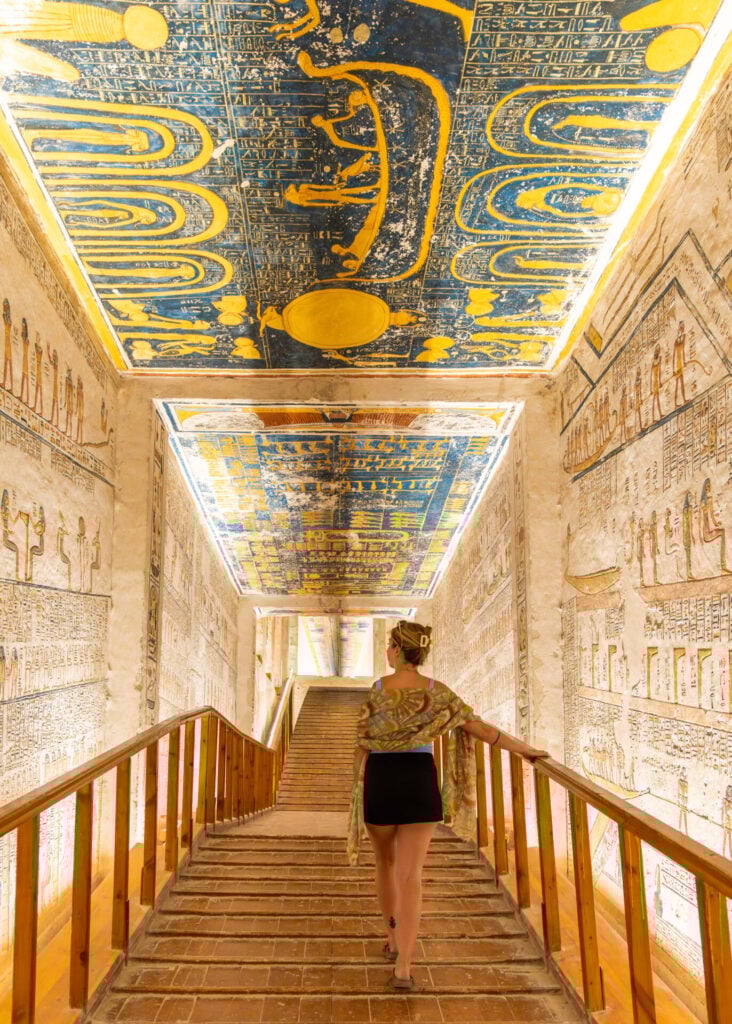
Of all the incredible ancient sites in Egypt, Valley of the Kings might just be my favourite, an ancient royal necropolis where pharaohs were buried in elaborately decorated tombs. We strongly recommend purchasing an extra ticket to visit some of the premium tombs—more info in my Luxor guide!
Boarding the cruise for lunch, you’ll set sail towards Edfu, eventually docking and overnighting near the temple (which you’ll visit the following morning).
Edfu + Kom Ombo (3rd day of the cruise)
Begin your morning by visiting the spectacular Temple of Edfu, one of the most complete and best-preserved temples in all of Egypt. Because it spent thousands of years buried beneath the sand (protected against erosion and vandalism), almost every element of a traditional Egyptian temple is still standing!


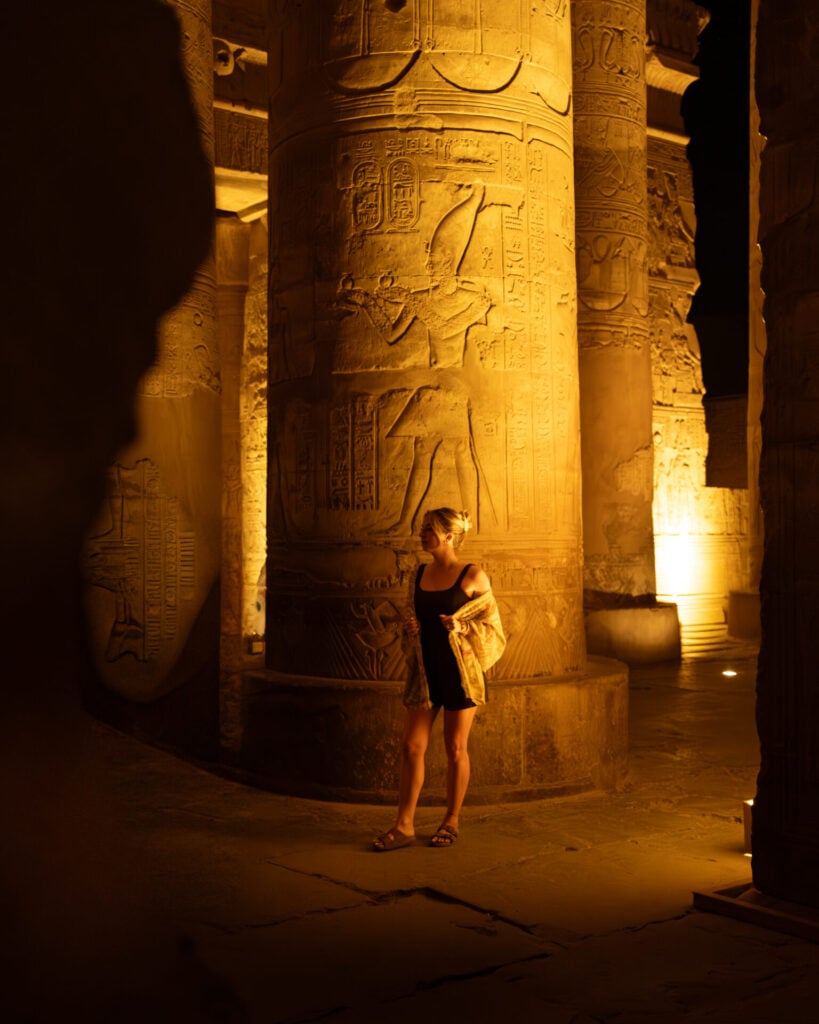
After Edfu, the cruise will sail further south to dock at Kom Ombo, where you’ll disembark to explore this unique two-sided temple dedicated to two gods, including the crocodile god, Sobek. Kom Ombo is particularly beautiful after dark, when the inscriptions are illuminated and thrown into sharp contrast!
Before leaving Kom Ombo, make sure to visit the crocodile museum to see mummified crocs and learn more about the significance of this sacred animal to the ancient Egyptians. Some boats will dock here, while others sail onwards to Aswan for the night.
>>> After 5 trips to Egypt, I wrote a detailed guide recommending the BEST ancient temples across the country!
Aswan (4th day of the cruise)
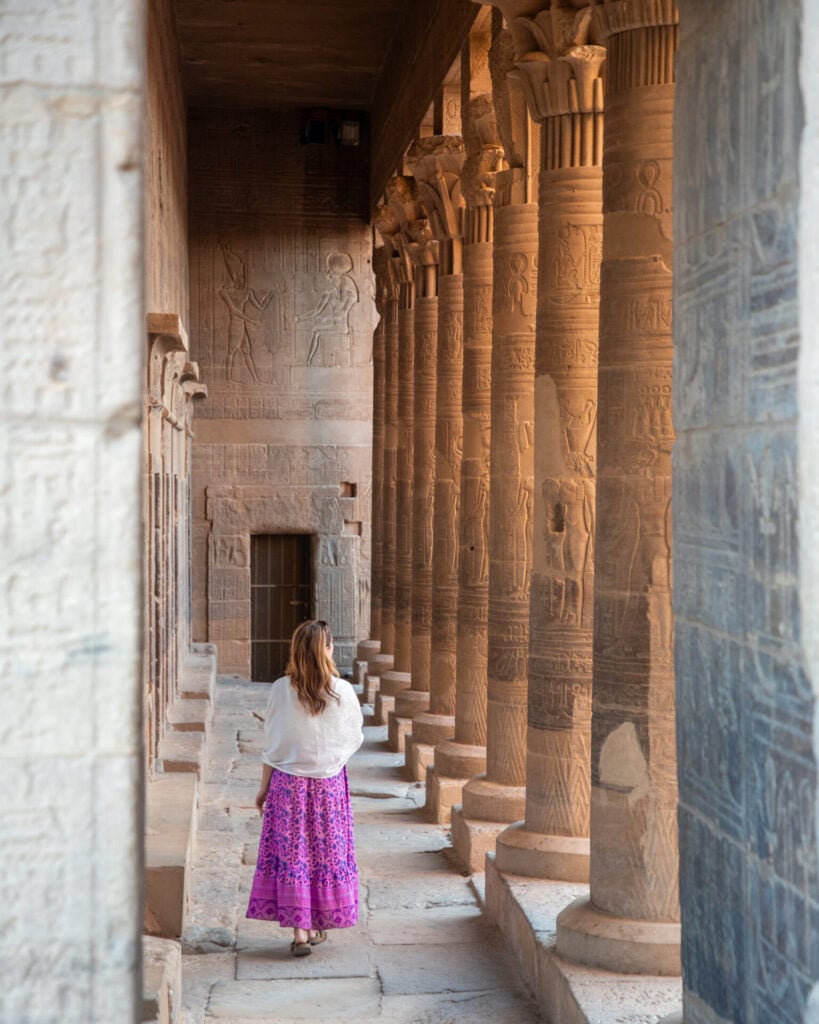
Once in Aswan, disembark from the cruise ship and board a smaller wooden boat to reach Philae Temple, set on a lush island and dedicated to Isis, goddess of magic, motherhood, and healing. As one of the last active temples in ancient Egypt, its history AND its setting make Philae particularly memorable!


The afternoon usually consists of a visit to a Nubian village, a welcome cultural contrast to the ancient temples. Rooted in a distinct heritage from southern Egypt and northern Sudan, these colourful riverside communities offer insight into Nubian traditions, architecture, and daily life along the Nile. Spend your final night on the boat in Aswan.
Abu Simbel (5th day of the cruise)
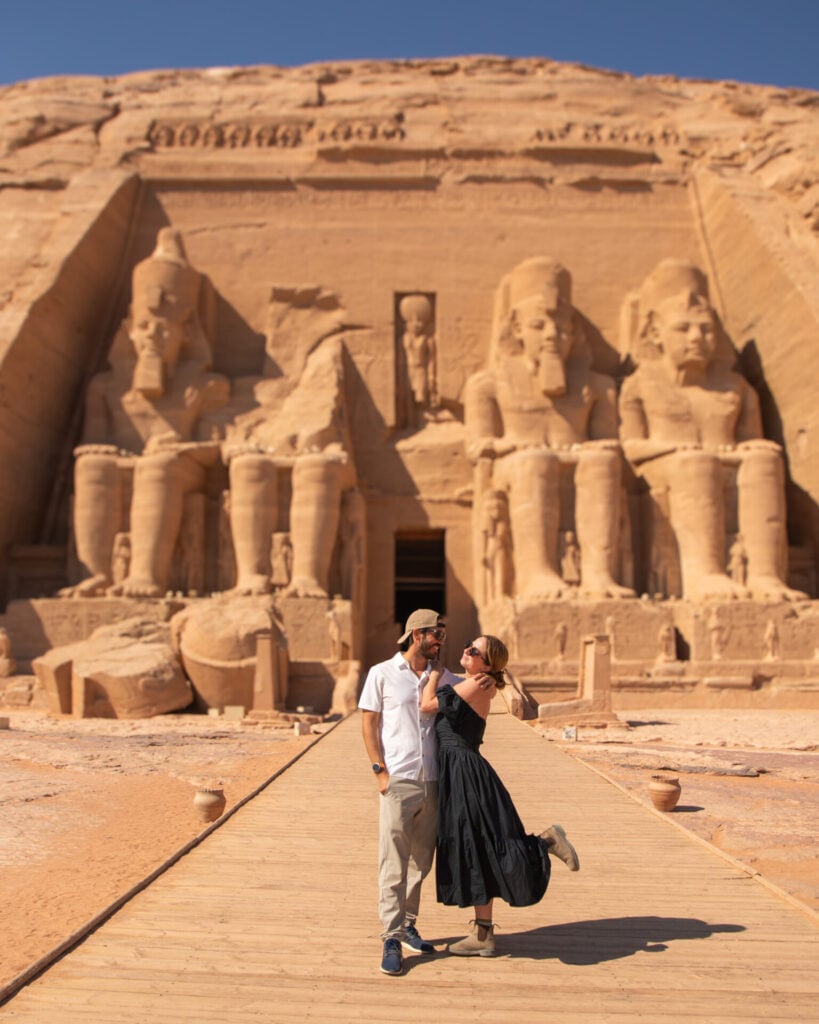
Offered as an optional extra to your cruise itinerary, Abu Simbel is located about 3hrs south of Aswan and can be reached by bus, private car, or short flight— we highly recommend the private car option, as it allows you to visit around 11am (a little-known window of quiet between the early morning rush and the mid-morning flight arrival).
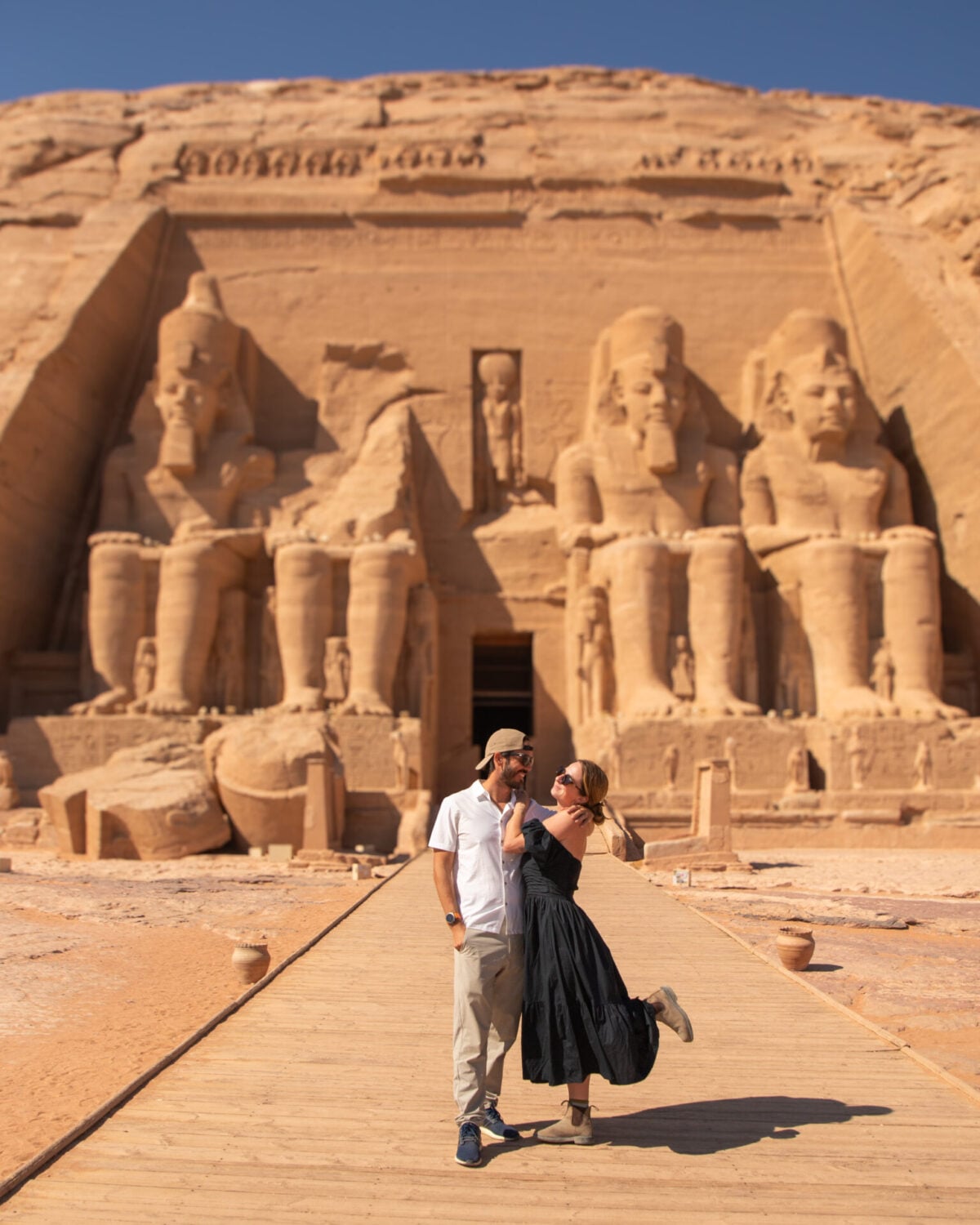
Abu Simbel is one of the most iconic temples in Egypt, instantly recognisable for its four colossal 20m-tall statues of Ramesses II carved directly into the rock face and renowned for its precise solar alignment, when sunlight penetrates deep into the inner sanctuary on just two days each year.


Back in Aswan, collect your bags from the boat (stored at reception) and continue onwards to the airport for the next leg of your trip.
>>> The best way to book a Nile Cruise is to contact a local agent like Mustafa and the Egylust team, who can access industry-only deals and recommend the best boat for your departure date, within your budget.
Days 9-11: Dahab or Sharm el-Sheikh
After a week immersed in ancient Egypt, head to the Red Sea to experience turquoise water, vibrant coral reefs, and a completely different side of the country. Hurghada is a classic choice, located about 4hrs east of Luxor on the mainland, but we found it overly touristy and rather charmless, so we’d strongly recommend heading to the Sinai Peninsula instead!
>>> Read my detailed Dahab travel guide for more essential Sinai experiences


The Sinai offers some of the best diving in the world, along with dramatic granite mountains, historic sites like St. Catherine’s Monastery, and the iconic Mt Sinai rising from the desert. This region also boasts a rich cultural heritage, shaped by Bedouin communities who have lived here for centuries, adding another layer to the experience beyond the beaches.
Dahab vs Sharm el-Sheikh
There are two popular bases on the Sinai (about 1hr apart), and while we absolutely LOVE Dahab, the best choice will depend on your own travel style:
Dahab is a barefoot beach town tucked between the granite mountains and the calm waters of the Red Sea— an unexpected paradise in Egypt that feels more like old-school Southeast Asia. Expect a laid-back vibe, simple accommodation, excellent cafés, and some of the best shore diving, rock climbing, and kite surfing in the world!


Sharm el-Sheikh, on the other hand, is a resort destination, defined by large all-inclusive hotels and a more packaged holiday experience. It’s not particularly charming, but it does offer higher-end accommodation and easier access to Ras Mohamed National Park, one of the most spectacular diving areas in the Red Sea. Sharm is also served by its own airport, which makes it more convenient for a short stay.
ش A NOTE ABOUT TRANSLITERATION
Travelling through Egypt, you’ll routinely see different spellings for the same sites (ex. Ras Mohamed/Muhammed), and this is due to the imprecise process of converting Arabic sounds into English letters— there’s almost no standardisation, so just figure that all similar spellings are referring to the same place!
Getting to the Sinai
From the end of your Nile Cruise in Aswan, hop on a domestic flight to Sharm el-Sheikh (likely transferring through Cairo). Those continuing onwards to Dahab will need to grab a shuttle or inexpensive taxi about 1hr up the coast.
What to do on the Sinai
I’ve written a complete Dahab travel guide with detailed recommendations, but these are the standout experiences that we’ve personally loved (from either Dahab or Sharm):
- Scuba diving: world-class reefs with exceptional visibility, colourful coral, and abundant marine life— Dahab is best known for its relaxed shore diving, while Sharm offers easy access to Ras Mohamed National Park
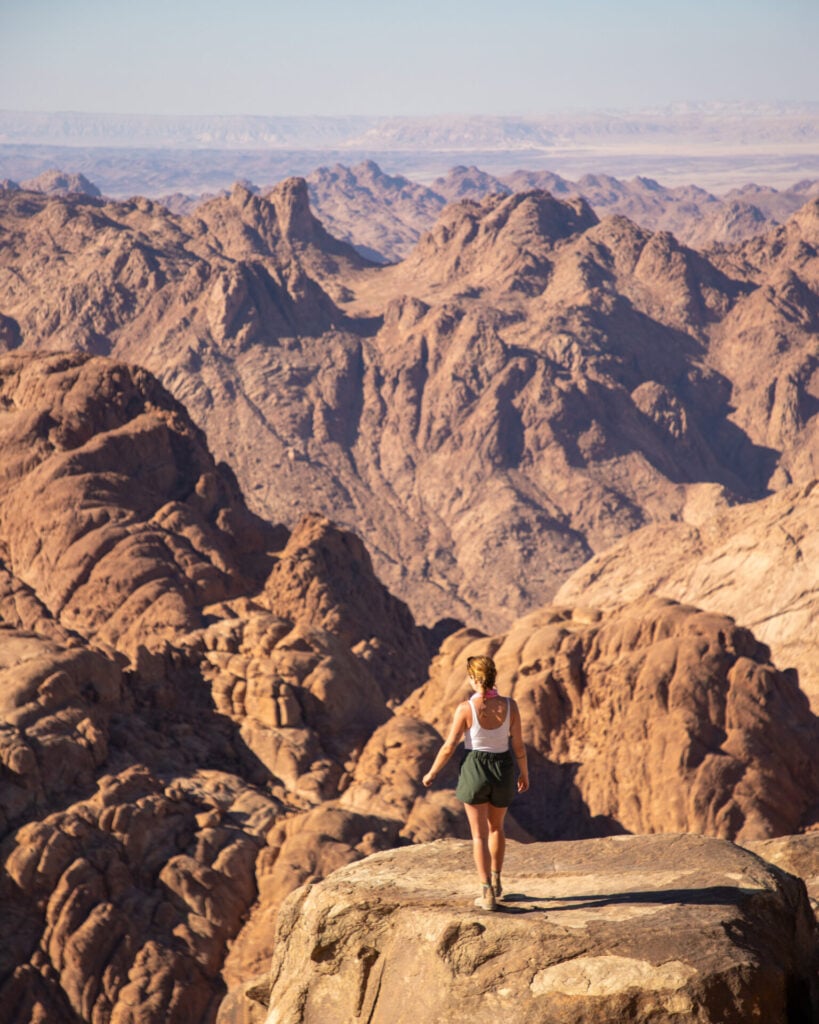
- Mt Sinai hike: hike up one of the most historically significant mountains in the world, with incredible sweeping views across the desert
- St. Catherine’s Monastery: the oldest continuously operating Christian monastery in the world, located at the base of Mt Sinai
- Rock climbing: excellent desert climbing from Dahab, with sport and trad routes in the granite mountains of the Sinai just a short drive from town
- Blue Lagoon: a remote stretch of glowing turquoise water and beach huts, famous for kite surfing but equally incredible for relaxing
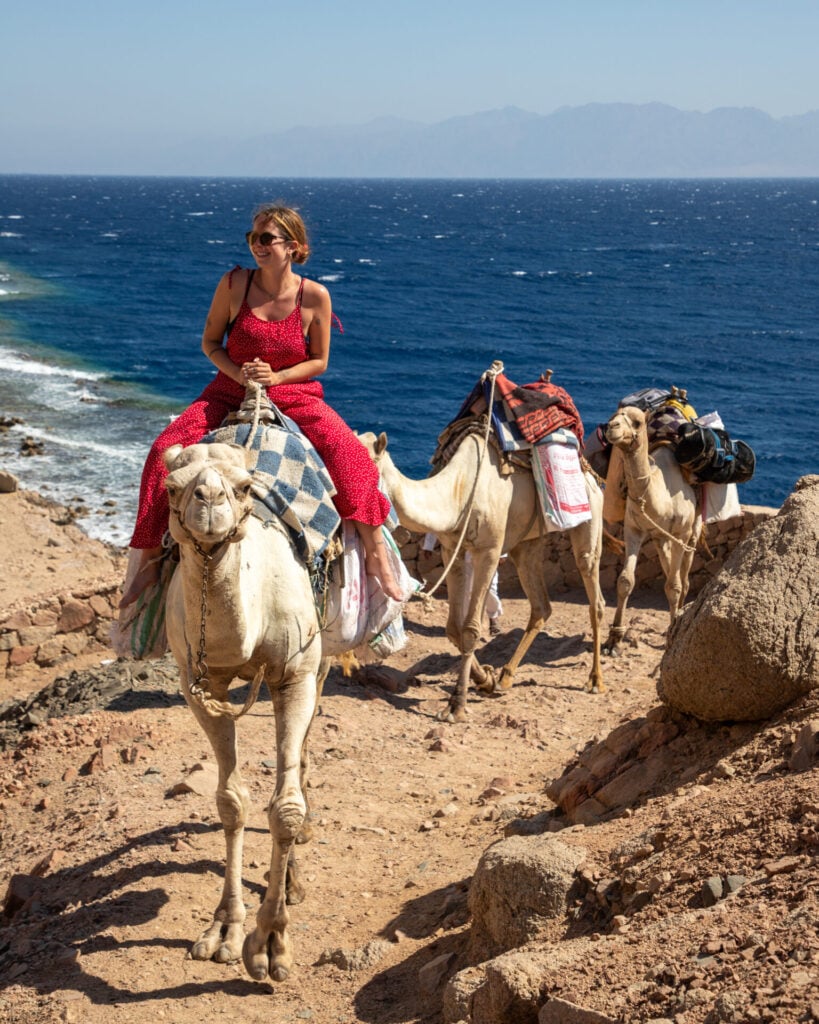
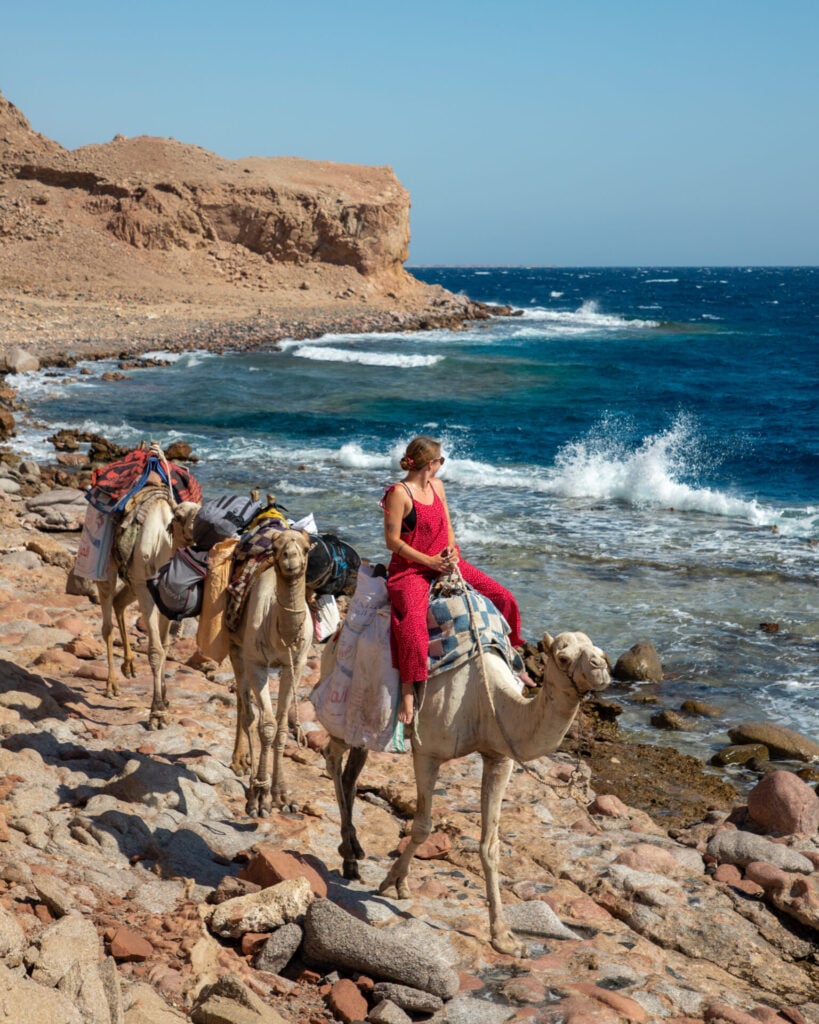
- Camel safari to Ras Abu Galum: a unique overnight adventure combining camel trekking with pristine reef diving in a protected marine reserve


Where to stay on the Sinai
In Dahab, we love Sindbad Camp, a relaxed beachfront property with private rooms (shared or ensuite bathrooms) and a long-standing reputation among divers. It’s within easy walking distance of the best restaurants, cafés, and dive shops, yet just outside of the touristy promenade area.
In Sharm el-Sheikh, we’ve previously stayed at the Sunrise Remal Resort, a large all-inclusive property with comfortable rooms and many pools. It offers great value if you’re just after a holiday, but it’s not the kind of place we’d ordinarily stay. Divers should check out Camel Dive Club, which came highly recommended to us by several divers in Dahab and offers stay & dive packages.
Day 12-14: Siwa Oasis
For the final leg of this itinerary, venture deep into Egypt’s Western Desert to one of its most remote and fascinating destinations: Siwa Oasis. Isolated near the Libyan border and culturally distinct from the rest of Egypt, Siwa’s mudbrick villages, palm groves, salt lakes, and strong Berber/Siwan identity are entirely distinct from the Nile Valley and the Sinai.
The lack of easy access is a huge part of the appeal. Siwa is rustic, uncrowded, and largely untouched, offering a slower, more atmospheric end to your trip. In the interest of full transparency, we had some mixed feelings about our time here— but it’s undeniably unique, and still worth including with a few realistic expectations!
Getting to Siwa Oasis
From Sharm el-Sheikh, take a quick domestic flight back to Cairo, the starting point for the journey out to Siwa Oasis. From here, you have two options:
- Overnight bus (10–12hrs): the most budget-friendly option (around $20pp), but in our experience, it was extremely uncomfortable— I’ve travelled on a lot of long buses over the years, and this has to be one of the worst
- Private driver (6–8hrs): we paid $120USD for a private driver to return to Cairo, which was FAR more comfortable and efficient (locals love to speed on this highway), with the added benefit of flexible departure times and stops along the way
What to do in Siwa Oasis
Once you get to Siwa Oasis, spend 2 days exploring the surrounding highlights in any order you like:
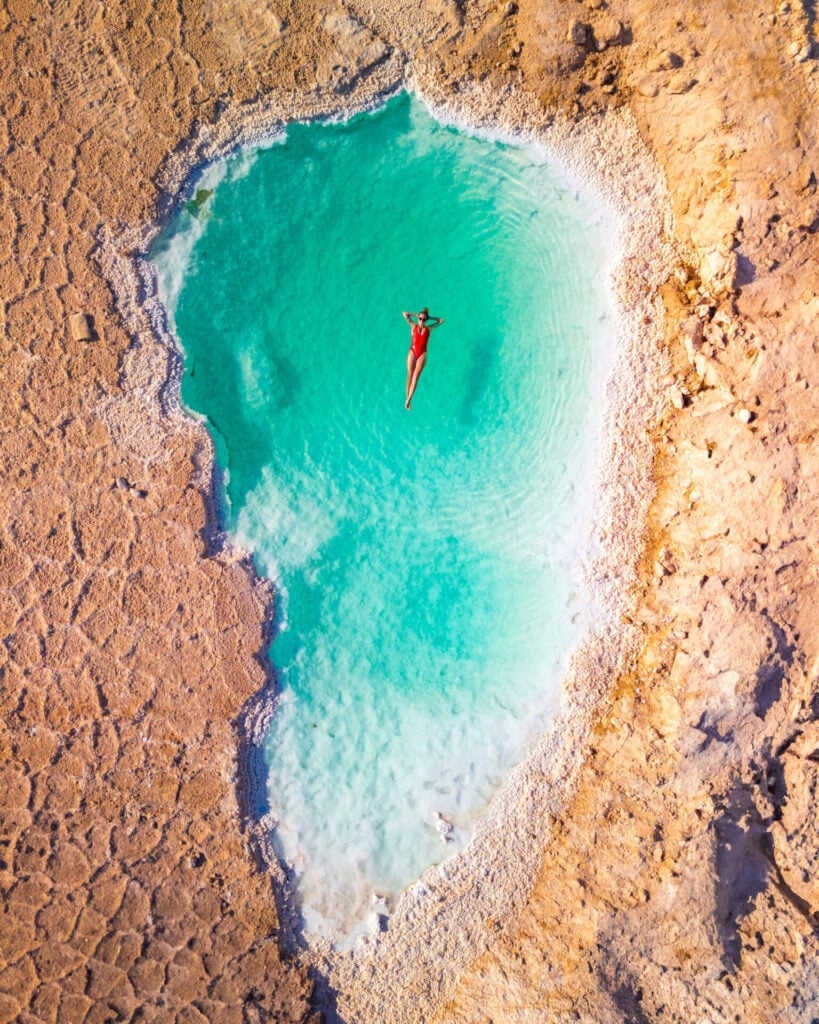
- Salt lakes: the most famous photo spot in Siwa, where you can float effortlessly in a range of brilliant turquoise pools— but to balance your expectations, this is also a working salt mine and the surrounding area is full of noisy, unsightly diggers that we conveniently cropped out of our photos
- Fatnas Island: one of the best sunset spots in Siwa, overlooking beautiful palm groves and salt lakes
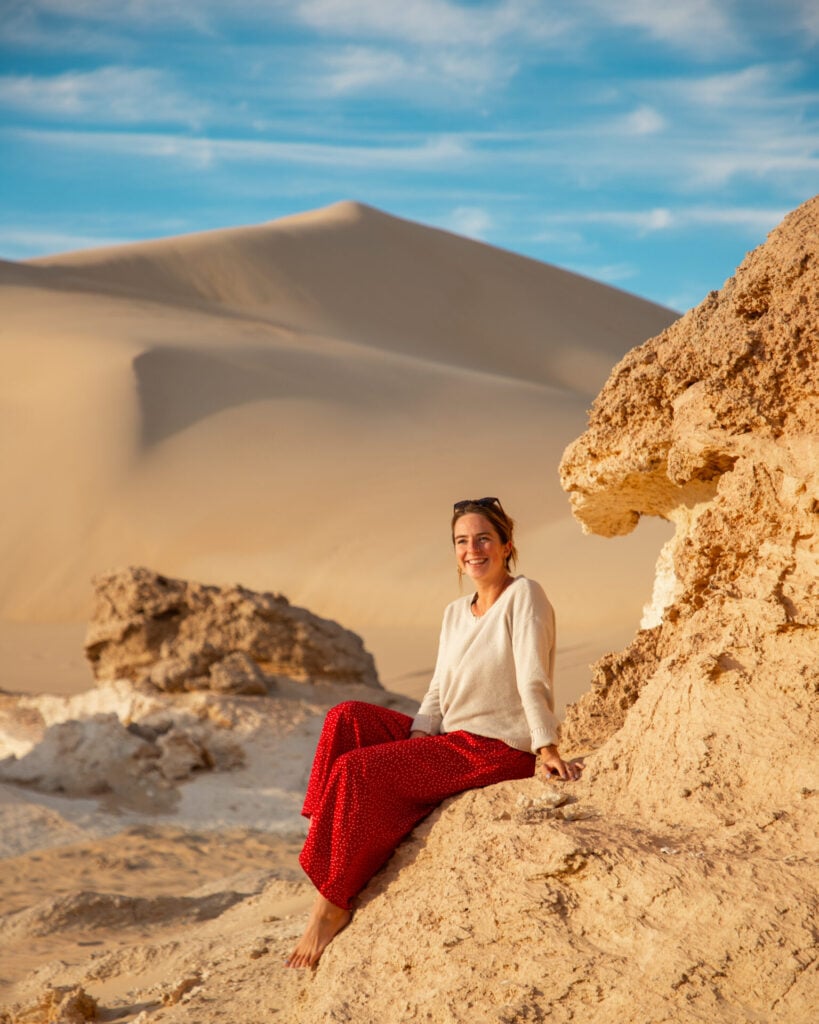
- Desert safari: head into the Great Sand Sea for dune bashing (driving through the sand in a 4×4), sandboarding, and sunset in the desert
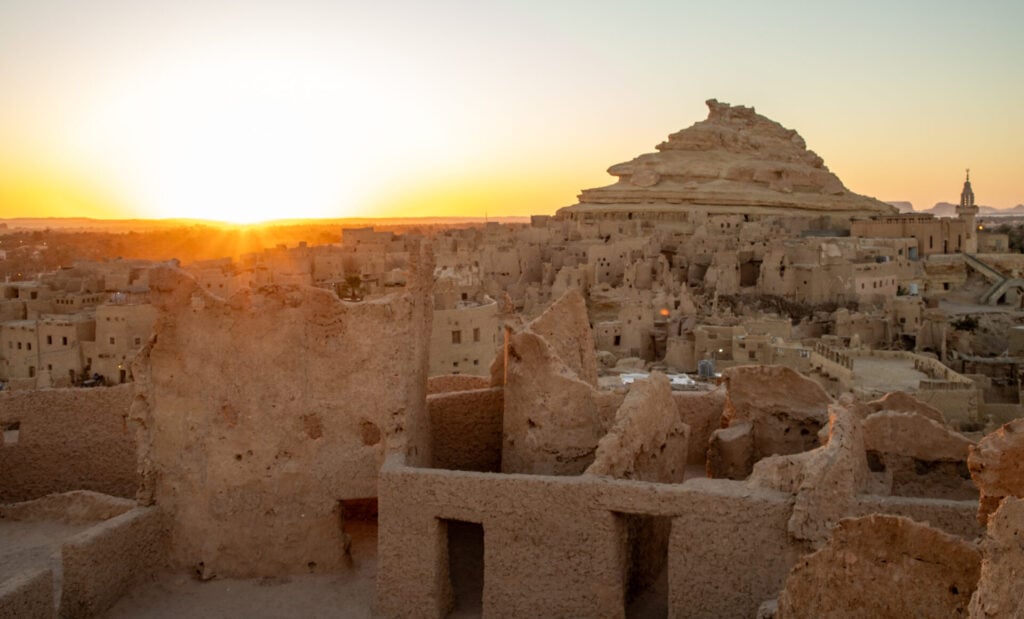
- Shali Fortress: the crumbling mudbrick ruins of Siwa’s original fortified town, built in the 13th century— a popular sunset spot that you can easily access by inexpensive tuktuk!
- Mountain of the Dead: thousands of ancient tombs dating back to the 26th Dynasty (about 2,700 years ago), offering both historical insight and panoramic views over the dense palm oasis


Where to stay in Siwa Oasis
Accommodation in Siwa is part of the experience, with a focus on traditional architecture and simple, atmospheric stays rather than luxury hotels. We recommend choosing a locally owned guesthouse that includes full board (3 meals a day), since food options in town are very limited. Some good options include:
>>> Alternatively, contact Mustafa and the team at Egylust, who can book your transport (bus or private driver), your accommodation, and all activities in Siwa— we’ve worked with them many times over the years, including as support for our group trips!
Itinerary extensions & modifications
- With only 1 week? Focus on the classic ancient Egyptian highlights in Giza, Cairo, and a Nile Cruise. If you need to trim Cairo to 2 days, you can combine Saqqara, Giza, and the GEM into one day (skipping Dahshur) and visit Khan el-Khalili on the same day as Islamic & Coptic Cairo.
- With only 10 days? Follow the recommended itinerary through Cairo, Luxor, and Aswan, then choose either the Sinai (Dahab/Sharm) OR Siwa Oasis depending on your interests.
- Want more diving? Head further south along the mainland coast to Marsa Alam or Wadi Lahami— the “deep Red Sea” offers more remote reefs, fewer divers, and exceptional marine life! We spent several weeks diving here and can specifically recommend Red Sea Diving Safari, which operates a network of well-organised, comfortable dive camps in prime locations.
- Combined with other regional highlights? We always run Egypt and Jordan together on our group trips, and they fit seamlessly into a single itinerary! With 1 week in Jordan, you can see Amman, Jerash, the Dead Sea, Wadi Mujib, and Petra; with 2 weeks, you can add Wadi Rum and Aqaba. Read my detailed 2-week Jordan itinerary for more ideas!


Read all of my Egypt travel guides
- Luxor travel guide: best temples & tombs of the East & West Bank
- 10 best temples in Egypt (from a 5-time visitor!)
- Choosing the best Nile Cruise in Egypt: absolutely everything you need to know
- Nour El Nil review: sailing from Luxor to Aswan on a luxury dahabiya
- Detailed 3-day Cairo & Giza itinerary for first-time visitors
- What to do in Dahab: a guide to Egypt’s coolest beach town
