
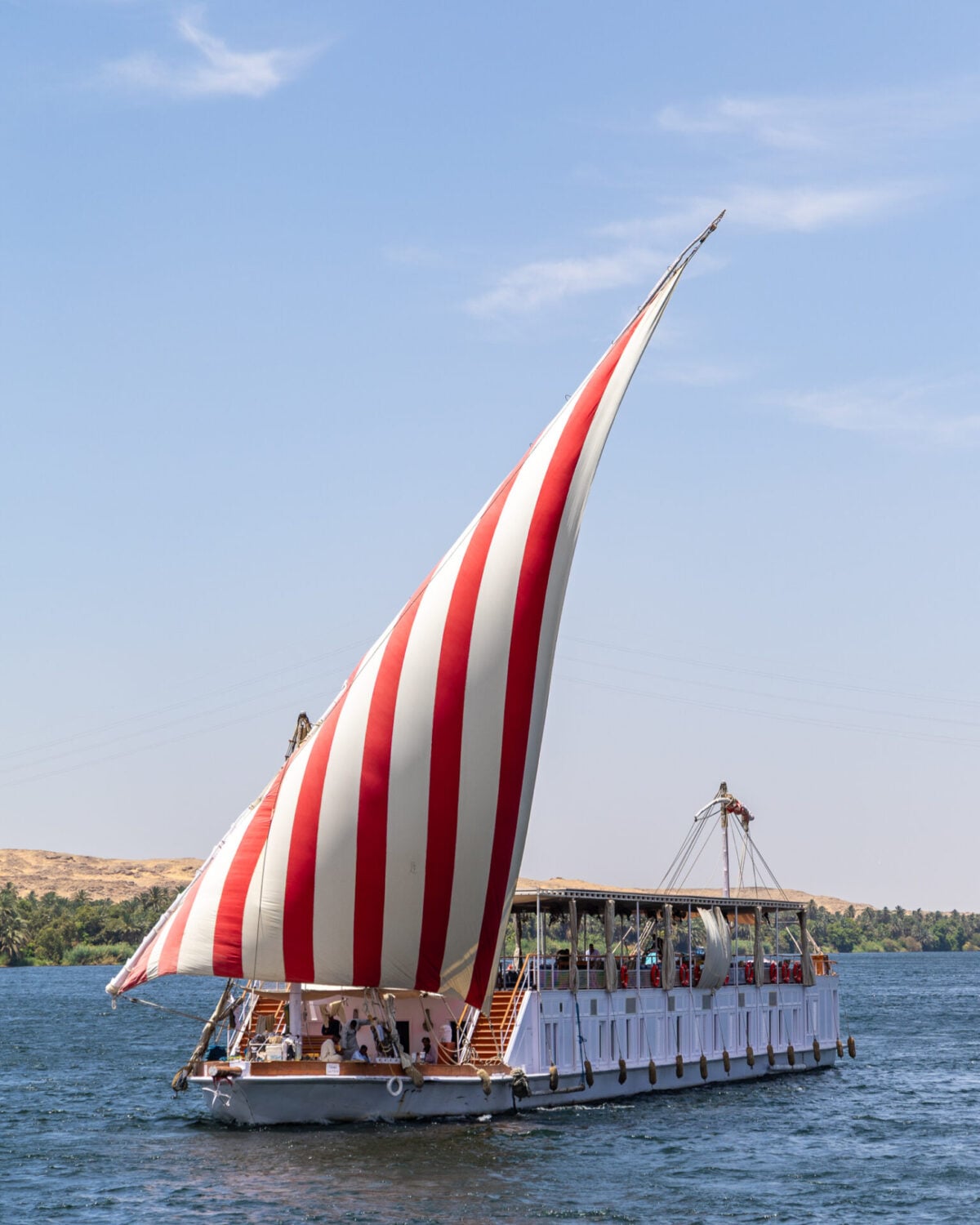
Nour El Nil review: sailing from Luxor to Aswan on a luxury dahabiya
Last Updated on 5 October 2026
Long before the Nile was crowded with large-scale cruise ships, it beckoned aristocrats, archaeologists, artists, and adventurers who explored Egypt aboard elegant wooden sailing boats known as dahabiyas. Popular throughout the 19th century, these graceful vessels eventually fell out of fashion as motorised cruise boats became the new standard— but in the early 2000s, a small boutique company set out to reintroduce them to the river.
A world away from the parade of modern cruise ships jostling for space at the same crowded temples, Nour El Nil invites guests return to the golden age of Nile travel on their small fleet of luxury dahabiya.
We recently spent 6 unforgettable days aboard Nour El Nil’s Poppee, drifting beneath canvas sails and stopping at remote villages, hidden archaeological sites, and quiet stretches of shoreline that larger cruise ships simply can’t reach. In this honest (and rather glowing) review, I’ll share exactly what it’s like to sail with Nour El Nil, from the cabins and food to the unique stops between Esna and Aswan— and explain why we believe this is the ultimate Nile Cruise experience for travellers seeking something truly extraordinary!
We sailed with Nour El Nil in May 2026 as part of a luxury Jordan & Egypt group trip that we designed and operated ourselves. We paid for the experience in full, received no sponsorship or compensation from Nour El Nil, and all opinions expressed here are entirely our own!
This post contains affiliate links, which means I may earn a small commission if you book something I recommend, at no extra cost to you. I ONLY recommend tours, rentals and places I’ve personally used (or would happily book again) — your support helps keep this site going and the adventures rolling!


About Nour El Nil
Helmed by a visionary Egyptian, French, and Mexican-American trio, Nour El Nil operates an elegant fleet of traditional wooden dahabiyas that pay homage to the golden age of Nile travel. With a maximum of just 20 guests, the experience feels remarkably relaxed and intimate— and though we’ve loved all 3 of our previous Nile Cruise experiences, Nour El Nil is the undisputed highlight of my ongoing love affair with this river.
While most Nile Cruises spend surprisingly little time actually cruising (and a lot of time docked in Luxor or Aswan, effectively operating like a floating hotel), Nour El Nil’s dahabiyas spend six leisurely days sailing from Esna to Aswan beneath striped canvas sails— the longest sailing time of any boat operating on the Nile.
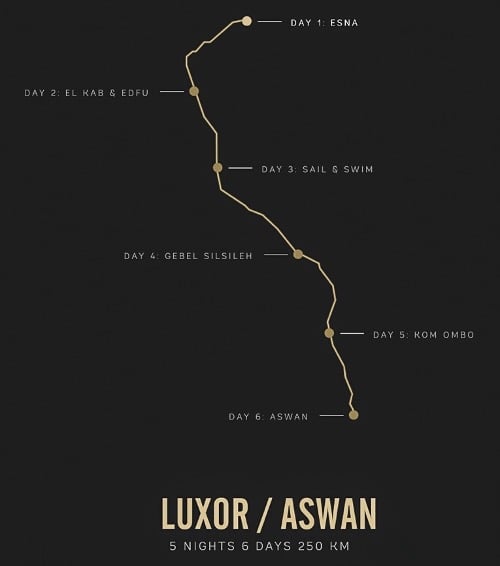
Surrendering to the rhythm of the Nile, an entirely new side of Egypt unfurls before you: empty temples, lush islands, village markets, and remote stretches of the river that feel almost undiscovered. Nour El Nil is a celebration of the destinations that emerge when you slow to appreciate the journey.
Our experience with Nour El Nil
As part of our most recent luxury group trip through Jordan & Egypt, we hosted 13 travellers aboard Poppee for 5 nights in May 2026. In our capacity as trip leaders, we experienced every aspect of the operation— from inspecting each cabin category and coordinating logistics with the crew to meeting the owners and spending time with the wonderful boat manager, Khaled, which really gave us a unique behind-the-scenes perspective on how Nour El Nil operates.
This was also our THIRD Nile cruise, having previously travelled on two different ships in 2024 and 2025, so we feel uniquely positioned to compare Nour El Nil against the experience offered by other Nile cruises (95% of which are exactly the same). Believe me when I say that this was one of the best travel experiences of our entire lives and it quite honestly blew the classic cruise experience out of the water!
>>> If you’re interested in reading more about the classic Nile Cruise experience, check out my detailed post on choosing the best Nile Cruise.
What to expect on a cruise with Nour El Nil
Private rooms
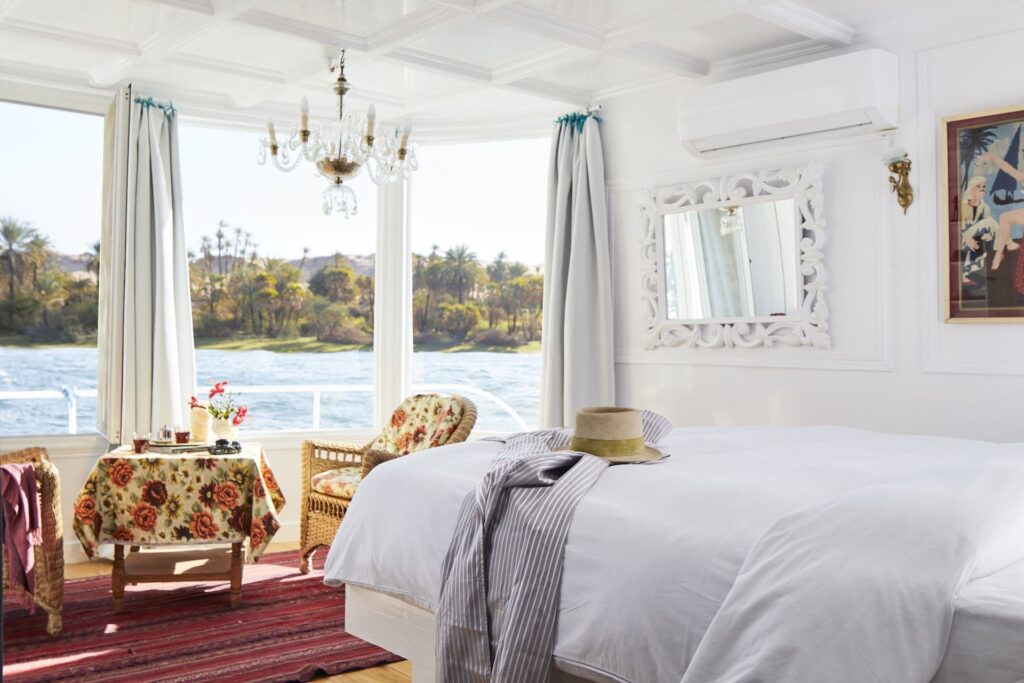
Each Nour El Nil boat has 8-12 rooms, ALL equipped with private en suite bathrooms, ample storage for clothing and luggage, powerpoints, and aircon. Since we booked out nearly the entire boat for our recent group trip, we had the opportunity to inspect all these room types in person and can give you a quick run-down:
- Luxury room: the standard accommodation aboard nearly every Nour El Nil boat features a king bed (also configurable as two twins). Room sizes vary slightly between boats, but I spent an embarrassing amount of time comparing cabin sizes across the fleet and concluded that Meroe offers the best price per square footage (i.e., largest Luxury Room for the lowest price), followed by Agatha and Adelaïde.
- Deluxe Suites: available only on some boats, the Deluxe Suite combines 2 adjoining Luxury Rooms into a much larger living space. We had two couples on our trip book a Deluxe Suite and use it as a 1-bedroom unit with adjoining sitting room, but you can also configure is as connected bedrooms for families travelling together (each with their own bathroom and aircon unit).
- Panoramic Suite: the rear two rooms on every boat feature large windows that provide uninterrupted views of the Nile and a flood of natural light throughout the day! We stayed in a Panoramic Suite aboard Poppee, and it’s about 1.5x the size of the standard Luxury Room for about 1.5x the price.


NOUR EL NIL ON A BUDGET?
The smallest boats in the fleet, Assouan and El Nil, offer compact cabins for the lowest price, so they can be a good entry point for budget-conscious travellers who still want to experience the magic of Nour El Nil. In all honesty, we spent very little time in our room anyway, preferring to lounge on the sun deck throughout the day!
>>> See more info on room pricing below.
Sun deck
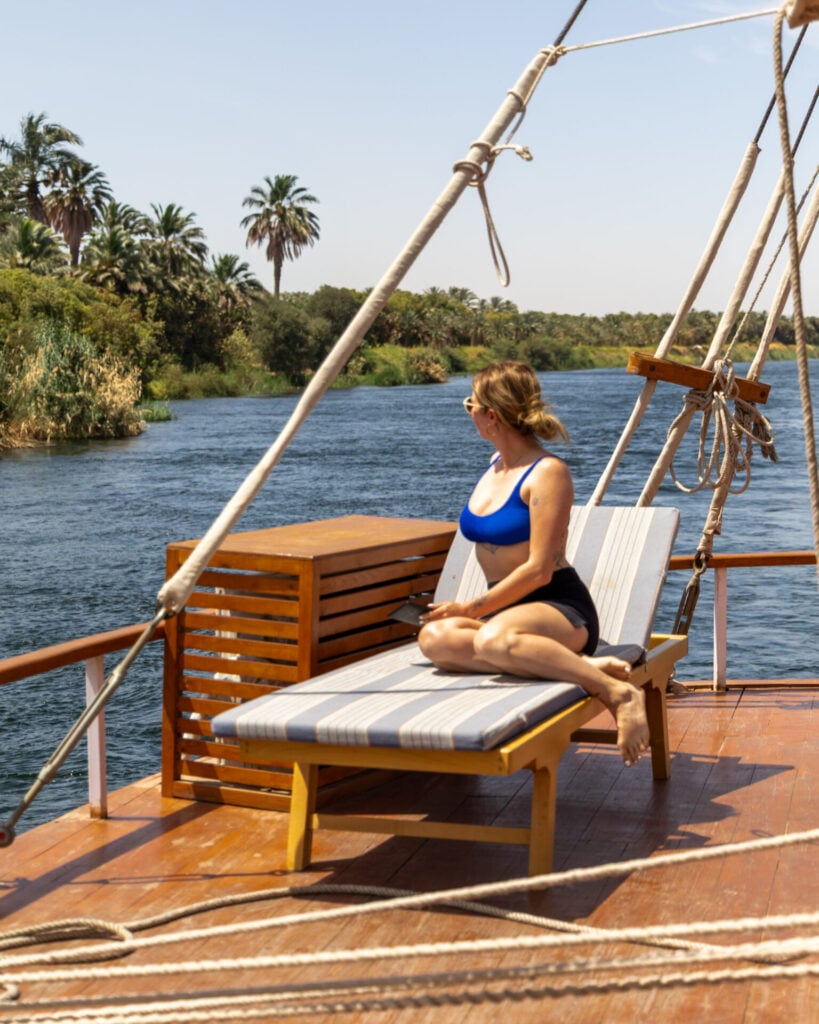
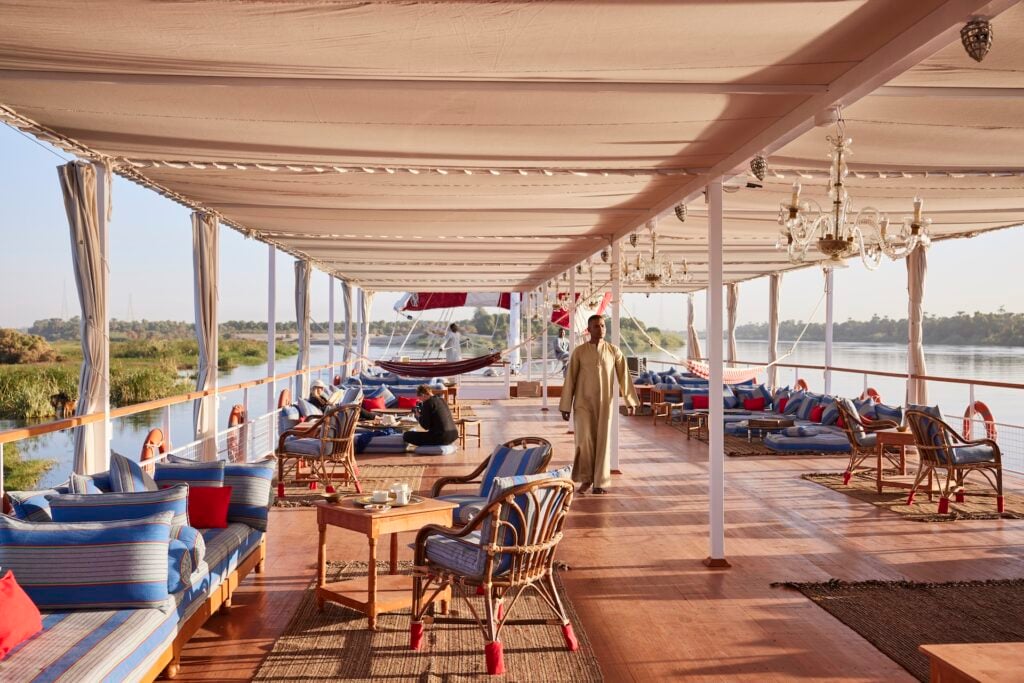
Each Nour El Nil dahabiya is thoughtfully designed with handcrafted Egyptian furnishings and features a sprawling open-air deck furnished with cushions, couches, and shaded lounging areas where guests can luxuriate as they watch life unfold along the riverbanks.
We spent nearly all of our time relaxing on the sun deck, reading, chatting with fellow travellers, and watching village life unfold along the riverbanks. Despite travelling in late May when temperatures simmered around 40°C, the combination of shade, river breezes, and fans made the deck surprisingly comfortable throughout most of the day!


Wifi on the boat
Wifi is available on all Nour El Nil boats, but since it relies on local mobile networks, coverage and speeds vary throughout the journey. I’d estimate we had working internet roughly 80% of the time and fast internet around 40% of the time, but personally, I think this is part of the charm— bring a good book, embrace the slower pace, and plan to disconnect for a few days!
Meals on the boat
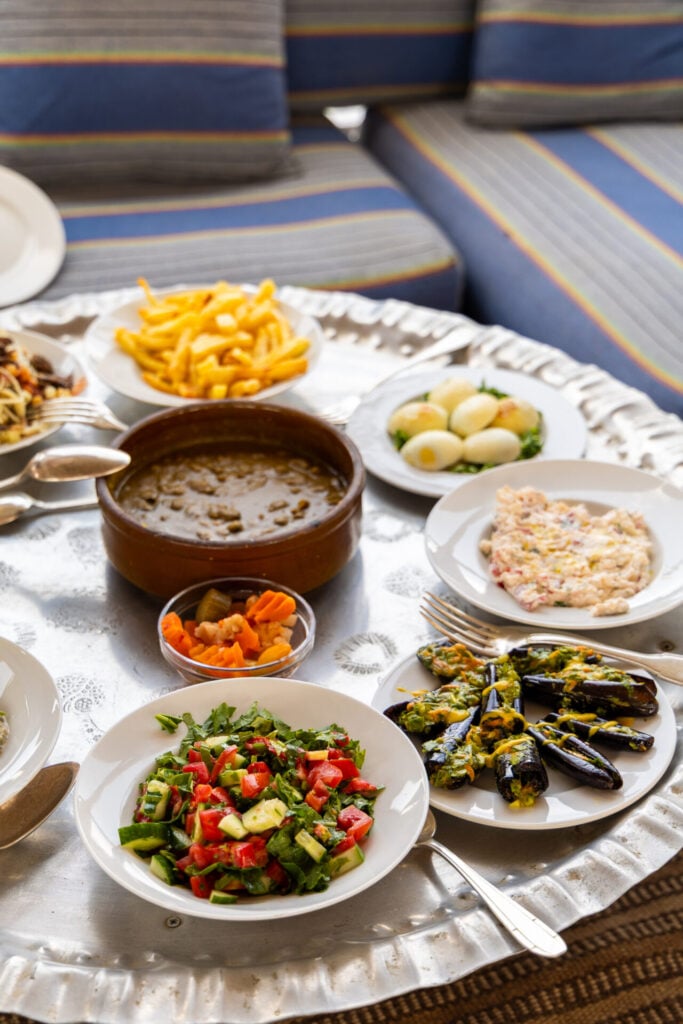
All meals are included in the price of the room and served communally on the sun deck. Prepared daily from fresh, local ingredients, the food was consistently one of the highlights of the experience!
Breakfast typically includes made-to-order eggs, crepes, fresh fruit, juice, coffee, and tea. Lunch and dinner feature an impressive spread of around 8–10 dishes, and during our voyage, we enjoyed fresh fish and shrimp, roasted duck, lamb tagine, grilled chicken, stuffed vegetables, falafel, hummus, salads, hot chips, and countless other dishes. Even the pickiest eaters in our group always found multiple dishes they loved, and dietary requirements were handled without issue.


Drinks on the boat
Soft drinks, fresh juice, and cold water are all included on the cruise. Alcohol is available for purchase at a very reasonable price (3€ per local beer, 20€ beer bottle of wine), but you’re also permitted to BYO alcohol onto the boat! We picked up 2L of gin at duty free for $25 each and used free tonic water and ice on the boat to make drinks for our guests.
Sailing on the Nile
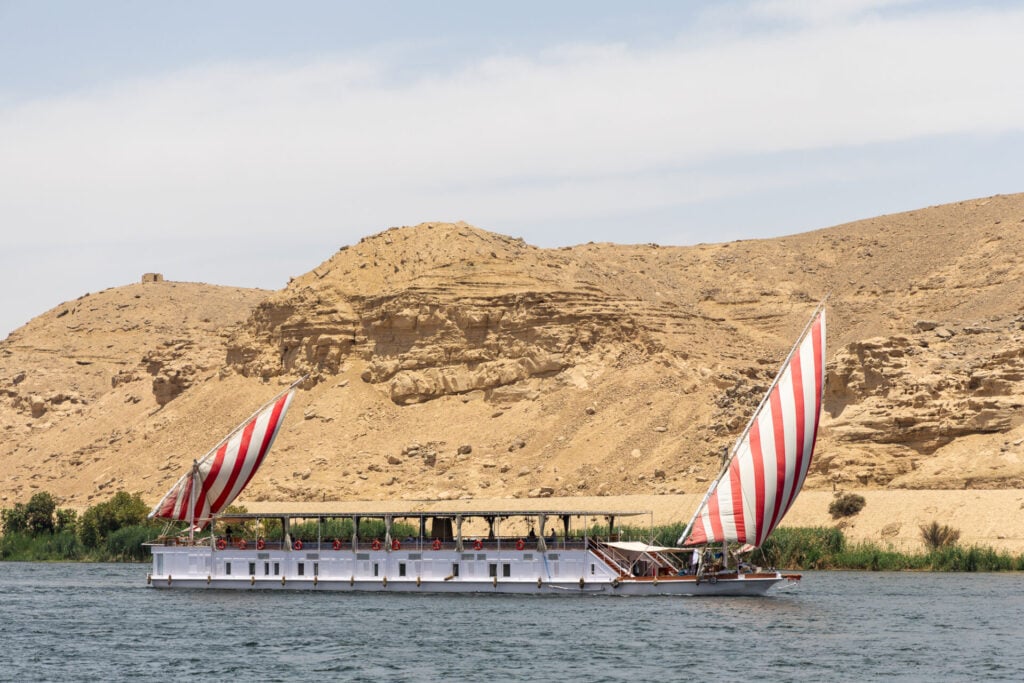
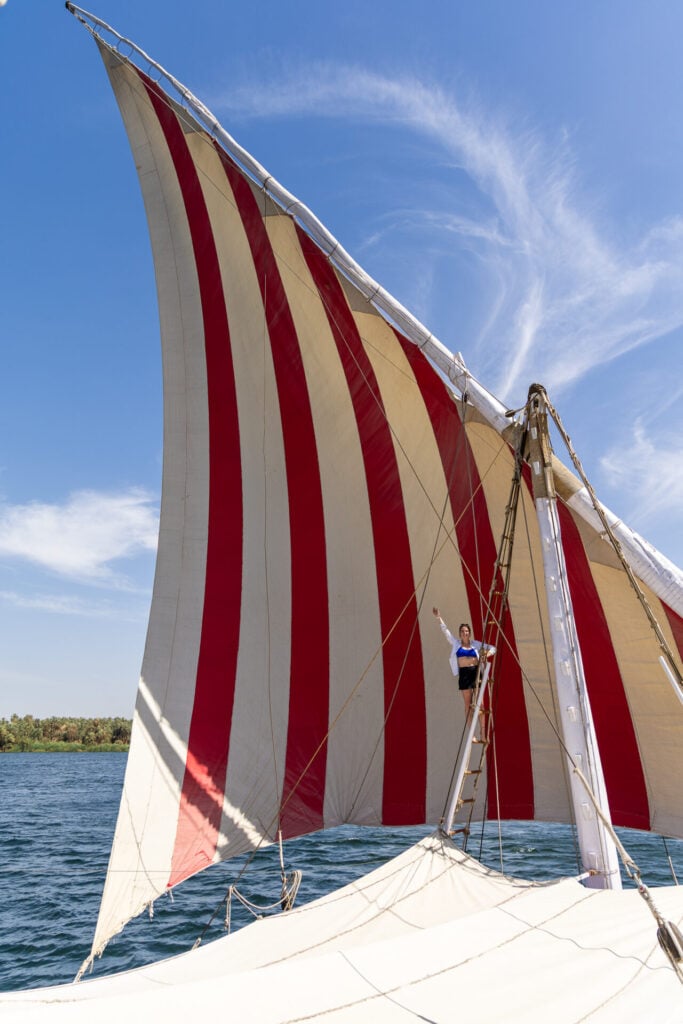
Swapping raucous boat engines for the gentle flap of canvas sails, one of the most magical parts of this journey is simply sailing on the Nile.
Although the river flows to the north, the prevailing winds in Upper Egypt typically blow south, allowing Nour El Nil’s dahabiyas to sail much of the route. These boats are completely motorless, but each is accompanied throughout the journey by its own small tugboat, so on days where the wind is inadequate, you’ll get a gentle tow instead.
We were lucky to sail every single day of our trip, though the tugboat was occasionally used to ensure we arrived at certain stops on schedule — and the transition between sailing and towing was so seamless (and silent) that we never even noticed. Having travelled on two motorised Nile cruise ships previously, I can tell you just how relaxing and special this felt in comparison.


Swimming in the Nile
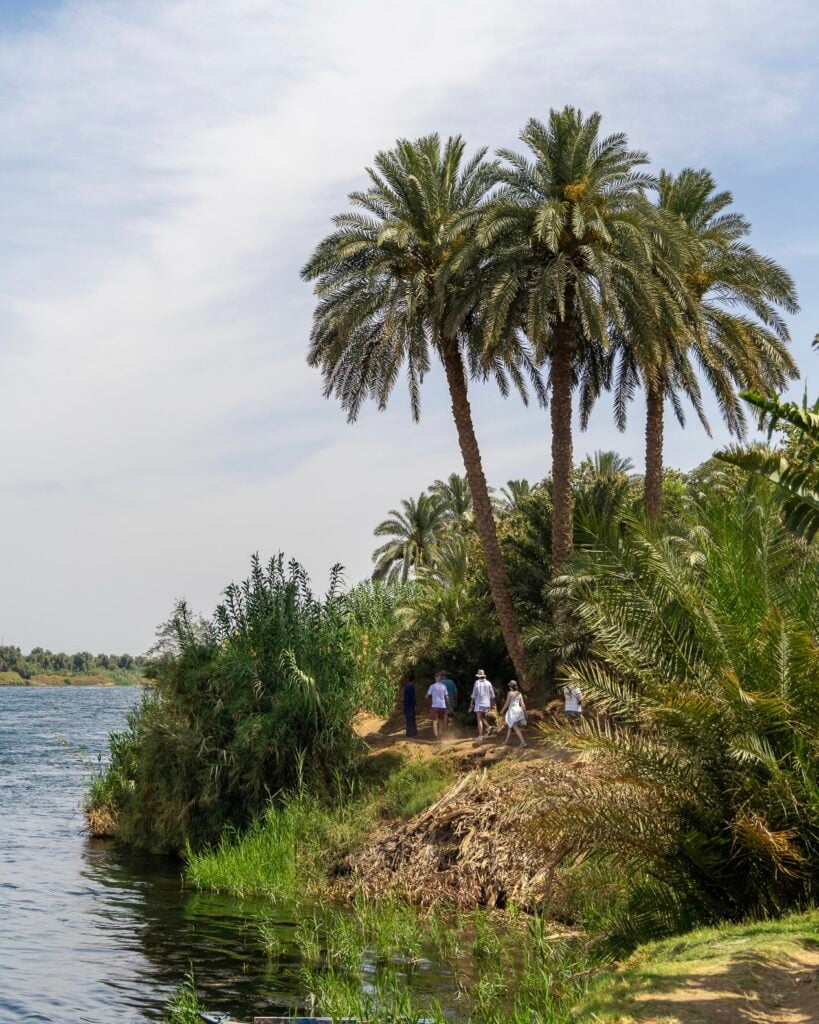
Another unique part of the Nour El Nil experience is swimming in the Nile almost every day— and visiting in late May with sweltering 40°C afternoons, these refreshing swims quickly became a highlight of our trip!
When I shared photos from the river on a recent Instagram post, I was inundated with questions about whether it’s clean (and whether there are crocodiles), but we were genuinely surprised by how pristine the river appeared in the rural stretches between Esna and Aswan. And it’s thankfully been croc-free since the construction of the Aswan High Dam in the 1960s!


Because of the powerful current, “swimming” usually involves travelling a short distance upriver in one of the tugboats, hopping into the water, and then floating gently back towards the dahabiya. Floaties are available for anyone who wants them, but most of us simply drifted with the current and enjoyed the river scenery.
Guided temple visits & nature walks
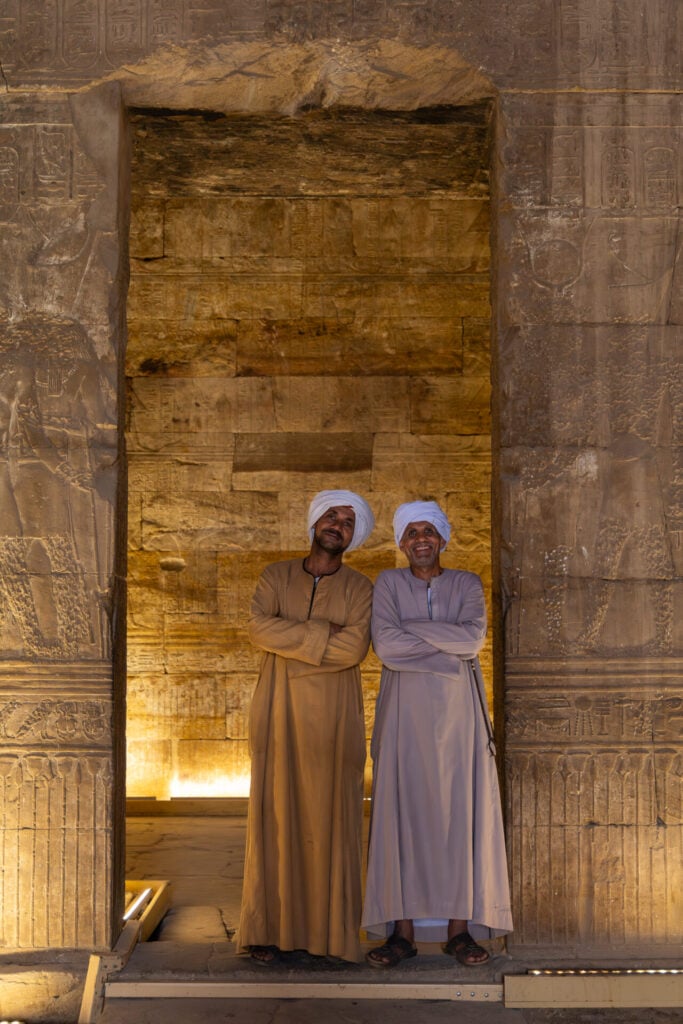
Each day combines a mix of included activities: ancient temples and tombs are explored with a licensed Egyptologist guide, while village walks and other cultural experiences are typically hosted by the boat manager.
Rather than travelling aboard the dahabiya, your Egyptologist will meet you at each archaeological site and lead a guided tour through its history and significance. Guides are available in multiple languages, so groups are often quite small— you may be as few as 2 but not more than 20 people, depending on how many others share your language on the boat.


*5-day Nour El Nil itinerary
While 95% of Nile Cruises follow an identical same route between the same handful of temples, Nour El Nil has crafted something entirely different. In addition to the cultural visits, guided walks, and daily opportunities to swim in the river, these are the remarkable ancient sites you’ll visit along the journey:
Esna Temple
The journey begins with a road transfer from Luxor to Esna, where you’ll kick off the trip with a visit to one of Egypt’s most underrated archaeological sites— and because the large cruise ships can’t stop here, you’ll likely have this spectacular temple almost entirely to yourselves!


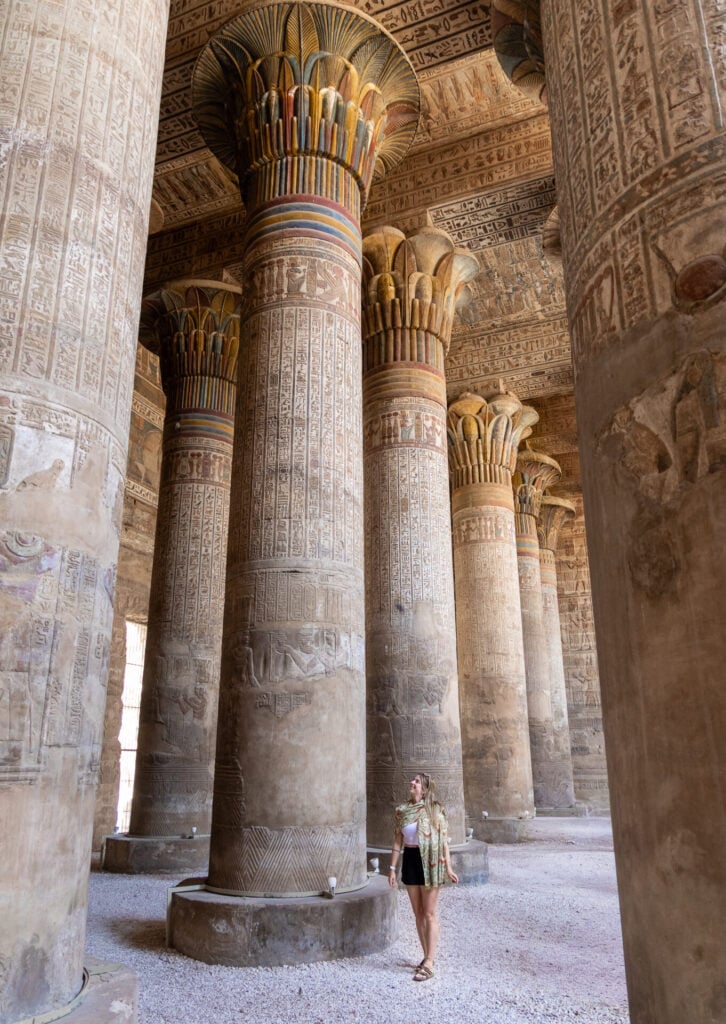
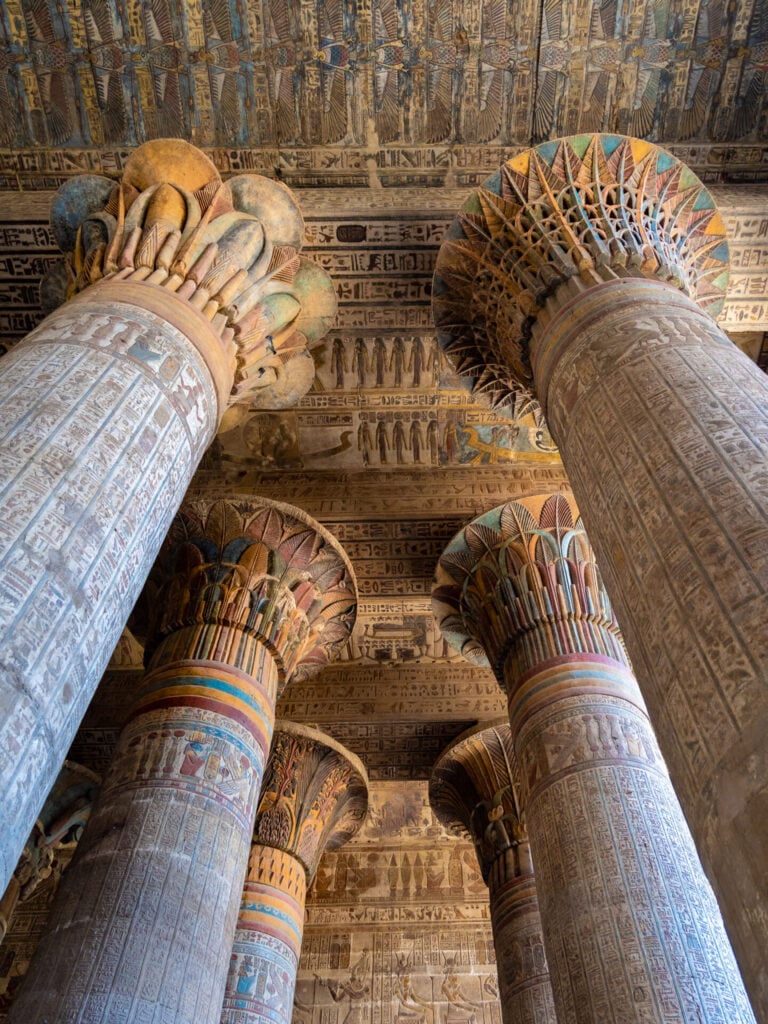
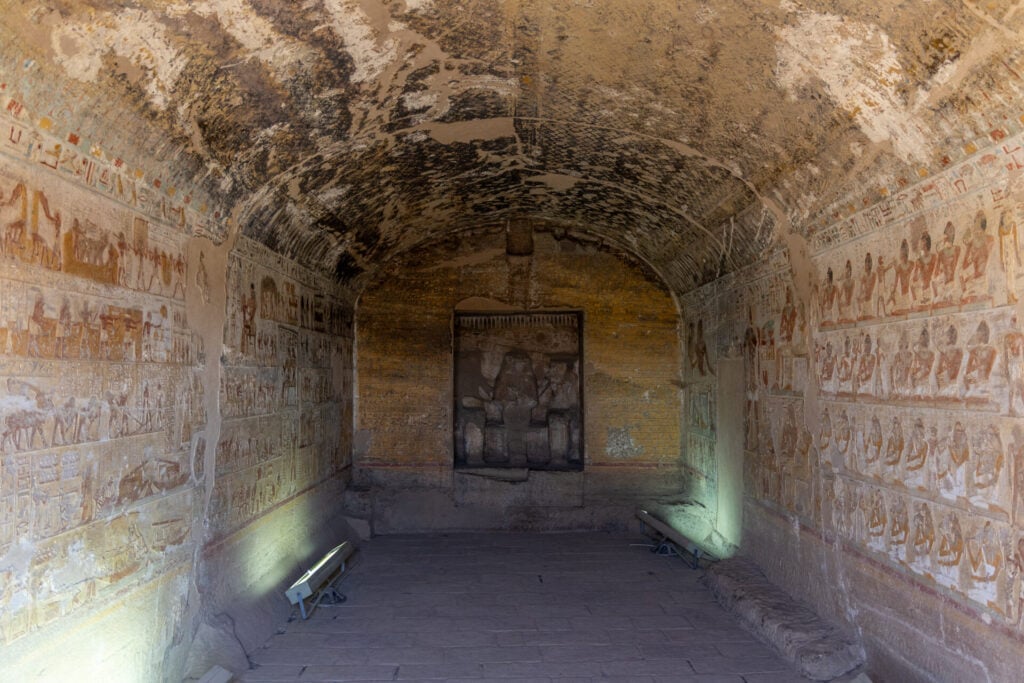
While nearly all Egyptian temples were originally painted in vibrant colours, thousands of years of sun exposure, flooding, soot, and neglect have stripped most sites of their original appearance. But recent restoration work at Esna has removed centuries of dust and grime to reveal vivid blues, fiery reds, brilliant yellows, and intricate astronomical scenes that make this the MOST colourful surviving temple anywhere in Egypt!
Dedicated to Khnum, the ram-headed god of creation, Esna Temple is famous for its richly decorated ceiling and the ornate floral capitals crowning each column of the Hypostyle Hall. This is the only structure still standing at the temple, but the colours really are without equal.
El Kab
On the morning of Day 2, leave the dahabiya behind and walk about 20min through farmland and desert to reach El Kab, another hidden gem far off the standard cruise route.
Carved into the cliffs overlooking the Nile around 3,500 years ago, the tombs of El Kab belonged to powerful New Kingdom officials who served in the nearby ancient city of Nekheb. The most impressive are the Tomb of Paheri and Tomb of Renni, both decorated with remarkably well-preserved scenes depicting daily life, agriculture, religious rituals, and funerary processions.


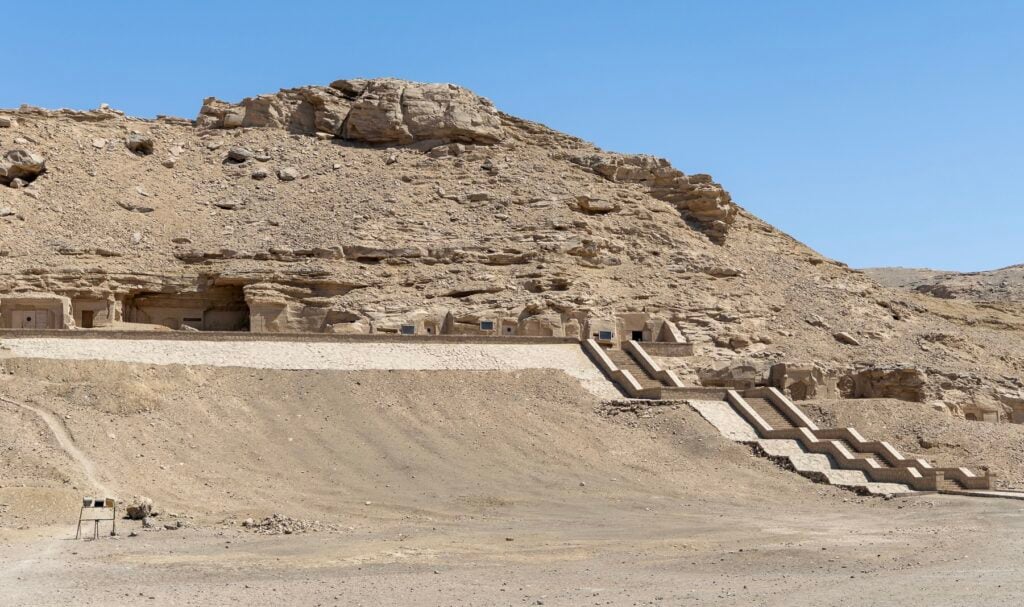
Standing alone in these ancient burial chambers, surrounded by desert cliffs and overlooking the enormous mud-brick walls surrounding the ancient city, feels like stepping back to a time before Egypt’s archaeological treasures became world-famous. You simply won’t find El Kab on other itineraries!
Edfu Temple
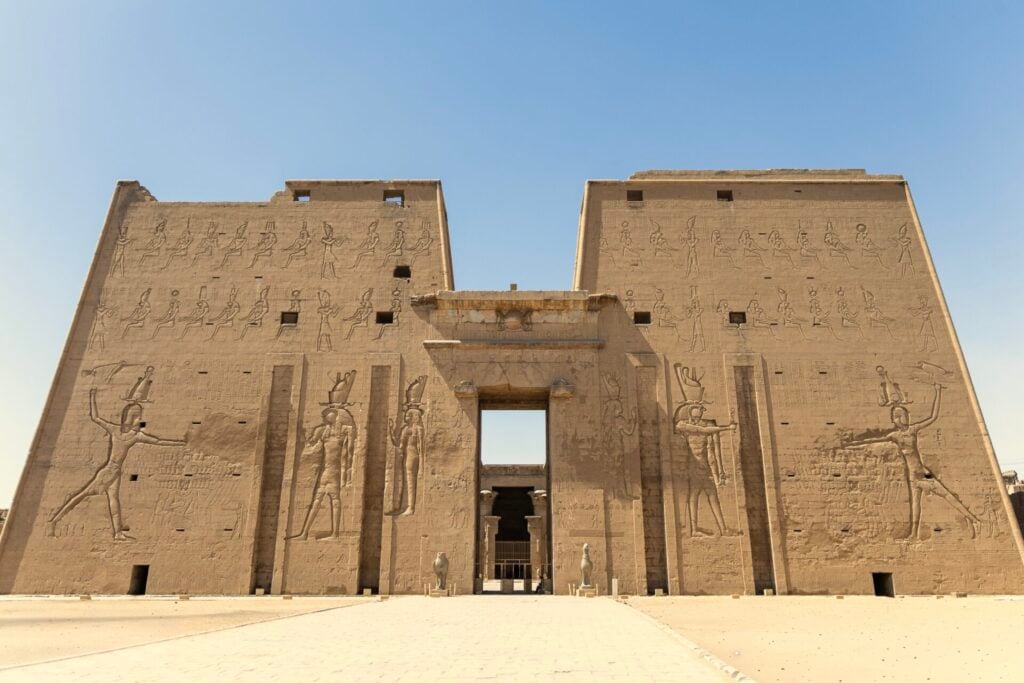
On the afternoon of Day 2, the boat docks at Edfu and you’ll transfer a short distance to the temple. This is one of the few major sites shared with other Nile Cruise ships, but thanks to careful timing on the part of Nour El Nil, you’ll avoid the overwhelming influx of morning tour groups and instead experience the temple in near-complete solitude.
Edfu Temple is one of the most complete and best-preserved temples in all of Egypt, buried beneath desert sand until the 1860s and therefore protected from centuries of erosion and vandalism. Its discovery was pivotal in shaping our understanding of how Egyptian temples were organised and religious rituals were performed more than 2,000 years ago!


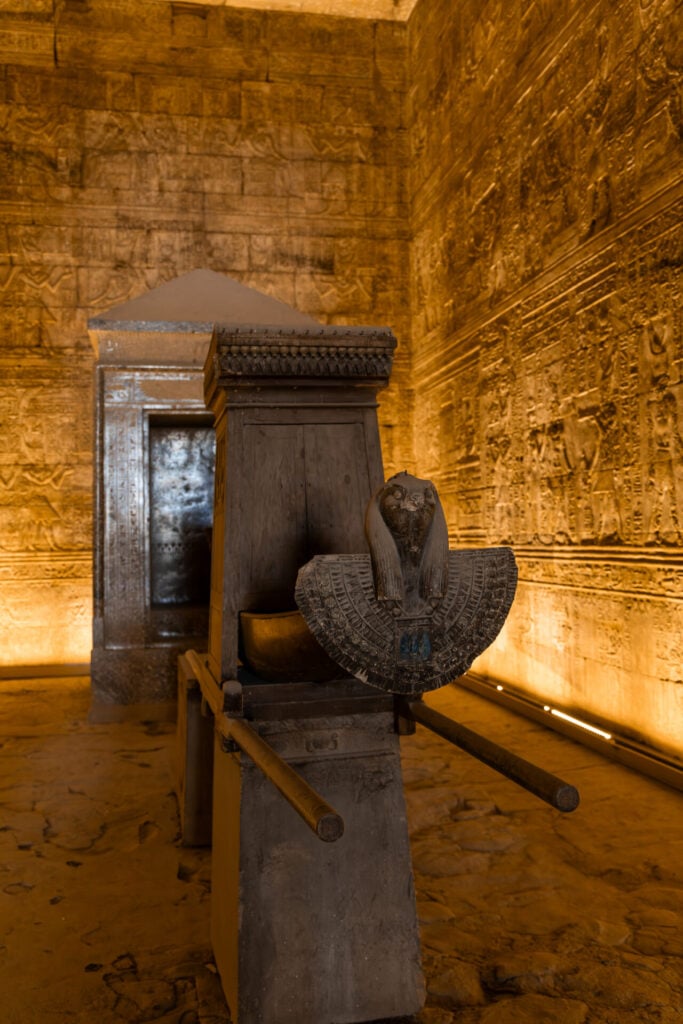
Built during the Ptolemaic period (237–57 BCE) and dedicated to Horus, the falcon-headed god of kingship and protection, Edfu is a spectacular maze of offering rooms covered in detailed artwork. It’s also home to a large bat colony, so you may make a few friends on your visit!
At the heart of the temple lies the Inner Sanctuary, a holy space housing a granite shrine and ceremonial boat (represented today by a replica) that offer a fascinating glimpse into the religious festivals of ancient Egypt, including the famous Festival of the Beautiful Reunion, when Horus was believed to sail down the Nile to visit Hathor at Dendera.
Speos of Horemheb
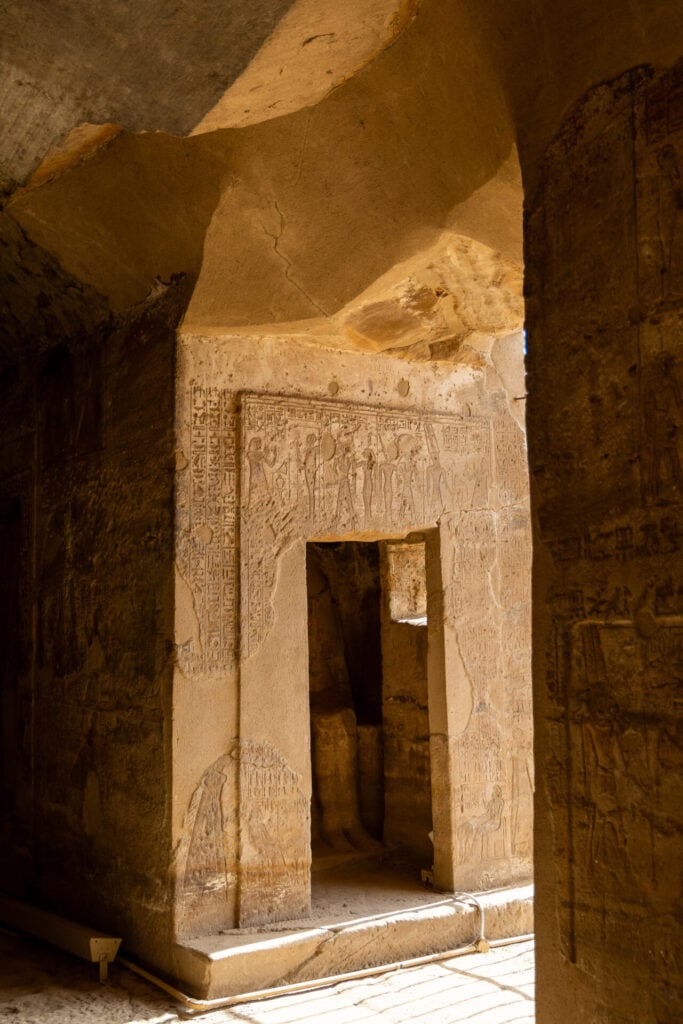
After a leisurely day of swimming on Day 3, you’ll spend the night docked at the narrowest point of the Nile near Gebel Silsileh and step off on the morning of Day 4 to visit the Speos of Horemheb, a tiny rock-cut temple built by Pharaoh Horemheb around 1300 BCE.
Originally a military commander, Horemheb rose to the throne following the tumultuous Amarna Period and is often credited with restoring stability to Egypt after the religious revolution of Akhenaten and the short reigns of Tutankhamun and Ay. Carved directly into the sandstone cliffs and dedicated to seven ancient deities, this small sanctuary is yet another incredible hidden gem uniquely included on the Nour El Nil itinerary!
Gebel Silsileh
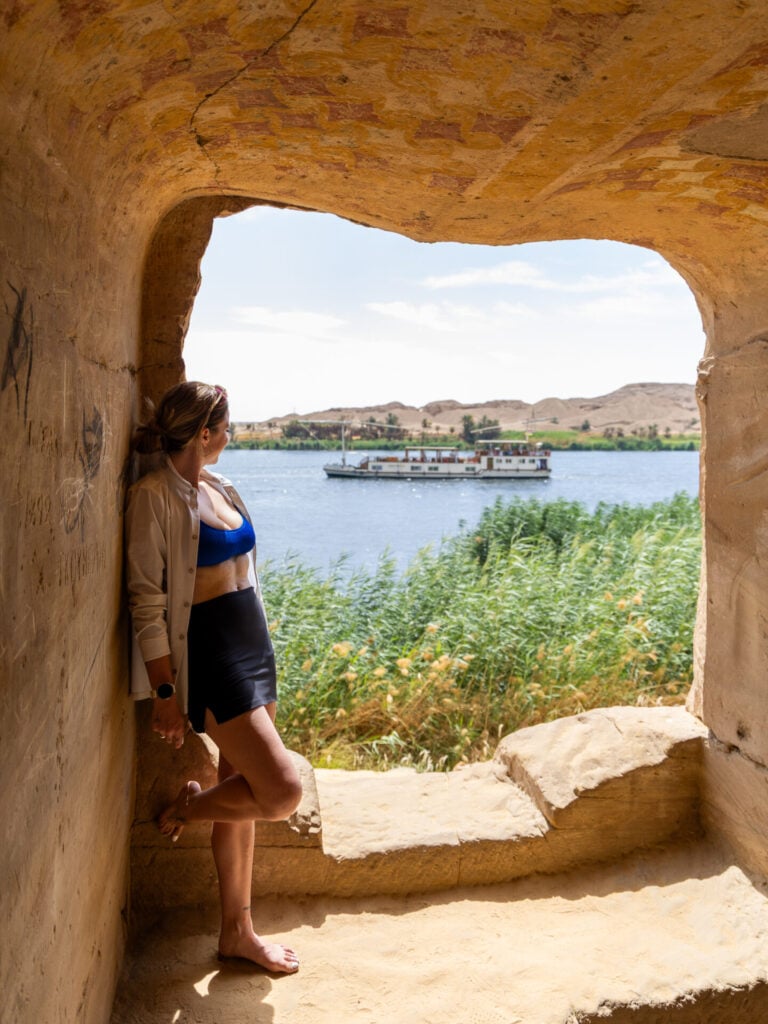
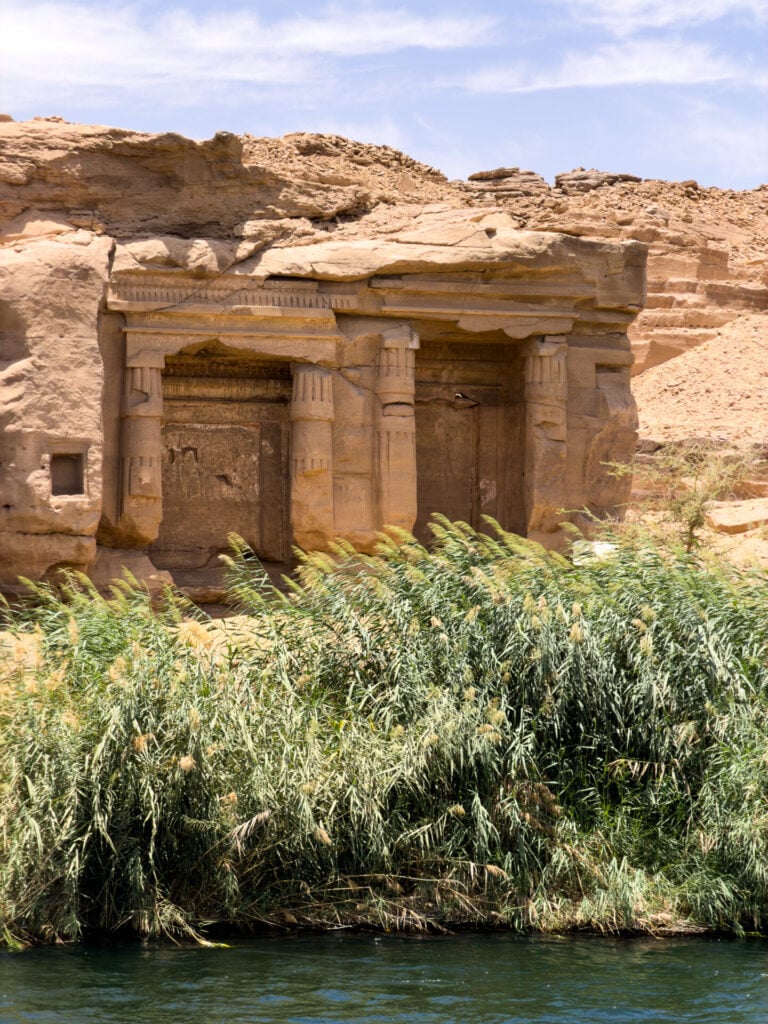
Beyond the Speos of Horemheb, walk along the riverbank past dozens of small chapels and shrines carved into the sandstone to reach Gebel Silsileh (sometimes spelled Gebel el-Silsila), the most important sandstone quarry in ancient Egypt. For centuries, stone extracted from these cliffs was transported along the Nile to build many of the great temples of Upper Egypt, including Karnak, Luxor, Edfu, Kom Ombo, and Esna.
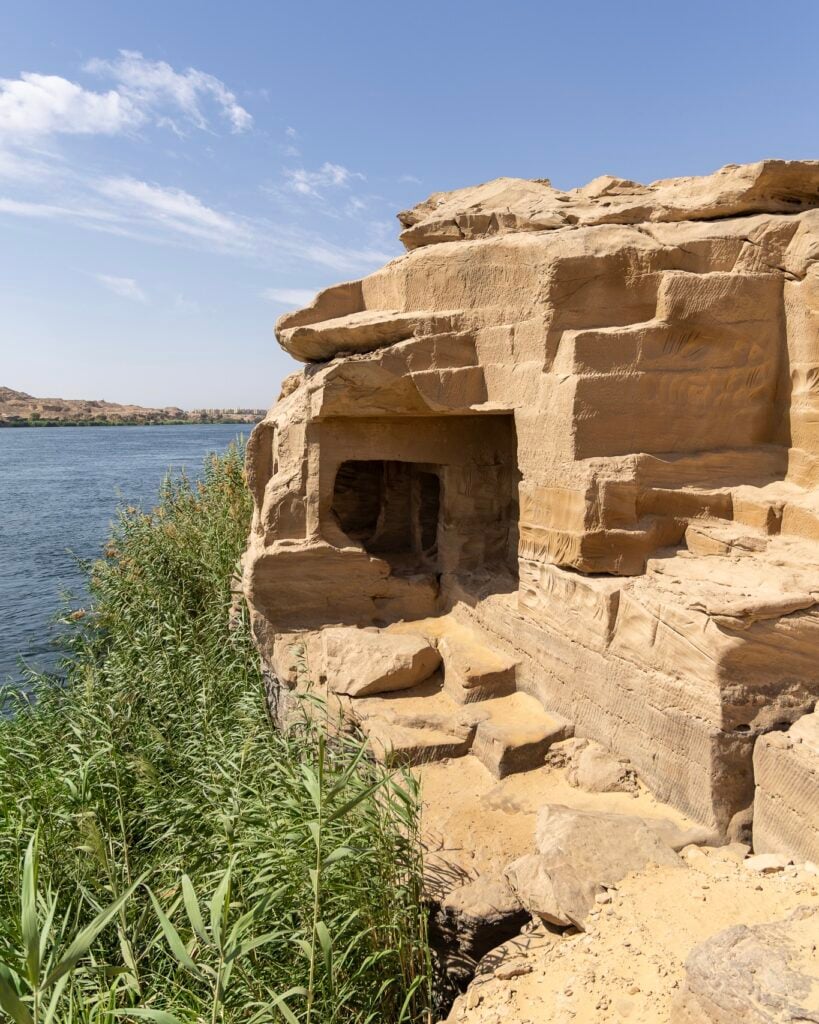


The marks are clearly visible where workers cut enormous blocks directly from the quarry walls using hand tools more than 3,000 years ago, and walking through these ancient cliffs offers a fascinating glimpse into the physical effort and engineering brilliance that made Egypt’s monumental architecture possible.
You can also explore a few of the 32 rock-cut memorial chapels carved directly into the cliffs and decorated with some beautiful surviving artwork of daily offerings and prayers to river deities. These shrines were primarily commissioned by high officials of the New Kingdom, and notable examples you might recognise include the Chapel of Paser (visor of Ramesses II) and the Chapel of Panehesy (vizier of Merenptah).
Kom Ombo
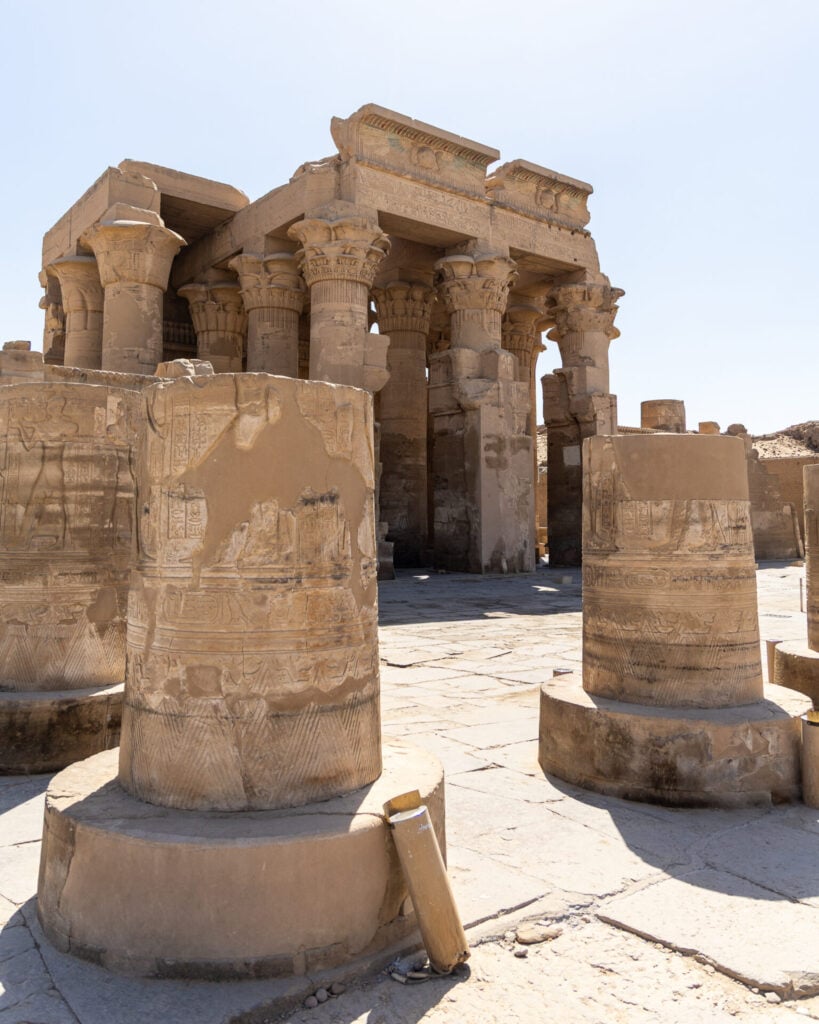
On the morning of Day 5, disembark for the final archaeological visit of the trip at one of the Nile’s most spectacular riverside temples. Although Kom Ombo appears on the classic Nile Cruise route and can be wildly busy around sunset, visiting in the morning means you’ll have the site almost entirely to yourselves!
Kom Ombo is uniquely dedicated to two gods: Sobek, the crocodile god associated with the Nile and fertility, and Horus the Elder, the falcon-headed god of kingship. Reflecting this dual dedication, the entire temple was built in a perfectly mirrored layout, with two entrances, two hypostyle halls, and two sanctuaries running side by side.
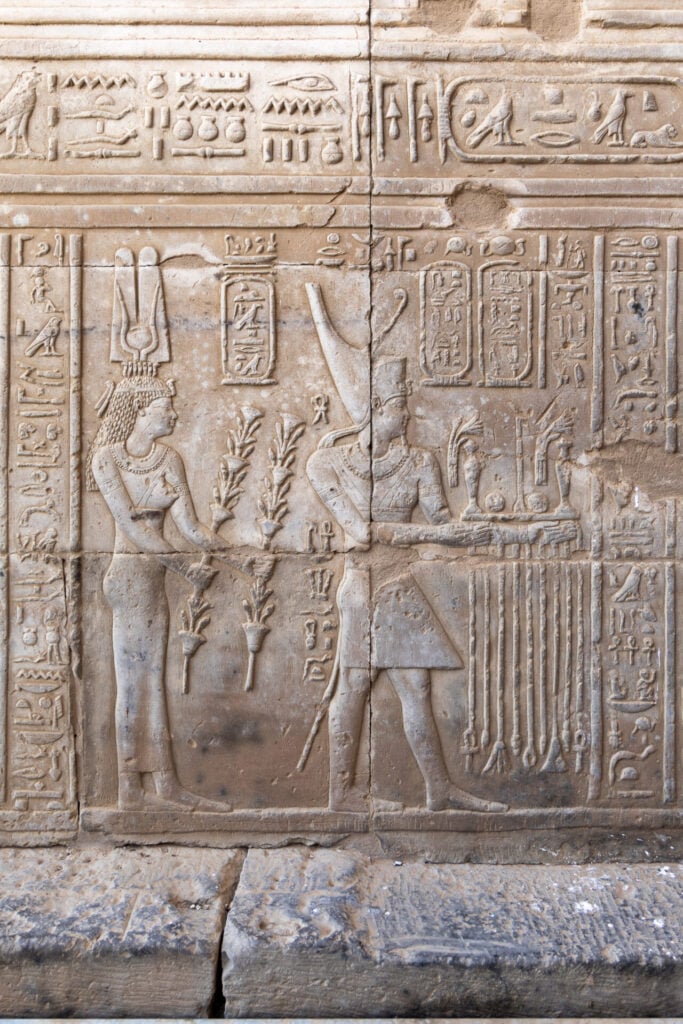


It’s one of our favourite temples in Egypt for the extraordinary details preserved on its walls, including a festival calendar, depictions of ancient surgical instruments, and countless representations of Sobek.
Built on a stretch of the Nile once inhabited by crocodiles, the temple offers a fascinating glimpse into the ancient Egyptians’ relationship with the river— be sure to check out the mummified crocs in a small museum alongside the temple!
Practical information about Nour El Nil
Where does the trip begin and end?
Unlike nearly all Nile Cruise ships that depart directly from Luxor, Nour El Nil voyages begin in Esna, about 1hr south of Luxor. A private transfer from your Luxor hotel or from the airport are included with your booking.
>>> Since Nour El Nil doesn’t include any temple visits in Luxor, check out my complete Luxor travel guide for details on my favourite boutique hotel in Egypt, Malkata House, and a perfect 3-day itinerary for the East & West Bank!
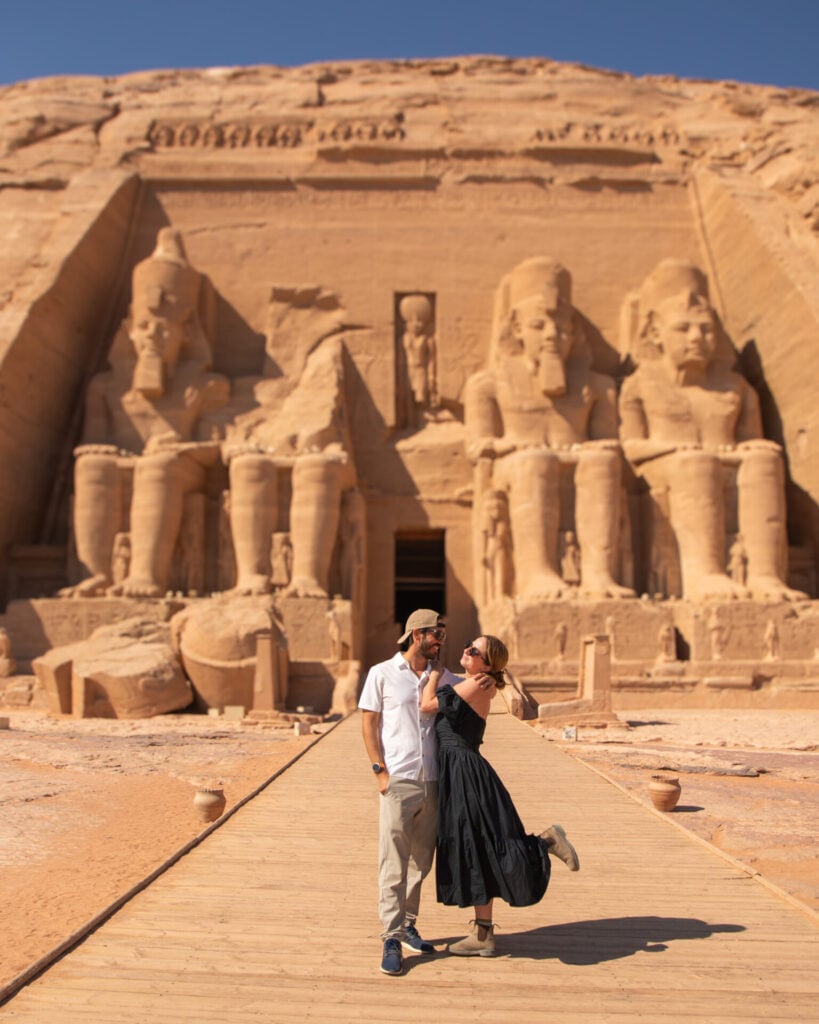
The cruise concludes in Aswan and, on the final morning, you’ll be transferred to your hotel in Aswan or (for an additional cost) to the Aswan airport for onwards travel. We definitely recommend hanging around for at least 1 extra night so you can visit Abu Simbel and Philae Temple!
What dates does Nour El Nil operate?
Nour El Nil’s dahabiyas depart Esna on Mondays or Tuesdays and sail south to Aswan on a 6-day itinerary. These trips operate from September through May, with departures completely paused during the scorching summer months.
How much does a Nour El Nil cruise cost?
Pricing varies depending on boat, room type, and sailing dates, but you can reasonably expect to pay around:
- 3,500€ for a basic room on the smallest boats (Assouan and El Nil)
- 5-7,000€ for a Luxury Room on the newer boats
- 8-10,000€ for a Panoramic Suite
- 10-12,500€ for a Deluxe Suite
Note that costs are per room, regardless of whether you are 1 or 2 people sharing.
Is Nour El Nil worth the cost?
This is essentially the crux of this entire review: if you can book a classic Nile Cruise for as little as $500USD per person (that also includes all meals, guiding, and entrance fees), does the experience on Nour El Nil really justify paying thousands of dollars MORE?
For true budget travellers, the answer is probably no— and in the early years of my travel career, I would have balked at spending an entire month worth of my travel budget on a single experience.
But to our recent group of luxury travellers and a fervent Egyptophile such as myself, it was 100% worth the price. This was one of the most extraordinary trips we’ve EVER taken, flawlessly executed from start to finish, and I would highly recommend it to high-end travellers, honeymooners, or anyone looking for a truly unique experience that they will remember forever!


Read all of my Egypt travel guides
- Choosing the best Nile Cruise in Egypt: absolutely everything you need to know
- Luxor travel guide: best temples & tombs of the East & West Bank
- Perfect 1 & 2-week Egypt itinerary: Giza, Luxor, Aswan & the Red Sea
- Detailed 3-day Cairo & Giza itinerary for first-time visitors
- 10 best temples in Egypt (from a 5-time visitor!)
- What to do in Dahab: a guide to Egypt’s coolest beach town
