

A complete guide to hiking Tasmania’s Three Capes Track
Last Updated on 19 September 2026
Tasmania’s newest and most innovative walk, the Three Capes Track seeks to take hikers on a journey, seamlessly infusing unrivalled comfort and context into the untamed beauty of the Tasman Peninsula.
Now widely regarded as one of the best bushwalks in the entire country, experience the otherworldly dolerite pillars and rugged coastal scenery that are entirely unique to the Capes, fall in love with the romantic desolation of the landscape, and immerse yourself in nature— all before retiring to a public hut that could be straight out of Architecture Australia.
This guide contains everything you need to know about walking the Three Capes Track, including the booking process, daily trail notes, the huts, what to expect on the trail, and heaps more!
About the Three Capes Track
In late 2015, after more than 10 years of conceptualisation, design and rigorous construction, the incredible and highly anticipated Three Capes Track was opened to the public.
A complete reimagining of Tasman National Park’s existing network of trails, this enormous project saw more than 35km of track laid from Denmans Cove to Fortescue Bay and out to each Cape Pillar and Cape Huay, requiring more than 18,000 helicopter flights each carrying 800kg of materials, a team of several hundred people working around the clock, and a $20million federal grant.
The result is staggering. Now inarguably Australia’s best-maintained hiking trail, the Three Capes Track incorporates all the success of New Zealand’s amazing hut system with the wild beauty of the Tasman Peninsula for what is honestly one of the most incredible hiking experiences you’re likely to have in Oceania.


How hard is the Three Capes Track?
And like NZ’s Great Walks, a large part of what makes this experience so notable is its accessibility to walkers of all experience levels.
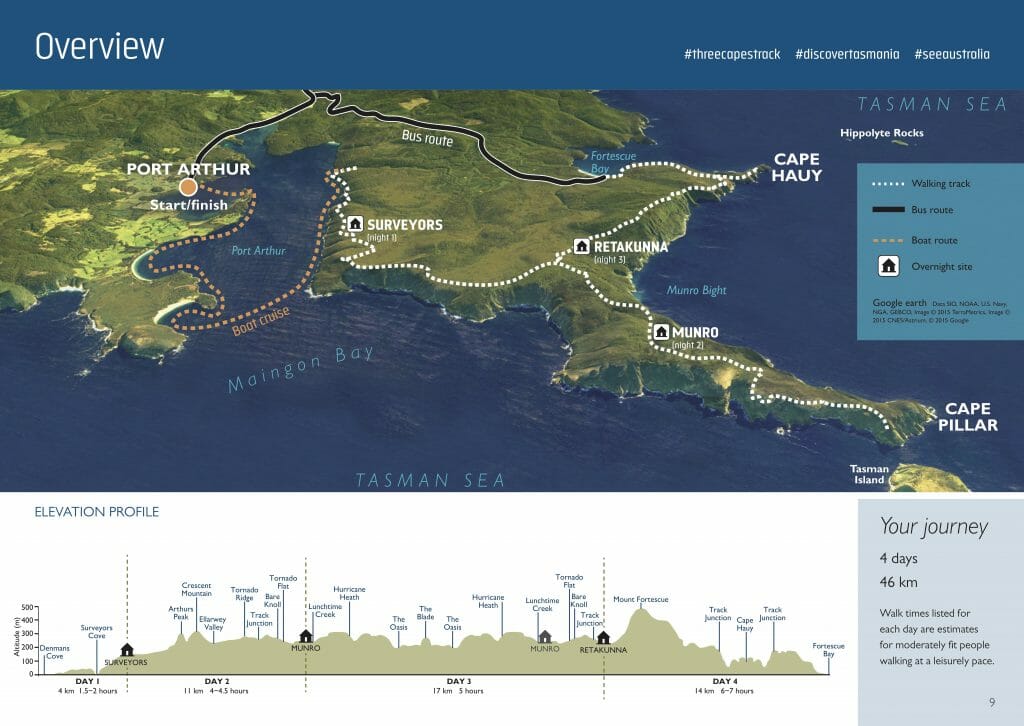
At only 4 days and 48km, it is substantially shorter than the Overland Track, but also features infinitely flatter trails with none of the rocks or roots, a hut system with reserved spots so you don’t need to carry a tent, and beautiful kitchens that allow you to prep your mountain meals without bringing your own fuel, stove, or cookpot.
Encounters on the Edge
At check-in, all hikers receive a copy of Encounters on the Edge, a custom-compiled booklet of information for your walk. In addition to maps and guides, the booklet also contains 40 stories, each designed to be read at a unique seat (or sometimes just a spot) along the trail. Some of these stories focus on the convict history of the Tasman Peninsula, some on the geology of the area, some on the local flora and fauna, and others still on the development of this track.
The Three Capes Track truly is an immersive experience, and Encounters on the Edge has been thoughtfully crafted to provide depth and context to the many thousands of steps you’ll take along the way. I really encourage you to stop and read at each of the storyseats, many of which are artistically fascinating in their own right (having been created by UTas design students and staff), rather than just blazing along the trail from Point A to Point B.
Slow down and look at your surroundings, connect with the rich culture and history, be present in nature, and I promise you’ll leave with an even greater appreciation of this incredible part of the world.


Booking the Three Capes Track
Track permit
Only 48 hikers are allowed to depart each day on the Three Capes Track, but it’s extremely simple to reserve your spot online. Reservations can be made about 13 months in advance, and I’d recommend trying to grab your spots at least 6 months out, particularly if you are inflexible with dates or if you’re hiking during the holiday period (summer or long weekends).
As of mid-2026, passes are $625AUD per person, which is considerably more than any other public walk in Australia… but the quality of the trail and the huts (plus the included transportation) really do warrant the fee!
Included in the booking fee
- Pass for walking the 4-day Three Capes Track
- Reserved accommodation for all 3 nights in each of the beautiful huts
- Scenic cruise from Port Arthur to the trailhead
- Bus from the trail back to Port Arthur
- Pass to Port Arthur Historic Site valid for 2 years (see “Other things to do on the Tasman Peninsula”)
In addition to selecting the dates for your walk, you will also need to make a few choices regarding your transportation to and from the trailhead. I’ll revisit this under “Getting to and from the Three Capes Track”, but essentially there are 2 boats bringing people from Port Arthur to the start of the track (11.30am or 2pm) and 2 buses returning people to Port Arthur 4 days later (2.30pm or 4pm).
If your plans do later change, it’s possible to request a different boat or bus, but that’s entirely subject to availability. On our hike, several people were able to swap with another group for the time they wanted, but again, that’s obviously not a guarantee, so choose wisely!
Steps for making an online booking
- Visit the online booking system and select your desired date of departure
- Select either the 11.30am or 2pm boat departure from Port Arthur to Denmans Cove
- Select either the 2.30pm or 4pm bus departure from Fortescue Bay to Port Arthur
- Enter your name, DOB, address
- Submit payment using Visa or MasterCard ($495)
Before you submit payment, there’s an option to add comments to the booking. If you would like to request to be placed in the same bunkroom with friends or family who made separate bookings, you should include their names here and the hut rangers will try to put you together for the duration of the trip.
Bunkrooms are 4 or 8 people, so if you don’t have those numbers, you will still have some new friends rooming with you.
Checking in for your walk
On the morning of your scheduled departure, you will need to check in at the Three Capes Track office to obtain your pass and collect your Encounters on the Edge booklet. The office is located on the lower level of Port Arthur Historic Site and opens at 9am. It’s also possible to store any luggage in the office if you don’t have a car parked on site.

Getting to and from the Three Capes Track
Getting to Port Arthur
The best way to get to Port Arthur is to drive about 1.5hrs from Hobart and park for free during your hike (there’s a designated long-term car park for the Three Capes Track about 500m from the Visitor’s Centre and the bus will return you directly there after you finish).
If you’re coming across from the mainland on the Spirit of Tasmania, check out this post. However, if you’re just flying in for this hike and don’t have a car, it’s fairly easy to get from Port Arthur to Hobart using a bus!
Three Capes Track recommends these bus companies specifically:
Transport to and from the trailhead
Transport for the Three Capes Track is included in the price of your booking and is exceptionally easy!
Port Arthur to Denmans Cove
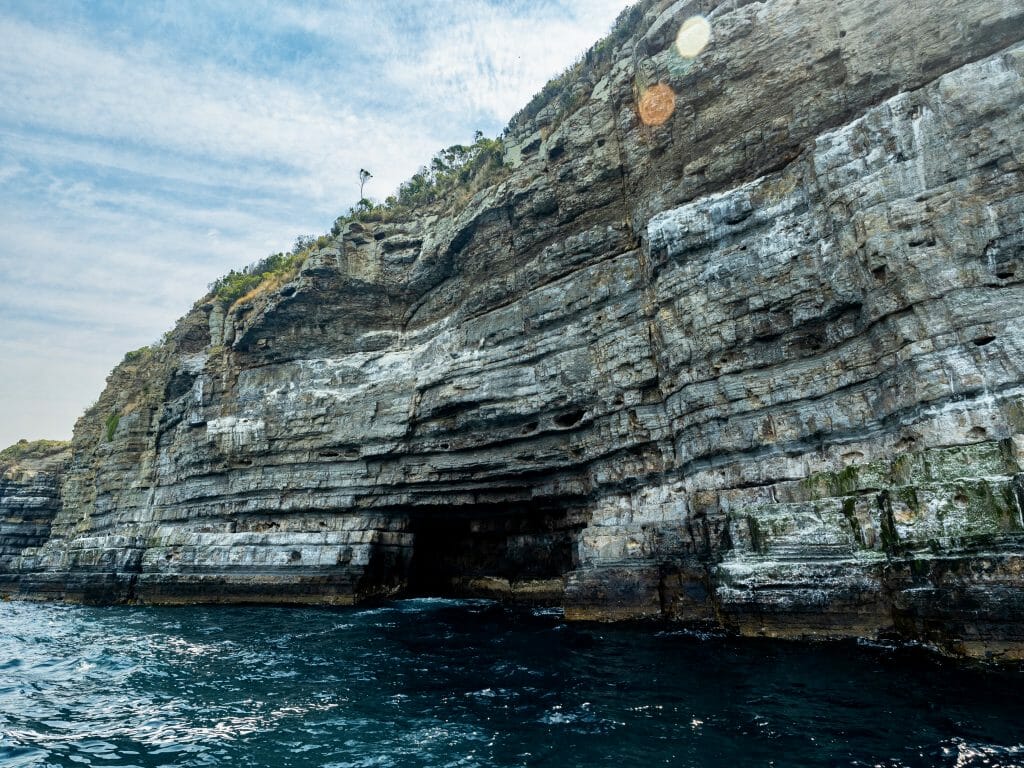
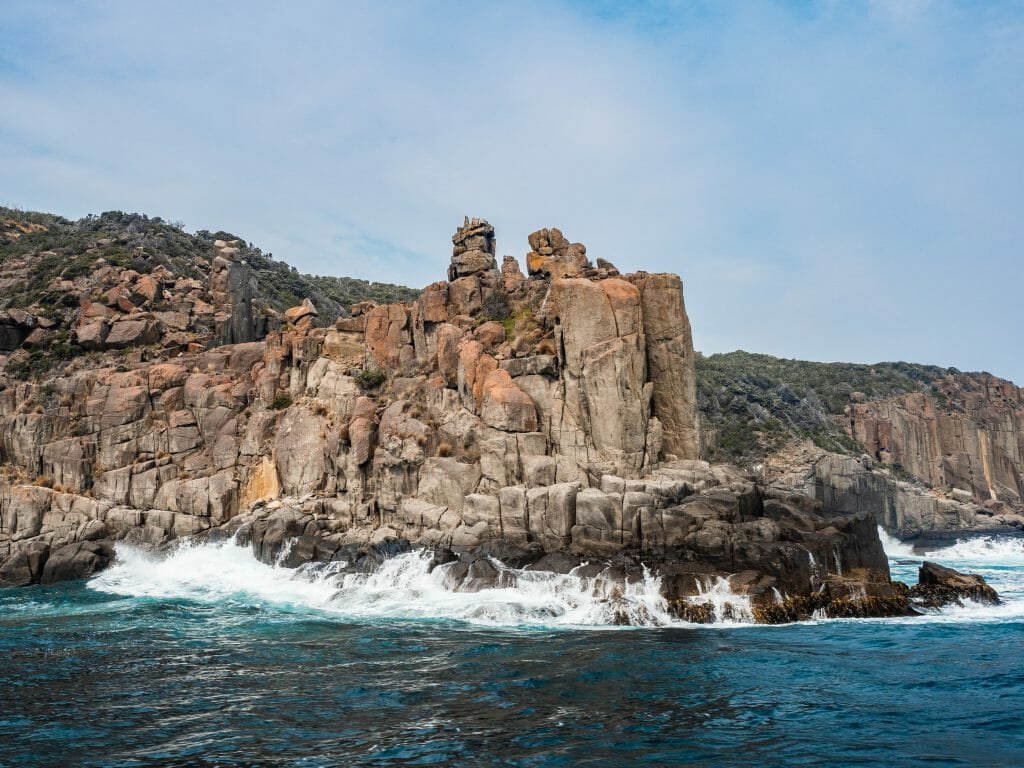
On the way to the trailhead from Port Arthur, you’ll enjoy a 1.5hr scenic cruise along Cape Raoul before reaching Denmans Cove and disembarking for your hike.
The guys that operate these boats give you full commentary along the way, pointing out wildlife and discussing the geology of the area, so I really found this to be a highlight! There are 2 departures daily, and you should have chosen one when you made your booking (11.30am or 2pm). Meet at the jetty about 15min early.
Fortescue Bay to Port Arthur
After completing the fourth and final day of the walk, you’ll board a bus in Fortescue Bay to drive about 20min back to Port Arthur. The bus driver offered to drop us directly at Port Arthur Historic Site, the long-term car park, or in town (probably more convenient for catching a bus).
Like the boat, there were two departures for you to select from at booking (2.30pm or 4pm), but we did find that there were some extra spots on each bus in case people arrived very early and wanted to leave sooner or (more likely) in case hikers were running behind. Still, I wouldn’t rely on this! Contact details for the bus are listed in the third hut (Retakunna) in case you want to try and change your booking.

*Three Capes Track itinerary
Begin the journey on a scenic cruise along Cape Raoul, the beauty of which is only a small preview of what’s to come, and then disembark at Denmans Cove to begin an incredible 4-day, 3-night adventure on the Three Capes Track.
Over impossibly well-graded trails and through equally impossible natural scenery, this 48km walk leads you up and over mountains, out to two more breathtaking capes, through lush rainforests and scraggly wind-whipped ridges, and finally culminates at the idyllic Fortescue Bay. Every moment on the trail is scenic, but there’s so much more to enjoy than just the view!
Everyone who begins the Three Capes Track on the same day will follow an identical itinerary, as your beds are reserved in each hut along the way. There’s always the option to skip one of the side-trips if you are worried about the distance, but I’d strongly discourage that— the capes are such a big part of this walk, it would be devastating to miss them!

Day 1: Denman’s Cove to Surveyors
- Distance: 4km
- Trail hours: 1.25hrs, including 2 storyseats
- Campsite: Surveyors Hut
- Daily trail journal: Three Capes Track (day 1): Denmans Cove to Surveyors
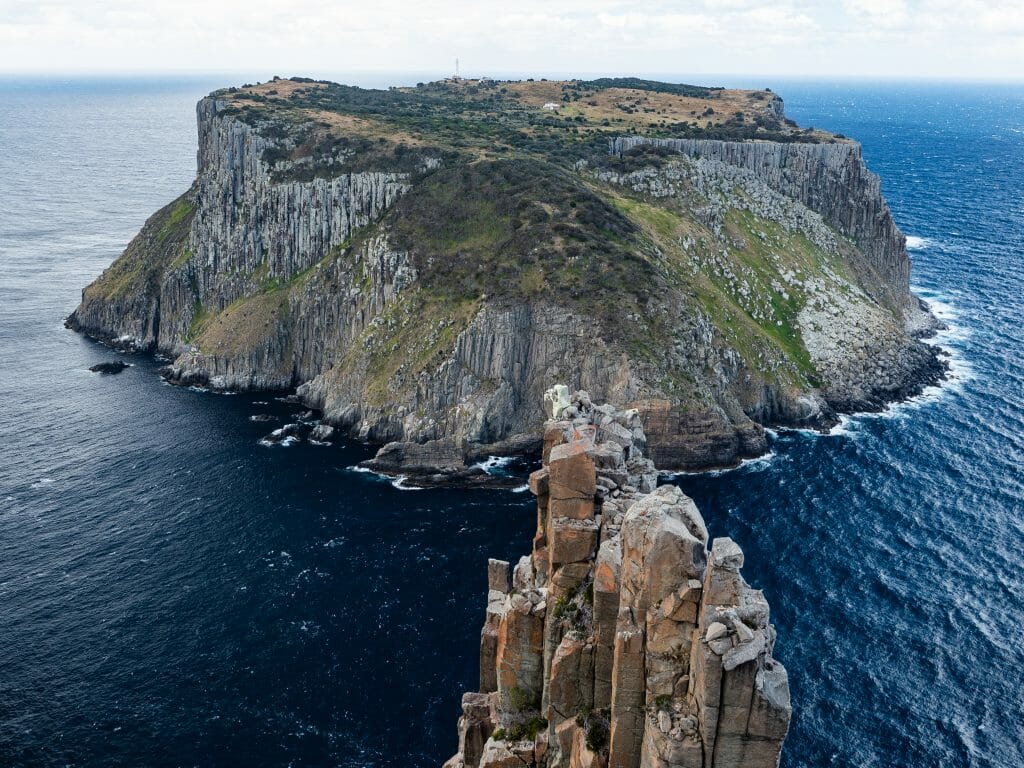
Day 1 of the Three Capes Track begins with a scenic boat cruise from Port Arthur to Denmans Cove, offering incredible views of the rugged dolerite coastline and out towards Cape Raoul. This 1.5-hour journey is far more than just a transfer— it’s a spectacular introduction to the Tasman Peninsula and sets the tone for the days ahead!
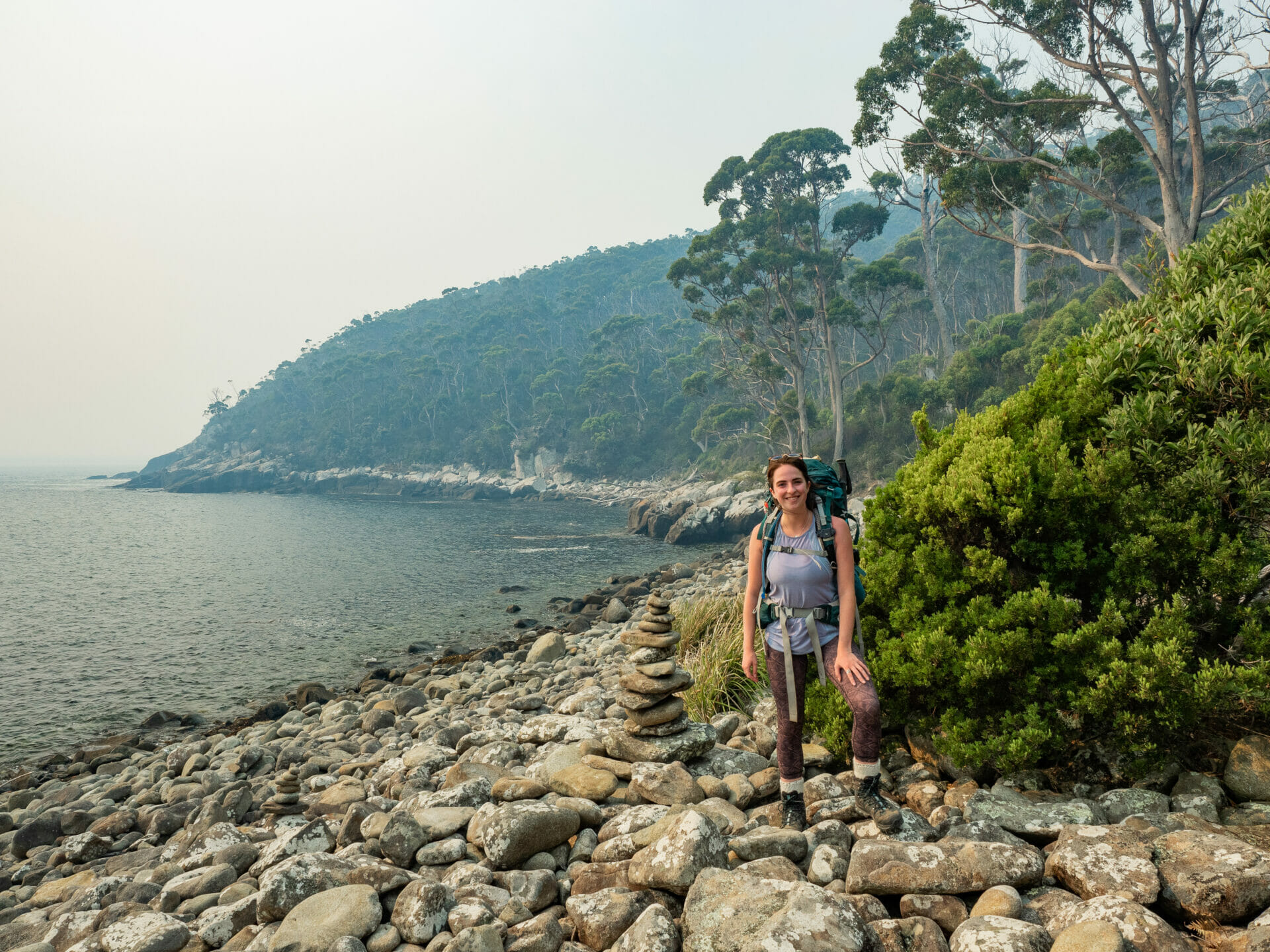
From Denmans Cove, a short 4km walk leads to Surveyors Hut, following a wide, gently graded trail through coastal bushland. Along the way, “storyseats” provide insight into the rich history of the region, from convict-built Port Arthur to the modern construction of the track itself. Despite the relatively easy terrain, there are plenty of scenic viewpoints to enjoy along the coast.
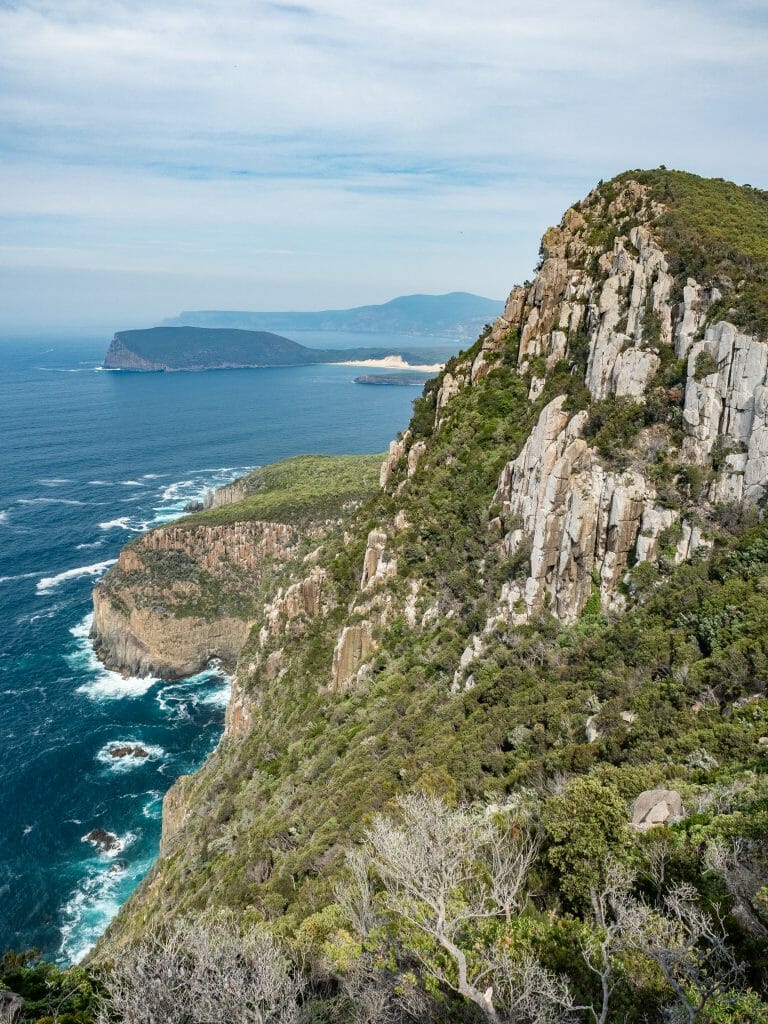
The day finishes at Surveyors Hut, perched above the coastline with sweeping views towards Cape Raoul. Overall, an impressive reward for a short and relaxed first stage, and a taste of the dramatic landscapes to come!
Day 2: Surveyors to Munro
- Distance: 11km
- Trail hours: 3.75hrs, including 10 storyseats
- Campsite: Munro Hut
- Daily trail journal: Three Capes Track (day 2): Surveyors to Munro via Arthur’s Peak
Day 2 begins on easy, gently graded trail before a steady ascent to Arthur’s Peak, where expansive views open up over Crescent Bay and across to Cape Raoul.


Beyond the summit, the track winds past towering dolerite formations and through a mix of eucalypt forest, cloud forest, and coastal heath, with “storyseats” offering insight into the unique geology, ecology, and history of the Tasman Peninsula. The landscape shifts noticeably as you cross Ellarwey Valley (a wide, wind-swept plateau that makes for an ideal lunch stop), before continuing on rolling terrain towards the coast.
The final section trends gently downhill to Munro Hut, set near the cliffs of Munro Bight with distant views towards Cape Hauy. With its diverse scenery, excellent viewpoints, and immersive storytelling along the trail, this is a short but sweet day on the trail!
Day 3: Munro to Retakunna via Cape Pillar
- Distance: 19km
- Trail hours: 5.25hrs, including 14 “storyseats”
- Campsite: Retakunna Hut
- Daily trail journal: Three Capes Track (day 3): Munro to Retakunna via Cape Pillar
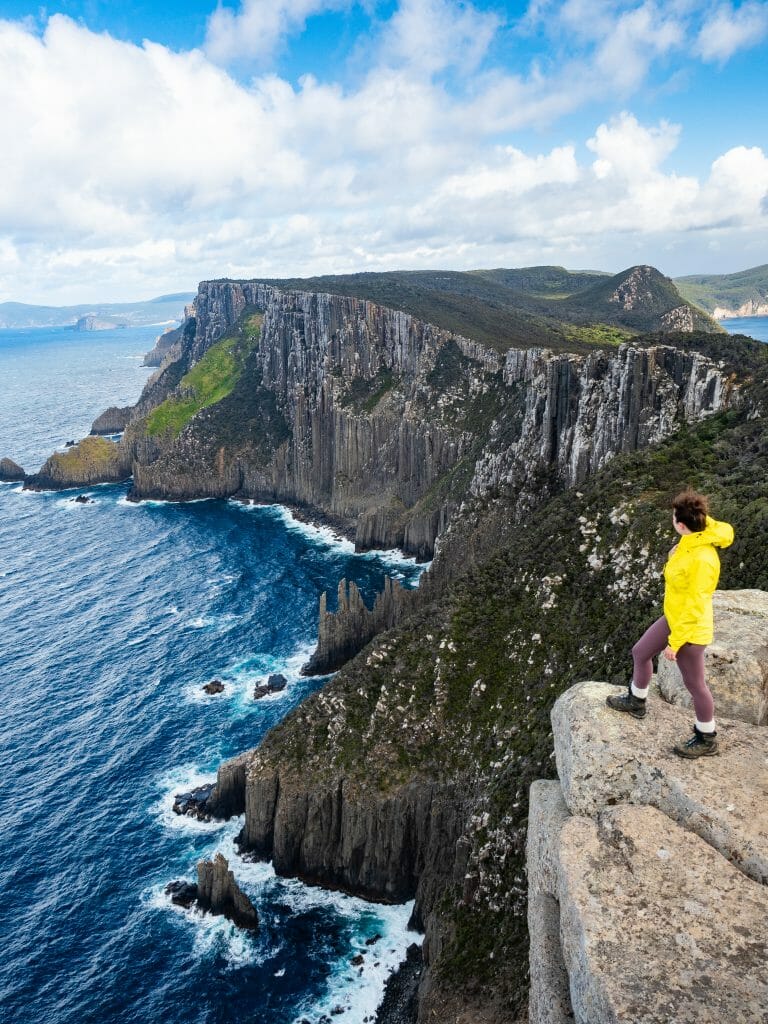
Day 3 bringing even MORE spectacular coastal scenery, featuring a wonderful out-and-back side trip to Cape Pillar and The Blade before continuing on to Retakunna Hut. Leaving your main pack at Munro, the walk to the cape is completed with just a light daypack— allowing you to fully enjoy what is arguably some of the most spectacular coastal scenery in Australia.

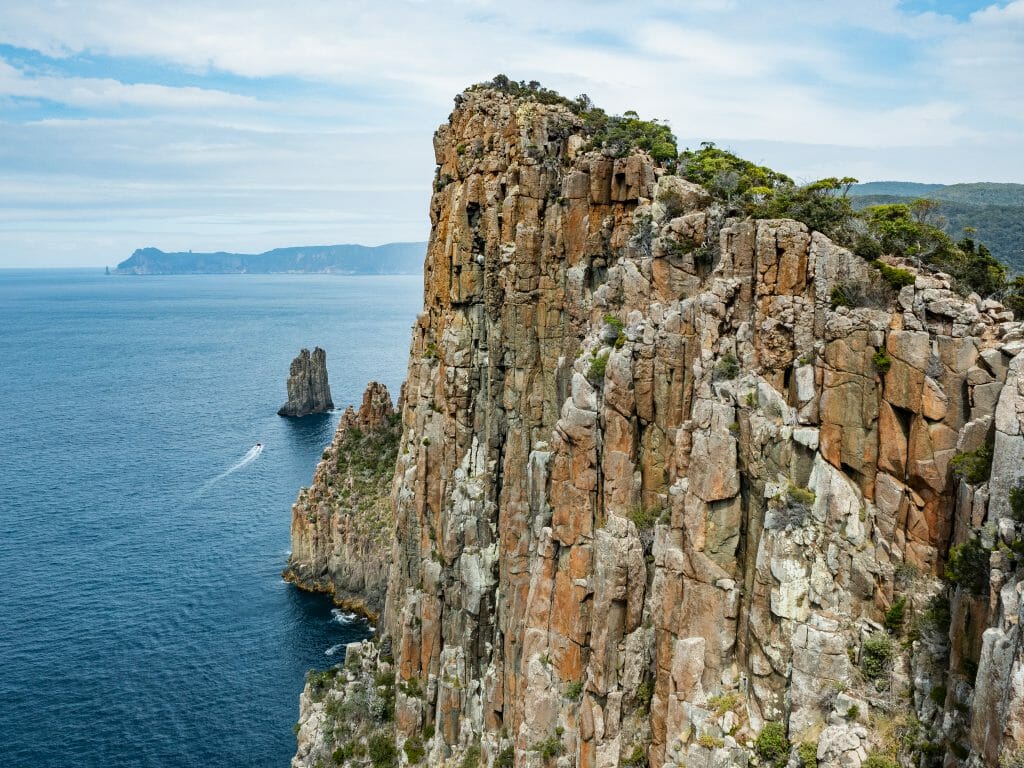
The track traverses windswept clifftops and exposed plateaus, with increasingly dramatic views over Tasman Island, Cathedral Rock, and the towering dolerite columns that define the Tasman Peninsula. Highlights include the narrow ridge of The Blade and the expansive viewpoints at Cape Pillar, where sheer sea cliffs plunge hundreds of metres into the Tasman Sea below. With constant lookouts and “storyseats” along the way, this section feels relentlessly scenic from start to finish.
After returning to Munro Hut to collect your pack, it’s a short and mostly gentle walk to Retakunna Hut for the night. Despite covering 19km, the day passes quickly thanks to the unencumbered walk to the cape and the sheer quality of the scenery!

Day 4: Retakunna to Fortescue Bay via Cape Huay
- Distance: 14km
- Trail hours: 5.75hrs, including 14 “storyseats”
- Daily trail journal: Three Capes Track (day 4): Retakunna to Fortescue Bay via Cape Huay
The final day begins with a steady climb up Mt Fortescue, the highest point on the track, passing through shaded wet forest before emerging onto open terrain with expansive views back towards Cape Pillar. Despite the elevation gain, the climb feels surprisingly manageable thanks to the excellent trail design!
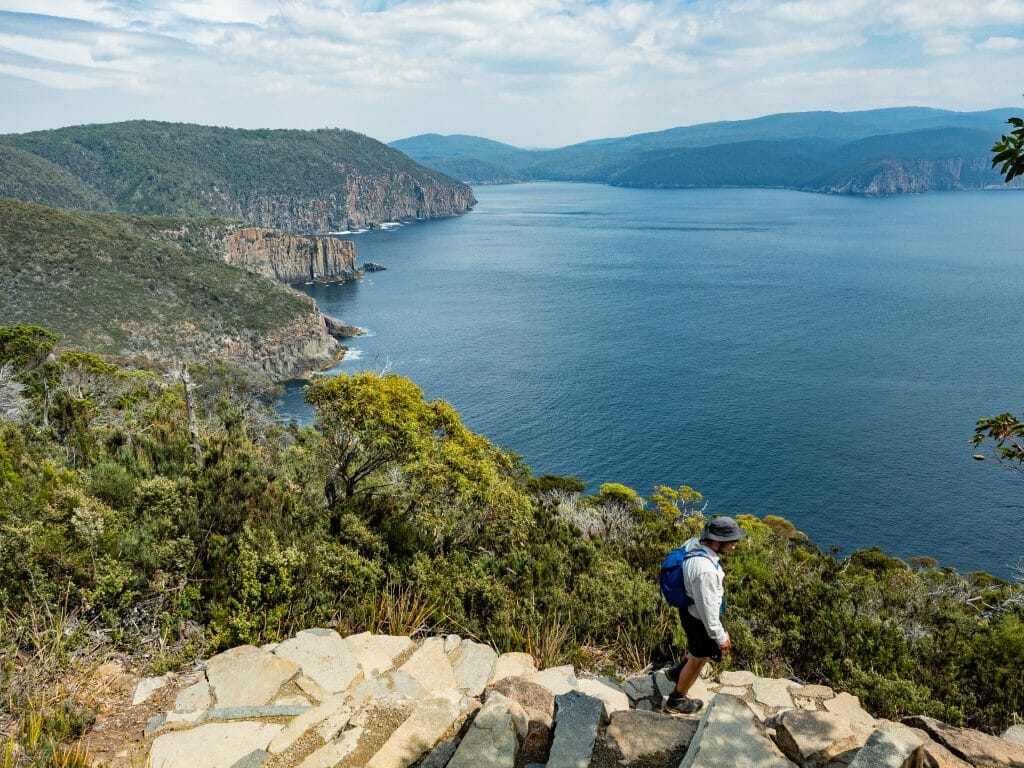
From the summit, the track descends towards the junction for Cape Huay, where most hikers drop their packs to complete the out-and-back side trip to the cape. This section features a series of stone staircases and short climbs, leading to breathtaking views of the Totem Pole, the Candlestick, and the surrounding dolerite cliffs rising dramatically from the Tasman Sea.


Returning to the main track, it’s an extended downhill walk to Fortescue Bay, where the trail finishes at one of Tasmania’s most beautiful beaches. A refreshing swim in the clear, sheltered water is the perfect way to celebrate the end of the Three Capes Track— a spectacular and fitting conclusion to one of Australia’s most scenic multi-day hikes!
Read more: THREE CAPES TRACK (DAY 4): RETAKUNNA TO FORTESCUE BAY VIA CAPE HUAY
What to expect on the Three Capes Track
Terrain
I’d actually go so far as to say that the Three Capes Track is one of the best-graded track I’ve ever hiked. Even on the biggest climb of your journey (which isn’t actually that big), you’ll hardly even notice that you’ve gone uphill until you arrive at the top.
No roots, no stray rocks, absolutely no obstacles to your walk, which means you can focus on the scenery and the storyseats rather than the terrain!
Water access
The only consistent place (and often the ONLY place) to find water on the trail is at the huts, all of which have rainwater for your drinking and cooking needs. There’s no need to filter this water, so feel free to leave your filters or iodine tablets at home. That being said, make sure to carry plenty of water with you each day, as it will likely be the only water you have until you arrive at the next hut!
Three Capes Track huts
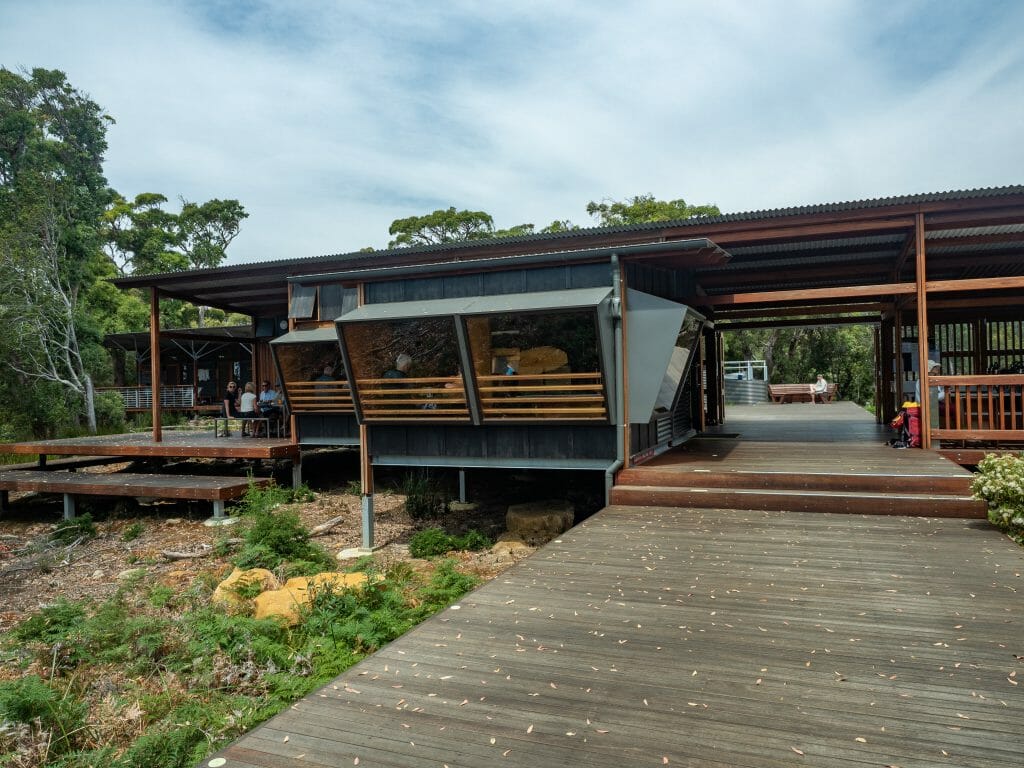
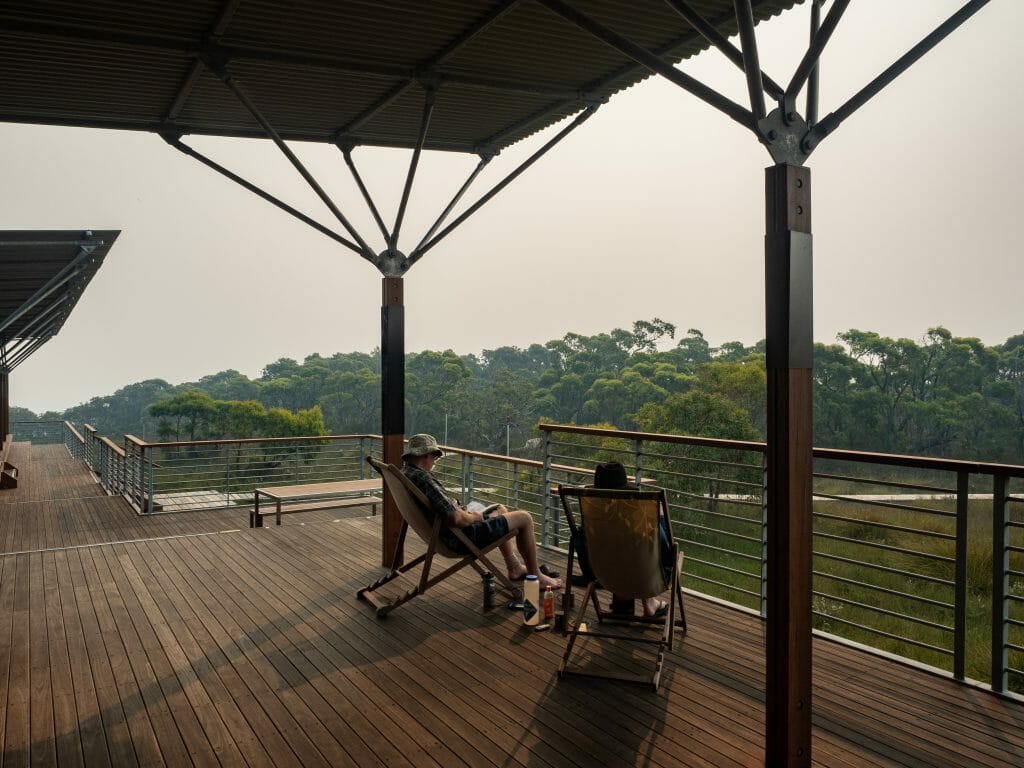
Without question, this track boasts the best public huts in all of Australia, and I’d even go so far as to say they are strong contenders internationally. Each of the 3 huts you stay in along your hike— Surveyors, Munro, and Retakunna— are unique and beautiful in their own way, fitting effortlessly into the landscape to bring comfort and luxury to a hut experience that has historically been about cramming as many people as possible into a small, dry room.
Here are the common ammenities you can expect in each and the special treats available at specific huts:
- 2 indoor kitchens with plenty of seating for meals
- Gas stoves, kettles, and a wide assortment of fry pans and pots for you to cook with (need to bring your own cutlery and food)
- Also in the kitchen, rain water sinks (this is untreated water, but no one seems to filter it and the rangers might give you an odd look if you do, as it’s totally unneeded)
- BBQ— only at Surveyors (you can backpack in with frozen meat and have a feast on the first night!)
- Collection of boardgames and a library (all huts have the same books, so you can start reading in one hut and continue in another)
- Large outdoor decking with lounge chairs
- Yoga mats
- 4 or 8 person bunkrooms with comfy mattresses, hooks for clothes, benches, etc
- Bathrooms (with TP!), sinks with running (rain) water, anti-bacterial soap
- 2 hot showers— only at Munro (use a bucket to empty heated rainwater into a sack, hoist above your head inside one of the corrugated iron scrolls, and set to slowly drizzle while you enjoy the best shower of your life)


Camping
Even though this guide won’t cover camping, it would be remiss of me not to mention that there are two small campsites along the trail which technically make it possible to do some of the Three Capes Track without paying $625. The camps weren’t marked on our maps and there’s next to zero information about them online, but because we passed right by them on days 2 and 3, I do know that Wugahlee Campsite and Bare Knoll are both near Munro Hut.
Even though it cuts out a good portion of the walk and really changes the experience, you can do the 29km “Cape Pillar Track” from Fortescue Bay in 2/3 days (or even add in Cape Huay at another 5km) by staying at these camps. Each only has a half dozen tent spots and it doesn’t appear that you can reserve these, so make of that what you will, but the cost is just $24 for a Parks Pass.
>>> Need advice on choosing a tent? Check out this post: How to choose the best tent for backpacking & mountaineering
Safety on the Three Capes Track
Safety concerns along the Three Capes Track are somewhat mitigated by the well-staffed huts, immaculate trail, and consistent mobile reception, but that doesn’t mean there aren’t risks. In my opinion, these are the three most important safety considerations for any hike in Tasmania, and they absolutely still apply to the Three Capes Track:
- Be prepared for all weather
- Be ready to respond to a medical emergency
- Be able to call for help if the situation requires
Be prepared for all weather
Weather on Tasmania’s coast may not be as extreme as it is in the mountains, but conditions can still change in an instant. Much of the Three Capes Track follows the cliffs without any physical barrier, so it’s important to be wary of the conditions (particularly the wind, which can reach 170km/hr on the Capes) before you get too close to a ledge.
There haven’t been any incidents on this track since it opened, but it would be good to keep it that way! Exercise basic wilderness precautions by giving the edge a wide berth, packing appropriate wind and rain gear, and knowing when to turn back from the Capes.
>>> I put together a complete layering system guide with all my favourite gear picks for staying warm, dry & comfortable in every condition
Be ready to respond to a medical emergency
It’s also essential that you carry a well-stocked first aid kit in case of emergencies, probably the most concerning of which is a snake bite. I didn’t personally see any snakes during our hike, but most other people in the huts said they had, and even though no one has died of a snake bite in Tassie since the 60’s, all snakes in Tasmania are poisonous!
People are bitten every year, so it is important to have the necessary items in your kit and know how to use them. Most first aid courses in Australia teach the Pressure Immobilisation Technique (also works for some spider bites), but you can get the idea just from watching a video on YouTube. You don’t need to buy a special snake kit (although we actually had one); a few elastic bandages from a supermarket or chemist will more than do the trick.
Make sure you also stock your kit with plenty of bandages, antiseptic, strapping tape, and assorted drugs (painkillers, anti-inflammatories, antidiarrhoeals, and antihistamines are a good place to start, but include anything else you can think of).
Be able to call for help if the situation requires
Lastly, you need to be able to call for help if someone is badly injured (even correctly using the PIT for a snake bite, you have to be urgently rushed to hospital for anti-venom) or if weather conditions get too far out of hand and you’re worried for your safety (e.g bushfire).
Thankfully, it is so much easier to get help on the Three Capes than on other more remote bushwalks in Tasmania, simply because there is decent mobile reception on the trail and every hut has USB charging ports. If you aren’t travelling with your phone, it’s a good idea to carry an SOS device like the Garmin inReach Mini, which allows you to call for help without signal (and be connected with the appropriate local emergency service in real time).
Packing list for the Three Capes Track
Have a look at my core packing lists for heaps of up-to-date recommendations on my favourite hiking layers, backpacking packs, trail boots, camp cookware, and more!
>>> For the Three Capes Track, you can reference my hut to hut packing list!
Other things to do on the Tasman Peninsula
Day hikes
I mentioned previously that the 29km Cape Pillar Track can be done as an alternative to the Three Capes Track, but there are also two different day hikes either on the Three Capes or in the area that might be of interest. Cape Raoul especially makes a great addition to your walk, as these trails have yet to be connected to the offical Three Capes Track!
- Cape Huay (9km return): Drive to Fortescue Bay and walk out to Cape Huay in just a few hours for some spectacular scenery without the time commitment
- Cape Raoul (14km return): From Stormlea Road, the walk out to Cape Raoul and back will take several hours, but offers a look at the only one of the capes that isn’t actually part of the Three Capes Track (although TasParks is hoping to incorporate it)

Port Arthur Historic Site
Before you set out on the Three Capes Track, spend a day or two learning about Tasmania’s rich and storied convict history at this World Heritage-listed penal colony.
As part of the free entry included with your hike, you can wander through many of the beautifully-preserved structures, such as the Penitentiary or the Silent Prison, or join a 45min introductory tour to get a good overview of convict life here in Port Arthur. For a bit extra, hop onto one of the specialised tours, like Escape from Port Arthur or the Ghost Tour, both of which we really enjoyed during our visit.
Eaglehawk Neck
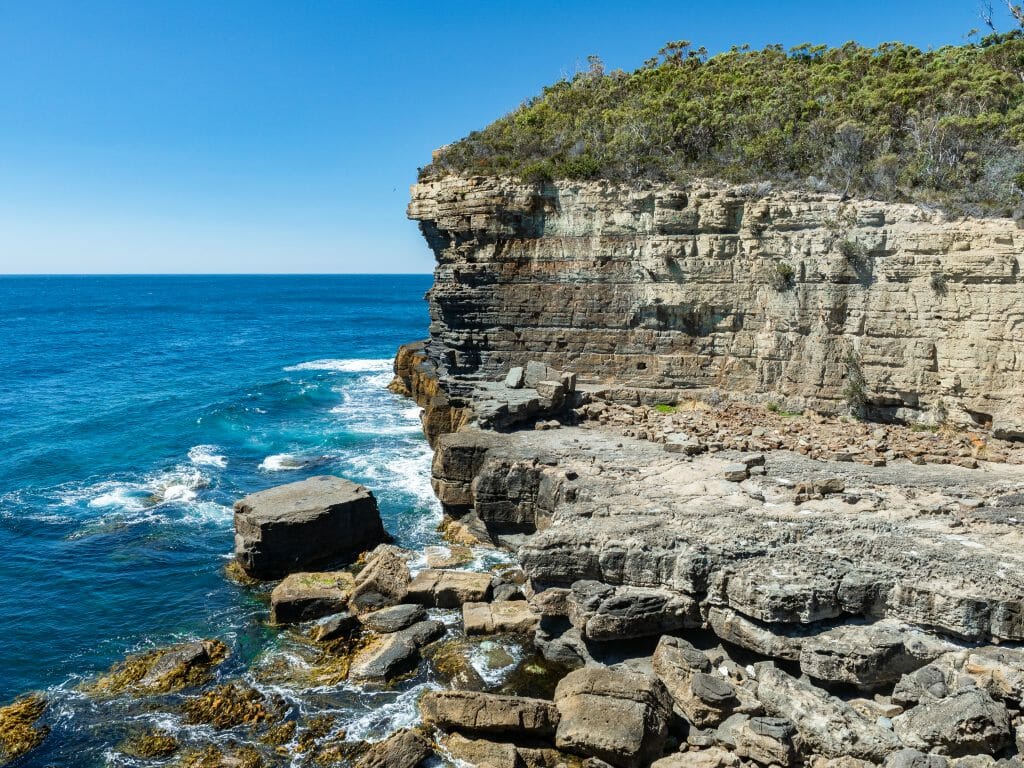
The Tasman Peninsula is one of the state’s most beautiful and diverse areas, home to an endless supply of coastal lookouts and fascinating geological phenomena that exist in few other places on earth.
Turn the short drive from Hobart to Port Arthur into a mini-roadtrip by stopping off at a few of these scenic spots in Eaglehawk Neck, including the Tessellated Pavement, Remarkable Cave, Devil’s Kitchen, Tasman’s Arch, the Blowhole, and more.
Read about more multi-day hikes in Australia

The Comments
LC
Such a great article when preparing for the trek. My burning question is how did you make margaritas with out ice?!
😉
brooke brisbine
LCThat was true roughing it 😉
Hope you enjoy the trek!
xx bb
Ann
My husband uses a sleep apnea machine are there any power points or 12v outlets in the cabins? Would hate to upset other hikers!
brooke brisbine
AnnHi Ann,
As I remember, the only power points were offered within the communal kitchens and there was nothing in the cabins themselves. Might be worth enquiring if they do have one specific cabin with outlets for just such a situation, though!
Happy trails!
-Brooke
Anonymous
AnnHi Ann, I am just about to embark on the track and also use a cpap machine. What was the “upshot” of your experience?
dak
Hi Brooke,
Thanks for this helpful website. I really appreciate it.
I planning to do the three capes track & camping independently (without paying $495).
Can I book a cruise/ferry ride from Port Arthur to Denmans Cove?
Also, can I book a bus from Fortescue Bay to Port Arthur?
All info only mentions they are included in the $495 booking.
Cheers,
Dak
brooke brisbine
dakHi Dak,
Unfortunately, I’m not totally sure about where to organise private transport if completing the walk without huts, but I am sure there’s a way, as plenty of people do the trek this way! Probably a matter of Googling to find the cheapest option.
Happy trails!
-Brooke
Nikki Bennett
This is incredibly helpful. Thank you!
Can you tell me how much your pack weighed with your packing list?
Thanks,
Nikki
brooke brisbine
Nikki BennettSo glad you found it helpful, Nikki! I don’t remember off the top of my head how much my pack weighed, but I’d estimate around the 12kg mark.
Happy trails!
-Brooke
Anonymous
Thank you for the fabulous detail. I really appreciated the information on the independent hiking option and free campsites. Rather than do each of the capes as day hikes, I will now do Cape pillar and cape hauy with an overnught at bare knoll.
Cheers, Mary
brooke brisbine
AnonymousHi Mary, so happy to hear you found this post helpful!
Have fun on your hike, and if you get a chance, I’d love if you left another comment letting me know how the independent hiking and camping went! Not having done it myself, I’m eager to hear about it 🙂
Happy trails!
-Brooke